

The Operating Project
One operating problem. Four sessions. One finished result. You pick the problem. I bring the structure, the worksheets, and the build. This is not open-ended coaching. The outcome is defined before we start, and the project closes when the finished asset or outcome exists.
Read about the full opportunity here.

The Founding Offer:
Regular price is $999. The next ten seats are $499.
Run your four sessions any time through December 31, 2026.
TL → DR
The headline that AI is hollowing out the knowledge economy is half the story. The work is not disappearing. It is relocating, out of the firm and onto the independent expert.
The largest controlled study of AI and knowledge work found expert-led work got 40 percent better and 25 percent faster inside AI’s competency frontier, and 19 points more likely to be wrong outside it. Judgment is the variable that decides which side you land on.
This is Ronald Coase running in reverse. AI collapsed the cost of finding, briefing, and supervising outside experts, so the reason to keep them on payroll collapsed too.
The money already moved: 1.9 trillion dollars in independent contractor spend in 2024, 42 percent of Fortune 500 workforce spend going to external labor, and 6 dollars of services for every 1 dollar of software, the budget AI is now coming for.
The losers are junior generalists, mid-tier firms, and the billable hour. The winners are specialists, boutiques, and solo operators who now run at the output of a team. Capital is racing in too, rolling up services firms, which only deepens the demand for senior judgment it cannot manufacture.
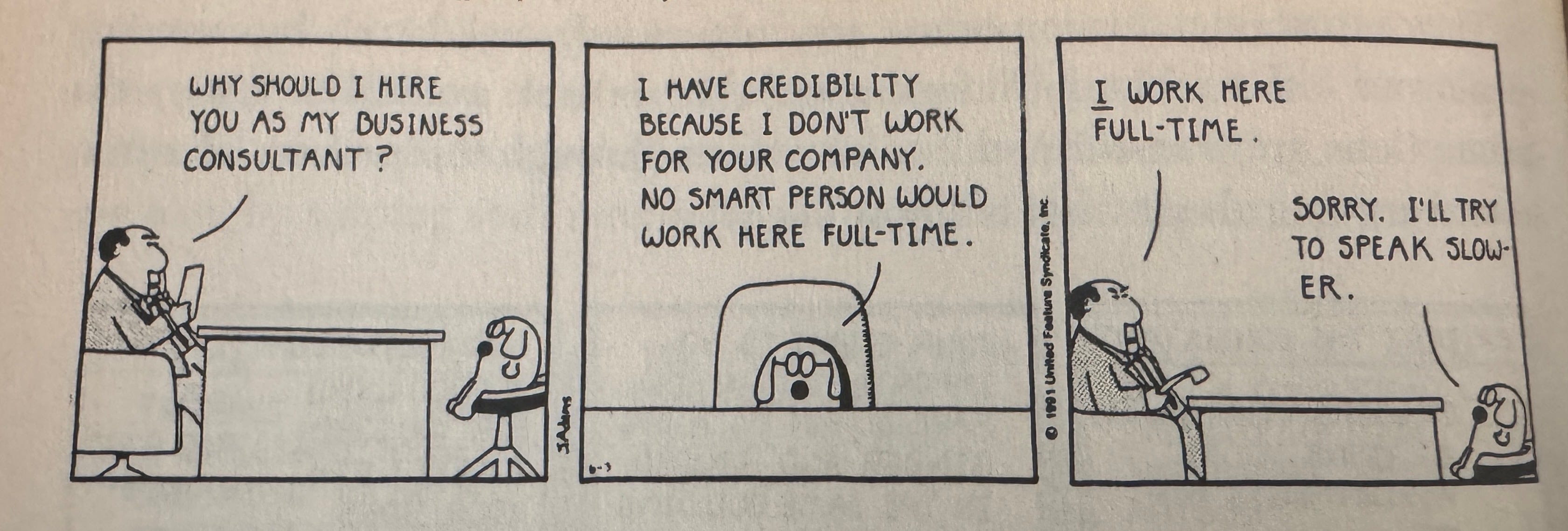
Special thanks to my friends at Strategy Shots for introducing me to this cartoon. Be sure to give them a subscribe if you haven’t, yet!
AI is not emptying the knowledge economy. It is moving the value from the institution to the individual who knows what the company machine got, or is getting, wrong.
Is AI killing the consulting industry?
The consensus is loud and everywhere. AI replaces the analyst. It replaces the associate, the junior lawyer, the research assistant, the strategist who lived inside a slide deck. Every outlet has run the obituary for white-collar work, and McKinsey laying off close to 10 percent of its people reads like the first paragraph of it.
The consensus is looking at the right event and drawing the wrong conclusion. The work is not disappearing. It is changing hands. Call it the Great Relocation. The value that used to sit inside the firm, protected by the cost of assembling forty smart people under one roof, is relocating to the individual expert who can now do the work of forty without the roof.
This is not a story about machines doing the work, or eliminating opportunity.
It is a story about who still gets paid to make the strategy and then execute on the work at hand.
What did the Harvard–BCG study actually find about AI and consultants?
In the largest controlled experiment ever run on AI and white-collar work, 758 consultants given a frontier model finished tasks 25 percent faster and produced work rated more than 40 percent higher in quality. That half gets quoted constantly. It is the half that sells the tool.
On tasks that sat outside the model’s competence, the same consultants using the same model were 19 percentage points more likely to be wrong than the consultants using nothing at all. The machine did not make the novice an expert. It made the novice confidently wrong, which is worse, because when inaccurate confidence travels, errors, problems and fires compound.
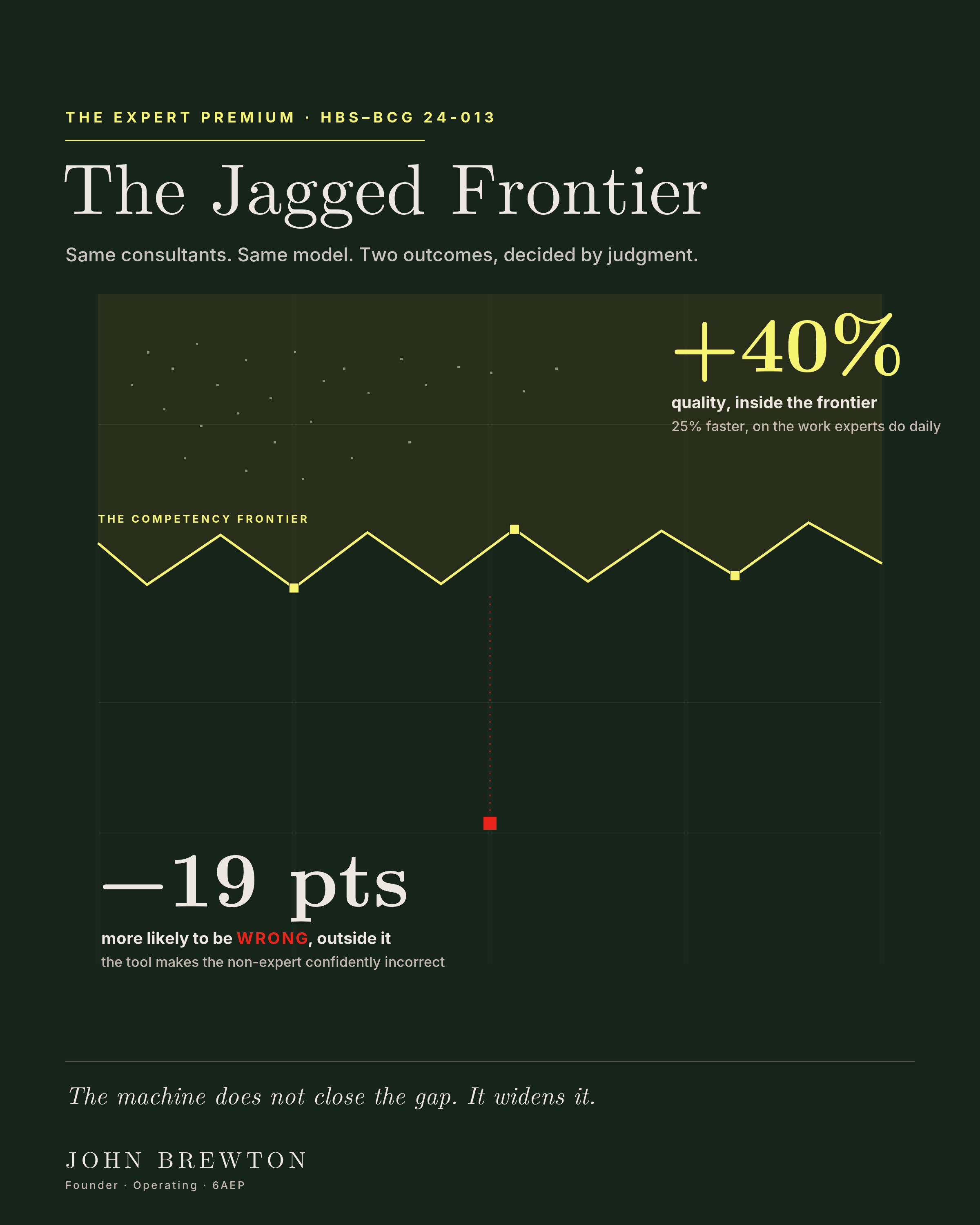
Figure 1: The jagged frontier. Inside the boundary of what the model does well, expert-led work gets 40 percent better and 25 percent faster. Outside it, the same tool makes the user 19 points more likely to be wrong. The variable that decides which side you land on is judgment. Source: Dell’Acqua et al., HBS Working Paper 24-013.
Do you want to start becoming AI-Fluent?
Register for my free Masterclass on June 16th, where I will teach you how to build your own AI Employee that runs your calendar and inbox! Register Here

The tools are widening the gap between the expert and everyone else. The expert knows where the frontier ends. The expert can review a fluent, formatted, fully cited answer and articulate why the third paragraph is wrong. This capability is the entire job now.
Why is AI moving work from firms to independent experts?
The mechanism is ninety years old. In 1937, Ronald Coase asked why firms exist at all. If markets are so efficient, why not buy every piece of work on the open market instead of hiring anyone? His answer was that using the market is expensive. Finding the right person costs money. Bargaining with them costs money. Writing the contract and making sure the work gets done costs money. When those costs run high, it is cheaper to put people on payroll and skip the market entirely. The firm exists because the market was too expensive to use.
AI has collapsed the cost of finding the right expert, which has collapsed the cost of briefing them when the brief writes itself, which has collapsed the cost of supervising the work, because the work arrives in hours in an easily reviewable form. Which removed the last reason the expert had to sit on your payroll at all. Most companies are still writing job descriptions for roles the market now prices better than they do.
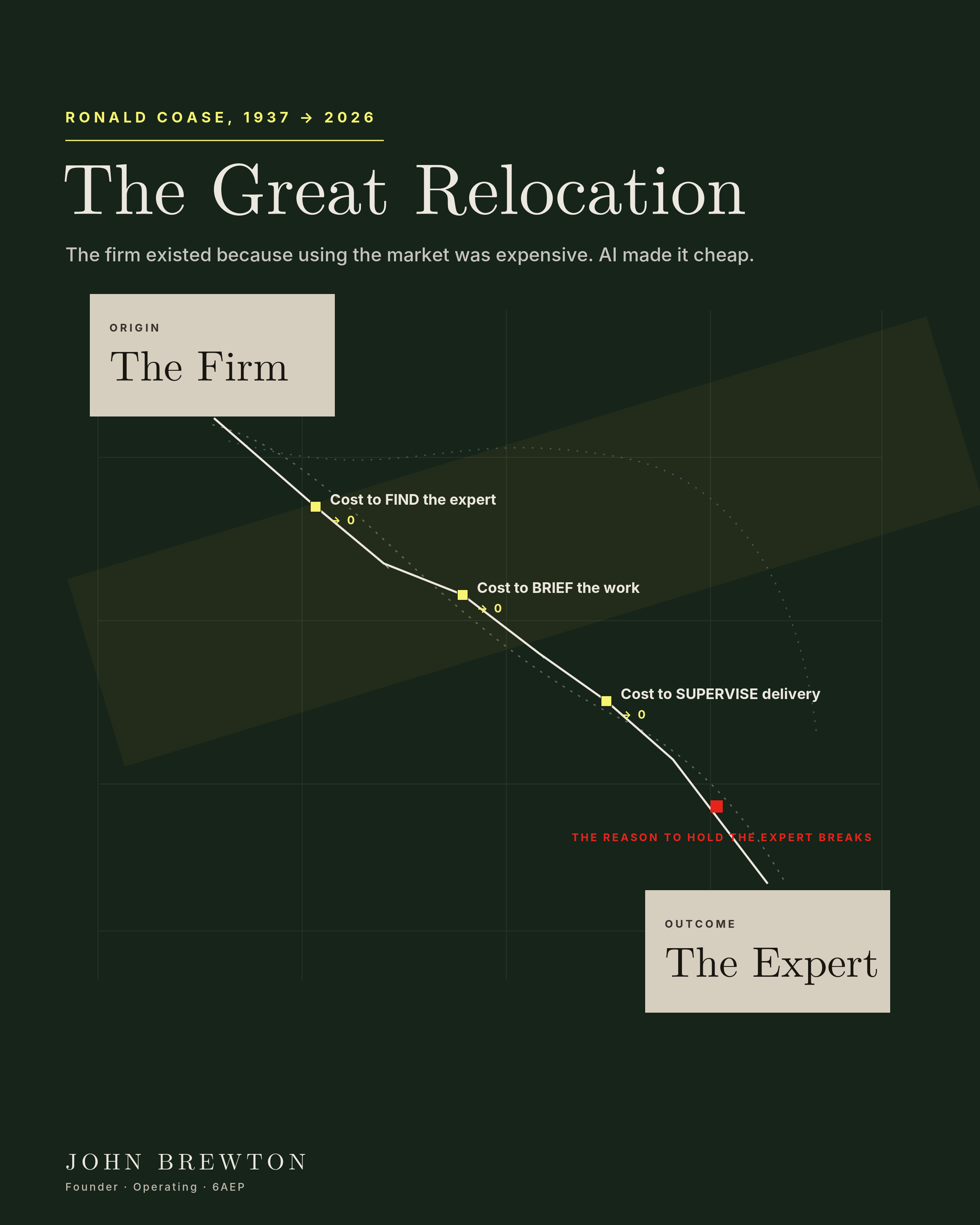
Figure 2: The Great Relocation. As AI drives the cost of finding, briefing, and supervising an expert toward zero, the reason to keep that expert on payroll breaks. Value moves out of the firm and onto the individual. Coase, running in reverse.
This is the part where the panic is mistaken. The contractor economy is not a glitch in the system. It is a Coasian structure running in reverse, exactly as the theory predicts, with AI as the tool that is reducing the cost of discovery and execution. The technology serves as an efficiency driver for discovery and matching in the market for knowledge work and execution.
How big is the contractor and consulting market in 2026?
The figures are no longer directional. Rather, they are settled.
Independent contractors generated 1.9 trillion dollars in spend in 2024, the largest and fastest-growing slice of the external workforce. At the Fortune 500, 42 percent of total workforce spending now goes to external labor rather than to employees. Sequoia put the prize in one ratio: for every 1 dollar a company spends on software, it spends 6 dollars on the services around it, and AI is now coming for the 6.
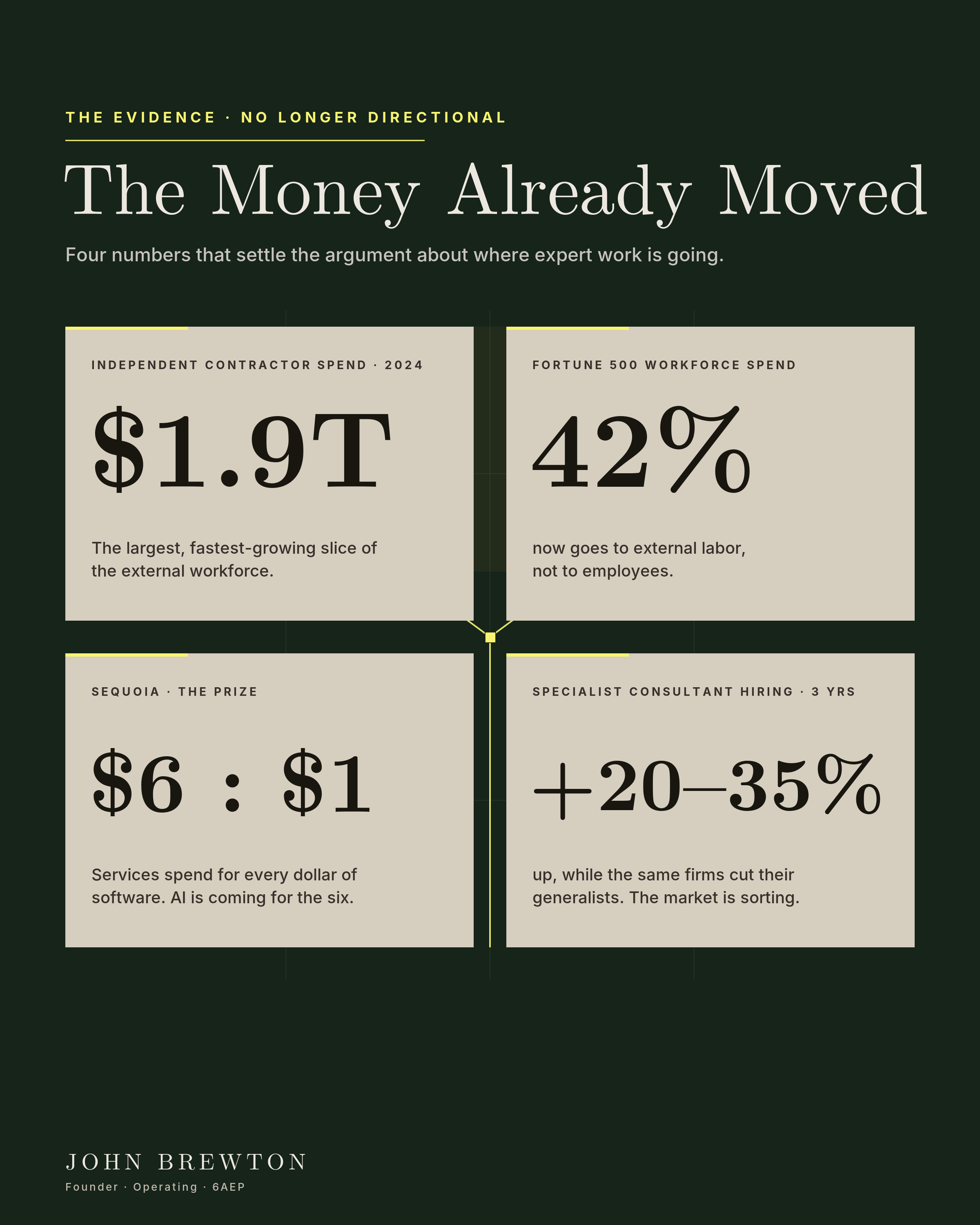
Figure 3: The money already moved. Four figures that are no longer directional: $1.9 trillion in independent contractor spend, 42 percent of Fortune 500 workforce spend going to external labor, Sequoia’s six-to-one services-to-software ratio, and specialist consultant hiring up 20 to 35 percent over three years.
And within the consulting market itself, the split is already visible in the hiring data. Specialist consultant hiring rose by 20 to 35 percent over three years, while the same firms cut their generalist roles. The market is not shrinking. It is redistributing and the generlist narrative we’ve been following is being proven incorrect.
Which consultants and consulting firms will AI replace?
Here is the uncomfortable truth. The consultants’ AI destroys are not the experts. They are the people who were selling the appearance of expertise, the ones whose value was knowing something the client could not easily look up. That asymmetry was the whole business, and it is gone, because the client can now run the analysis in an afternoon.
You can watch the old model break in the pricing. A consultant who finishes a market study in 4 hours instead of 16 delivers the same answer and, under hourly billing, charges 75 percent less for it. Professional services are the only major industry where becoming faster makes you poorer. A 2025 Deloitte benchmark captured the divergence clearly: firms that held onto time-based pricing grew revenue by 2.1 percent, while firms that moved to value-based pricing grew by 8.7 percent. The billable hour is not the tool. It is the trap.
The pyramid that the big firms were built on, partners on top and an army of junior analysts underneath doing the work that AI now does for nothing, is collapsing from the base up. The firms in real trouble are the mid-tier generalists, too big to be nimble and too undifferentiated to be missed. The ones growing are the boutiques and the specialists. As is also true across other B2B markets, the opportunity for small and mid-sized firms to supplant the legacy providers and products is growing.
How are VCs and private equity rolling up services firms with AI?
The independent expert is not the only one who figured out that the 6-dollar services budget is the prize. The available capital figured it out too. General Catalyst, one of the larger venture firms in the country, is running what it openly calls a Creation Strategy: a reported $ 1.5 billion committed to buying unglamorous services firms, accounting practices, IT shops, and legal back offices, and rebuilding them with AI. Its portfolio company Eudia bought the legal consultancy Johnson Hana in July 2025, the first move in a 75 million dollar acquisition program.
So there are two ways to capture the relocated value, not one, and they are not the same business. Capital industrializes the volume. It buys the firm, installs the model, and runs the high-frequency work at a margin the old partners never saw. The independent expert captures the judgment, the engagements where being right matters more than being cheap and where the client is buying a person, not a process.
The mistake would be to think these firms compete for the same dollar. The roll-up wins the work that can be standardized. The expert wins the work that cannot. And the roll-ups, as they scale, generate their own demand for exactly the senior judgment they cannot manufacture, which is who they call when the standardized process meets a situation no process anticipated. The rising tide of capital into services does not drown the expert; it creates clear market share for them to take.
Does AI commoditize expertise?
The strongest objection to all of this comes from Harvard Business School. The argument, made by Karim Lakhani, is that generative AI is lowering the cost of expertise and that when something stops being scarce, the people who sell it lose their pricing power. By that logic, the expert is not the winner. The expert is the next thing to be commoditized.
The objection is half right. AI does commoditize part of what experts used to sell. The production layer, the research, the synthesis, the first draft, the benchmarking, the formatting, all of it is now close to free. If that was your value, the objection is not a warning. It is an obituary.
But firms were never selling the production side of their operation as the expertise that deserved the highest rates. It was their judgment built from years, even decades, and learning from what has worked and hasn’t. AI lowered the cost of everything around that expert instinct to zero, but in doing so, it was not able to commoditize the instinct. It concentrated all the value on it. When the production, execution, framing, citations, and polish are free, the only thing left to pay for is the part that decides whether they are pointed at the right problem.
Can one person build a billion-dollar company with AI?
In 2024, Sam Altman mentioned to Alexis Ohanian that a group of technology chief executives had started a betting pool. The wager was a single number: the year the first one-person billion-dollar company would appear. A thing that would have been unimaginable before AI, Altman said, would happen.
In May 2025, Dario Amodei was asked the same question directly on stage. When does the first billion-dollar company with one human employee arrive? His answer was one word. 2026. He put the odds at 70 to 80 percent.
You do not have to believe the unicorn arrives on schedule to see the structure underneath it, because the structure is already here. Medvi did 401 million dollars in sales in 2025 with two people, a pair of brothers running a fleet of AI agents that handled the code, the copy, the ad creative, and the customer messages. Not everyone becomes Medvi. The point is that the ceiling on a single expert has just moved by an order of magnitude. A solo operator running the right stack pays $300 to $600 a month for production capacity that used to cost $15,000 to $25,000. The economics of being one smart person who knows a domain cold have never looked like this.
Why is now a golden age for independent experts and consultants?
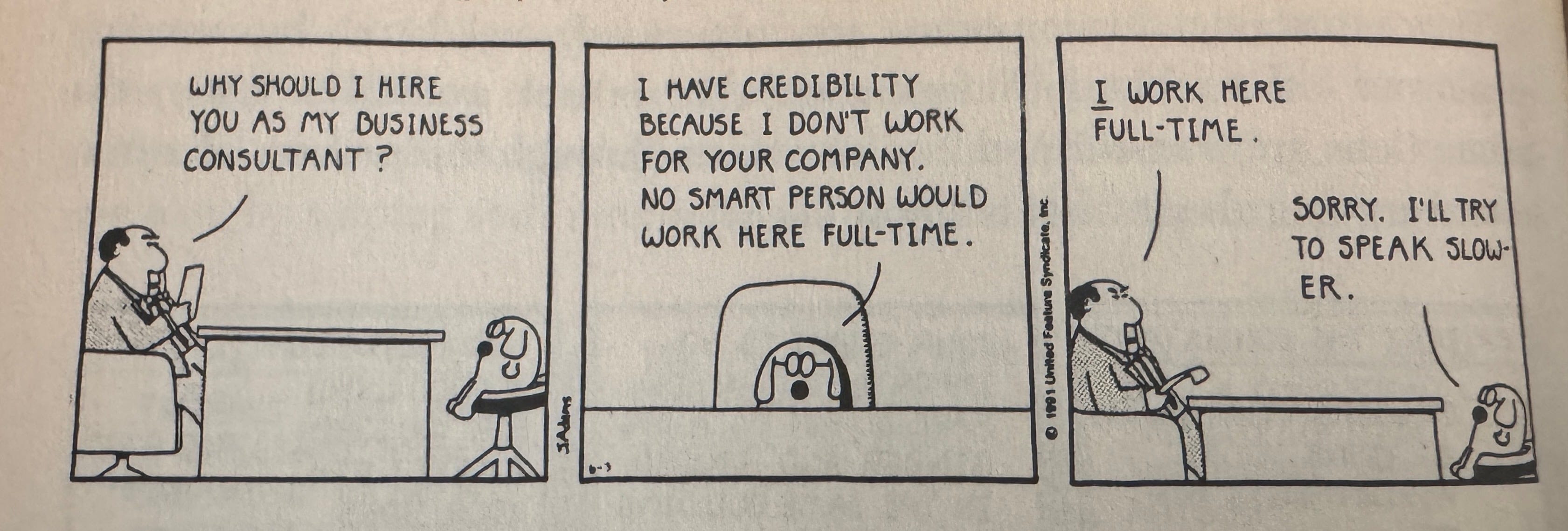
Credibility comes from independence, because independence is the signal that you are not captured by the incentives of the institution you are advising. That was true in 1991 when the above cartoon was published. What has changed is everything around it. The independent expert now has the production capacity of a firm and the overhead of a freelancer, and the market has finally gotten cheap enough to reach them.
This is the golden age of consulting. Not for the institution, which is shedding the headcount it can no longer justify. Not for the generalist, whose asymmetry just evaporated. For the expert, the person who knows the domain, knows which questions are worth asking, and can tell when the confident machine is confidently wrong. That person is in the best position any knowledge worker has held in living memory.
The relocation is already underway. The only question left is whether you have built the system to catch the work as it moves, or whether you are still waiting for someone to put you back on a payroll that is not coming back.
The dog had it figured out in 1991.
He just needed the tools to catch up.
- j -
Frequently asked questions
Is AI going to replace consultants? It is replacing some and enriching others. The Harvard–BCG study shows AI lifts expert work 40 percent on tasks inside its competence and makes work 19 points worse on tasks outside it. Junior generalists who added value by doing what AI now automates are exposed. Domain experts who can direct the tool and catch its errors are not.
Why are companies hiring contractors instead of employees? Because AI collapsed the transaction costs that made employees cheaper than the market. Finding, briefing, and supervising an outside expert used to be expensive enough to justify a payroll. It is not anymore. Independent contractor spend hit 1.9 trillion dollars in 2024, and 42 percent of Fortune 500 workforce spend now goes to external labor.
What is “services as software”? It is Sequoia’s thesis that the next trillion-dollar companies will sell the work itself rather than the tool. For every 1 dollar spent on software, 6 dollars is spent on the services around it. AI lets a company deliver that service directly, at software margins, going after the larger budget.
Can one person really build a billion-dollar company with AI? Not yet, but the trajectory is real. Anthropic’s Dario Amodei puts 70 to 80 percent odds on it happening in 2026. The proof of concept exists below the line: the telehealth company Medvi reported 401 million dollars in 2025 sales with two people and a stack of AI agents.
Which consulting jobs are most at risk from AI? Junior analysts, generalist strategy consultants, and entry-level audit and tax roles, because their work sits inside AI’s competence. Mid-tier generalist firms are the most exposed institutions. The pricing model is at risk too, since a 40 percent productivity gain becomes a 40 percent revenue cut under the billable hour.
Does AI make expertise worthless? It makes the production around expertise worthless and the judgment at the center of it more valuable. As HBR’s Karim Lakhani argues, AI lowers the cost of expertise, which erodes pricing power for anyone selling commodity output. Tacit judgment, the kind built from having been wrong before, is what remains scarce.
How do independent experts compete with AI-funded roll-ups? They do not compete for the same work. Roll-ups like the ones General Catalyst is building win standardized, high-volume work at scale. Independent experts win the judgment-heavy engagements that cannot be standardized, and they increasingly get hired by the roll-ups when a process meets a situation it was not built for.
About the Author

John Brewton documents the history and future of operating companies at Operating by John Brewton. He is a graduate of Harvard University and began his career as a PhD student in economics at the University of Chicago. After selling his family’s B2B industrial distribution company in 2021, he has been helping business owners, founders, and investors optimize their operations ever since. He is the founder of 6A East Partners, a research and advisory firm asking the question: What is the future of companies
Appendix: sources
Studies and frameworks
Fabrizio Dell’Acqua, Edward McFowland III, Ethan Mollick, et al., “Navigating the Jagged Technological Frontier,” Harvard Business School Working Paper 24-013 (2023). HBS listing · Full PDF · SSRN. The 758-consultant field experiment behind the +40 percent and −19 point findings.
Ronald Coase, “The Nature of the Firm,” Economica (1937). Overview. The transaction-cost theory of why firms exist.
Karim Lakhani, “How Gen AI Could Change the Value of Expertise,” Harvard Business Review (2025). Link. The “lowering the cost of expertise” argument. See also HBR, 2024.
Market and industry data
Worksome, The External Workforce Index. Link. Source for 1.9 trillion dollars in 2024 independent contractor spend. Underlying data from Staffing Industry Analysts.
AlphaSense, consulting industry trends. Link. Two-tier consulting structure and specialist hiring growth.
Deloitte 2025 professional services pricing benchmark, the 2.1 percent versus 8.7 percent revenue-growth split. Cited here via secondary coverage in BPM’s 2026 outlook; verify against the Deloitte original before republication. Billable-hour pressure via Thomson Reuters.
The 42 percent Fortune 500 external-labor figure originates with workforce-data aggregator WifiTalents, as cited in the underlying research brief. Treat as directional and verify before republication.
Specialist consultant hiring up 20 to 35 percent: attributed to Business Insider 2026 reporting in the source brief; corroborated by AlphaSense above.
Strategy and venture theses
Sequoia Capital, Julien Bek, “Services: The New Software.” Link. The 6-to-1 services-to-software ratio and the copilot-to-autopilot framework. Coverage in Fortune.
Andreessen Horowitz, “’AI Inside’ Opens New Markets for Vertical SaaS.” Link. The parallel services-as-software case from a second venture firm.
Company and deal reporting
General Catalyst, “The Future of Services.” Link. The Creation Strategy and AI services roll-up thesis. Deal context in PitchBook.
Eudia acquires Johnson Hana, July 8, 2025. PR Newswire · acquisition-strategy analysis.
Medvi, 401 million dollars in 2025 sales with two employees. US Reporter.
McKinsey workforce reductions, roughly 10 percent. Fast Company.
Predictions and commentary
Sam Altman on the one-person billion-dollar company betting pool. Fortune, 2024.
Dario Amodei, 70 to 80 percent odds of a one-person billion-dollar company in 2026, at Anthropic’s Code with Claude conference. Inc..
The 1991 source cartoon is Scott Adams’s Dilbert. Solo-operator tooling economics (300 to 600 dollars per month versus 15,000 to 25,000 dollars in equivalent headcount) are drawn from the underlying research brief and should be presented as illustrative.