

There is a category of AI work I don’t think we talk about nearly enough. Not asking ChatGPT a question, generating an email, or summarizing a document. I mean the ugly, multi-step projects sitting on your to-do list that you know need to get done but could easily consume half a day or more of your valuable time.
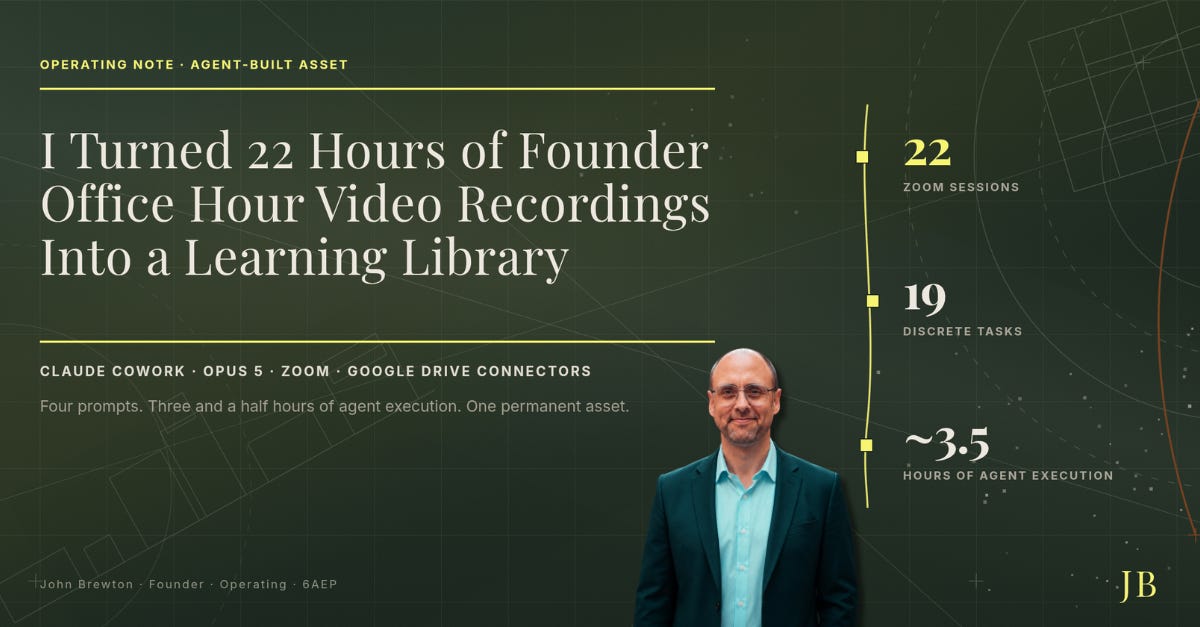
I had one of those projects this week. I had 22 recordings from my Operating Founder Office Hours sessions that I wanted organized, summarized, researched, packaged, branded, linked, and ultimately turned into a learning library for my community. Doing all of that manually would have meant hours and hours of opening files, reading transcripts, finding links, researching topics, formatting documents, and organizing folders.
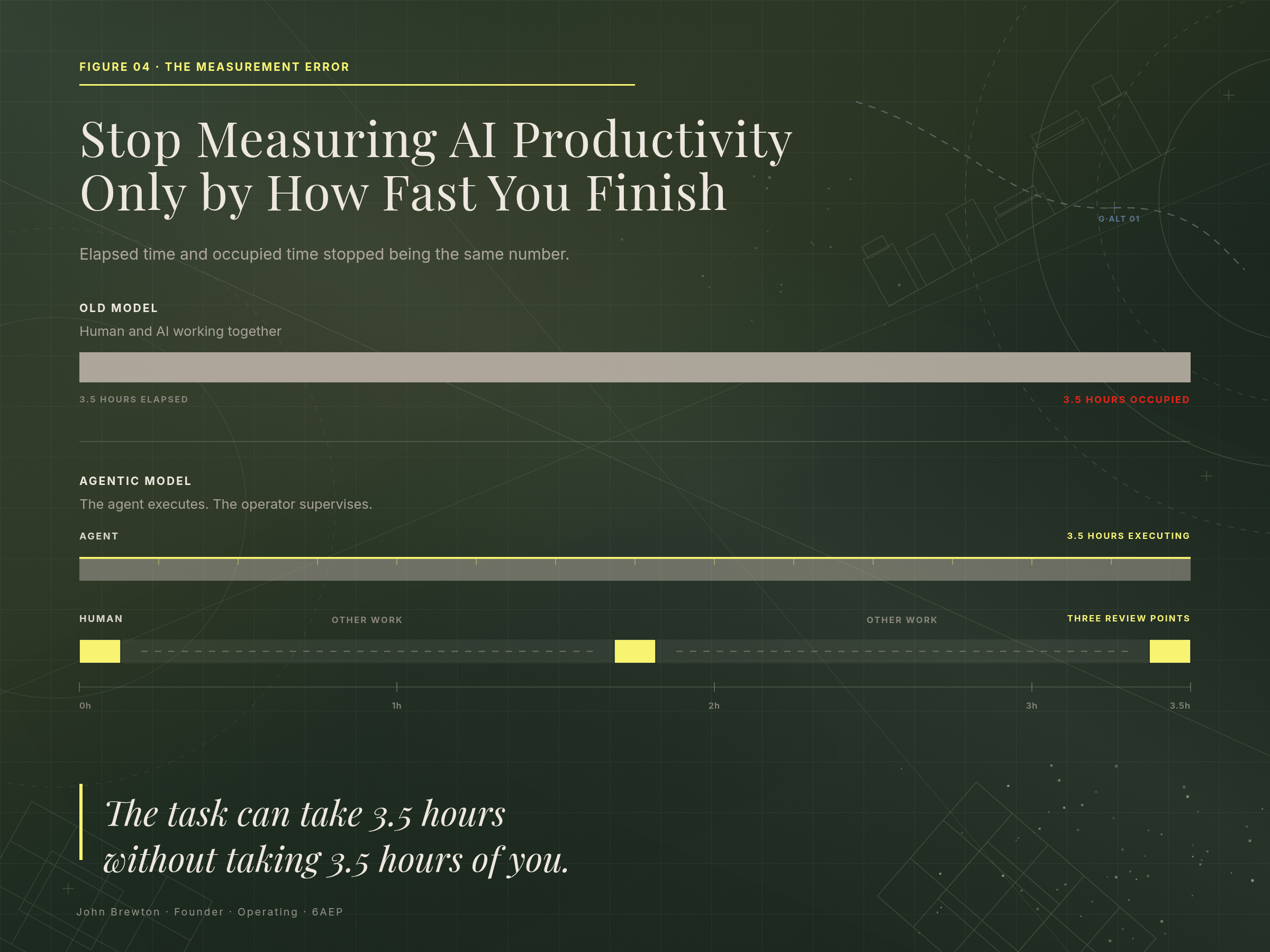
Instead, I gave the project to Claude Cowork and Opus 5. Across roughly four or five major prompts, my agents worked on it for about three and a half hours. I did not spend three and a half hours doing the work. Claude did the work, while I focused my enery on more important tasks and was able to spend time with my family.
While the agents worked, I kept working on other things. I responded to client emails, wrote the outline for a new article, got some reading done answer, thought through other projects, and spent time playing with my daughter. That distinction is becoming incredibly important: the value of AI isn’t simply that something that used to take three hours can now take 20 minutes, it is increasingly that a task can take an AI agent three hours while taking almost none of yours.
Watch Me Build It Here on Loom

I recorded the build as I was doing it so you could see what this kind of work actually looks like. I give Claude a set of instructions, let it work, come back to review the output, decide what the next layer should be, and then send it back to work again. The cycle was essentially direct, delegate, leave, review, redirect.
That is increasingly what agentic work looks like for me. I am still responsible for the outcome, the judgment, and the quality of the final product. But I no longer need to personally perform every action from beginning to end.
Become an Operating Founder and join our weekly live office hours this week!
The Project Started With 22 Zoom Calls
Every week, I hold Office Hours for the founding members of my Operating Founders community. We discuss how we are building our companies, Operating with AI, sales and go-to-market strategy, creator and content strategy, and whatever problems founders and operators are working through at the time. I record those sessions on Zoom, and over time, I have accumulated 22 recordings filled with useful conversations.
But I didn’t want a folder containing 22 recordings. I wanted someone to be able to arrive months later and immediately understand what happened in each session, watch the relevant recording, and then go deeper through additional research and resources. I wanted to turn an archive into a learning system.
How I Built a $200,000 Newsletter Business From a Substack Nobody Was Reading
The Five Moves That Turned My Substack Into a $200,000 Business
The Operating Project: Most Coaching Ends With Notes. This Ends With a Machine.
Prompt One: Retrieve and Organize Everything
The first layer was operational. Using my Zoom connection, I asked Claude to retrieve the recordings and associated material, move everything into Google Drive, create the appropriate folder structure, and apply a consistent naming convention.
Think about the manual alternative: finding recordings, downloading them, creating folders, renaming files, uploading everything, checking dates, and making sure every file is where it belongs. Necessary work, yes. A particularly good use of my time, no.
Prompt Two: Understand 22 Conversations
Next, I asked Claude to work through all 22 transcripts. For every session, I wanted a title, a concise description of what we discussed, the correct date, and a link back to the corresponding recording in Google Drive.
Even if I could manually review, summarize, and link each session in ten minutes, that step alone would have taken more than three and a half hours. Instead, I defined the desired output once, let Claude work through the entire collection, and returned when it was ready for review.
Prompt Three: Make the Existing Work More Valuable
I didn’t simply want summaries. For every session, I wanted my community to have high-quality resources that extended the conversation beyond what we discussed during Office Hours.
So I had Claude use an Elite Research skill I built to analyze the topics in each transcript and identify strong articles, research, media, and reference materials. The output was no longer simply “Here is what John said.” It became, “Here is what we discussed, here are the important ideas, and here are additional experts and resources that can help you explore the subject further.”
Take a look at one of the session note documents here.

Prompt Four: Turn the Work Into Finished Assets
Then I applied another reusable skill I have built around my personal brand. Claude took the transcripts, summaries, and additional research and turned them into 22 professionally formatted research and notes packages—one for every Office Hours session.
This is where the scale of agentic execution becomes easier to appreciate. Formatting documents, structuring sections, inserting research links, applying branding, naming files, exporting PDFs, and organizing the outputs are not one task. They are dozens of small tasks hiding inside a larger project, and those small actions are exactly where so much of our working day disappears.
Prompt Five: Build the Final Experience
The last step was creating a single resource that my community could actually navigate. For each session, I wanted a title, a short description, a link to the recording, a branded visual, and a link to the associated research package, all assembled into a document I could move directly into Substack.
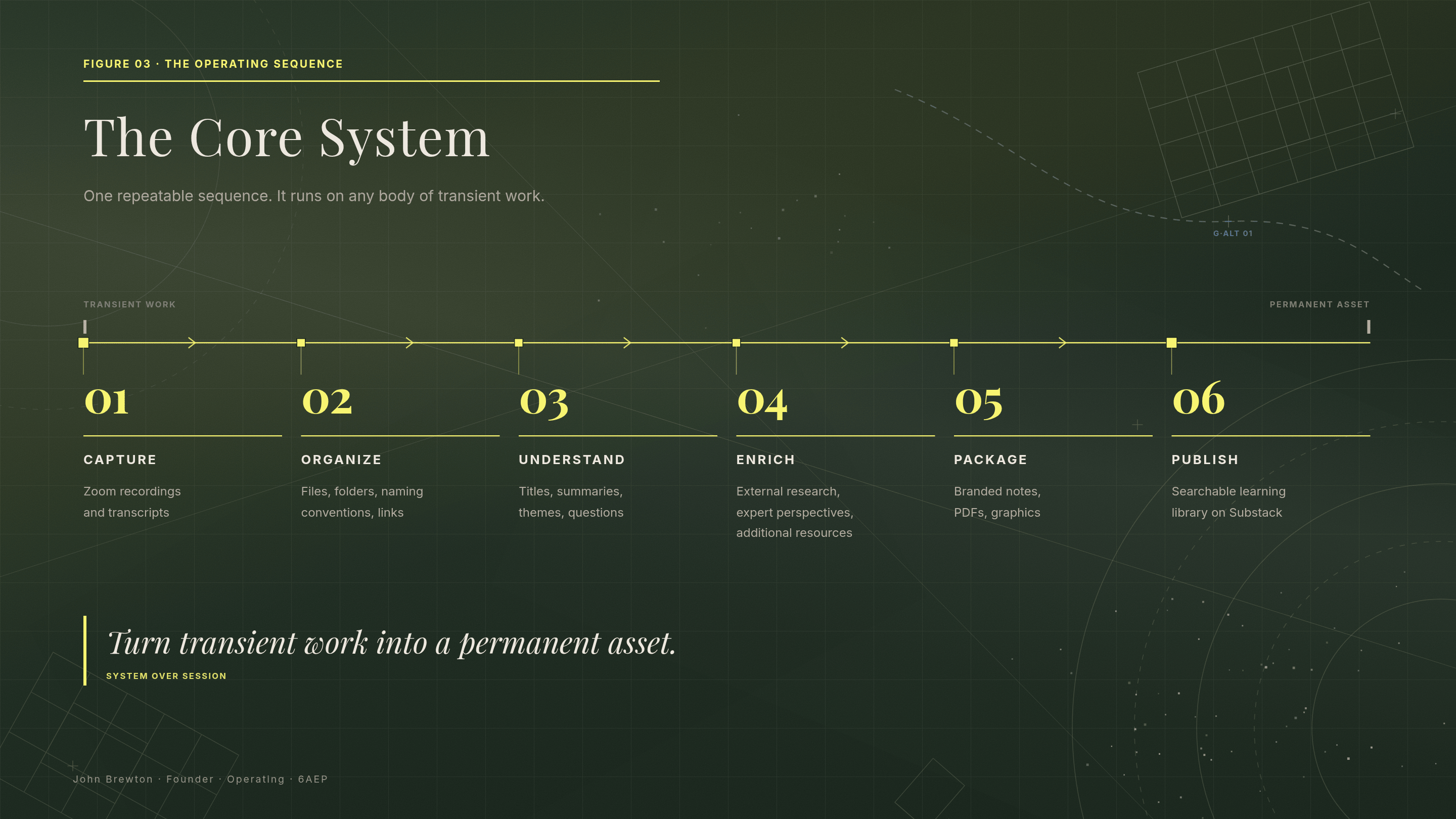
The result was an organized library of 22 sessions rather than a pile of recordings. The overall workflow was straightforward: Capture → Organize → Understand → Enrich → Package → Publish.
Here’s a look at what the final product looks like on Substack:
Become an Operating Founder and join our weekly live office hours this week!
Your Agent’s Time Does Not Have to Be Your Time
This is the biggest lesson I took from the project. If someone hears that the build took three and a half hours, they might reasonably think that doesn’t sound particularly fast. But those were primarily Claude’s three and a half hours, not mine.
My time was concentrated at the places where judgment mattered: What am I trying to build? Is the output good? What should happen next? What needs to change? Once those decisions were made, I could hand the execution back and continue doing something else.
That changes the productivity question. Instead of asking only, “How much faster can AI help me perform this task?” I increasingly want to ask, “How much of this task requires me at all?”
Start Looking for Three-Hour Agent Jobs
Look through your own week for these projects. Maybe it is reviewing 30 customer calls, researching 40 companies, cleaning up a CRM, turning old webinars into training materials, analyzing proposals for common patterns, organizing a document archive, or converting sales conversations into objection-handling material.
These projects are everywhere, and many of us still calculate whether they are worth doing based on how many hours we would need to spend completing them. That calculation is becoming outdated. The better question is: Can I spend 10 or 20 minutes defining this well enough that an agent can spend the next three or five hours doing it?
You may not be able to delegate 100 percent of the work. That’s fine. Delegate 60 percent, then 80 percent, while keeping yourself at the judgment points and letting the agents own more of the execution.
Find the Work You Should Stop Doing Yourself
The bigger opportunity here is not better prompting. It is developing the ability to look at complicated work, see the complete system, break it into layers, and understand which parts require human judgment and which parts can increasingly be delegated.
Historically, I might not have built this library at all—not because it wasn’t valuable, but because the opportunity cost of spending most of a day doing it would have been too high. AI didn’t simply make the project faster. It made a project that might previously have been uneconomic worth doing.
That is what excites me most about where we are headed. The productivity revolution isn’t going to come from humans simply learning to perform the same work slightly faster with AI sitting beside them. It is going to come from learning how to orchestrate meaningful work that continues while we are doing something else.
My agents worked for three and a half hours on this project.
The important part is that I didn’t have to.
- j -
Join the Operating Founder Office Hours each week to work through the real problems, decisions, and opportunities you are facing alongside other founders and operators. Every session is recorded and added to a growing learning library of summaries, research, and additional resources, so the value of the conversation continues long after the call ends. Come for the live discussion, and leave with a deeper body of knowledge you can keep using.
John Brewton documents the history and future of operating companies at Operating by John Brewton. He is a graduate of Harvard University and began his career as a PhD student in economics at the University of Chicago. After selling his family’s B2B industrial distribution company in 2021, he has been helping business owners, founders, and investors optimize their operations ever since. He is a career consultant and business operator, asking the question: What is the future of companies?
Systems!! Systems are the best! Thanks for encouraging all of us with your work every time. 🤍
John, once again, you are a creative AI genius! Will have to look to do something similar in the future!