

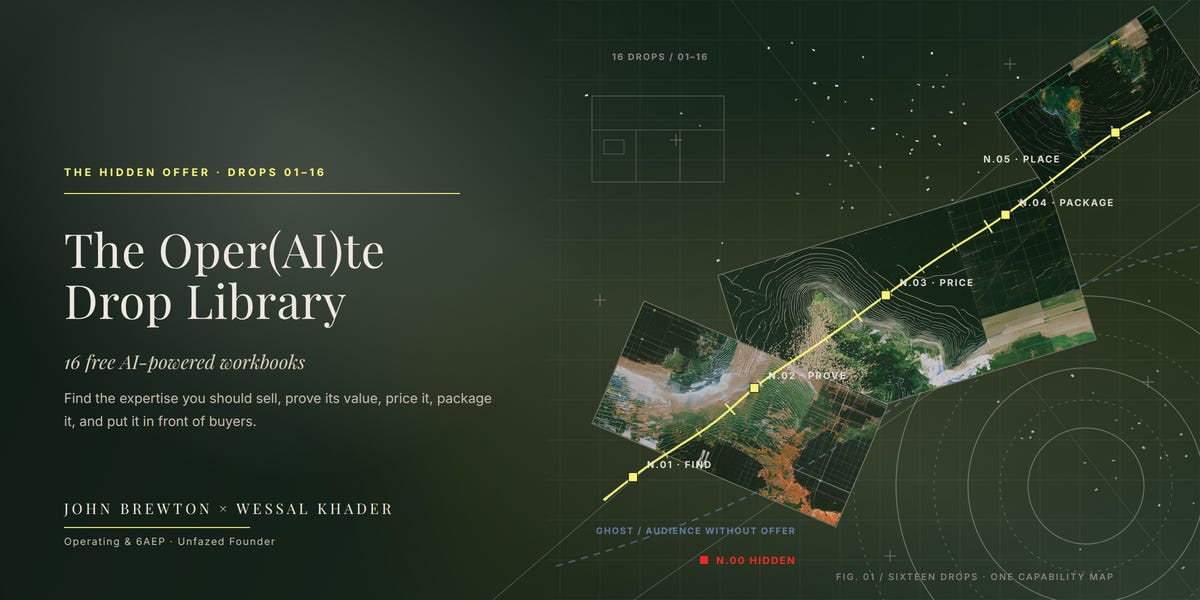
For the next two weeks, I am giving away one of the operating tools Wessal Khader and I have been building around Oper(AI)te: The Hidden Offer, every morning.
Each drop is a small AI-powered operating system built to take something you already have (your calendar, an old client result, emails people have sent you, your pricing, a competitor’s website) and turn it into a meaningful insight or asset that will help you to build a better offer and a better business to operate.
A piece of evidence.
A clearer understanding of what you are unusually good at.
A pricing insight.
A case study.
A list of real prospects.
A better way to explain what you sell.
My goal is to give you something valuable enough to change how you see the expertise you already own. I created this article to keep every drop in one place. I will update it each morning as the next one goes live.
Bookmark it. Save it. Send it to somebody who has spent a career becoming excellent at something and still has not figured out how to turn that expertise into an offer.
How to Use the Drops
1. Download the workbook.
2. Upload it into Claude or ChatGPT.
3. Tell the model to begin the workbook.
Then follow the conversation.
The workbook will ask the questions, analyze the information, and produce the output. Some drops work entirely from information you provide. Others use your files, connected tools, live research, or material you have already created.
Do not overthink them.
Run them on your own intuition and instinct.
The value is not in understanding what the workbook does. The value is in seeing what it discovers about you.
What These Drops Are Actually Building
There is a larger reason Wessal and I built these 16 workbooks.
Most experienced founders, operators, executives, consultants, and advisors do not have an expertise problem. They have a problem seeing, packaging, pricing, and selling what they already know.
That is our entire premise behind Oper(AI)te: The Hidden Offer.

The offer someone will pay you for is probably not something you need to invent from scratch. It is much more likely to be sitting inside the work you have already done, the results you have already produced, the problems people already bring you, and the expertise you have accumulated so gradually that you no longer recognize how unusual it is.
These 16 drops are designed to help you start finding it.
Over the next two weeks, we are going to move through a very deliberate sequence:
Find the proof.
Identify the expertise.
Understand the buyer.
Check the market.
Establish the price.
Articulate the offer.
Build the sales assets.
Start selling.
But there is an important distinction.
The drops give you pieces. The course builds the system.
The free drops take one problem, one input, and one pass and give you something useful back. Inside Oper(AI)te, we connect those discoveries.
Instead of examining one quarter of your calendar, you build an Everything File that lets AI understand the body of work you have built across your career.
Instead of identifying a single piece of valuable expertise, the Superpower Scan and Fit Test help determine what you should actually build a business around and which business model fits it.
Instead of focusing on a single competitor or a single pricing question, the Market Map and Price Evidence Sheet examine what buyers are paying right now and what your evidence can support.
Instead of writing a better sentence, the Intersection Engine, Page Builder, and Language Audit turn the evidence into an offer and put it onto an actual sales page.
And instead of finding five prospects once, the Selling Agent and Daily 15 are built to help make selling part of how the business operates every day.
There are 9 AI agents in the complete system. You build with them live, and you keep them. By the end of the October program, the goal is not for you to simply understand more about offers.
The goal is for you to leave holding one.
Your evidence gathered. Your superpower named. Your business model selected. Your market understood. Your offer stated clearly. Your price supported by evidence. Your sales page live. Your selling system operating. Your first buyer conversations underway.
But you do not need to take my word for any of this yet.
Run the free tools first.
If they show you nothing useful, keep the workbooks. If they begin uncovering things you have spent years overlooking, pay attention.
Those discoveries are not random.
They are your evidence.
Eventually the question becomes:
What happens if you connect all of it?
For now, let’s start with the work.
AVAILABLE NOW
FREE DROP 1
The Calendar Autopsy

Your title tells people what your job was called. Your calendar shows what you were actually paid to do.
Your résumé is aspirational. Your LinkedIn profile is curated.
Your calendar is harder to fake.
Open 90 days of it and you will find a surprisingly honest record of what an organization actually depended on you to do.
The Calendar Autopsy analyzes the problems you repeatedly spent time solving, the capabilities that kept pulling you into rooms, the work consuming the largest share of your time, and which of those capabilities sat closest to revenue.
It then asks a much more interesting question:
Does the work your title says you do match the work your calendar says people actually needed you to do?
For many experienced operators, the answer is no.
That gap matters because the work people repeatedly pull you into is often much closer to your monetizable expertise than the generic description sitting at the top of your LinkedIn profile.
What this drop finds
The capabilities people repeatedly relied on you to provide and the evidence of what your real job actually became.
What it doesn’t know yet
Which of those capabilities a market would pay for, what form the offer should take, or which piece of your experience should become the business.
Download The Calendar Autopsy →
One note: this workbook works best when the model can access your calendar or when you provide the last 90 days of calendar data.
FREE DROP 2
The Receipt Finder

Turn “I helped them improve the business” into a claim a buyer can actually evaluate.
Experienced people are often surprisingly bad at describing what they have accomplished.
We say things like:
I helped grow the company.
I improved operations.
I helped the team scale.
I worked on the transformation.
All of those statements may be true. Almost none gives a buyer enough information to understand what actually happened.
The Receipt Finder starts with one accomplishment and forces you to establish four things:
What was true before you arrived?
What was true afterward?
Over what period did the change happen?
What role did you actually play in creating it?
Then it goes one step further. The workbook builds multiple versions of your claim based on what your evidence actually supports.
A conservative version. An accurate version. And the strongest version you can currently defend.
That distinction matters.
Because I do not think the answer to selling expertise is making enormous claims. I think the answer is becoming unusually precise about the value you have actually created.
You leave with language you can use in a buyer conversation and a clear list of the evidence you would need before making a stronger claim.
What this drop finds
The measurable result hiding underneath a vague accomplishment and the strongest version of that result your current evidence supports.
What it doesn’t know yet
Which of your dozens of career accomplishments matters most to the buyer you eventually decide to serve.
FREE DROP 3
The Compliment Decoder

Other people may already have written your positioning for you.
One of the hardest transitions in building a coaching, consulting, advisory, or expertise-based business is becoming comfortable selling yourself as the service.
We tend to believe we need a library of polished testimonials and professionally produced case studies before we have enough proof. But much of the proof already exists.
It is sitting inside old emails from clients, thank-you notes from colleagues, LinkedIn recommendations, performance reviews, referral introductions, Slack messages, texts, and sentences people have written for years about what you do unusually well.
The Compliment Decoder turns that unstructured feedback into evidence.
Give it 10–20 pieces of real feedback and it begins looking for repetition. Which capabilities keep appearing? What do people actually rely on you for? What language do they naturally use when describing the value you create?
And there is an important distinction buried inside that analysis:
What people admire about you is not always what they rely on you for.
The workbook separates those two things. Then it looks for something even more useful: the blind spot.
The thing other people consistently recognize in you that barely appears in the way you describe yourself.
That can be uncomfortable. It can also be incredibly useful.
Because suddenly your positioning is no longer based entirely on what you hope you are good at. It is grounded in what other people have been telling you for years.
What this drop finds
The recurring themes and exact language other people already use when they describe the value you create.
What it doesn’t know yet
Whether that valued capability maps to a real market, a specific buyer, a viable business model, or a problem somebody will pay to solve.
Download The Compliment Decoder →
FREE DROP 4
The Free Advice Audit
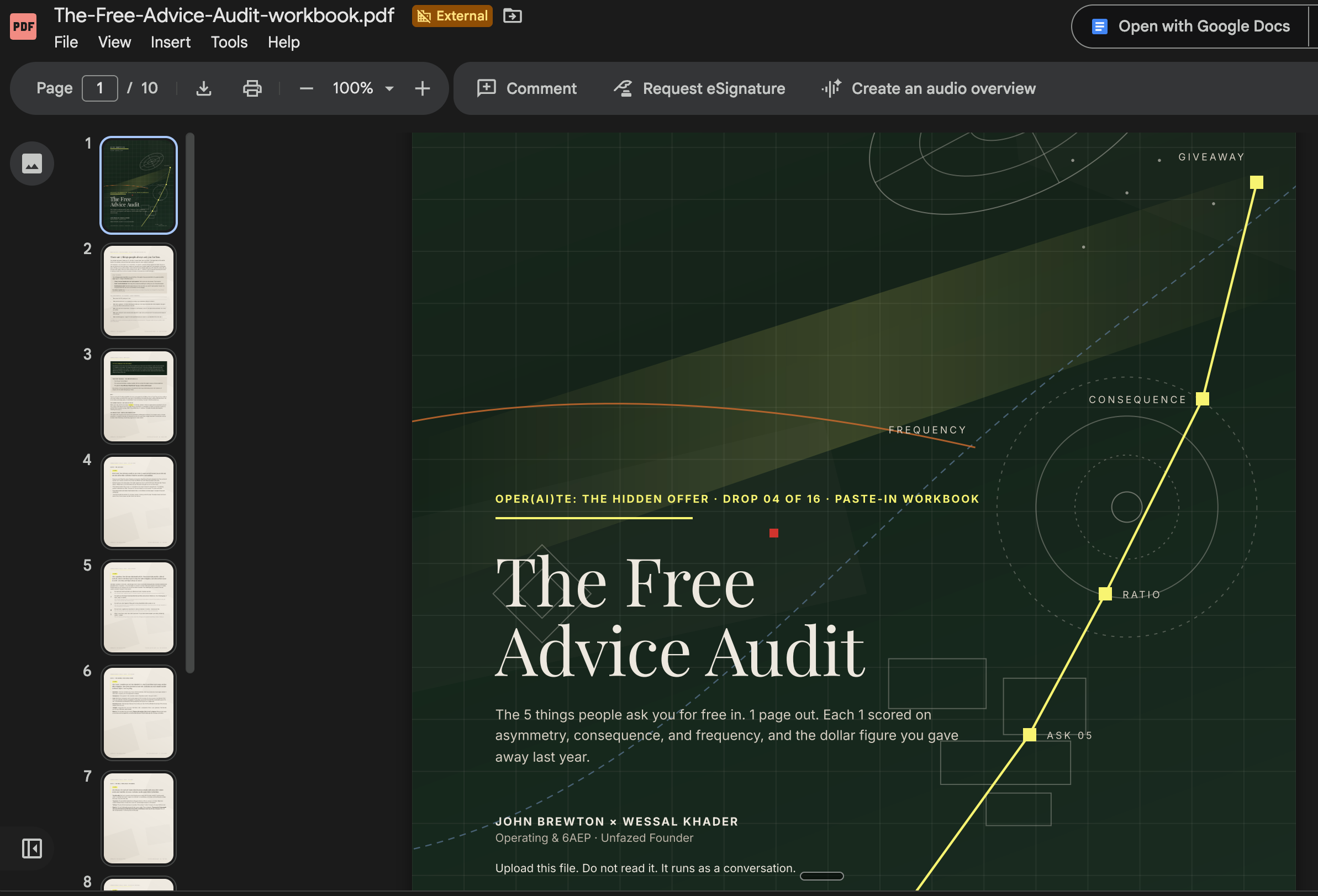
The thing you give away in 20 minutes may take somebody else six months to learn.
There are probably a handful of questions people ask you constantly.
“Can you take a quick look at this?”
“What would you do here?”
“Can I get your opinion on my pricing?”
“Who would you hire?”
“Can I pick your brain for 20 minutes?”
And because answering feels easy, you answer. Usually for free.
That ease is exactly the problem The Free Advice Audit is designed to expose.
Something that takes you 20 minutes may take the person asking you weeks or months to solve without you. That difference is not trivial.
It is the accumulated value of your experience, pattern recognition, mistakes, judgment, relationships, and expertise. And in some cases, it may be the beginning of an offer.
The workbook asks you to identify the five things people most frequently come to you for and then compares them across three dimensions:
Effort asymmetry: How long does solving this take you compared with them?
Consequence: What happens if they make the wrong decision?
Frequency: How often does this problem occur?
The workbook ranks all five. Then it identifies the strongest candidate and gives it a very specific label:
This is a product, not a favor.
But my favorite part is the final number.
The workbook looks at your own hourly value and estimates how much of this expertise you gave away during the last 12 months. It puts a dollar figure on the advice.
That number may sting a little.
I hope it does.
Because one of the easiest things in the world to undervalue is knowledge you acquired so slowly that you forgot how difficult it was to learn.
What this drop finds
The piece of expertise with the greatest gap between how easy it feels to you and how valuable it may be to somebody else.
What it doesn’t know yet
Whether anyone will buy it, which buyer needs it most, what form it should take, how it should be positioned, or what that buyer will pay.
Download The Free Advice Audit →
Your Operating Inventory After Four Drops
This is the part I want you to notice.
If you have actually run the first four workbooks, you no longer have four PDFs. You have real, unique evidence.
You have a picture of what your work has actually required you to do. You have at least one career result translated into a defensible claim.
You have language other people repeatedly use to describe the value you create. And you have a ranked list of expertise people already seek from you, including s omething you may be giving away that deserves to become a product.
Four days ago, much of that information already existed. But it was scattered between your memory, calendar, inbox, client work, and other people’s words.
Now you can see it.
And this is where the next phase begins, because identifying valuable expertise is not enough. You still have to decide what to build around it.
COMING NEXT…
FREE DROP 5 · SEPTEMBER 17
The Model Sorter
Most people choose a business model by imitation. They see somebody selling a course, coaching program, retainer, advisory engagement, or productized service and decide that must be the model they need too.
The Model Sorter starts somewhere else: with the shape of your expertise and the shape of your life.
It looks at your available time, appetite for synchronous work, how dependent the value is on your personal judgment, whether the customer problem repeats, and other constraints. Then it compares different business models and tells you not only which models fit, but which one you should probably rule out.
FREE DROP 6 · SEPTEMBER 18
The Buyer’s Real Words
You describe the customer’s problem using your vocabulary. Your buyer describes it using theirs.
Those two languages often barely overlap.
The Buyer’s Real Words researches the places your customer talks naturally and pulls out the language they use to describe the problem, what they have already tried, and why those attempts failed.
You leave with language you can use in positioning and sales because it came from the market instead of your imagination.
FREE DROP 7 · SEPTEMBER 19
The 90-Second Teardown
You have probably looked at competitor websites. You may never have actually read one.
Give this workbook a competitor URL and it breaks the page into the promise, buyer, proof, pricing logic, objection handling, and something most competitive analyses ignore:
What the competitor never talks about.
That silence may be where your differentiation is hiding.
FREE DROP 8 · SEPTEMBER 20
The Price Spread
Three people can appear to sell roughly the same work for $2,000, $15,000, and $80,000. The work is rarely 40 times different.
Something else is creating the spread.
The Price Spread researches real providers across different pricing tiers and begins identifying what the buyer is actually paying more for: risk transfer, access, proof, buyer type, outcome ownership, contract structure, category framing, or some combination of them.
The question changes from “How can they charge that?” to “What would have to become true for me to occupy that tier?”
FREE DROP 9 · SEPTEMBER 21
The Underpricing Calculator
Most experts price the work. Buyers value the outcome.
Those are two entirely different numbers.
The Underpricing Calculator puts your current price beside the financial consequence of the outcome you create and calculates the relationship between the two. Not to manufacture the biggest number possible, but to find the number your existing evidence can actually support.
FREE DROP 10 · SEPTEMBER 22
The Generic Detector
You cannot hear your own filler. Most of us have bios, About pages, and LinkedIn profiles full of phrases thousands of competitors could use word for word.
The Generic Detector applies a simple test:
Could a direct competitor say this exact sentence?
If the answer is yes, the sentence is carrying almost no information. The workbook flags the generic language, calculates how much of your writing is truly specific to you, and begins replacing the filler with evidence from your actual work.
FREE DROP 11 · SEPTEMBER 23
The One-Sentence Compressor
If it takes three paragraphs to explain what you sell, you probably do not have an offer yet. You have a description.
The One-Sentence Compressor takes your current explanation and creates several structurally different versions, then tests them for specificity, buyer recognition, clarity, and one criterion I especially like:
Could somebody else accurately explain what you do after hearing it once?
Because an offer that cannot travel without you is much harder to sell.
FREE DROP 12 · SEPTEMBER 24
The Proof Page
Most experienced operators already have work that could help close their next customer. Nobody can see it.
The Proof Page takes one past project and turns it into a clean, client-facing case study built around the situation, the constraint, what you did, the defensible result, and what that result demonstrates you can do again.
Unlike most of the drops, this one does not only give you an insight.
It gives you something you can send to a buyer that day.
FREE DROP 13 · SEPTEMBER 25
The Objection Pre-Mortem
You are going to hear many of the same objections repeatedly once you start selling an offer. You can wait for the next 20 conversations to discover them, or you can prepare now.
The Objection Pre-Mortem starts with your actual offer and price, identifies the objections most likely to appear, separates the surface objection from the underlying concern, and determines what evidence would answer it.
You leave with something even more useful than an objection list:
An inventory of the proof your business still does not have.
FREE DROP 14 · SEPTEMBER 26
The First Five
“Find me leads” is a terrible instruction.
“Who specifically appears to have this problem right now, and what is the evidence?” is much better.
The First Five starts with your offer and buyer and looks for five real companies or people with a reason the problem may be live now: a new hire, funding round, leadership change, job posting, launch, complaint, regulatory shift, or another observable trigger.
Five prospects. Five reasons why now.
FREE DROP 15 · SEPTEMBER 27
One Day of the Daily 15
This drop is not really another diagnostic. It is a protocol.
One post. One new conversation. One follow-up. Fifteen minutes.
You use the work produced by the previous drops to execute one complete day of a simple selling rhythm.
The interesting part is not whether you can do it once.
The interesting question is what happens when the business can help you do it every day.
FREE DROP 16 · SEPTEMBER 28
The Headline Stress Test
You can spend months developing an offer and four minutes writing the headline that introduces it.
The final numbered drop takes your offer and produces 12 different headline structures, then scores them for specificity, buyer recognition, clarity, and how much meaningful information appears in the first few words.
You finish with page-ready language.
But by then, the headline will almost be beside the point.
Because look at what you will have accumulated.
What You Will Hold After 16 Drops
You will have a much clearer description of the work people have actually relied on you to do, along with a defensible career result and a bank of language other people use to describe your value. You will also have evidence of expertise you may have been giving away for years without realizing how commercially valuable it could be.
You will have a business model that better matches how you actually want to work. You will understand more of your buyer’s language, your competitive environment, and what creates pricing power in your category.
You will have a better view of the relationship between your price and the value you create, more specific positioning, and a one-sentence offer. You will also have a finished case study, a clearer view of your likely objections, and an inventory of the evidence required to answer them.
You will have five real prospects with reasons to contact them now. You will have a simple selling rhythm and page-ready language to put around the offer.
Sixteen useful outputs, all built from your career, your evidence, your market, and your buyers.
And then we arrive at the most important part.
What you still will not have is anything that runs.
You will have performed the analysis and produced the individual pieces. But you will not yet have one AI business brain that holds that evidence together, updates it, and uses it across the rest of the business.
You will not have agents continually reading that evidence or a Market Map designed to be rerun as the category changes. You will not have a permanent Price Evidence Sheet connecting your market, proof, and pricing decisions.
You may have the pieces of an offer, but not yet the complete offer assembled from the intersection of your proof and actual market demand. You may have stronger copy, but not necessarily the sales page published and working as a conversion surface.
And you will not have a Selling Agent waking up with you every morning and turning all of that thinking into activity.
That difference is Oper(AI)te: The Hidden Offer.
The drops are designed to let you experience pieces of what Wessal and I have been building. The October cohort is where we assemble those pieces into the operating system.
From October 1–29, we build it live.
You will build the Everything File, the Superpower Scan, the Fit Test, the Client Evidence Pull, the Market Map, the Intersection Engine, the Price Evidence Sheet, the Page Builder and Language Audit, and the Selling Agent with its Daily 15 rhythm.
That is 9 AI agents built on our IP, yours to keep.
Across six live sessions, you will build against your actual career, business, expertise, market, and buyers rather than watching us demonstrate the process against a hypothetical company. The objective is for the work to leave the classroom and become something operating inside your business.
Your sales page gets published. Your first real buyer conversations get opened and coached, and you leave with a 90-day rhythm for continuing to operate the system after the cohort ends.
The finish line is not, “I learned how to build an offer.”
It is being able to say: I have an offer. I know who it is for and why they need it. I know what evidence supports it and what I can defend charging for it.
You can send somebody the page.
And you have a system helping you sell it.
If these free drops are already showing you things about your career and expertise you had not seen before, that is the best explanation I can give you for why we built the full program. The question is no longer whether the expertise exists.
The question is whether you want to turn it into something that operates.
See everything inside Oper(AI)te: The Hidden Offer →
Doors close September 30, and the live cohort runs October 1–29. Until then, keep running the drops and keep paying attention to what the evidence is telling you.
Drop 5 goes live tomorrow morning.