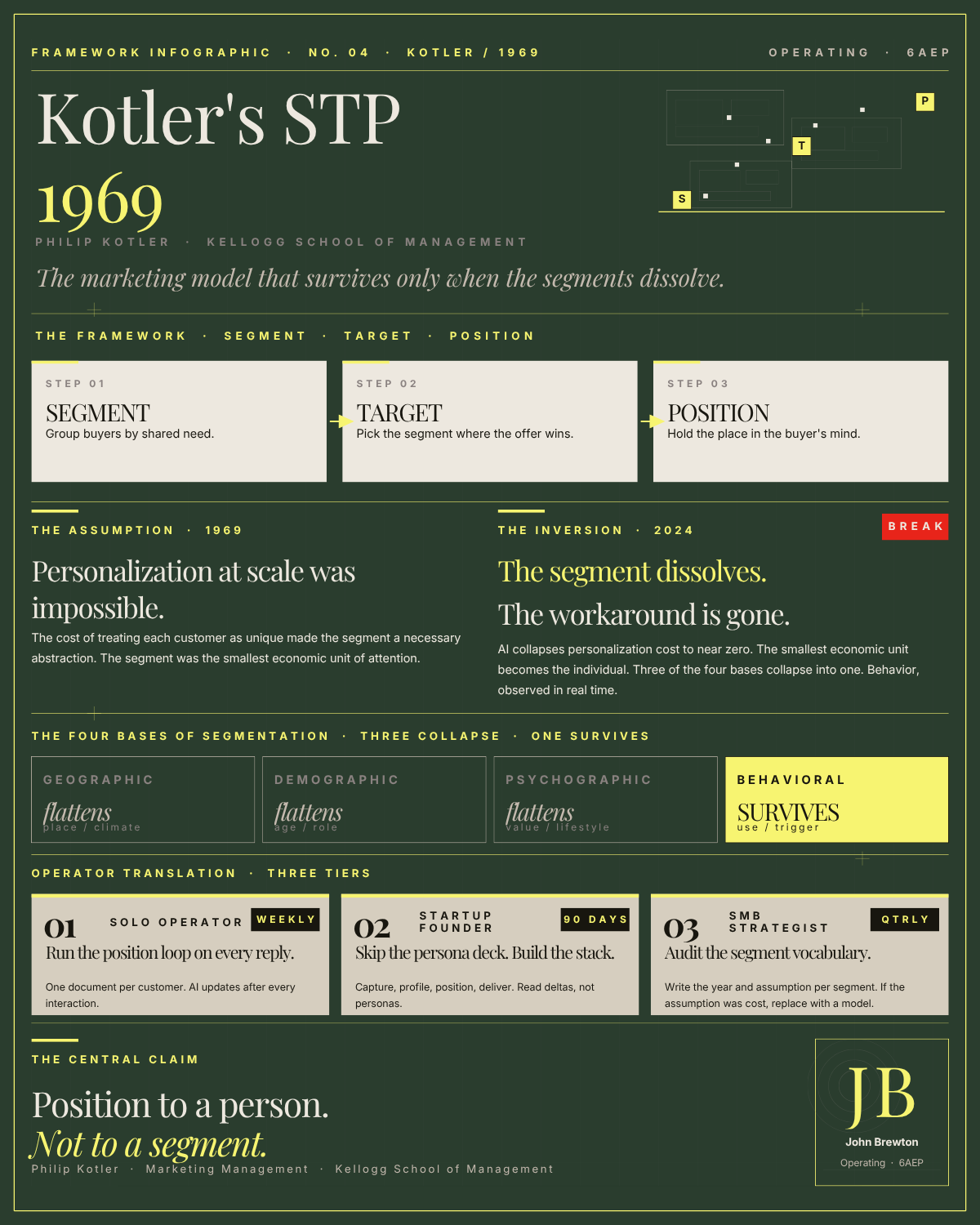
Philip Kotler formalized STP at Kellogg in 1969 to make personalization economically possible.
Philip Kotler taught a generation of marketers to think in three sequential acts. Segment the market by shared need. Target the segment where the offer wins. Position the offer in the buyer’s mind against the alternatives. The three-step discipline became the spine of marketing planning at every business school and consultancy that mattered for the next fifty years.
Personalization at scale was impossible. The cost of treating each customer as a unique market made the segment a necessary abstraction. The marketing organization could research, target, and position to a segment. It could not do that work for every individual buyer. The segment was the smallest economic unit of attention an organization could afford to treat as unique.
Bye Bye Bye Workaround
AI is collapsing the cost of personalization to near zero. Per-customer position generation now runs on the same operating budget as a marketing email. Behavioral signals can be observed continuously and predicted by a model. The smallest economic unit of attention is now the individual, not the segment.
Three of Kotler’s four segmentation bases collapse under that economics. Geographic, demographic, and psychographic segmentation were always proxies. They grouped buyers into bands that you could afford to treat differently because you could not afford to treat each buyer differently. With the cost gone, the proxies dissolve. Behavioral segmentation survives because behavior is the underlying signal the proxies were trying to estimate. Observed in real time and predicted by the model, it is the only base that earns its keep.
Segments do not disappear entirely. They survive where the channel forces them to aggregate. They survive where regulation forces aggregation. They survive in healthcare verticals, in legal tier marketing, in any context where the law or the surface itself demands a category. Outside those exceptions, most segments in your CRM are personalization-cost workarounds left over from human-era marketing economics.
Three Tiers
The solo operator runs a positioning loop on every reply. One document per active customer. AI updates after every interaction. The document contains the customer’s current job, alternative, objection, and position. Read it before every reply. Volume is what makes this competitive.
The startup founder skips the persona deck. The persona deck was the human-era artifact. Replace it in week one with a personalization stack. Capture every event. Maintain a live profile per buyer. Let AI generate a position per person. Deliver programmatically. The founder reads the deltas, not the personas.
The small business strategist audits the segment vocabulary. Walk through every segment label in the CRM, in email, in advertising, in product. Write the year it was created and the assumption it was built on. If the assumption was personalization cost, the segment is obsolete. Replace it with a model.
Operating Assets
Prompt Pack
The prompt pack ships five prompts that turn STP into a weekly positioning practice. Diagnose. Stress-test. Translate. Decide. Loop. Run them in sequence against any capable model. The first prompt scores your existing segments by predictive value. The second re-runs the analysis under the AI-era inversion and marks each segment KEEP, REPLACE, or SIGNAL. The third translates the output to your operating tier. The fourth forces a single move for the quarter. The fifth schedules the practice as recurring intelligence.
Worksheet
The worksheet runs the same logic on paper. Ninety minutes. Seven steps. One inventory of the segments you actually use. One audit of the year and assumption behind each. One scoring of the four bases. One mark of OBSOLETE, STANDS, or REVIEW per segment. One sketch of the personalization stack you would build today. One move for the quarter. One cadence for the loop.
Hope this helps. Tune in tomorrow for another framework, prompt pack and worksheet to help you become a better Operator.
- j -
About the author
John Brewton documents the history and future of operating companies at Operating by John Brewton. He is a graduate of Harvard University and began his career as a PhD student in economics at the University of Chicago. After selling his family’s B2B industrial distribution company in 2021, he has been helping business owners, founders, and investors optimize their operations ever since. He is the founder of 6A East Partners, a research and advisory firm asking the question: What is the future of companies


