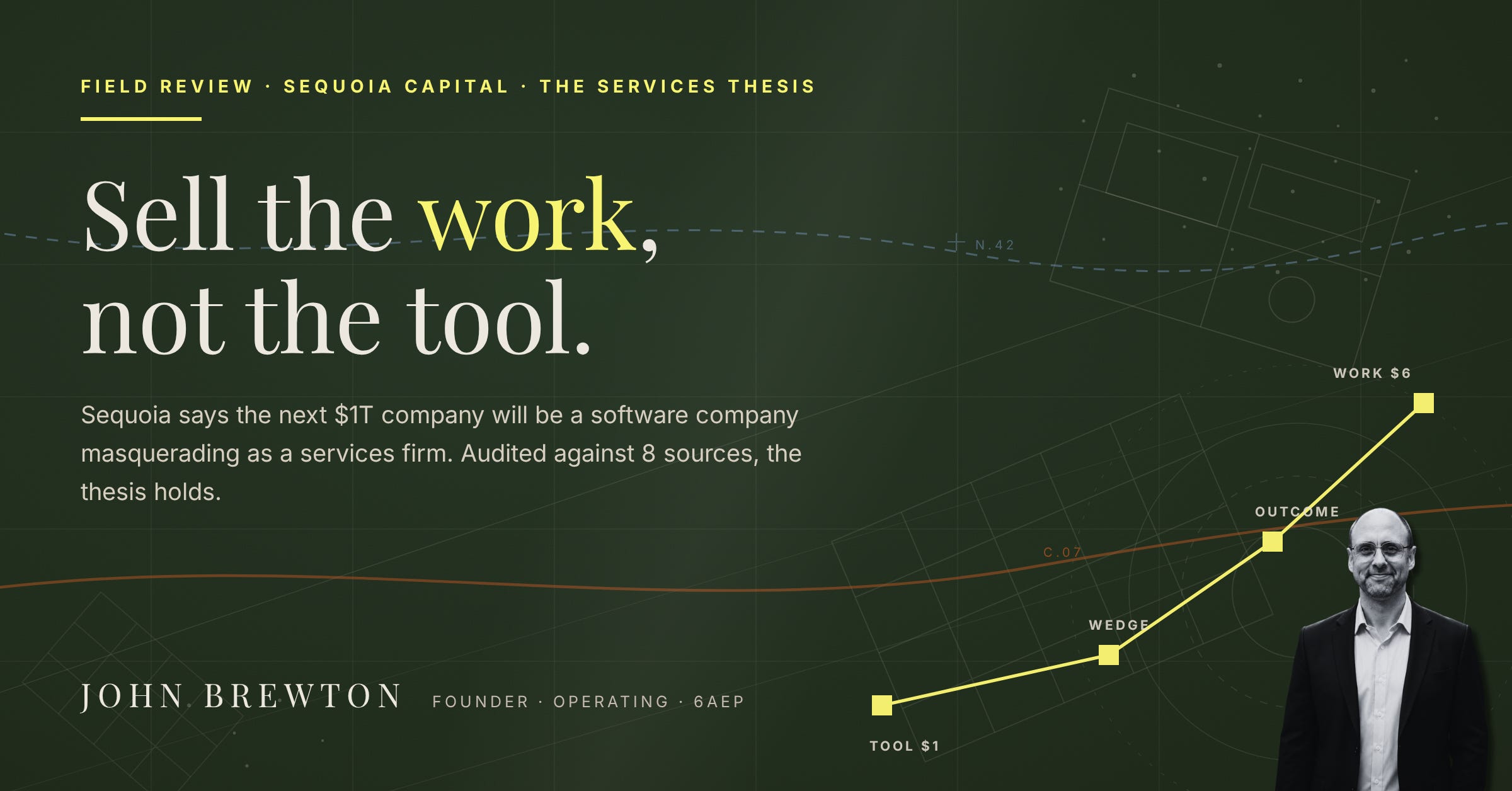
Sell the Work, Not the Tool
For every $1 spent on software, $6 goes to services. Sequoia’s thesis on AI autopilots, audited against 8 sources.
TL;DR
Sequoia published “Services: The New Software” on March 5, 2026. The claim: the next $1T company will sell completed work, not software tools. Companies spend $6 on services for every $1 on software. AI autopilots capture that 6x budget by delivering outcomes directly. The best entry point is work a company already outsources. The largest unclaimed market is management consulting at $300-400B. I verified the thesis against Foundation Capital, Bessemer, Goldman Sachs, a16z, HBR, Stanford, and WSJ. It holds.
For every $1 a company spends on software, it spends $6 on services.
Sequoia published that ratio on March 5. The firm’s claim is bigger than the ratio. The next $1T company will be a software company masquerading as a services firm. It will not sell you the tool. It will sell you the finished work.
I spent the week auditing the thesis against 8 sources: Foundation Capital, Bessemer, Goldman Sachs, a16z, 2 HBR studies, Stanford’s Digital Economy Lab, and WSJ reporting. The thesis holds. Here is the field review.
Why does Sequoia say services are the new software?
A company pays $10K a year for QuickBooks. It pays $120K a year for the accountant who closes the books. Same function, 12x the budget.
Every software founder is fighting over the $10K line. The $120K line sits next to it, larger and less defended. Sequoia’s argument is that AI now lets a vendor take the $120K line directly. The next legendary company will just close the books.
The investors agree on the size of the prize. Foundation Capital sizes the services-as-software pool at $4.6T. Bessemer frames it as a roughly $10T services and labor market against a $600B software market. Goldman Sachs projects that more than 60 percent of software industry operating profit accrues to systems built around AI agents by 2030.
$4.6T. Foundation Capital’s sizing of the services-as-software opportunity, against a global software market of roughly $600B. The work budget is 7x the tool budget at planetary scale.
What is the difference between intelligence work and judgement work?
Writing code follows rules. The rules are complex, but they are rules. Sequoia calls this intelligence work. Deciding which feature to build next, whether to take on tech debt, when to ship before it is ready. That is judgement, built on years of pattern recognition.
AI crossed the intelligence threshold first in software engineering. The category now accounts for more than half of all AI tool usage across professions. Every other category sits in single digits. A year ago Cursor users treated AI as autocomplete. Today agents start more coding tasks than humans do.
Stanford’s Digital Economy Lab audited 844 tasks across 104 occupations and found workers in 36 percent of occupations already using AI for at least 25 percent of their tasks. The threshold crossing is not a software story. It is an everything story arriving on a lag.
What is the difference between an AI copilot and an AI autopilot?
A copilot puts AI in the professional’s hands. An autopilot delivers the finished work to the company that needed it.
Harvey sells to law firms. Rogo sells to investment banks. The professional remains the customer and takes responsibility for the output. That is the copilot model, and it captures the tool budget.
Crosby sells the drafted NDA to the company that needs it, not to outside counsel. WithCoverage sells the CFO insurance, not the broker a workflow. That is the autopilot model, and it captures the work budget from day one.
Where should an AI-native services company start?
Start with work somebody already outsources. The playbook section of Sequoia’s piece is the part operators should read twice.
If a task is already outsourced, 3 things are true. The company accepts that the work can be done externally. A budget line exists and substitutes cleanly. The buyer already purchases an outcome rather than hours.
Replacing an outsourcing contract is a vendor swap. Replacing headcount is a reorg. Vendor swaps close in a quarter. Reorgs take a year and an executive sponsor.
Crosby started with NDAs for exactly this reason. Well-defined task, primarily intelligence, already outsourced, immediate ROI. a16z documented the same pattern in its 2025 BPO work: the outsourced layer unbundles first, and pricing moves from seats to outcomes. Decagon prices per conversation handled, not per agent seat.
Which services markets have the largest AI opportunity?
Sequoia plots 10 service verticals by labor TAM. Insurance brokerage at $140-200B. Recruitment and staffing at $200B+. Supply chain and procurement at $200B+. IT managed services at $100B+. Accounting, healthcare revenue cycle, and claims adjusting at $50-80B each. Tax advisory at $30-35B. Legal transactional work at $20-25B.
Nine of those squares have named players. The largest does not. Management consulting, $300-400B, carries the label best candidates TBD.
The supply side tells you why the timing matters. The US lost roughly 340,000 accountants in 5 years while demand grew. 75 percent of CPAs are nearing retirement. WSJ counted more than 300,000 departures between 2019 and 2022 alone. Shortage forces AI acceptance faster than any sales motion ever could.
Will AI replace management consulting?
The pyramid is restructuring in public. McKinsey cut 3,000 to 4,000 roles in 2025 and 2026, its largest reduction since 2008. McKinsey, BCG, and Bain froze starting salaries for the third consecutive year. KPMG UK cut its graduate class 29 percent. HBR has now published 2 separate studies documenting the pyramid model breaking, in September and October 2025.
HBR flagged consulting as being on the cusp of disruption in 2013. The cusp lasted 12 years. The break took 18 months.
The replacement is disaggregation, not deletion. Data gathering, benchmarking, and modeling get automated. The strategic recommendation stays human and gains value. The operator who packages judgement on top of automated intelligence inherits the margin the pyramid used to capture.
Why don’t the successful AI copilots just become autopilots?
The fastest-growing AI companies of 2025 were copilots. In 2026 many will try to become autopilots. They have the product and the customer knowledge. But selling the work means cutting their own customers out of doing it.
That is the innovator’s dilemma, running live, with 18-month-old companies playing the incumbent. The hesitation is the opening for pure-play autopilots.
What should operators do now?
If you are building or advising in this market, the playbook runs in 5 moves.
Pick an outsourced, intelligence-heavy task in a vertical you know. The budget line already exists.
Sell the outcome, not the seat. Price the work.
Substitute the vendor, not the org chart.
Compound proprietary judgment data with every engagement. Today’s judgment becomes tomorrow’s intelligence.
Expand toward the insourced, judgment-heavy work. The wedge is the entry. The labor line is the TAM.
This week, do 1 thing. List every function your company or your clients currently outsource, with the annual spend next to each line. That list is the opportunity map for your specific situation. It takes 30 minutes and most operators have never written it down.
FAQ
What does “services as software” mean? AI companies deliver completed work instead of selling tools. The vendor owns the outcome, the way a services firm does, with software economics underneath. Foundation Capital coined the framing and sizes the opportunity at $4.6T against a $600B global software market.
What is an AI autopilot? An autopilot is an AI company that sells the finished work directly to the buyer. Crosby delivers drafted NDAs to companies. WithCoverage delivers insurance to CFOs. The customer buys the outcome, and the vendor captures the work budget rather than the tool budget.
How big is the services-as-software market? Foundation Capital sizes it at $4.6T over 5 years. Bessemer frames the full services and labor market at roughly $10T, against a $600B software market. Sequoia’s ratio: $6 of services spend for every $1 of software spend.
Which industries will AI services companies disrupt first? Industries where the work is rules-based and already outsourced: insurance brokerage ($140-200B), accounting ($50-80B US outsourced), healthcare revenue cycle ($50-80B), claims adjusting ($50-80B), and legal transactional work ($20-25B). High judgement fields move later.
Is management consulting threatened by AI? The $300-400B consulting market is the largest square on Sequoia’s map and the only one without named candidates. The work disaggregates: research, benchmarking, and modeling get automated while strategic recommendation stays human. McKinsey cut 3,000 to 4,000 roles in 2025-2026 and froze salaries 3 years running.
What is the difference between a copilot and an autopilot in AI? A copilot makes a professional more productive and sells to that professional. An autopilot replaces the engagement and sells the outcome to the end customer. Harvey is a copilot for lawyers. Crosby is an autopilot for the company that needs the NDA.
The reading list
Sequoia, “Services: The New Software”. The source text. 7 minutes.
Foundation Capital, “The $4.6T Services-as-Software Opportunity”. The sizing.
a16z, “Unbundling the BPO”. The wedge in detail.
Goldman Sachs, “AI Agents to Boost Productivity and Size of Software Market”. The profit-pool math.
HBR, “AI Is Changing the Structure of Consulting Firms”. The pyramid, breaking.
HBR, “How AI Is Upending How Consulting Firms Hire Talent”. The hiring evidence.
Stanford, “Future of Work with AI Agents”. The task-level data.
Bessemer, on the ~$10T labor framing. The biggest frame.
— j —
John Brewton documents the history and future of operating companies at Operating by John Brewton. He is a graduate of Harvard University and began his career as a PhD student in economics at the University of Chicago. After selling his family’s B2B industrial distribution company in 2021, he has been helping business owners, founders, and investors optimize their operations ever since. He is the founder of 6A East Partners, a research and advisory firm asking the question: What is the future of companies


