

I used to write 3,000-word essays. Then I looked at the data. The average newsletter reader gives you 51 seconds. Even on Substack, most people scroll to about 65% depth on a long piece. So I’ve created Starting Points.
Each edition gives you a sharp thesis in a few sentences, two to three AI prompts built to interrogate that thesis, and a curated pack of the best articles I found on the topic.
Read it in 90 seconds. Take it to Claude, ChatGPT, Gemini, NotebookLM…
The creator market does not need more content explaining what AI can do. It needs clearer thinking about what AI changes. This edition is about the operating model most businesses are still running — and why the window to rebuild it from scratch has never been wider for smaller firms.
I write starting points. You build the rest.
— j —
Last week I watched an ERP software demo.
At step nine, the presenter said: “And then your ops lead simply reviews the exception report and makes the appropriate adjustment.”
Simply?
I’ve been in rooms like this for fifteen years. The word simply has never once described what actually happened.
The software we built businesses on for the last thirty years was never designed for the people running it. ERP, CRM, Excel, BI dashboards, approval workflows — these were elaborate intermediary systems built for computers that couldn’t yet do the work themselves. They structured the world so humans could perform tasks that machines lacked the intelligence to handle. Parsing context. Routing exceptions. Reconciling mismatched data across departments. Making judgment calls buried inside process flows.
The systems didn’t do the work.
They organized the workspace so humans could.
The AI era is dissolving that arrangement by removing the human from the loop where the human never belonged: procedural execution, data capture, pattern recognition at scale, and cross-system orchestration. The interface is no longer a set of screens that a human clicks through. The interface is intended.
My contrarian bet: The firms that win the next decade won’t be those with the most sophisticated tech stack. They’ll be the companies who rethink their operating architecture from first principles, before they bolt more AI features onto the same broken assumption.
The smallest firms can redesign fastest. That is not a consolation prize. In an era where structural advantage shifts from scale to speed of architectural adaptation, it is the opening.

Work with me directly.
You’ve read the framework. Most people stop there.
If you want to implement it — map your operating architecture, build your content system, design the AI-first workflows your business actually needs — this is how we do it together.
Three 1:1 strategic operating sessions with me.
Full access to the Operating Founders Skool community and all three course curriculam (43 DIY assets across 45 lesson plans)
The Operating Foundation,
The Brand Operating System,
The Content Engine.
Weekly live Zoom calls to keep you moving between sessions.
$99
This offer is for founders who are ready to stop reading about operating differently and start doing it.
Start Here
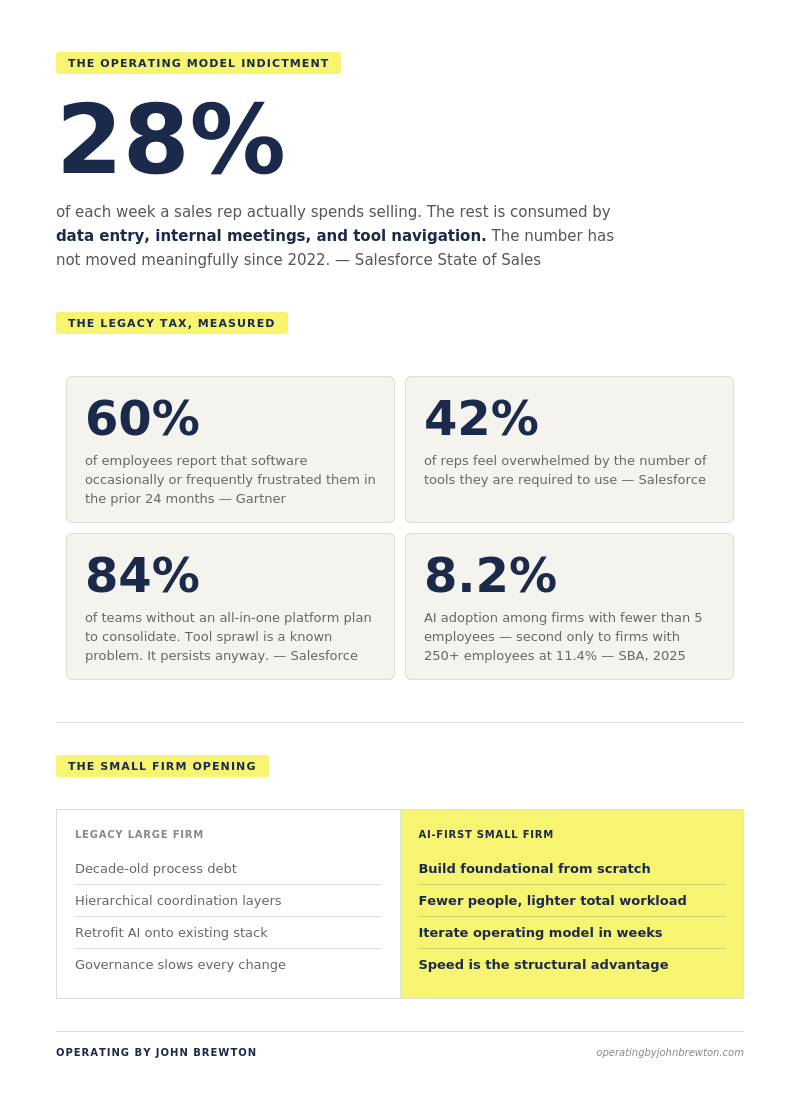
For decades, small operators looked to larger companies for operational guidance. There was logic in that. But the transfer was always imperfect. AI-first operations invert the dynamic entirely.
The very things that made large firms strong — layers of coordination, massive headcounts, deep process libraries — are now impediments. A $5 billion company cannot rearchitect its ERP overnight. A $15 million company can build a custom data model, deploy agents against its core workflows, and iterate in weeks. The World Economic Forum profiled AI-first startups in early 2026 running lean teams of fewer than ten people across hundreds of agents spanning full operational functions. The structural advantage is speed, proximity to real problems, and the absence of legacy process debt.
For decades, small operators looked to larger companies for operational guidance. There was logic in that. But the transfer was always imperfect. AI-first operations invert the dynamic entirely.
The very things that made large firms strong — layers of coordination, massive headcounts, deep process libraries — are now impediments. A $5 billion company cannot rearchitect its ERP overnight. A $15 million company can build a custom data model, deploy agents against its core workflows, and iterate in weeks. The World Economic Forum profiled AI-first startups in early 2026 running lean teams of fewer than ten people across hundreds of agents spanning full operational functions. The structural advantage is speed, proximity to real problems, and the absence of legacy process debt.
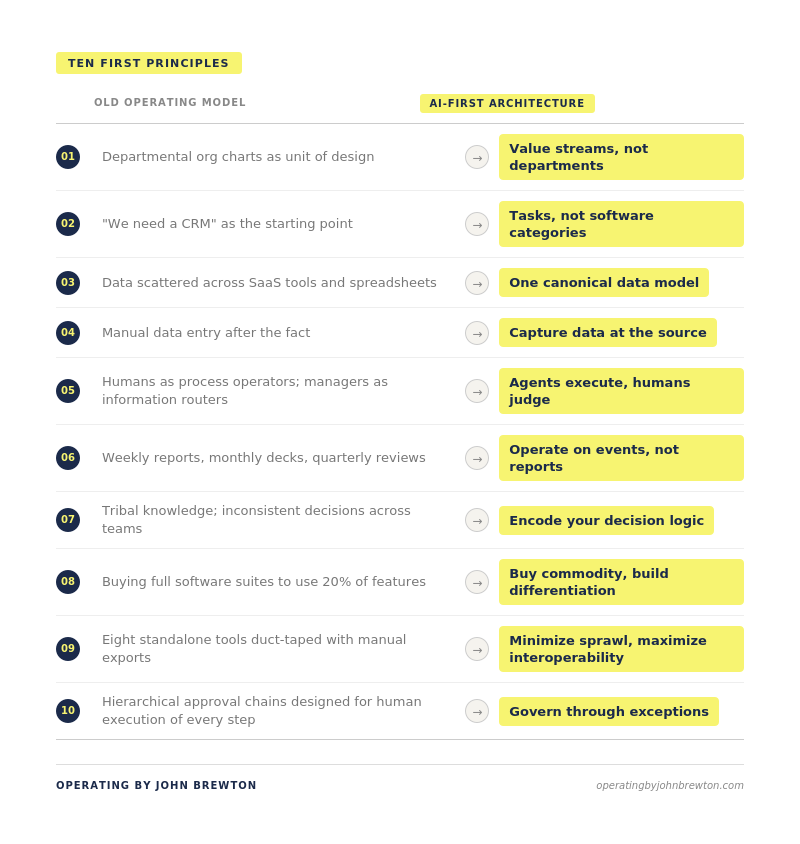
The question is what you build instead. Here are the ten principles.
1. Value streams, not departments: Design operations around end-to-end flows — lead to cash, procure to pay, ticket to resolution — not around the functional silos that make org charts tidy and decision-making slow.
2. Tasks, not software categories: Before selecting any tool, decompose your operations into discrete tasks: what is actually being done, what data does it require, what decision does it produce. Buy for the task. Not the category.
3. One canonical data model: A single governed source of truth for customers, transactions, and operations. Everything reads from it and writes to it. Twelve SaaS tools and thirty spreadsheets is not a data strategy. It is a liability.
4. Capture data at the source: If a conversation generates information, the system captures it in real time — not after a human logs it later. Post-meeting data entry is not a workflow. It is a gap waiting to fail.
5. Agents execute, humans judge: Assign procedural, repetitive, and pattern-recognition tasks to agents. Reserve human attention for exceptions, ambiguity, and relationship judgment. The human who reviews every step is a bottleneck. The human who judges what matters is an asset.
6. Operate on events, not reports: An agent that alerts you when pipeline velocity drops 15 percent on Tuesday is more useful than a dashboard you check on Friday. Shift from periodic review cycles to continuous, event-driven signals.
7. Encode your decision logic: Your policies, thresholds, escalation rules, and next-best-actions should live as explicit, executable logic — not as tribal knowledge in someone’s head or inconsistent calls across a team.
8. Buy commodity, build differentiation: Use off-the-shelf infrastructure for identity, payments, and communications. Build custom systems only around the workflows and data models that constitute your actual competitive advantage.
9. Minimize sprawl, maximize interoperability: Every tool in your stack should expose clean APIs. If a system cannot be queried or written to programmatically, it is a dead end. Eight tools duct-taped with manual exports is not a stack. It is a maintenance burden.
10. Govern through exceptions: Governance in an AI-first model is not approval chains. It is exception handling: defining what the system escalates to a human, maintaining a clear audit trail of agent actions, and building feedback loops so the system improves over time.
The question is what you build instead.
These are not software recommendations. They are design decisions. Before selecting any tool, decompose your operations into discrete tasks:
What is actually being done?
What data does it require?
What decision does it produce?
Then build around the answer, not around a software category.
Stop thinking in CRM. Stop thinking in ERP.
Start thinking in tasks, data, decisions, and loops.
Build from there.
Prompts to explore:
“Map your own business against the ten principles. For each one, rate your current state: 0 (fully legacy), 1 (in transition), or 2 (already AI-first). Where do you score lowest? What would it cost — in time, money, and process disruption — to move that specific principle from 0 to 2 in the next 90 days? Be specific about what changes and what you stop doing.”
→ Before you go further — take the free operating model evaluation:
The Operating Model Audit Quiz

Score your organization against the ten principles. Come back with your three lowest scores. The prompts below are built for that.
Paid subscribers get the full prompt pack for this edition — the workflow redesign prompt, the evaluation-linked diagnostic, and the complete reading pack with NotebookLM instructions.
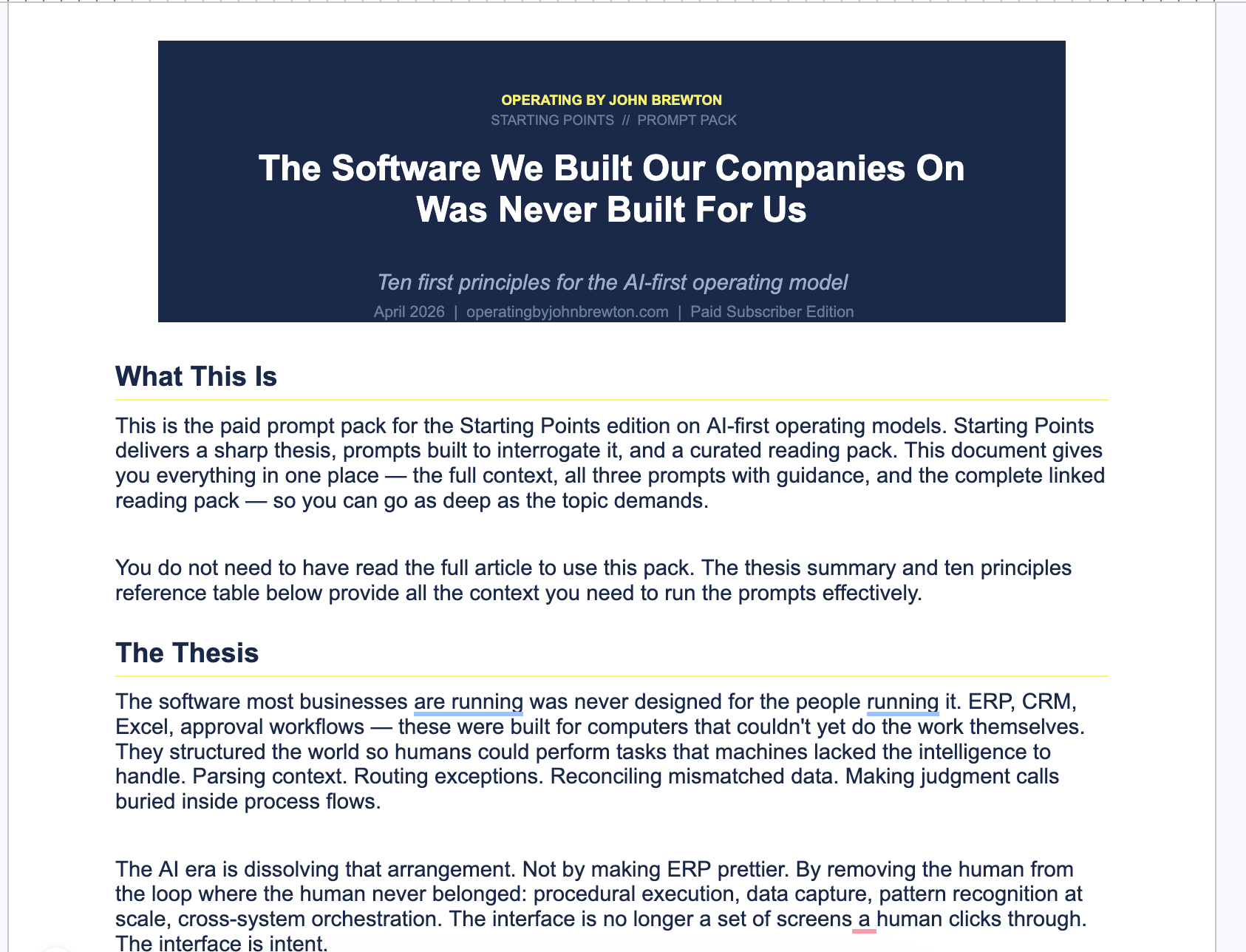
Here’s the prompt one preview:
“Using principles 1, 2, and 5 — value streams, task decomposition, and agents-execute-humans-judge — redesign one end-to-end workflow in your business from scratch. Describe the workflow as it exists today, then rebuild it from first principles. Be specific about what an agent handles, what a human judges, and how you would know when something goes wrong.”
“Before running this prompt, take the evaluation below. Come back with your three lowest-scoring principles. Then ask: what is the single workflow in my business where improving that score would have the most immediate impact on revenue or margin? Now design the intervention, not the tool, the architecture.”
Most operators will read a framework like this and change nothing.
The full prompt pack is for those who want to do the work.
Two more prompts behind the wall: a workflow redesign built on principles 1, 2, and 5, and an evaluation-linked diagnostic that converts your lowest scores into a specific architecture decision. The complete reading pack — six sourced articles with NotebookLM instructions — included.
The work is the point. The prompt pack is how you do it.
Paid subscribers get the full prompt pack for this edition.
“Get the full prompt pack below →
