

Most coaching ends the same way.
You leave with notes, a few good ideas, and the intention to do the work.
Three weeks later, the notes are cold. The ideas are still ideas. The thing that was supposed to change inside the business has not actually evolved.
You paid for advice. But what you needed was a system.
That realization has shaped a lot of how I think about coaching, consulting, and advisory work now.
The traditional model has an implementation problem.
The coach explains. The client understands. The call ends. Then responsibility for translating that understanding into something operational gets handed straight back to the person who was already too busy, too close to the problem, or too unsure of the solution to fix it alone.
There is nothing inherently wrong with advice. I have benefited enormously from good advice throughout my career.
But increasingly, I do not think advice should be where the work stops.
Especially now.
AI gives us the ability to take what used to live in a strategy document, a set of notes, or somebody’s head and turn it into a working system.
That changes what I think clients should expect from me.
And it is why I built The Operating Project.
Why I Built This
Before I became a coach, advisor, writer, and investor, I was an operator.
I spent years helping operate, optimize, and scale my family’s B2B industrial distribution company from $27.5 million to $75 million in revenue before we sold the business in August 2021.
This year alone, I have spent more than 400 hours working directly with more than 100 founders, entrepreneurs, operators, and professionals.
Those engagements have taught me an enormous amount.
They have also made one pattern impossible to ignore.
The people I work with rarely lack ideas.
They usually lack a reliable way to turn an important idea into something that works repeatedly inside the business.
Sometimes the problem is an offer.
Sometimes it is pricing.
Sometimes it is positioning.
Sometimes the founder knows they need to publish consistently but have no content system.
Sometimes there is simply one stubborn operating problem inside a larger company that everybody can see and nobody has been able to solve.
The answer is rarely another 60-minute conversation about the problem.
What people need is a way to move from:
problem → decision → design → build → operating system.
That is what The Operating Project is designed to do.
One Problem. One Outcome. One Working System.
The Operating Project is a four-session engagement in which we take one important problem in your business from unresolved to solved—and build the system that helps keep it solved.
You bring the problem.
I bring the structure, the operating frameworks, the worksheets, the thinking, and the build.
Before we begin, we define what finished looks like.
Then we work toward it.
This is not open-ended coaching.
It is not a standing consulting retainer.
It is not four calls where I give you ideas and send you away with homework.
It is one operating problem, scoped to one outcome, worked on until something useful exists.
Bring Me the Problem You Keep Circling
You do not need to arrive knowing exactly what the solution is.
You need to know which problem matters.
Here are four kinds of projects I expect to work on most often.
1. Your offer or business model is not working
Maybe the pricing is wrong.
Maybe the offer is confusing.
Maybe customers do not understand what they are buying.
Maybe you have several products but no coherent architecture connecting them.
We can work through the economics, offer design, pricing, packaging, positioning, and go-to-market logic until the model makes sense.
The finished result might include an offer map, a pricing model, a product architecture, or a decision system for evaluating future offers.
2. Your brand feels different every week
Your website says one thing.
Your LinkedIn says another.
Your pitch deck says something else.
Every new piece of content feels like another attempt to rediscover what the company stands for.
We can build the positioning, messaging, brand architecture, and identity system that creates consistency across the business.
The goal is not simply a prettier brand.
It is a system that helps you make better brand decisions repeatedly.
3. Content keeps becoming a weekly emergency
You know you should publish.
You may even know what you should publish.
But every week still begins with the same question:
What am I going to make this week?
We can build the strategy, recurring formats, editorial calendar, research process, production workflow, and AI infrastructure that turns content from an act of recurring inspiration into an operating system.
4. Something inside the company is simply broken
Maybe it is a workflow.
Maybe it is a decision process.
Maybe it is a sales problem, an operating bottleneck, a reporting problem, or a process everybody has learned to work around.
You do not need to rebuild the company.
You need to isolate the problem, redesign how the work should happen, and create a practical system around the fix.
You Do Not Leave With Homework. You Leave With Infrastructure.
This is the part of The Operating Project that matters most to me.
Most advice dies because it stays a document.
A document still depends on you remembering it.
A framework still depends on you applying it.
A strategy still depends on somebody translating it into work every time the work needs to happen.
A machine is different.
If we redesign your content strategy, I do not want to stop at a PDF describing it.
I want to help you build the Claude Project and ChatGPT Project, skills, instructions, templates, research process, workflows, and supporting assets that enable the strategy to actually produce content.
If we redesign your offer, I do not want you to leave with a single pricing worksheet that you use once.
I want to help you build a decision system you can use when creating your next offer.
If we solve an operating problem, I do not simply want to describe the new process.
I want us to install the logic behind that process somewhere your business can use it again.
The objective is not for you to remember everything I told you.
The objective is to encode what we built.
That is what AI makes possible now.
And I think it fundamentally changes what good advisory work can look like.
What You Might Leave With
Every project will be different because every problem is different.
Depending on the engagement, you might leave with:
A redesigned offer and pricing architecture;
A complete positioning and messaging system;
A 90-day content strategy and editorial calendar;
A Claude or ChatGPT Project configured around your business;
Reusable AI skills, prompts, instructions, and workflows;
A business-model or financial decision framework;
An operating process your team can immediately begin using;
Research systems and templates for recurring work;
A diagnostic framework that helps you make the same class of decision in the future;
The actual documents, worksheets, models, and tools we create together.
The point is that there is something at the end.
Something you can open.
Something you can use.
Something that exists inside the business after the engagement is over.
The Four Sessions
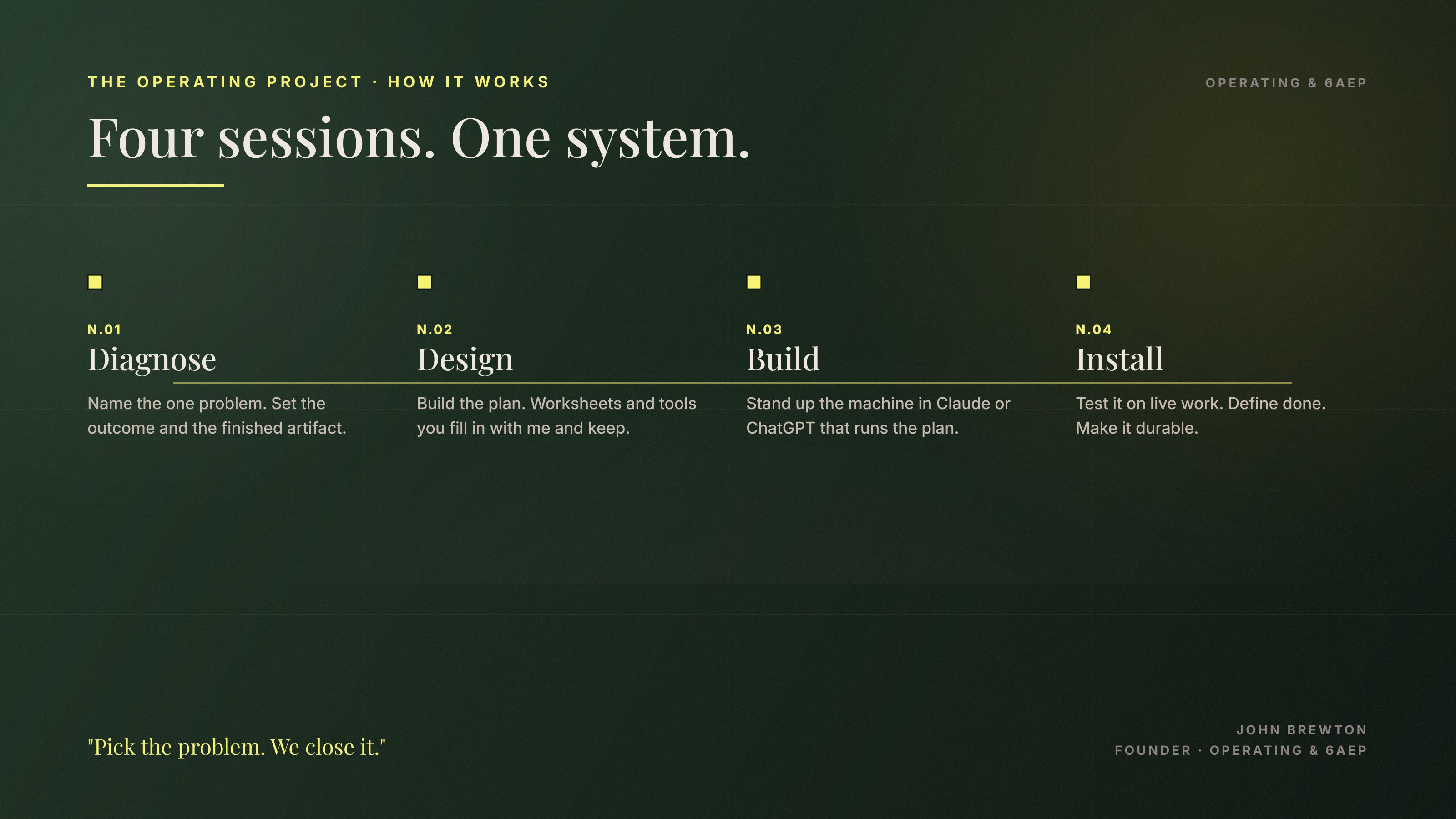
The Operating Project runs through four moves:
1. Define
We diagnose the problem in plain language.
We determine what is actually causing it, decide what needs to change, and define the artifact or operating outcome we want to hold at the end.
We also establish the scope.
What are we solving?
What are we not solving?
What does done mean?
2. Design
Then we build the solution.
Depending on the project, that might mean pricing models, offer architecture, positioning frameworks, operating processes, content calendars, decision trees, or another custom framework.
This is not something I disappear and create in a black box.
We build it around the reality of your business.
3. Build
Then we turn the solution into a machine.
This is where we build the working system inside Claude, ChatGPT, or another appropriate part of your workflow.
We create the projects, instructions, skills, prompts, reusable assets, and processes required to make what we designed repeatable.
You own everything we build.
It lives in your account.
4. Install
Finally, we run the system on live work.
We test it.
We find where it breaks.
We refine it.
We make sure you know how to use it.
And we define what happens after the project closes.
Define. Design. Build. Install.
That is the Operating Project.
I Do Not Sell You Four Hours
The sessions are not timed.
Some may take 30 minutes.
Some will take longer.
We might work across more than four sessions.
The unit of measurement is not the clock.
It is progress.
We stop when we have completed the work required for that stage of the project.
That matters because I do not want you thinking about whether we have seven minutes left in the session.
I want us thinking about whether the problem moved.
A Plan Tells You What to Do. A Machine Does It for You.
There is a much bigger idea underneath this offer.
For most of my career, business advice had an unavoidable limitation.
Eventually the advisor had to leave.
The consultant delivered the deck.
The coach ended the call.
The operator went home.
The client was left with the process of turning all of that expertise back into action.
AI changes the economics of that handoff.
We can now begin encoding expertise into systems the client continues to own and use. This capability makes good thinking more durable.
That is the principle I want The Operating Project to embody.
You should not simply become better informed because we worked together.
Your business should become better equipped.
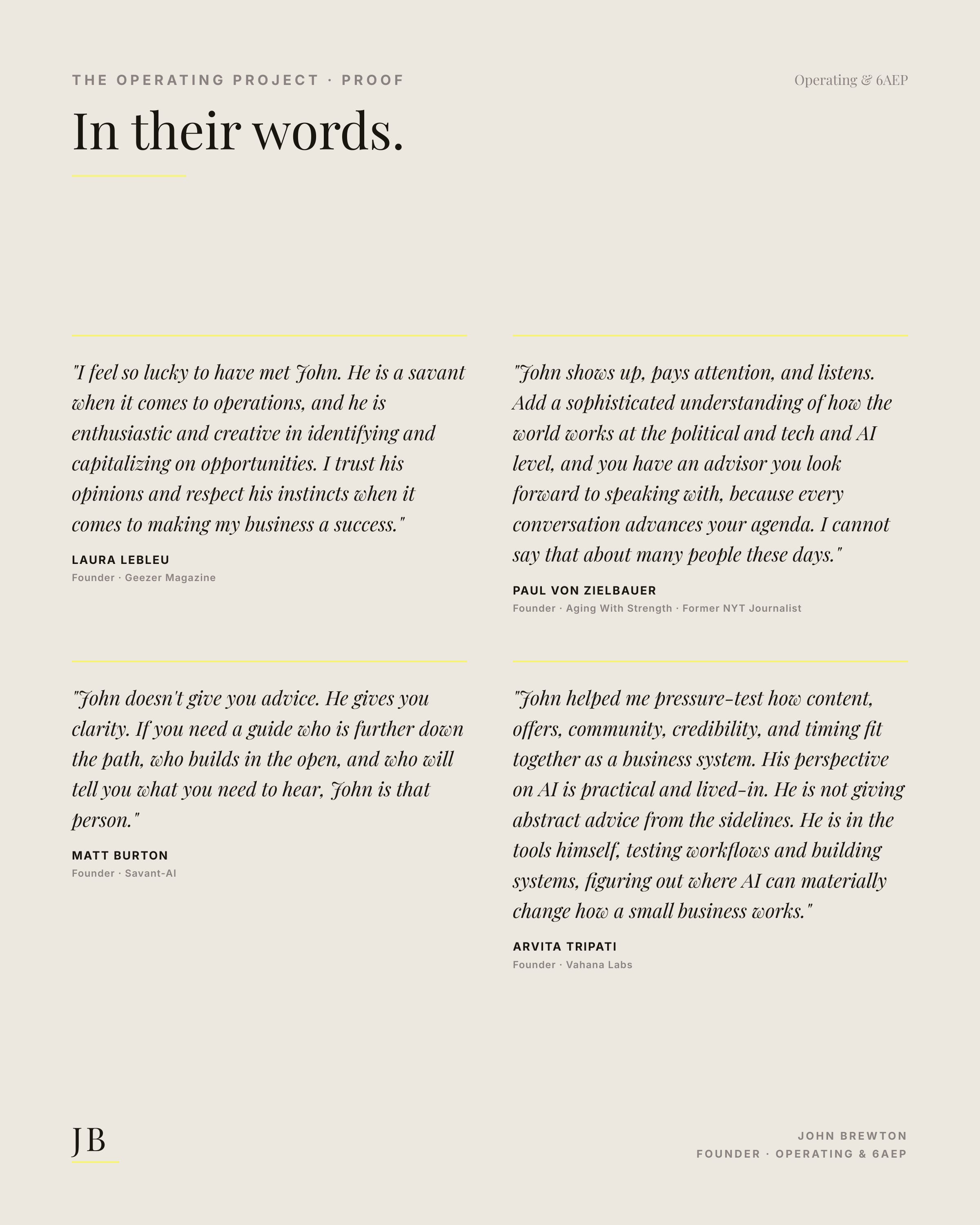
What People Are Saying
Who The Operating Project Is For
I think this engagement works best for founders, operators, creators, and business owners who have one meaningful problem worth solving now.
It is especially well suited to people who want to build rather than simply discuss.
You should be willing to make decisions, work through ambiguity, and use AI as part of the operating system we create.
You do not need to be an AI expert.
You do need to be willing to use the system once we have built it.
The Operating Project is probably not the right engagement if what you primarily want is general accountability, broad life coaching, indefinite access to an advisor, or someone to operate your company on your behalf.
This is finite by design.
One problem.
One project.
One outcome.
The Terms
The Operating Project is $999.
Your seat includes:
Four outcome-based working sessions.
All of the frameworks, worksheets, models, and operating assets we build together.
The Claude or ChatGPT system we create around the solution.
A full year of VIP access to my weekly Friday office hours.
Up to one year to schedule and complete your four project sessions.
There is no retainer.
There is no recurring consulting commitment.
There is no requirement that you start next week.
You can reserve the seat now and begin when the right problem is ready.
I would rather help you solve an important problem six months from now than manufacture an unimportant one because you bought today.
Bring Me One Problem Worth Solving
I am grateful for the more than 100 people who have trusted me with their businesses, careers, ideas, and ambitions this year.
Many of them have become friends and collaborators.
They have also helped me understand the kind of work I want to do more of.
I want to work on consequential problems with people who are serious about building.
I want the work to have a finish line.
And I want what we build together to keep producing value after I leave.
That is what The Operating Project is designed to do.
Bring me one problem worth solving.
We will define it, solve it, build the system around it, and put that system to work inside your business.
You will not leave with more homework.
You will leave with something that works.
— John
About John
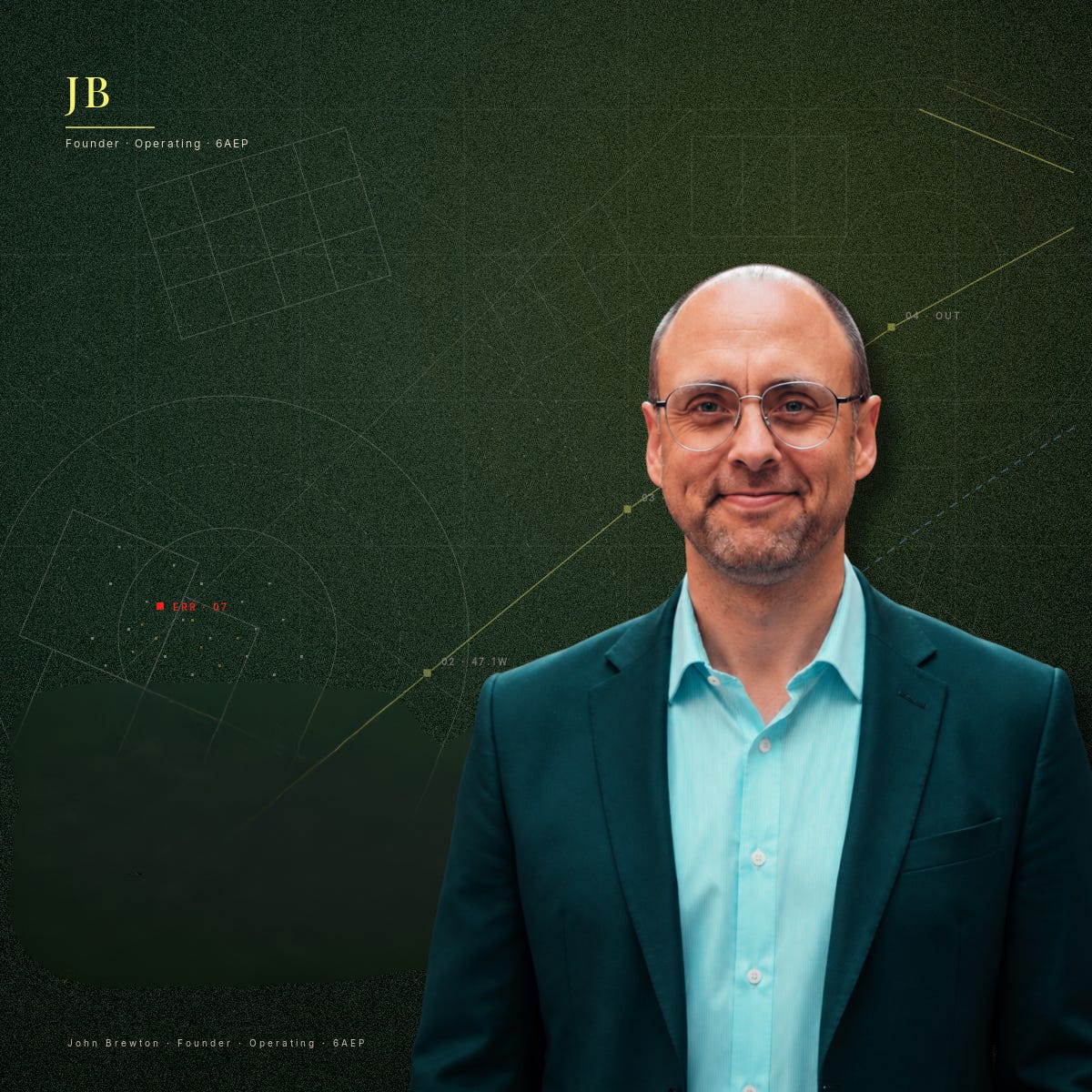
John Brewton documents the history and future of operating companies at Operating by John Brewton. He is a graduate of Harvard University and began his career as a PhD student in economics at the University of Chicago. After helping scale his family’s B2B industrial distribution company from $27.5 million to $75 million in revenue and selling the business in 2021, he has worked with business owners, founders, operators, and investors on company building, operating strategy, AI-enabled workflows, and growth. He is the founder of 6A East Partners, a research and advisory firm exploring the future of companies.
Ugh, I've been on the other side of this so many times. Walk out of a coaching session feeling fired up, and then life happens, and the notes just sit there. Building something that keeps working is a completely different thing.
The line that lands for me is that a document still depends on you remembering it. I have watched good strategy decay exactly that way, three weeks out.