By John Brewton · Founder · Operating by John Brewton
Start Here To Become An AI-Fluent Consultant
Are you a solo consultant or professional services provider? Whether you specialize in financial analysis, acquisition strategies, accounting, or brand marketing and sales, this article is tailored for you. In today's AI-driven landscape, consultants and service providers can expand their businesses faster and more efficiently than ever before. If this resonates with your work, you won't want to miss these transformative insights.
Let's dive in.
What once took 40 hours for a client audit now takes just 4. At $200 per hour, that efficiency comes at a cost of $7,200 in lost billable time. The billable hour penalizes consultants who create more efficient systems.
Over the past six months, I've tested the full Claude and Perplexity stack against the real-world workflows of a solo advisory practice. This article draws from 24 primary sources and 12 academic and institutional studies, all linked inline and organized in the appendix. The conclusion is clear: integrating AI into your current practice can boost efficiency by 20 to 30 percent, but redesigning your operating model around AI enables the productivity of a 3-to-5-person firm as a solo consultant.
TL;DR
AI-fluent means rebuilt, not retrofitted. Speeding up old workflows yields 20 to 30 percent gains. Redesigning the operating model around AI yields 5 to 10x output on research-heavy work, per Digital Applied’s micro-consulting benchmarks.
The stack is 2 tools with different jobs. Perplexity is the intelligence layer; it reads the live world and returns cited research. Claude is the execution layer; it holds your firm’s IP and produces the deliverables. Together, they close a loop: verified intelligence in, client-ready output out.
The evidence is no longer anecdotal. A field experiment with 758 BCG consultants found that AI users completed 12.2 percent more tasks, 25.1 percent faster, and at 40 percent higher quality on tasks within the model’s competence, per the Harvard Business School jagged frontier study.
Demand confirms the shift. AI-augmented freelance consulting skills grew 109 percent year over year in Upwork’s 2026 In-Demand Skills report.
Pricing is the play that captures the value. When delivery compresses, hourly billing becomes a liability. Outcome-based pricing converts the time savings into margin and raises practice exit multiples from 4x toward 6x EBITDA, per DEMG’s analysis.
The risks are manageable, not optional. Verification, data handling, and billing ethics decide whether the system compounds or collapses.
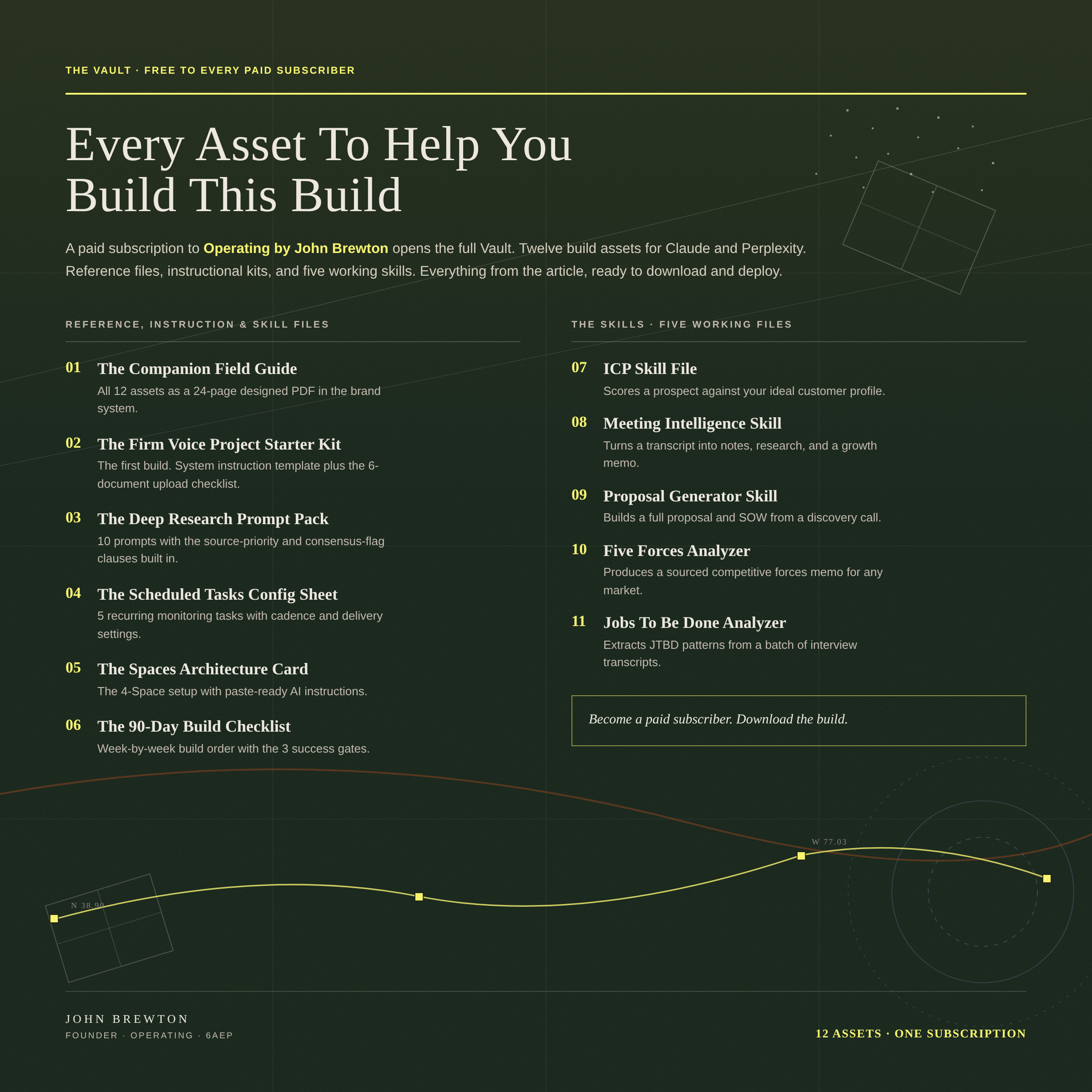
This week’s article builds one thing: a working AI operating system across Claude and Perplexity. The Vault hands you every asset to build it.
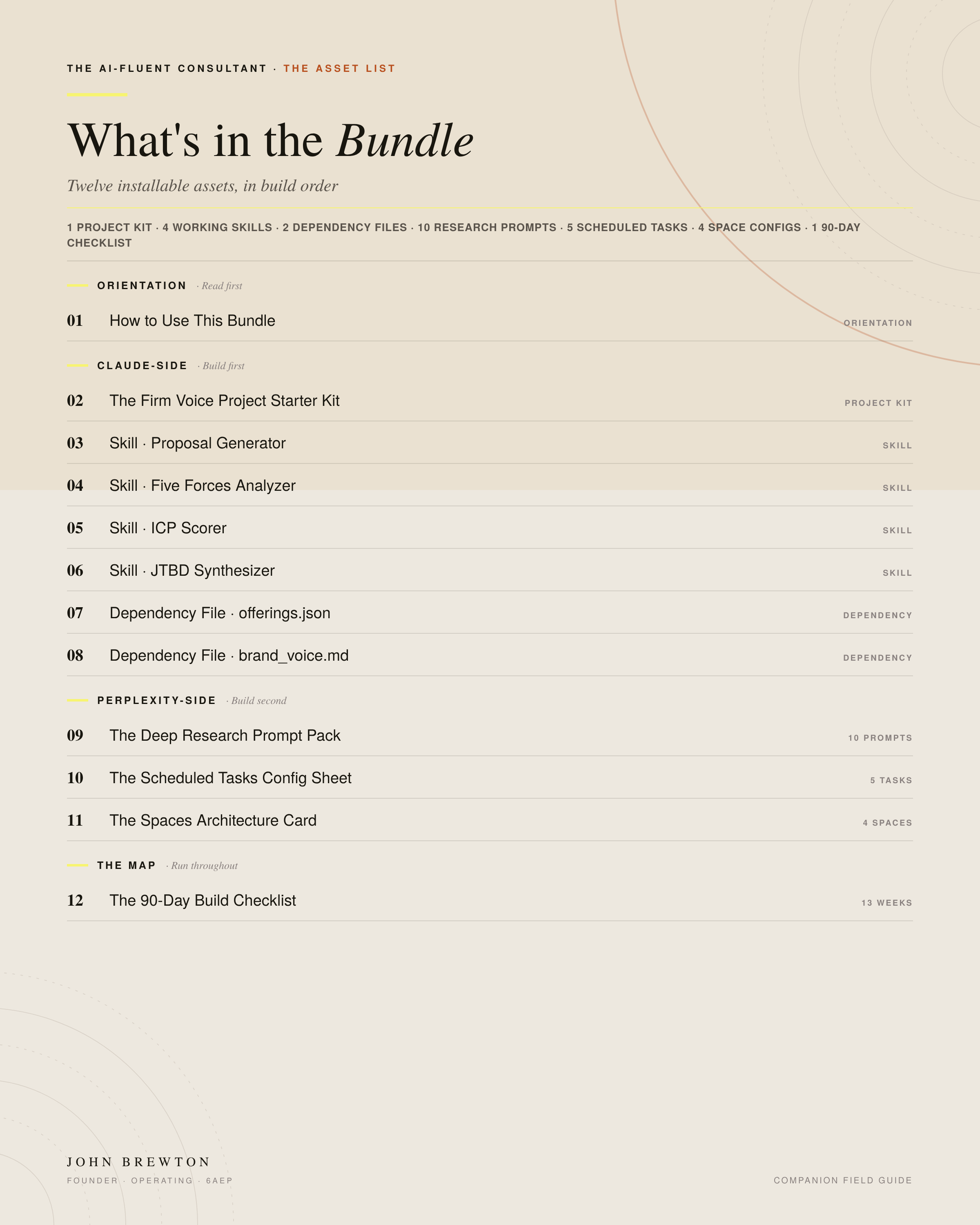
Twelve assets: Six reference and instruction files. Five working skills. One Companion Field Guide that compiles it all into a 24-page PDF.
The five skills do the work: ICP scoring, meeting intelligence, proposal generation, Five Forces, and Jobs To Be Done.
Free subscribers get the thinking. Paid subscribers get the build.
Subscribe and download the Vault.
What does “AI-fluent consultant” actually mean?
The phrase has been stretched to cover everything from a ChatGPT tab to full process reinvention. The useful definition is narrow. An AI-fluent practice is one in which the operating model is designed around AI from the start, rather than retrofitted onto a legacy service-delivery structure.
The distinction shows up in the economics, not the tooling. BCG’s 2025 study of 1,250+ companies found that only 5 percent achieve AI value at scale, while 60 percent report no material value despite real investment. The gap is not access to models. Everyone has the same models. The gap is in the operating model design.
The same split is restructuring the big firms. HBR documented in September 2025 that AI is collapsing the consulting pyramid into an obelisk, automating the research and modeling that justified thousands of junior billable hours. The FT reported in May 2026 that McKinsey is overhauling partner pay under Project Acorn because roughly a quarter of global fees are now tied to outcomes rather than hours. The Economist asked in June 2025 who needs Accenture in the age of AI, after the firm had shed roughly $60 billion in market value since its February 2025 peak.
The pyramid is breaking at the top of the market. That is the opening for the solo operator at the bottom of the cost curve.
What is the best AI stack for a solo consultant?
Claude is the execution environment: It holds your firm’s IP, frameworks, voice, and processes in Projects and Skills. It produces the deliverables clients pay for through Code, Artifacts, and MCP-connected tools.
Perplexity is the intelligence layer: it ingests the live world, web sources, internal files, competitor signals, and earnings transcripts, and routes these signals through specialized models to produce verified, cited research faster than any human team.
The Loop: Perplexity generates the intelligence. Claude shapes it into client-ready output. Your judgment sits between them as the quality gate.
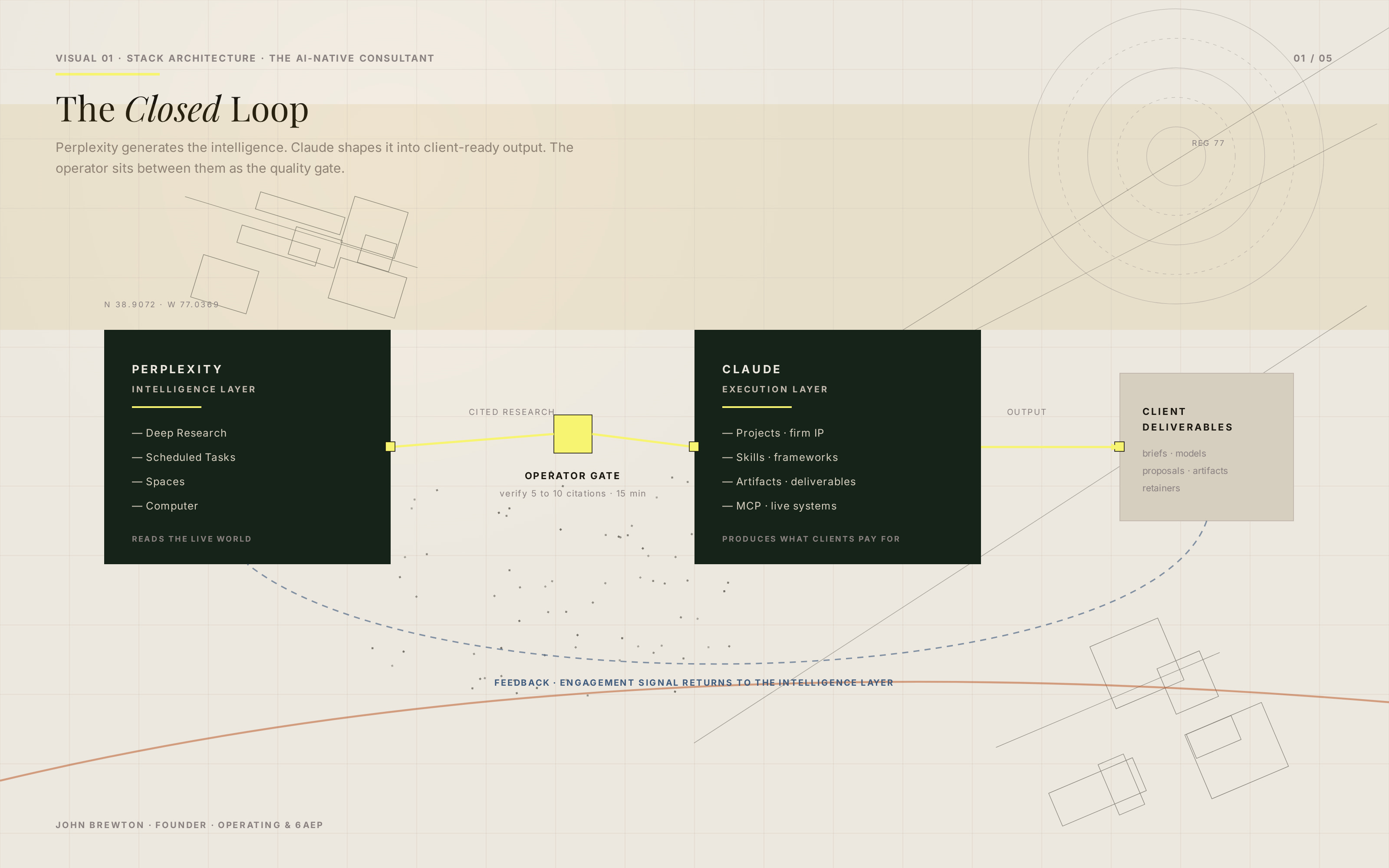
Perplexity intelligence layer (Deep Research, Tasks, Spaces, Computer) feeding the operator gate, feeding the Claude execution layer (Projects, Skills, Artifacts, MCP), feeding client deliverables, with the feedback loop returning to intelligence.
What are the 10 highest-leverage AI plays for a consulting practice?
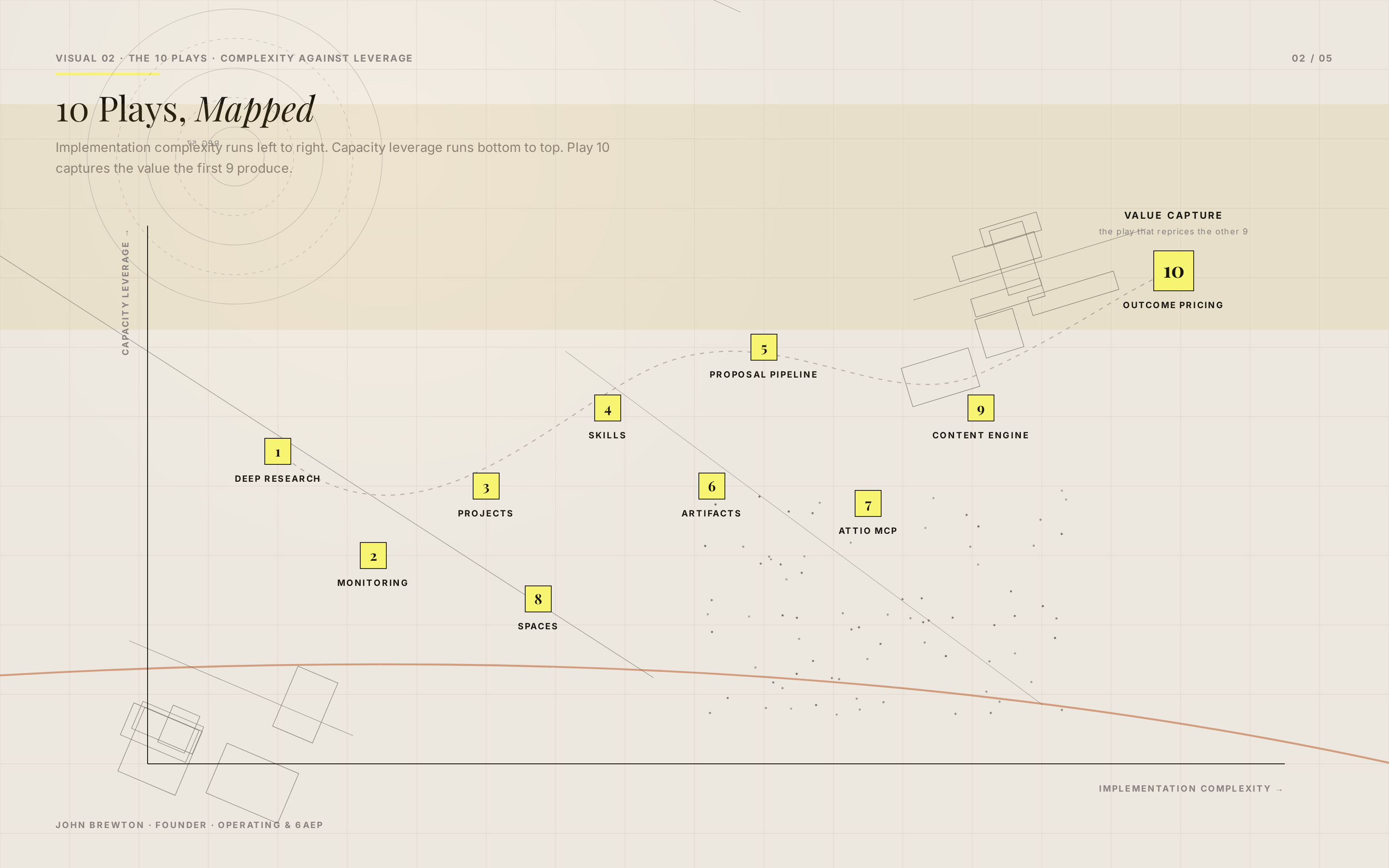
The full research report identifies 10, ordered roughly by implementation complexity.
Deep Research for first-pass analysis: A 30-page cited report in under 4 minutes replaces 20 to 40 hours of engagement research.
Always-on market monitoring: Scheduled intelligence replaces 3 to 5 hours a week of manual scanning across client verticals.
Claude Projects as the firm’s operating brain: Your frameworks, voice, and pricing persist across every conversation.
Claude Skills for repeatable frameworks: Porter’s Five Forces, ICP scoring, JTBD synthesis, encoded once, run in minutes.
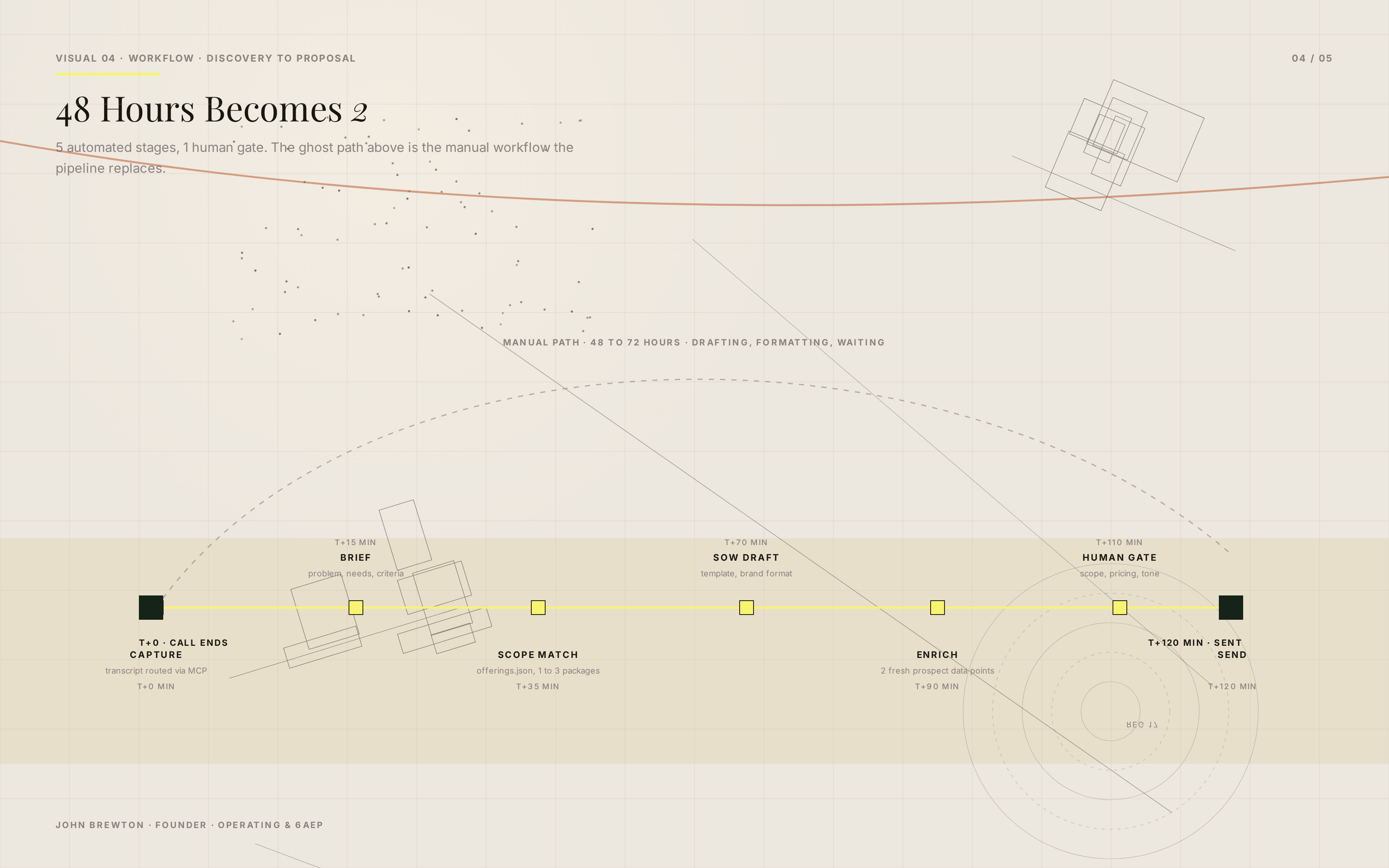
Discovery-to-proposal automation: 48 to 72 hours compressed to under 2.
First-draft deliverables via Artifacts: Interactive memos, 11-tab financial models, working mini-apps.
CRM intelligence via Attio MCP: Research, record creation, and outreach drafting in 1 conversational loop.
Perplexity Spaces as engagement hubs: Internal files and live web searched together.
The content engine: 1 newsletter becomes 10+ platform assets, client work becomes thought leadership.
Outcome-based pricing: The structural play that converts the first 9 into revenue.
How do consultants use AI for research without getting burned?
Perplexity Deep Research performs dozens of searches, reads hundreds of sources, and synthesizes a cited report in 2 to 4 minutes. It scores 93.9 percent on SimpleQA. The scope change matters more than the speed change. A human analyst carefully reads 20 to 30 sources. Deep Research reads hundreds, which changes the statistical odds of surfacing the non-obvious insight.
The discipline that makes it safe runs in 3 steps. First, run the research inside a Perplexity Space scoped to the engagement, with source instructions set to the client’s vertical. Second, export the cited report into the engagement’s Claude Project as reference material. Third, spot-check 5 to 10 citations per report before anything enters a client deliverable. That takes 15 minutes, compared to hours of independent verification.
The productivity evidence behind this play is peer-reviewed. Noy and Zhang’s MIT experiment, published in Science, found that access to ChatGPT reduced professional writing time by 40 percent and improved quality by 18 percent. Ethan Mollick documents a Danish study in which AI halved the working time on 41 percent of tasks. The Stanford and NBER call-center study found a 14 percent average productivity gain, with 34 percent for novices. Research-intensive consulting tasks compress harder than any of these because parallel search structurally beats sequential browsing.
Do you want to start becoming AI-Fluent?
Register for my free Masterclass on June 16th, where I will teach you how to build your own AI Employee that runs your calendar and inbox! Register Here

Can AI monitor my markets while I sleep?
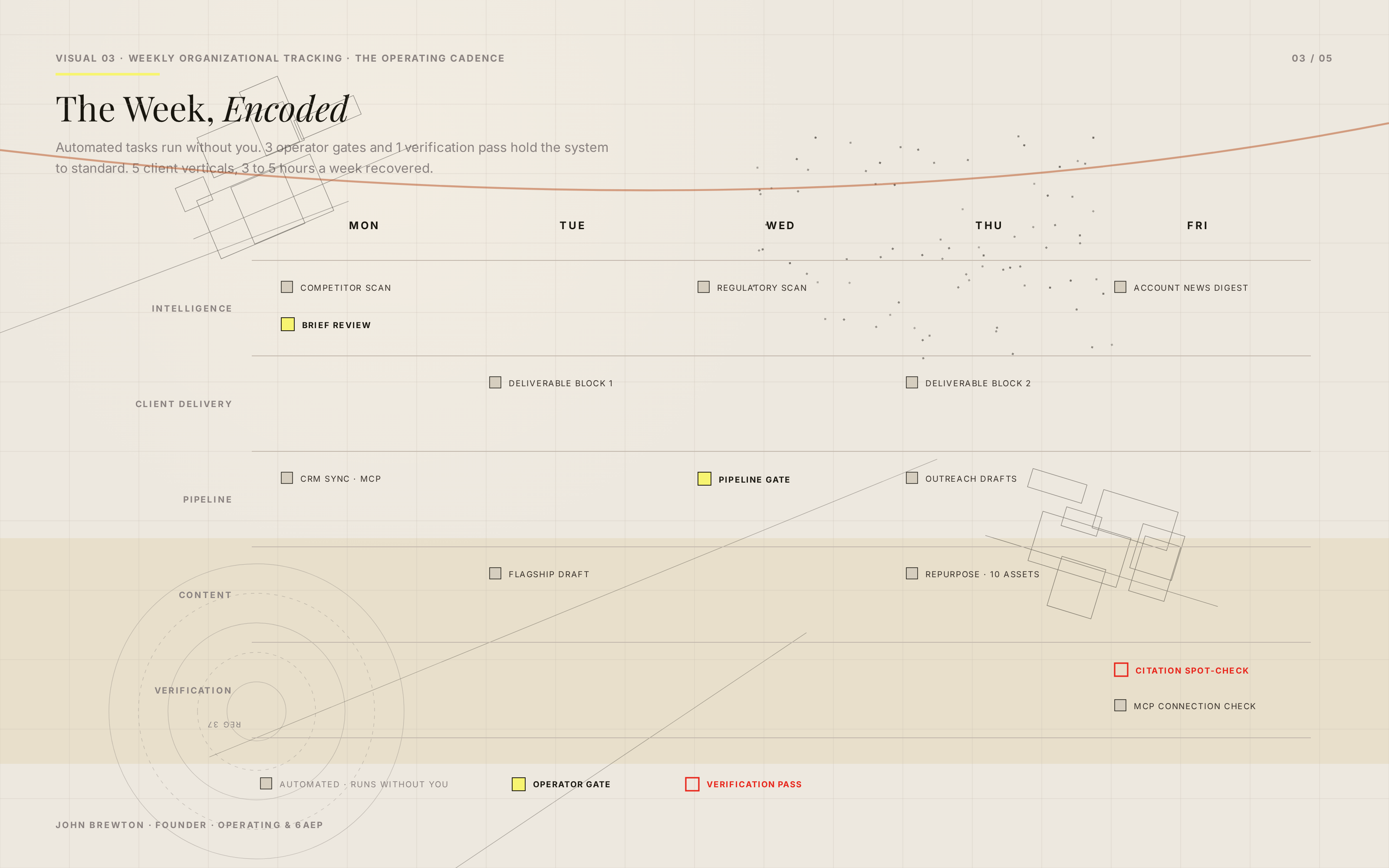
Yes, and this is the play most consultants skip. Perplexity Computer, launched February 25, 2026, runs asynchronous multi-step work across 19+ frontier models. Perplexity Tasks schedule recurring Deep Research queries delivered to your inbox.
The standing configuration for a 5-client practice: competitor funding and hiring scans weekly, contract awards from SAM.gov daily or weekly, regulatory changes weekly, client account news daily, earnings synthesis quarterly. Karo Zieminski documents 5 weekly workflows running in Computer, including the warning that matters: the May 2026 default orchestrator switch changed long-running task behavior, so pin specific models for production workflows.
The gain is 3 to 5 hours a week. The bigger gain is never missing the competitor funding round or policy change that should have triggered proactive client outreach.
How do I make Claude actually remember my firm?
Claude Projects persist documents and instructions across all conversations within them. The architecture that works: 1 Project per client engagement plus 3 standing firm-IP Projects.
Firm Voice and Methodology holds your style guide, frameworks, and anonymized past deliverables. Build this one first. Proposal Factory holds pricing structures, SOW templates, and scoping criteria. Research Synthesis Hub holds recurring frameworks and sector source lists.
Claude Skills are the action layer on top. A Project configures behavior. A Skill executes work: it takes inputs, runs multi-step logic, and produces a structured output. The canonical consulting Skills are a Five Forces analyzer, an ICP scoring engine, a JTBD interview synthesizer, and a proposal generator. One practitioner documented cutting proposal time from 2 hours to 90 seconds with the Skill pattern. A framework application that took 4 to 6 analyst-hours to build runs in 10 to 30 minutes. Across 5 engagements a month, that is 20-30 hours recovered.
The design principle: a Skill produces a specific, reviewable output, not a conversation.
How do I automate the discovery-to-proposal pipeline?
This is the most commercially sensitive workflow in any practice, the gap between qualified interest and signed engagement. Speed here moves close rates. Stack.expert’s pricing analysis notes AI-augmented consultants quote 2-day turnarounds where traditional firms quote 4 to 6 weeks, and clients pay premium rates for the speed.
The pipeline runs in 5 steps. A meeting notetaker routes the discovery transcript to the engagement Project via MCP. The Proposal Skill extracts the stated problem, the unstated needs, success criteria, and decision process into a 1-page brief. The Skill matches extracted needs against your offerings file and recommends 1 to 3 packages with pricing rationale. Claude drafts the full SOW in your template and brand format. A final Perplexity pass adds 1 or 2 fresh data points on the prospect to the executive summary.
Can AI build the actual client deliverables?
The deliverable layer is where the stack stops being a research assistant and starts being a production system.
Claude Artifacts produce interactive outputs: strategy memos with embedded charts, working ICP scoring tools, market sizing calculators, competitive positioning matrices a client can explore. As of April 2026, Live Artifacts connect to external tools via MCP and refresh in real time. Anthropic’s Financial Services solution ships pre-built plugins for financial modeling. One analyst built an 11-tab financial model in 10 minutes including sensitivity analysis. Perplexity Labs is the research-native equivalent, producing dashboards and reports grounded in cited web sources.
On the pipeline side, Attio MCP gives Claude OAuth-authenticated access to your CRM. The flow Attio documents: run deep research on a target in Perplexity, then instruct Claude to create the company record, add contacts, log the research as a note, and draft personalized outreach referencing a specific finding, all in 1 conversation. Estimate 3 to 5 hours a week saved across a 20-to-30-account pipeline, on engagements worth $15,000 to $150,000 each.
The rule that keeps this safe: client-facing Artifacts get read-only credentials. Write access to your systems always requires explicit confirmation.
How should I price consulting when AI does the delivery?
The consultant billing $200 an hour who compresses a 40-hour audit to 4 hours just converted AI into a pay cut. The resolution is to price the audit at its decision value, $7,000 to $8,000, and let delivery time become your margin.
The productized architecture runs in 3 tiers. Tier 1 is fixed-scope intelligence products: a competitive brief for $1,500 to $3,000 in 48 hours, and a market entry analysis for $3,000 to $6,000 in 5 days. Tier 2 is the retained intelligence service at $3,000 to $8,000 per month, built on the monitoring and synthesis plays, and requires 8 to 15 hours of your time. Tier 3 is the outcome-defined transformation engagement, priced at $25,000 to $75,000, based on value delivered rather than the $5,000 to $15,000 the same work would have earned under hourly rates.
The institutional signal points the same direction. Sequoia’s services-as-software thesis notes $6 flows to services for every $1 to software, and argues the winners will sell completed work, not tools. DEMG’s analysis documents outcome-based practices commanding 5 to 6x EBITDA at exit against 4 to 4.5x for hourly firms. Digital Applied’s benchmarks show solo practitioners reaching $200 to $500 effective hourly rates on productized offerings. And there is an ethical floor here: if you bill time-and-materials, you bill the 4 hours, not the 40. Outcome pricing eliminates the ambiguity.
What are the risks of using AI in client work?
Hallucination: The HBS jagged frontier experiment found consultants using AI outside its competence were 19 percentage points more likely to produce wrong answers. The Stanford RegLab study of legal AI tools found error rates of 17 to 33 percent in tools marketed as hallucination-free. Barclay Damon’s legal analysis states the standard: the legal risk lies not in the existence of hallucinations but in the failure to govern and verify them. Trace every market sizing figure to a primary source. No exceptions.
Confidentiality: Use Claude Team or Enterprise and Perplexity Enterprise Pro for client work. Consumer tiers carry weaker data commitments. For defense clients handling ITAR or CUI material, verify contractual data handling with counsel before uploading anything.
Trust mechanics: MIT Sloan Management Review’s global survey found users who can interpret AI outputs are 2.8x as likely to trust the technology. Your clients follow the same curve. Show sources, show methods, and the deliverable lands.
Workflow fragility: Model updates break Skill behavior, long Project histories dilute context, OAuth tokens expire. Pin models for production workflows, compress old conversations into summary documents, and check MCP connections weekly.
What do the first 90 days look like?
Days 1 to 30, foundation. Build the Firm Voice Project, configure 1 Perplexity Space per active engagement, connect Attio MCP, run your first 5 Deep Research queries. Success: Claude produces on-voice first drafts without style corrections.
Days 31 to 60, automation. Build the Proposal Skill and 2 framework Skills, configure 2 to 3 scheduled monitoring Tasks, start the content engine. Success: proposal drafts in under 10 minutes, intelligence briefs arriving automatically.
Days 61 to 90, repricing. Launch the first productized offering, raise rates on new engagements, ship the first client-facing Artifact. Success: 1 engagement closed at outcome pricing and a measurably higher effective hourly rate.
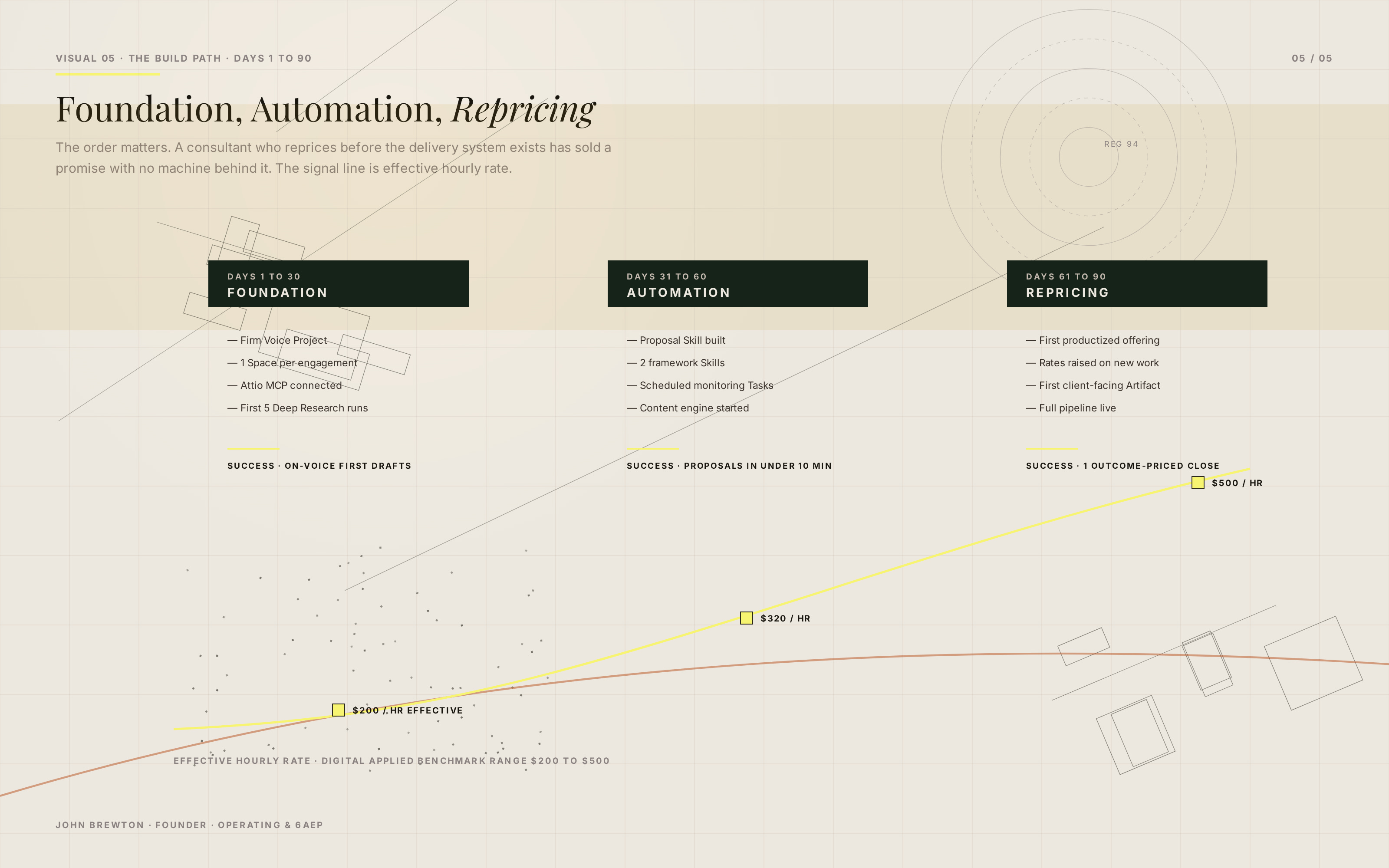
The order matters. Foundation before automation, automation before repricing. A consultant who reprices before the delivery system exists has sold a promise with no machine behind it.
- j -
FAQ
Is this realistic for a generalist, or only for niche consultants? The stack works for both. The economics favor the niche. Scheduled monitoring, vertically tuned Spaces, and a newsletter thesis all compound faster inside a defined boundary. Weak boundary: business strategy. Strong boundary: GTM strategy for defense tech firms navigating CMMC compliance.
What does the full stack cost? Claude Pro or Team runs $20 to $30 per seat per month; Perplexity Pro $20, with enterprise tiers higher. Attio and a meeting notetaker add $50 to $100. Total tooling sits under $200 a month for a practice billing $15,000 to $50,000 a month. The constraint is build time, not cash.
Do clients care that AI produced the work? Clients pay for judgment and outcomes. You own every deliverable, and your professional accountability is undiminished by who drafted it. The MIT Sloan trust data says the practical move is transparency about the method paired with visible source citations.
Which play should I build first? The Firm Voice Project. Every other play inherits its quality. A proposal Skill without encoded voice produces templates. With it, the output sounds like you on the first pass.
Can I run this on consumer-tier subscriptions? For internal work, yes. For client work, no. Enterprise tiers include the contractual data protections, SOC 2 compliance, and no-training commitments required by client confidentiality.
Does outcome pricing work for existing clients? Reprice at the next natural boundary, a renewal, a new SOW, a scope change. Grandfather current agreements. New engagements start on the new model from day 1.
What breaks first? Verification discipline. The system produces confident, polished, occasionally wrong output at volume. The consultant who stops spot-checking citations ships the error that costs the relationship. Build verification into the workflow, not the calendar.
Become A Paid Subcriber Today To Access All The Assets Below.