Most companies are using AI to solve the least interesting problem with meetings.
They record the call. They generate a transcript. They ask AI for a summary. Someone skims it, closes the window, and the team moves on with their business.
That is useful. But it dramatically underutilizes the opportunity at hand. A meeting transcript is not merely a record of a conversation. It is a structured source of decisions, commitments, customer intelligence, objections, deadlines, requirements, ideas, risks, owners, and institutional knowledge.
In an AI-NAtive company, all of those things can become inputs into other systems.
The transcript can update the CRM. It can create tasks. It can draft the follow-up email. It can write the project brief. It can generate a proposal. It can prepare an executive summary. It can tell someone who missed the meeting exactly what they need to know. Months later, an AI agent can search thousands of previous conversations and answer a question nobody remembers discussing.
That changes the purpose of the transcript entirely.
The transcript should not simply tell us what happened in the meeting. It should reduce the probability that another meeting is required.
That may eventually become one of the most important operating advantages of AI.
A Practical Example: Turning One Transcript Into a Finished Asset

I wanted to show one small example of what this looks like in practice.
Every Friday, I host Operating Founder Office Hours for members of my paid Substack community. We spend the session working through questions from operators, builders, solopreneurs, and small-business owners. Those conversations can move across dozens of ideas, resources, frameworks, and problems in a single hour.
Historically, the recording itself would have been the primary asset.
Now the transcript becomes the starting point.
In the Loom above, I show Claude pulling the recording and transcript directly from Zoom and creating a comprehensive, anonymized set of session notes. I then have it run my Elite Research skill across the conversation, identifying the concepts, books, academic research, articles, and thought leadership connected to what we discussed.
That produces an expanded research library members can use to keep learning long after the call ends.
Finally, I use my JB Personal Brand skill to turn everything into a polished PDF that can be distributed alongside the recording.
One conversation becomes a summary, a knowledge resource, a research library, a learning tool, and a finished community asset without requiring me to manually reconstruct the session.
Members can then feed the document back into Claude or ChatGPT, ask which resources are most relevant to them, explore an individual topic, or have an extended conversation about the research.
Record it once. Structure it once.
Reuse the intelligence many times.
The same principle becomes much more powerful when applied across an entire company. Here is a sample of the weekly session notes that all Operating Founders receive from our weekly calls:

What You’ll Learn in This Article
Why is the meeting transcript becoming an operating layer rather than just a record of what happened?
How transcripts can automatically improve CRM quality by capturing decisions, objections, commitments, stakeholders, and next steps.
How AI can turn meetings into execution by creating tasks, assigning owners, identifying deadlines, and surfacing blockers.
How better transcript workflows can eliminate future meetings, especially recap, handoff, status, and information-sharing calls.
How one conversation can become an asset factory, producing follow-ups, briefs, proposals, project plans, and internal documentation.
Why thousands of transcripts can become proprietary institutional intelligence that teams and AI agents can search and learn from.
The new KPI for meetings: not how well they were summarized, but how much work they created—and how many future meetings they made unnecessary.
What You’ll Get With This Article
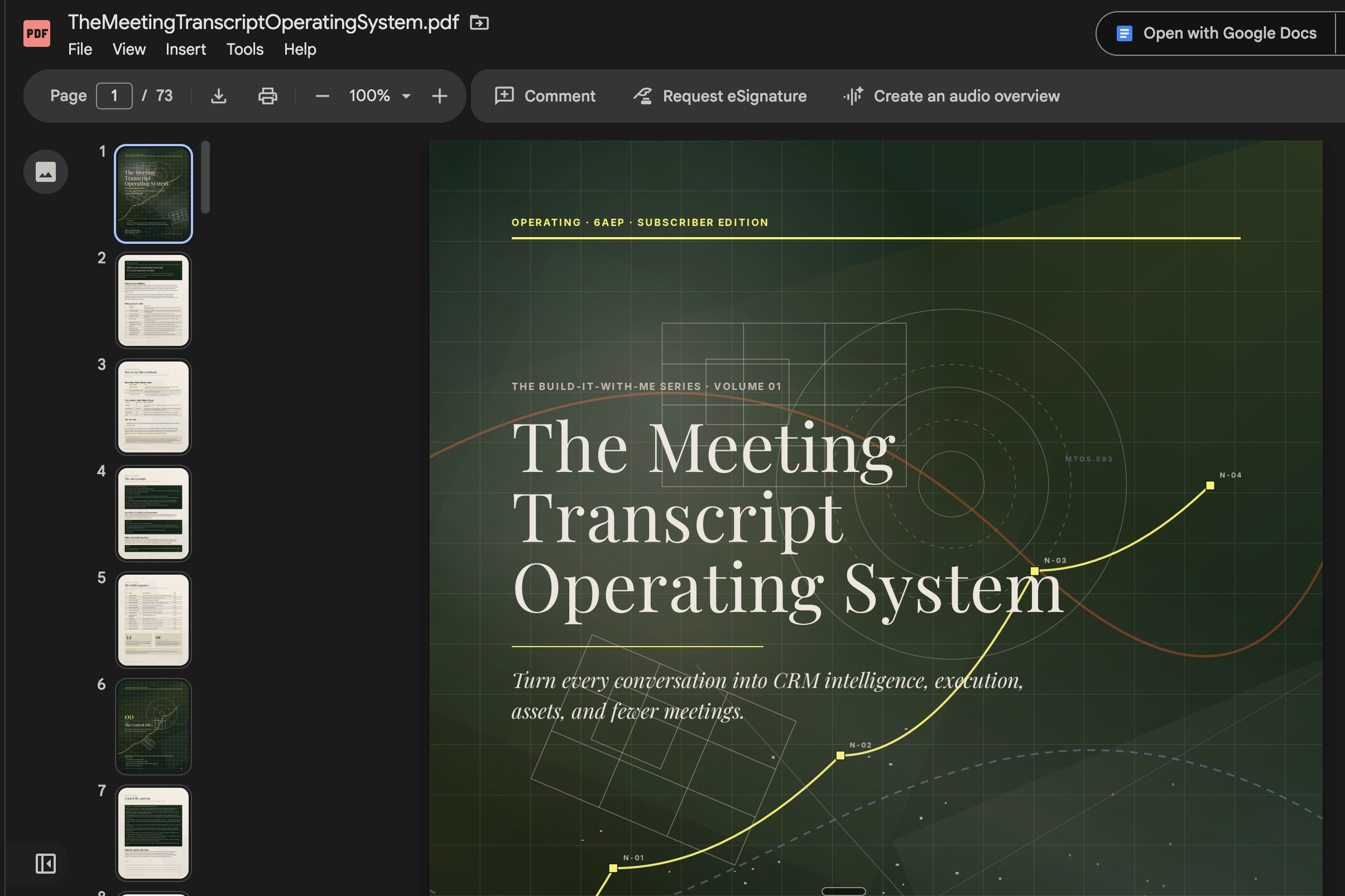
The Meeting Transcript Operating System: Paid subscribers get a complete interactive workbook designed to be uploaded directly into Claude or ChatGPT. Bring one real meeting transcript, and the workbook walks you through building a repeatable system for extracting decisions and commitments, routing intelligence into your CRM and other tools, creating high-value assets automatically, identifying meetings that can be eliminated, and turning the finished workflow into reusable AI instructions, skills, scheduled tasks, and agents. You leave with a working Transcript-to-System Map, CRM Extraction Schema, Asset Factory, Meeting Elimination Report, Transcript Agent Instruction Set, Transcript Value Scorecard, and a 30-day implementation plan. This is not simply another set of prompts.