

As Harvard Professor Karim Lakhani puts it: “AI won’t replace humans, but humans with AI will replace humans without AI.”
Why This Workbook
I’ve spent two years preparing for this shift:
✅ I’ve redistributed my workflow across AI-native platforms Perplexity, Claude, Gemini, and ChatGPT.
✅ I’ve trained custom models on ChatGPT, Gemini, and Claude, and learned to prompt effectively for each model’s context window and task requirements
✅ I’ve built data lakes, learned modern data cleansing with Apache Spark, and deployed Kubernetes containers to orchestrate enterprise agents
✅ I’ve learned what the future of enterprise operations looks like, and it’s bright.✅ I spent my twenties at Harvard and the University of Chicago studying economics, learning how to perform top notch research.
Most professionals feel the same quiet tension right now:
“I know AI is changing everything. I’m dabbling with tools. I’ve watched the videos. But I don’t have a real system for staying relevant.”
Executives recognize AI as transformational, 97% of them, according to recent McKinsey surveys. Yet only 13% of organizations report creating measurable business value from AI deployment.
That 84‑point gap is the story of this moment.
It’s not a technology gap. Most people now have access to the same models and tools.
It’s a capability gap.
The difference between those who thrive in the AI era and those who quietly fall behind is not “who has the best prompt” or “who works at the coolest company.” It’s who is systematically building the right stack of skills—over months and years, not days and weeks.
This playbook is your operating manual for that.
This workbook is designed to function as a complete upskilling guide in a narrative form:
It gives you the research foundation behind AI-era success.
It introduces my Three Pillars Framework that underpins every tool and template.
It walks you through self-assessment, prioritization, and roadmap design.
It defines the habits and operating system required to make the change tangible.
Throughout you’ll find linked resources (assessments, worksheets, and templates) that turn ideas into concrete action. As those tools expand and evolve, this article remains the canonical source: the master guide to your AI-era upskilling development.

This playbook operates on two levels: it is both a practical toolkit you can deploy immediately and a comprehensive research framework for why these skills matter.
Choose your path below.
Path A: The 15-Minute Quick Start
If you want to skip the theory and start building capabilities right now, use this sequence.
Establish Your Baseline:
[Link: Complete the Three Pillars Self-Assessment]
Action: Score yourself across AI Fluency, Human Capabilities, and Strategic Acumen. Identify your lowest pillar.Build Your Plan:
[Link: Create Your 90-Day Upskilling Roadmap]
Action: Choose one primary focus pillar and define your weekly milestones for the next quarter.Install the Operating System:
[Link: Download the Weekly Upskilling OS Template]
Action: Use this one-page template to run your weekly “Learn → Design → Apply” block.Select Your Toolkit:
Grab the specific resource for the pillar you’re focusing on:For AI Fluency: [Link: AI Fluency Prompt Pattern Library]
For Human Capabilities: [Link: EPOCH Practice Guide]
For Strategic Acumen: [Link: Strategic Framework Pack]
Path B: The Deep Dive (Recommended)
If you want to understand all the research that underpins these tools, and learn why this specific combination of skills predicts resilience, keep reading.
The following analysis breaks down the “Three Pillars” framework, explains why most professionals upskill the wrong way, and details how to build an operating system that actually sticks.
Operating by John Brewton goes deep on what it takes to build, scale, and optimize modern companies. This breakdown analysis is just the starting point. Check out last week’s analysis of Amazon’s current operating strategy to see more.

Open LinkedIn and you’ll see the same pattern:
“10 prompts you must know…”
“Top 50 AI tools for knowledge workers…”
“Learn [tool] in 30 minutes…”
These aren’t useless. But they share a hidden assumption:
If I just learn more tools, I’ll be future-proof.
That assumption is wrong.
Across research from Harvard Business School, MIT Sloan, Wharton, Stanford’s Digital Economy Lab, and top consulting firms, a different picture emerges:
Organizations that pair AI investments with comprehensive capability building see profitability gains exceeding 40% and free up 50%+ of labor capacity for higher-value work.
The critical differentiator is not “who has the model,” but who has the integrated skill set to use it in context: technical fluency, human strengths, and strategic acumen working together.
When AI is everywhere, three things become true:
Tools Commoditize. The half-life of a specific model or interface is measured in months.
Capabilities Compound. The half-life of a capability—strategic thinking, judgment, presence—is measured in decades.
Integration Wins. Isolated skill spikes matter less than the combination of skills applied to real problems.
Most people are over-rotated into a single dimension:
The “tool chaser” with dozens of apps and no strategy.
The “people person” who leads well but can’t speak the language of AI.
The “big-picture strategist” who can’t translate ideas into model-powered workflows.
The AI era doesn’t reward any of those in isolation.
It rewards those who intentionally develop three interlocking domains.

Across studies from Harvard, MIT, Wharton, Stanford, Berkeley, McKinsey, BCG, and Deloitte, three recurring capability domains predict who actually creates value with AI and who doesn’t.
This playbook calls them the Three Pillars:
AI Fluency and Technical Competencies
Human‑Centric Capabilities (EPOCH)
Strategic and Business Acumen
Think of them as the three legs of a stool.
Remove any leg, and the whole thing tips over.
Pillar 1: AI Fluency and Technical Competencies
This is your baseline literacy.
Do you understand, at a conceptual level, what these systems can and cannot do?
Can you use AI tools to improve your daily work, reliably and safely?
Can you identify and implement basic automations?
Can you interpret data‑driven outputs with appropriate skepticism?
Research from MIT and Deloitte on digital competency frameworks highlights two critical truths:
Role-specific technical skills matter.
But outcomes hinge just as much on behavioral capabilities: knowing when to use a tool, how to structure a problem, and when to override the model with human judgment.
AI fluency is not about memorizing interfaces; it's about understanding the underlying concepts. It’s about developing:
Conceptual understanding (how these systems behave)
Prompting and interaction skill (how to direct them)
Workflow integration (how to embed them into real processes)
Risk awareness (biases, hallucinations, privacy, governance)
This pillar is the easiest to “see” and the easiest to fake. Watching someone run a prompt looks like skill. But without the other pillars, it’s mostly theater.
Pillar 2: Human‑Centric Capabilities (EPOCH)
As AI takes on more routine analysis and synthesis, distinctly human strengths become more, not less, valuable.
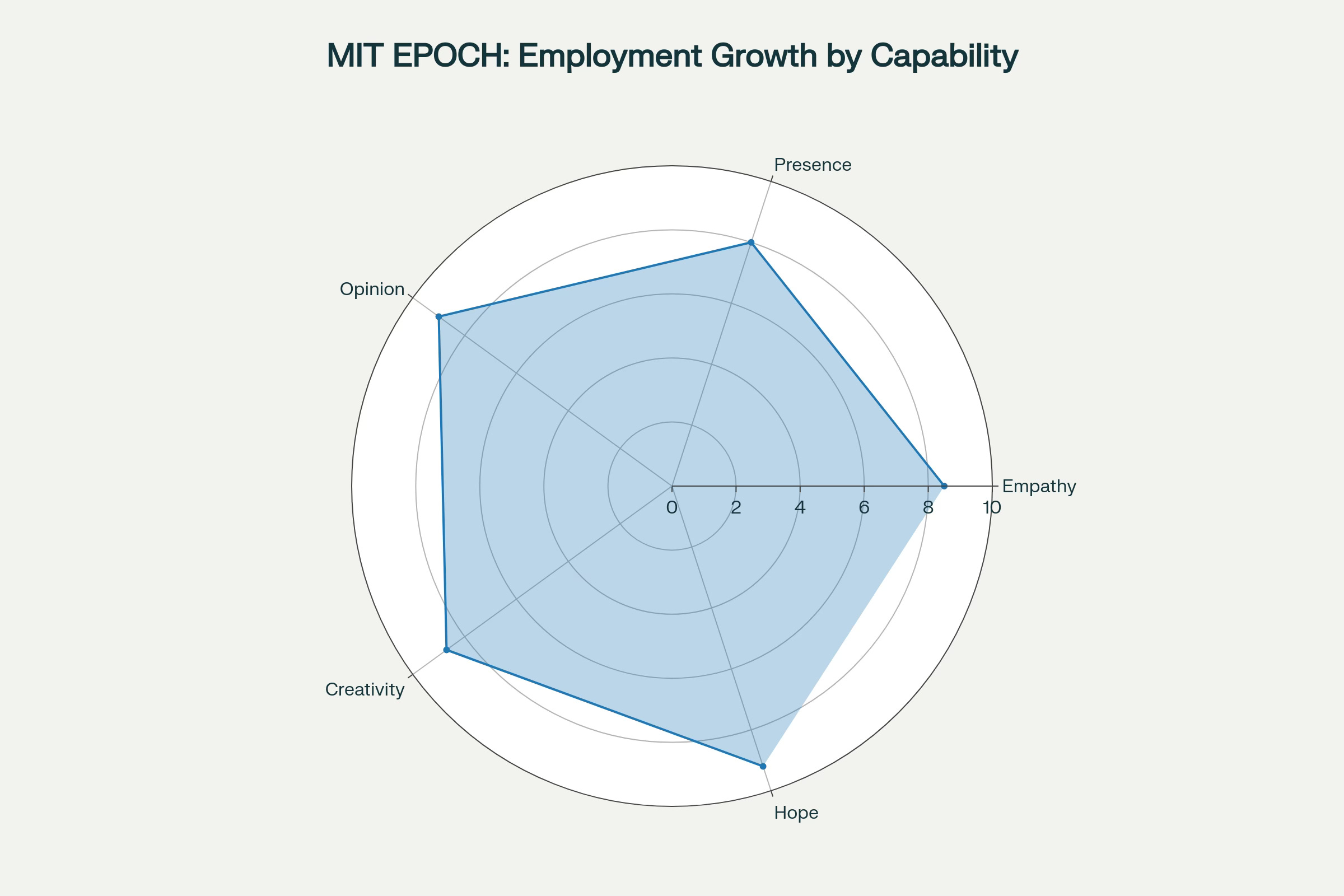
MIT’s work on human‑AI complementarity points to a cluster of capabilities that machines cannot replicate but heavily amplify: empathy, contextual judgment, creativity, the ability to hold and communicate a compelling vision.
In this playbook, we utliize MIT’s EPOCH model:
E – Empathy & Emotional Intelligence
Reading the room. Understanding unspoken concerns. Regulating your own emotional state.
P – Presence & Networking
How you “show up.” Your ability to build trust, influence, and durable relationships.
O – Opinion & Judgment
Having a point of view rooted in evidence. Making decisions under uncertainty.
C – Creativity & Innovation
Generating novel ideas, reframing problems, exploring non-obvious options.
H – Hope & Vision
Articulating better futures and convincing others they’re attainable.
When people talk about soft skill becoming the new hard skills, these are the capabilities about which they are speaking.
Harvard’s competency research makes a different point: these are harder to build than technical skills.
They require experience, not just information.
They depend on reflection and feedback loops, not just content.
They unfold over dozens of interactions across months and years.
Wharton’s 360° leadership assessments find that these human-centric capabilities strongly correlate with:
Team performance
Decision quality
Cross-functional collaboration
Resilience under stress
In an AI‑saturated world, EPOCH is not “nice to have.” It’s the core of what remains scarce.
Check out these reader favorites:
Pillar 3: Strategic and Business Acumen
AI has lowered the cost of “doing things.”
It has not lowered the cost of doing the right things.
Strategic and business acumen is what separates:
The person who can generate 50 ideas with AI from the person who can identify the one idea that actually moves the P&L.
This pillar includes:
Strategic thinking: Seeing patterns, trade-offs, second-order effects.
Systems thinking: Understanding how changes in one part of the system ripple through others.
Financial literacy: Being able to read basic financials, understand unit economics, and talk credibly about ROI.
Domain expertise: Knowing the real constraints, norms, and leverage points in your industry.
Entrepreneurial capability: Experimenting, iterating, and owning outcomes.
Change management: Moving organizations from A to B without burning them down.
BCG’s capability-building research emphasizes that strategic competencies must abide by the following:
Behaviorally defined: observable actions, not vague aspirations.
Outcome-linked: tied to actual performance metrics and value creation.
Knowing a strategy framework for its own sake is not enough. What matters is being able to use it to:
Identify competitive advantages
Anticipate market shifts
Connect daily work to organizational value creation
An Interdependent System:
AI fluency without strategic acumen yields busywork—clever automations with no real business impact.
Strategic thinking without AI fluency yields unrealized potential—good ideas no one knows how to operationalize.
Human capabilities without either yield good intentions with limited leverage—people like you, but you’re not moving the numbers.
The relative emphasis shifts by career stage:
Individual Contributors
Roughly: ~40% AI fluency, 35% human capabilities, 25% strategic acumen.
You need enough strategy to understand context, but your edge is execution.
Managers & Directors
Roughly: ~25–30% AI fluency, 35% human capabilities, 35–40% strategic acumen.
You are now orchestrating others and translating strategy into team-level execution.
Executives & Founders
Roughly: ~10% AI fluency, 25% human capabilities, 65% strategic acumen.
Your primary value is in making and communicating decisions with wide blast radius.
Those percentages are directional, not prescriptive. The point is this:
You cannot outsource an entire pillar without outsourcing your relevance.
Before designing an upskilling plan, you need an accurate picture of your current situation.
This playbook uses a Three Pillars Self‑Assessment built on behaviorally anchored rating scales (BARS), a methodology developed by organizational psychologists and validated across environments like Harvard Business School, Wharton, and leading consulting firms.
Most people are familiar with rating scales like:
1 = Poor
3 = Average
5 = Excellent
The problem is that these labels are vague. “Excellent” means one thing to you, another to your manager, another to an external assessor.
Behaviorally anchored scales fix this by tying each numeric rating to specific, observable behaviors.
For example, instead of:
“3 – Good at using AI tools.”
BARS would specify:
1 – Rarely uses AI tools; avoids them or experiments only when forced.
3 – Uses AI tools for discrete tasks (summaries, drafts), occasionally integrates them into workflows; sometimes double-checks outputs.
5 – Regularly designs and iterates AI‑enhanced workflows; evaluates tools critically; mentors others on effective use and risk management.
In the full assessment, you’ll rate yourself across all three pillars using anchored behaviors like this. That gives you two advantages:
Less self‑deception. You’re not judging a vibe; you’re judging patterns of behavior.
Clearer development targets. Each “next level” is defined by specific behaviors you can practice.
You’ll also see your profile fall into a recognizable pattern.
Common Profiles You’ll See
The Technical Specialist
High AI Fluency; Low Strategic Acumen
You can build automations and workflows, but struggle to articulate their business impact or prioritize which to build.
The Empathetic Leader
High Human Capabilities; Low AI Fluency
People trust you. You navigate politics well. But you feel increasingly disconnected from the tools transforming your team’s work.
The Strategic Thinker
High Strategic Acumen; Low AI Fluency
You see the big picture, but have to rely on others to execute AI‑enabled solutions. You feel your “hands-on” relevance eroding.
The Balanced Practitioner
Moderate scores across all three
You’re solid. But you haven’t differentiated yourself. You are one reorg away from being “nice to have” instead of “must have.”
The AI‑Era Operator (Aspirational)
Strong, rising capability across all three
You can design, execute, and communicate AI‑enabled initiatives that move real numbers—and bring people with you.

Once you have your baseline, the core question becomes:
“Given where I am and where I want to go, what should I work on first—and how?”
This playbook suggests a simple, research‑aligned sequence:
Choose One Primary Pillar for the Next 90 Days.
You can maintain others, but focus creates compounding.
Here is the Operating by John Brewton 90 Day Upskilling Roadmap resource I built for this project (make a copy or download for your own use)
Select 2–3 Specific Capabilities Within That Pillar.
For example:AI Fluency → “Prompt Design,” “Workflow Automation,” “Data Interpretation”
Human Capabilities → “Empathy in 1:1s,” “Executive Presence in Meetings”
Strategic Acumen → “Financial Literacy,” “Systems Thinking for My Function”
Define Concrete Behaviors You Want to See.
Using behavioral anchors, write down:What you currently do.
What someone one level up would do regularly.
Translate Those Into Weekly Practice.
What will you do this week that forces you to operate at the next level?
Below is how this might look in practice for each pillar.
Pillar 1 in Practice: AI Fluency and Technical Competencies
Goal Example: “Within 90 days, I want to be the person my team comes to for practical AI workflows in our function.”
You might target:
Prompt Patterns
Learn 8–10 generalizable prompt structures (e.g., persona prompts, chain-of-thought prompts, critique-and-revise, scenario simulation).
Each week, deliberately use and refine one pattern across real tasks: writing, analysis, planning.
Workflow Automation
Identify 3 recurring workflows (e.g., monthly reporting, customer follow-ups, research synthesis).
For each, design a simple AI‑assisted flow:
Inputs → AI steps → Human review → Outputs.
Measure time saved and error reduction.
Critical Interpretation
For every AI output on important work, ask:
“What assumptions is this making?”
“Where could this be wrong or biased?”
“What data or domain knowledge do I have that the model doesn’t?”
Develop the habit of structured skepticism—not cynicism.
Over time, the behaviorally anchored shift looks like:
From: “I occasionally paste tasks into a chatbot.”
To: “I systematically design, evaluate, and improve AI‑assisted workflows that my team adopts.”
Pillar 2 in Practice: EPOCH Human Capabilities
Goal Example: “Within 90 days, I want to significantly improve how I show up in high‑stakes meetings and 1:1s.”
You might target:
Empathy & Emotional Intelligence
Before each key conversation, write:
“What is this person likely feeling?”
“What do they fear?”
“What would ‘success’ feel like for them in this interaction?”
After the conversation, reflect: “What did I miss? What cues did I ignore?”
Presence & Networking
Choose 1–2 recurring meetings where you typically stay quiet.
Decide in advance what value you will add:
A clarifying question
A crisp synthesis
A relevant example
Focus not on airtime, but on signal‑to‑noise ratio.
Opinion & Judgment
For important decisions, write down:
Your recommended course of action.
2–3 key reasons.
Your confidence level (0–100%).
Revisit after outcomes and calibrate: were you over‑ or under‑confident?
Creativity & Innovation
Weekly “idea sprints” using AI as a collaborator:
Generate 20 options.
Select 2 that are non‑obvious but plausible.
Run small experiments, not big bets.
Hope & Vision
Practice articulating “where this could go” for your projects:
Near-term: 3–6 months.
Medium: 12–24 months.
Share that vision with your team in plain language, not jargon.
Over time, the behaviorally anchored shift looks like:
From: “I’m reactive in interactions; I respond but rarely shape.”
To: “I create psychological safety, ask better questions, and consistently help people see a compelling path forward.”
Pillar 3 in Practice: Strategic and Business Acumen
Goal Example: “Within 90 days, I want to be able to explain how my work connects to our business model and key numbers.”
You might target:
Business Model Literacy
Sketch your organization’s business model:
Who are the customers?
What value is provided?
How does money actually flow?
Then sketch your team’s role in that model.
Financial Basics
Learn to read:
A simple income statement
Basic unit economics for your product/service
Ask: “What metrics do my leaders stare at every week?”
Systems Thinking
Take one recurring issue in your work (e.g., delays, rework, churn).
Map the system around it:
Inputs, processes, outputs
Feedback loops, bottlenecks, incentives
Use AI to help you generate possible causal diagrams—then refine them with your domain knowledge.
Strategic Framing
For each initiative, answer:
“What problem are we really solving?”
“What would success look like on a dashboard?”
“What are we trading off by doing this instead of something else?”
Change Navigation
During any change (new tool, reorg, strategy shift), ask:
“Who benefits? Who loses?”
“What invisible friction will this introduce?”
“How can I reduce that friction for others?”
Over time, the behaviorally anchored shift looks like:
From: “I do my tasks well.”
To: “I consistently choose and shape work that moves real business outcomes.”

A plan is useless without an operating system to run it.
You don’t need more willpower. You need better defaults.
Here is a simple, durable structure you can adopt.
1. The Weekly Block
Reserve a recurring 60–90 minute block each week dedicated purely to capability building. Here is your weekly upskilling review document.
Same time, same day whenever possible.
Protected like a client meeting.
Agenda pre-defined by your upskilling plan, not your inbox.
Within that block, cycle through:
Learn (20–30 min): Read/watch one high‑quality resource or review a concept.
Design (20–30 min): Translate it into a specific behavior, prompt, framework, or conversation you will try.
Apply (20–30 min): Use it immediately on a real task, decision, or interaction.
2. Daily Micro‑Practices
Complement the weekly deep work with 5–15 minute daily practices:
One AI workflow you consciously run and refine.
One EPOCH behavior you intentionally practice in a live interaction.
One strategic question you ask about the work on your plate.
Consistency beats intensity. Thirty minutes a day for 90 days will transform your skill stack more than a single weekend binge.
3. Reflection & Feedback Loops
Once a week, spend 10–15 minutes answering:
“What did I try?”
“What happened?”
“What surprised me?”
“What will I do differently next week?”
Where possible, add external feedback:
Ask a manager, peer, or direct report:
“What is one thing I did this week that helped you?”
“What is one thing I could do differently to be more effective?”
Research on habit formation is clear:
Self-reflection plus external input creates far more accurate self-awareness than either alone.
This article is designed to be a conceptual workbook in prose—a guide you can read, re-read, and work through with a notebook.
Alongside it, you’ll see a growing set of linked tools and assets, including:
The Three Pillars Self‑Assessment (Behaviorally Anchored)
A structured way to score yourself across AI Fluency, EPOCH, and Strategic Acumen, with clear descriptions for each level.Prompt Pattern Library
Generalizable patterns you can plug into your current tools and adapt to your role.EPOCH Practice Guides
Short, practical exercises for building empathy, presence, judgment, creativity, and vision in the flow of your work.Strategic Framework Templates
Simple canvases for mapping your business model, understanding systems, and connecting work to value.90‑Day Upskilling Roadmap Template
A planning tool that translates your assessment into concrete weekly practices and milestones.
This article will remain the anchor. As these assets evolve, you’ll always be able to return here for:
The why (research and philosophy)
The what (the Three Pillars and core concepts)
The how (principles for building your own operating system)
Think of this as your operating manual for staying relevant in an environment where everything else is updating on a daily basis.

If you’ve read this far, you are already in the top decile of professionals in terms of intent.
Now convert that intent into motion.
Step 1: Define Your Stakes
Write down answers to three questions:
“What part of my current role is most at risk of commoditization by AI?”
“What part of my current capability stack is most defensible and leverageable?”
“Where do I want to be, professionally, three years from now?”
Keep this somewhere visible. It will inform every upskilling choice you make.
Step 2: Establish Your Baseline
Complete the Three Pillars Self‑Assessment (linked from this article once available). Don’t overthink the scores; your first pass is usually directionally correct.
Identify:
Your lowest pillar.
Your three lowest‑scoring capabilities overall.
Those are your highest‑leverage development opportunities.
Step 3: Choose One Pillar for the Next 90 Days
You will not transform everything at once.
Pick:
The pillar that is most constraining your progress right now, or
The pillar that will most differentiate you in your desired future role.
Commit to focusing your deliberate effort there first.
Step 4: Design One Weekly Block and One Daily Micro‑Practice
Before the end of today:
Block a recurring weekly 60–90 minute session on your calendar labeled “AI‑Era Upskilling.”
Choose one daily micro‑practice (a prompt pattern, a conversational behavior, a strategic question) that you will repeat for the next two weeks.
Step 5: Build a Minimal Accountability System
Forward this article to one person you trust—a colleague, friend, mentor—and say:
“I’m using this as the foundation for a serious upskilling effort. I’m focusing on [Pillar] for the next 90 days. Can we do a 10–15 minute check‑in every other week to help each other stay honest?”
You are far more likely to follow through when someone else is watching.

AI will not “settle down.” The tools will keep changing. The models will keep improving. New abstractions will keep emerging.
What does settle down—if you design for it—is your personal operating system:
A clear mental model for what skills matter.
A way to measure where you stand.
A roadmap for what to work on next.
Habits that convert knowledge into capability.
A community of people committed to doing the same.
That is what this upskilling playbook is for.
The tools will come and go. The specifics of prompt syntax will change. Entire product categories will appear and disappear.
But if you deliberately build:
AI fluency that lets you understand and shape what the tools can do,
Human capabilities that let you lead, influence, and collaborate,
Strategic acumen that lets you choose work that actually matters,
You will be resilient in whatever version of the future shows up.
This workbook is your foundation. The linked assessments, templates, and guides are the scaffolding you’ll use to build on it.
The rest is reps.
Let’s get to work.
- john -
Let’s Start Building:
Establish Your Baseline:
[Link: Complete the Three Pillars Self-Assessment]
Action: Score yourself across AI Fluency, Human Capabilities, and Strategic Acumen. Identify your lowest pillar.Build Your Plan:
[Link: Create Your 90-Day Upskilling Roadmap]
Action: Choose one primary focus pillar and define your weekly milestones for the next quarter.Install the Operating System:
[Link: Download the Weekly Upskilling OS Template]
Action: Use this one-page template to run your weekly “Learn → Design → Apply” block.Select Your Toolkit:
Grab the specific resource for the pillar you’re focusing on:For AI Fluency: [Link: AI Fluency Prompt Pattern Library]
For Human Capabilities: [Link: EPOCH Practice Guide]
For Strategic Acumen: [Link: Strategic Framework Pack]
Operating by John Brewton goes deep on what it takes to build, scale, and optimize modern companies. This breakdown analysis is just the starting point. Check out last week’s analysis of Amazon’s current operating strategy to see more.

John Brewton documents the history and future of operating companies at Operating by John Brewton. He is a graduate of Harvard University and began his career as a Phd. student in economics at the University of Chicago. After selling his family’s B2B industrial distribution company in 2021, he has been helping business owners, founders and investors optimize their operations ever since. He is the founder of 6A East Partners, a research and advisory firm asking the question: What is the future of companies? He still cringes at his early LinkedIn posts and loves making content each and everyday, despite the protestations of his beloved wife, Fabiola, at times.
Research & Resource Index
AI-Era Skills, Upskilling, and Workforce Development
Harvard Business School & Harvard-Affiliated Resources
Developing a Digital Mindset – Harvard Business School
A foundational paper on the mindsets and capabilities needed to thrive in digital and AI‑enabled organizations.Upskilling for Tomorrow’s Workforce – Harvard FAS Career Services
Practical guidance on building future-oriented skills for a global digital economy.2024 Leadership Development Report: Time to Transform – Harvard Business Publishing
Global research on leadership capability gaps and the shift toward continuous, capability-based development.Using “Digital Academies” to Close the Skills Gap – Harvard Business Review
Case-based look at how organizations build structured internal academies to accelerate digital and AI skills.
MIT Sloan & MIT-Related Resources
Humans and AI: Do They Work Better Together or Alone? – MIT Sloan
Research on human–AI collaboration and the complementary skills that drive performance.Leadership and AI Insights for 2025 – MIT Sloan Management Review
Synthesis of the latest findings on AI, leadership, and workforce transformation.New MIT Sloan Research: AI Is More Likely to Complement, Not Replace, Human Workers
Evidence that AI augments human strengths when organizations intentionally design roles and workflows.MIT Sloan Workforce Intelligence: AI Skills & Learning
Frameworks for skill taxonomies and capability building in AI-enabled workplaces.
Wharton & Leadership Assessment Resources
Wharton McNulty Leadership Program – People Lab
Home of Wharton’s 360° leadership assessments and behaviorally anchored leadership competency research.Leveraging Personality and 360 Assessments for Excellence – Peter Berry Consultancy
Overview of how to use BARS and 360° tools to build leadership self-awareness and targeted development.
BCG, Deloitte & Strategy/Capability Building
Your Capabilities Need a Strategy – Boston Consulting Group
How to align capability-building with business strategy and define observable, outcome-linked competencies.How Skills-Based Organizations Can Succeed – BCG
A roadmap for moving from role-based to skill-based talent systems in the age of AI.BCG U: Capability-Building and Enablement
Examples of structured programs that turn strategy into skills at scale.The Future of Workforce Learning – MIT Sloan / Deloitte
Research on the balance between technical skills, behavioral capabilities, and business acumen in AI adoption.
McKinsey, World Economic Forum & Macro Workforce Trends
The State of AI – McKinsey
Key statistics on AI adoption, value realization (including the ~13% value capture figure), and organizational gaps.2024 State of AI Security Report – Orca Security
Insight into the emerging threat landscape around AI systems and associated controls.Future of Jobs Report 2025 – World Economic Forum
Macro view of job displacement, emerging roles, and critical skills through 2030.
Human-Centric Capabilities (EPOCH) & Leadership
The EPOCH of AI: Human–Machine Complementarities at Work – SSRN
Academic paper introducing the EPOCH framework and measuring complementary human skills in AI-rich environments.EPOCH Framework: Unlocking Human Strengths in AI Workplaces – CXQuest
Practitioner-oriented explanation of EPOCH and how to operationalize these human strengths at work.Why Human Skills Matter in the Workplace: EPOCH Framework (LinkedIn)
Short-form summary and interpretation of the EPOCH model for modern workplaces.
Strategic Thinking, Business Acumen & Personal Strategy
Strategy for You Workbook – Strategic Thinking Institute
Practical worksheets for applying strategic thinking frameworks to individual careers and decisions.Strategic Planning Process Template Workbook – SME Strategy
A structured process for building business-level strategic plans and connecting them to execution.A4 Strategic Planning Template – LifeLabs Learning
Simple one-page strategy design template useful for projects, teams, or personal initiatives.
AI Governance, Risk Management & Security
Governance & Responsible AI
AI Risk Management Framework – NIST
Official guidance from U.S. government on managing AI risks across the lifecycle.AI Governance Framework: Key Principles & Best Practices – MineOS
Practical overview of AI governance operating models, roles, and policies for enterprises.What Is AI Governance? – Palo Alto Networks
High-level guide to governance concepts, including roles, controls, and policy patterns.Building a Responsible AI Framework: 5 Key Principles – Harvard Professional
Principles and implementation guidance for responsible, human-centered AI in organizations.Seven Guidelines for Implementing Responsible AI – EY
A concise, board-level playbook for rolling out responsible AI programs.Why an Enterprise AI Governance Strategy Should Top Your To-Do List – Publicis Sapient
Perspective on building AI governance as a strategic capability, not just compliance.
Security, Privacy & Technical Risk
Essential AI Security Best Practices – Wiz
Concrete security controls for AI applications, from data protection to access management.AI Security Risk and Best Practices – ISACA
Overview of key AI-specific risks (model, data, supply chain) and governance responses.AI Application Security: Testing and Best Practices – Cycode
How to bring application security disciplines to AI applications and pipelines.OWASP Top 10 for LLMs: Prompt Injection & GenAI Risks
Security community consensus on major LLM vulnerabilities, including prompt injection.Prompt Injection & the Rise of Prompt Attacks – Lakera
Deep-dive on prompt injection, jailbreaks, and how to defend production systems.Joint Cybersecurity Information: AI Data Security – U.S. DoD / CISA
Government guidance on securing AI data pipelines and protecting sensitive information.AI Data Privacy: Challenges and Solutions – Fortra
How to approach data classification, anonymization, and privacy controls in AI projects.Data Privacy in AI: A Guide for Modern Industries – TrustArc
Practical roadmap for aligning AI initiatives with global privacy regulations.How State Privacy Laws Regulate AI: 6 Steps to Compliance – PwC
Implications of evolving state privacy laws for AI usage, and steps to prepare.
General Career Resilience & Future of Work
AI-First Leadership: Embracing the Future of Work – Harvard Business
Leadership capabilities and organizational practices needed to thrive in AI-first environments.Career Resilience in 2025: Building a Future-Proof Professional Path – Percolator
Perspective on designing a resilient career strategy amid AI and structural change.

That's so cool! Congratulations on putting it out.
Very useful. Thanks for sharing!
It might be useful to add the link to this article in the Google Doc as well since it seems like the doc only mentions it without the actual link