


The argument I keep making in Operating is that the companies that survive and become greater than their current location this decade will not be the firms that adopted AI. They will be the organizations that rebuild their operating philosophies and structure from AI-native principles. They will redesign every role, every process, every means of production through this new lens, with these new tools.
My good friend Alex Pawlowski has written a warning to leaders and executives that personifies this expectation, and I am thrilled to be publishing it in two parts, this week and next.
Alex is a friend and one of the sharpest people I know on agentic systems, orchestration, and the architecture of AI-native work. He spends his time building and investing in the next internet. We have spent much of the past year working on similar problems from varying viewpoints. I come at it through strategy, organizational capability, and judgment. He studies and speaks to the machinery that makes the transformation possible.
His claim in this article is as follows: Organizations have never managed knowledge. They manage distributed uncertainty. The internal engineer sees, develops and manages the architecture. The marketer speaks to the customer. Legal worries about exposure. Finance manages risk. Intelligence gets assembled out of incomplete views colliding before a decision hardens. In that system, “I don’t know” is a routing signal to send the query to another department.
Generative AI collapses the interval between question and answer to seconds, eliminating cross-functional departmental debates and meetings. The explanation that arrives is fluent, internally consistent, and often correct.
Encoding your operation is still the right move. Encode the answers without encoding the questions, and you have built a company that reaches conclusions faster than it ever could.
I’m sincerely excited about these two pieces and am privileged to be publishing them via Operating by John Brewton.
Hope this helps, friends.
- j -
Subscribe to Alex’s Substack, The Strategy Stack, here.

I. The Disappearing Space Between Question and Answer
Every organization, regardless of its industry or ambition, exists because no individual possesses a complete understanding of the environment in which it operates. Markets shift without warning, technologies evolve faster than planning cycles, customers behave inconsistently, competitors conceal their intentions, and the internal dynamics of even the best-run companies rarely resemble the tidy diagrams found in annual reports. Organizations were never designed to eliminate uncertainty. They emerged because uncertainty exceeded the capacity of any single person to manage it alone.
Seen from that perspective, knowledge has always been something of a collective achievement. The engineer understands the architecture but not the market. The marketer recognizes customer behavior but not the underlying code. Legal counsel anticipates regulatory implications that product teams overlook, while finance evaluates risks invisible to both. What eventually appears as organizational intelligence is assembled from dozens, sometimes thousands, of incomplete perspectives that gradually converge into a decision. The organization becomes intelligent not because everyone knows the same thing, but because different people know different things.
This also explains why the phrase “I don’t know” occupies a far more important place in healthy organizations than most management literature acknowledges. Contrary to popular intuition, uncertainty is not the opposite of expertise. It is often one of its most reliable indicators. Experience rarely removes ambiguity. Instead, it sharpens the ability to recognize where established knowledge ends and where additional evidence becomes necessary. Senior physicians request further tests not because they lack competence, but because they understand how easily complex systems produce convincing yet incomplete explanations. Seasoned investors hesitate before declaring certainty because markets have repeatedly demonstrated how fragile apparently robust assumptions can become. The same pattern appears in engineering, intelligence analysis, scientific research and strategy. Expertise does not eliminate doubt; it changes the reasons for doubting.
That observation has quietly shaped the institutions through which modern societies produce reliable knowledge. Universities, peer review, investment committees, architecture reviews, clinical conferences and scientific replication all emerged from the same underlying recognition: individual judgment improves when it encounters competing perspectives before hardening into conviction. None of these institutions were created because people lacked intelligence. They were created because intelligence, left entirely on its own, has a remarkable talent for mistaking coherence for accuracy.
For a surprisingly long time, the practical mechanics of acquiring knowledge reinforced that discipline almost automatically. A difficult question rarely produced an immediate answer. It initiated a process. People searched libraries, consulted colleagues, revisited old notes, designed experiments, waited for data, challenged assumptions and occasionally abandoned conclusions that had seemed persuasive only days earlier. The interval between curiosity and explanation was often frustrating, yet it performed valuable intellectual work. It slowed judgment just enough for alternative interpretations to remain alive, making it less likely that the first plausible explanation would become the final one.
Generative AI compresses that interval with astonishing effectiveness. Questions that previously initiated investigation now frequently produce polished explanations within seconds. The technological achievement is extraordinary, but its organizational consequences deserve equal attention. Every coherent response shortens the period during which uncertainty remains visible. The question no longer lingers long enough to invite additional perspectives before an explanation arrives, and because that explanation is fluent, internally consistent and delivered with confidence, it often satisfies the immediate psychological need that originally motivated the question. Whether it fully deserves that confidence becomes a separate matter, one that many users never reach because the cognitive tension has already dissolved.
An intriguing study published recently offers an early glimpse of what this shift may mean. Researchers observed that participants who relied on generative AI became less willing to acknowledge when they did not know something. Confidence increased even when underlying understanding did not improve accordingly. Read in isolation, the finding resembles another entry in the growing literature on overconfidence and hallucinations. Read more carefully, however, it points toward a different possibility. The study is less about the reliability of AI than about the changing role of uncertainty in human reasoning. It suggests that one of the oldest transitions in the production of knowledge—the movement from not knowing toward understanding—may itself be acquiring a fundamentally different shape.
That possibility reaches far beyond individual cognition. Organizations learn because uncertainty travels. Questions move between departments, assumptions encounter disagreement, partial explanations are revised through conversation, and decisions gradually improve as competing interpretations collide with one another. Remove uncertainty too early from that process and something subtle begins to change. Conversations become shorter. Alternative hypotheses receive less attention. Confidence appears earlier than evidence. The organization continues to generate answers, but it may become progressively less effective at recognizing which questions still deserve to remain open.
The challenge, therefore, is not to decide whether artificial intelligence produces better explanations than humans. In many domains it already does. The more consequential question concerns the role that uncertainty has quietly played inside organizations all along. If explanation becomes abundant, inexpensive and permanently available, what happens to the intellectual habits that were originally built around its scarcity? Before exploring how AI may transform work, management or strategy, it is worth examining something more fundamental: the organizational function that uncertainty has performed for far longer than most of us have ever noticed.
II. Organizations Do Not Manage Knowledge. They Manage Distributed Uncertainty.
Traditional management literature often describes organizations as repositories of knowledge. The language is understandable. We speak about knowledge workers, knowledge management, knowledge transfer and organizational learning as though the defining characteristic of an enterprise were the amount of information it possesses. Yet this perspective places the emphasis on the outcome rather than on the process that produces it.
The more closely one observes how organizations actually function, the less convincing this description becomes. Companies rarely fail because the relevant information exists nowhere inside the business. More often, the necessary pieces are already present, scattered across departments, embedded in individual experience or hidden within operational routines that have never been connected into a coherent picture. Product teams understand technical constraints that commercial teams rarely encounter. Legal departments anticipate regulatory implications long before they become strategic concerns. Customer support notices weak signals months before they appear in market research, while finance often recognizes structural patterns that remain invisible to both. Every function operates with a legitimate yet necessarily incomplete representation of reality.
The organization exists because none of those representations is sufficient on its own.
That observation changes the way we think about expertise. Expertise is frequently imagined as the progressive elimination of uncertainty through accumulated experience. Organizational life suggests something rather different. As people become more experienced, they certainly develop deeper knowledge within their own domains, but they also become increasingly aware of the boundaries surrounding that knowledge. The experienced engineer rarely assumes that technical elegance guarantees commercial success. The experienced strategist understands that market data cannot predict technological discontinuities with confidence. The experienced executive eventually learns that every important decision contains variables no dashboard is capable of measuring directly.
The consequence is that organizations spend remarkably little time managing certainty. Their daily work consists largely of coordinating uncertainty between specialists whose perspectives overlap only partially. Meetings, design reviews, investment committees, cross-functional workshops and executive discussions all serve the same underlying purpose. They are mechanisms through which incomplete models of reality encounter one another before irreversible decisions are made. The value of these conversations lies less in exchanging facts than in exposing assumptions that remained invisible within individual disciplines.
This also explains why disagreement often becomes a productive rather than destructive force inside high-performing organizations. Two departments rarely disagree because one possesses knowledge and the other lacks it. They disagree because each observes reality through a different set of constraints. Engineering optimizes feasibility. Sales optimizes customer opportunity. Finance optimizes capital allocation. Legal optimizes compliance. Strategy attempts to reconcile those competing perspectives into a coherent direction. What appears as conflict on the surface frequently represents something far more valuable beneath it: the organization discovering where its own understanding remains incomplete.
Much of organizational learning therefore occurs before anyone learns anything new. It begins when existing explanations encounter friction. A marketing assumption collides with operational data. A customer interview contradicts internal expectations. A prototype behaves differently than predicted. A financial model no longer reflects observed market behavior. Progress starts at precisely the moment when confidence becomes difficult to maintain. The objective is not to eliminate disagreement as quickly as possible but to understand what reality is attempting to reveal through it.
Viewed from this perspective, uncertainty begins to resemble an organizational resource rather than an organizational defect. It identifies where current models no longer describe the environment with sufficient accuracy. It highlights where additional observation, experimentation or conversation is likely to generate the greatest returns. Organizations capable of recognizing those moments early often appear unusually adaptive, not because they possess superior forecasting abilities, but because they remain willing to revise their understanding before circumstances force them to do so.
Generative AI enters this landscape in a fascinating and somewhat paradoxical way. On the one hand, it increases access to information on a scale that would have seemed extraordinary only a few years ago. Individuals can summarize research, compare legal frameworks, draft technical documentation or explore unfamiliar domains within minutes. In many respects, AI lowers the cost of acquiring explicit knowledge more dramatically than any previous technology.
At the same time, lowering the cost of explanation also changes the signals flowing through the organization. If every uncertainty immediately produces a coherent narrative, the distinction between possessing an explanation and understanding the problem becomes progressively more difficult to detect. Questions that previously travelled through multiple perspectives may now terminate after the first plausible answer. Cross-functional conversations become shorter because apparent certainty arrives earlier. Teams may still collaborate, yet they increasingly collaborate around explanations that have not undergone the same process of collective scrutiny that organizations historically relied upon to improve decision quality.
The strategic challenge therefore extends well beyond accuracy. Even if future models become dramatically more reliable than those available today, organizations will still face the question of how uncertainty should move through the enterprise before action is taken. That movement has always been the hidden architecture of organizational learning. Decisions improve because uncertainty circulates between different perspectives, gathering evidence, exposing contradictions and forcing assumptions to justify themselves against reality. If that circulation gradually slows because explanation becomes abundant, organizations may discover that they have optimized access to knowledge while quietly weakening one of the mechanisms through which knowledge becomes trustworthy in the first place.
The discussion surrounding artificial intelligence often assumes that better answers naturally produce better organizations. History offers a more nuanced picture. Enduring institutions have rarely distinguished themselves through the speed with which they arrived at conclusions. Their advantage came from designing environments in which conclusions had to survive repeated encounters with alternative perspectives before they were allowed to shape consequential decisions. What deserves protection, therefore, is not uncertainty for its own sake, but the organizational processes that transform uncertainty into judgment rather than replacing it prematurely with confidence.
III. “I Don’t Know” as Organizational Infrastructure
When people speak about organizational capabilities, they usually think of engineering excellence, operational efficiency, strong leadership or an innovative culture. Rarely does anyone mention uncertainty. Yet many of the practices that distinguish mature organizations exist for one surprisingly simple reason: they create environments where uncertainty can be expressed before decisions become irreversible.
Consider how many institutional mechanisms depend on someone being willing to acknowledge that the current explanation may not be complete.
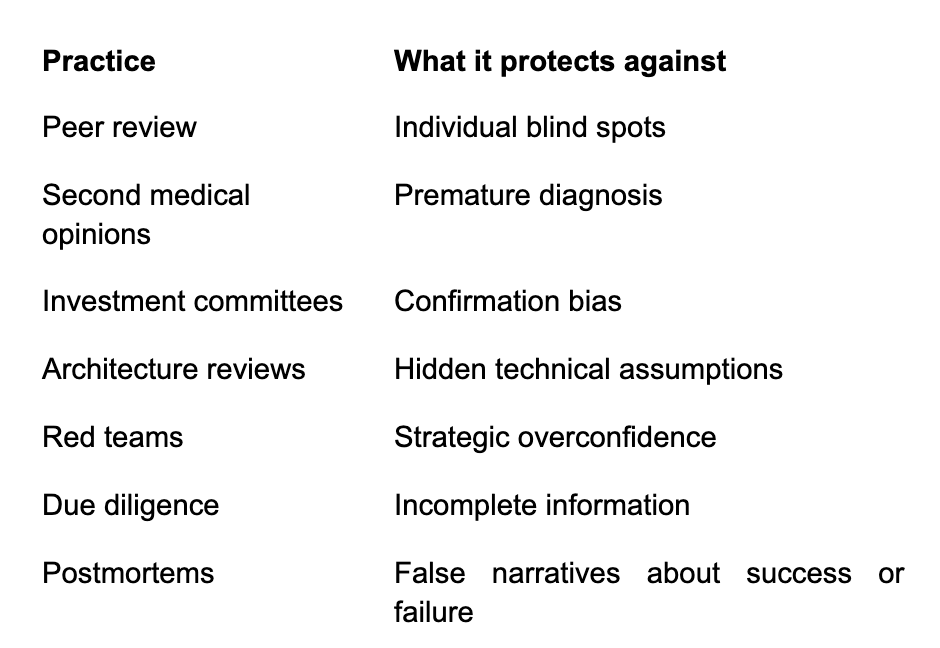
These practices were not invented because organizations distrusted intelligence. They were invented because intelligent people repeatedly arrive at convincing conclusions that later prove incomplete. The stronger the expertise, the more sophisticated those conclusions often become, which makes them even harder to challenge.
The phrase “I don’t know” therefore performs a function that extends far beyond individual humility. It becomes an organizational signal. It tells everyone else that the current model of reality has reached its limits and that additional perspectives are now valuable.
Interestingly, the most experienced professionals often become increasingly comfortable with this signal. Not because they know less than their junior colleagues, but because experience changes their relationship with confidence. After enough product launches, acquisitions, clinical cases or market cycles, certainty begins to feel less like expertise and more like a hypothesis waiting to encounter reality.
This observation creates an intriguing inversion of how expertise is commonly perceived.
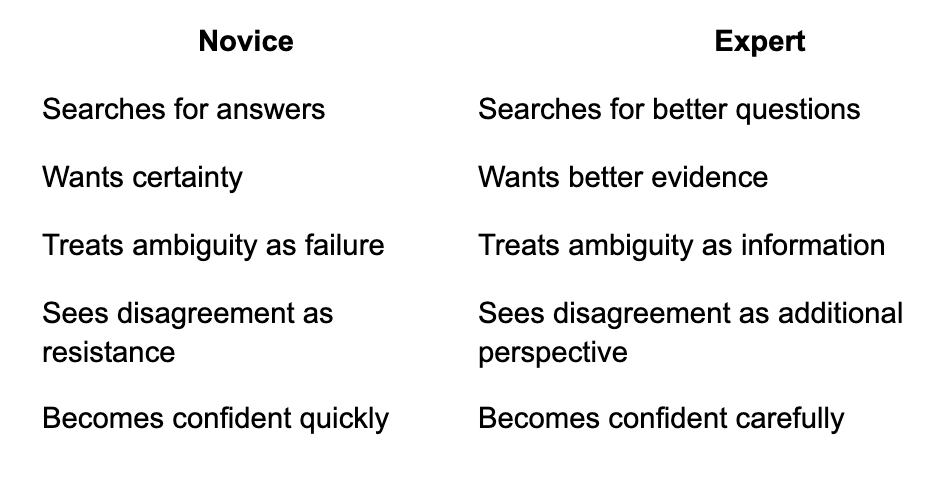
None of these characteristics imply indecision. Organizations cannot function if every question remains permanently open. Decisions eventually have to be made, resources committed and strategies executed. The distinction lies elsewhere. High-performing organizations separate the exploration of uncertainty from the execution of decisions. They encourage broad disagreement while understanding the problem, and disciplined alignment once a direction has been chosen.
That separation has quietly become one of the defining characteristics of modern organizational life. Aviation investigates every incident regardless of how minor it appears because small anomalies often reveal systemic weaknesses. Hospitals conduct morbidity and mortality conferences not to assign blame but to examine where existing understanding failed. Intelligence agencies invest heavily in structured analytic techniques precisely because history demonstrates how easily coherent narratives become accepted without sufficient evidence. Across these very different domains, one pattern repeats itself: uncertainty is treated as something to be examined before it becomes something to regret.
Perhaps this explains why organizations so often struggle after periods of exceptional success. Success has a remarkable ability to reduce the perceived need for uncertainty. Strategies that repeatedly work begin to feel universally applicable. Processes that solved yesterday’s problems gradually become assumptions about tomorrow. Confidence accumulates not because reality has become simpler, but because past experience begins to substitute for fresh observation. By the time external conditions finally challenge those assumptions, organizations frequently discover that the habit of questioning them has quietly disappeared.
This is where the conversation returns to generative AI, although from a different direction than most current discussions. The central concern is not whether a model occasionally hallucinates or whether a summary omits important context. Organizations have always possessed imperfect information. Their resilience depended less on avoiding mistakes than on maintaining mechanisms capable of discovering them before they spread. The more interesting question is whether systems designed to produce immediate explanations unintentionally weaken one of those mechanisms by making uncertainty less visible inside everyday work.
John and I have spent much of the past year exploring organizations from different vantage points. One of us has focused primarily on strategy, organizational capability and judgment; the other on agentic systems, orchestration and the emerging architecture of AI-native work. Those conversations repeatedly converged on the same observation: the future of enterprise AI may depend less on how well systems answer questions than on how well they preserve the conditions under which good questions continue to emerge.
That possibility leads naturally to a broader question. If uncertainty has always functioned as an invisible form of organizational infrastructure, what happens when explanation becomes effectively abundant? What changes inside the enterprise when every employee, every team and eventually every autonomous agent can generate convincing narratives on demand? And perhaps more importantly, what kinds of systems should organizations build if their objective is not merely to generate explanations, but to preserve the quality of organizational judgment itself?
Tune in next week for the concluding sections of the essay…
Subscribe to Alex’s Substack, The Strategy Stack, here.

Thanks for the feature, as always - really enjoyed the collaboration !
“I don’t know” is doing far more work than we usually give it credit for.
It keeps the question open long enough for another perspective, contradiction, or piece of evidence to enter.
AI makes explanations arrive faster. The harder design problem is making sure confidence doesn’t arrive before the organization has finished thinking.