


The argument I keep making in Operating is that the companies that survive and become greater than their current location this decade will not be the firms that adopted AI. They will be the organizations that rebuild their operating philosophies and structure from AI-native principles. They will redesign every role, every process, every means of production through this new lens, with these new tools.
My good friend Alex Pawlowski has written a warning to leaders and executives that personifies this expectation, and I am thrilled to have published this work in two parts. Part One can be found here and today we are releasing Part Two below.
Alex is a friend and one of the sharpest people I know on agentic systems, orchestration, and the architecture of AI-native work. He spends his time building and investing in the next internet. We have spent much of the past year working on similar problems from varying viewpoints. I come at it through strategy, organizational capability, and judgment. He studies and speaks to the machinery that makes the transformation possible.
His claim in this article is as follows: Organizations have never managed knowledge. They manage distributed uncertainty. The internal engineer sees, develops and manages the architecture. The marketer speaks to the customer. Legal worries about exposure. Finance manages risk. Intelligence gets assembled out of incomplete views colliding before a decision hardens. In that system, “I don’t know” is a routing signal to send the query to another department.
Generative AI collapses the interval between question and answer to seconds, eliminating cross-functional departmental debates and meetings. The explanation that arrives is fluent, internally consistent, and often correct.
Encoding your operation is still the right move. Encode the answers, not the questions, and you have built a company that reaches conclusions faster than it ever could.
I’m sincerely excited about these two pieces and am privileged to be publishing them via Operating by John Brewton.
Hope this helps, friends.
- j -
Subscribe to Alex’s Substack, The Strategy Stack, here.

IV. Explanation Is Becoming Cheap. Judgment Is Not.
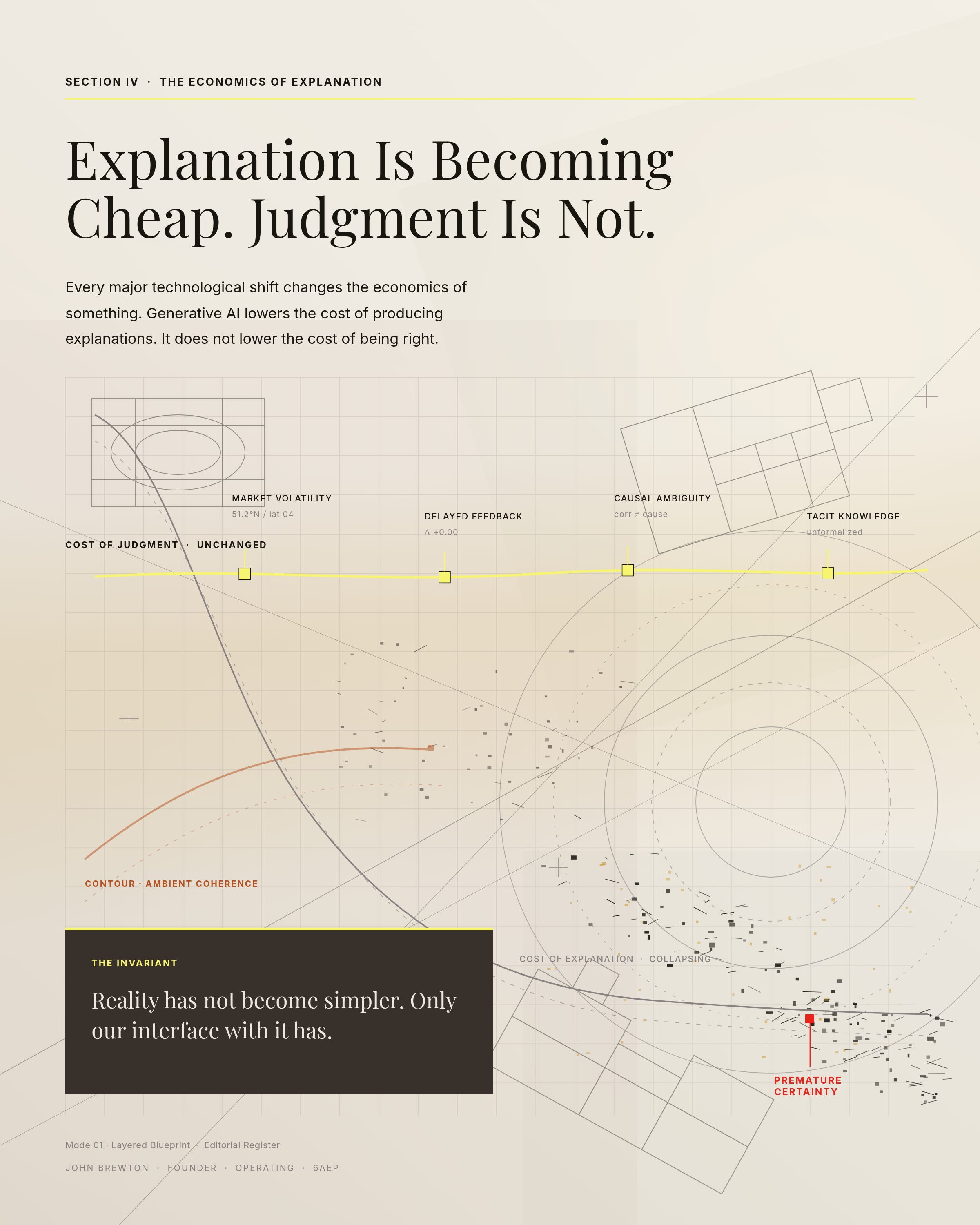
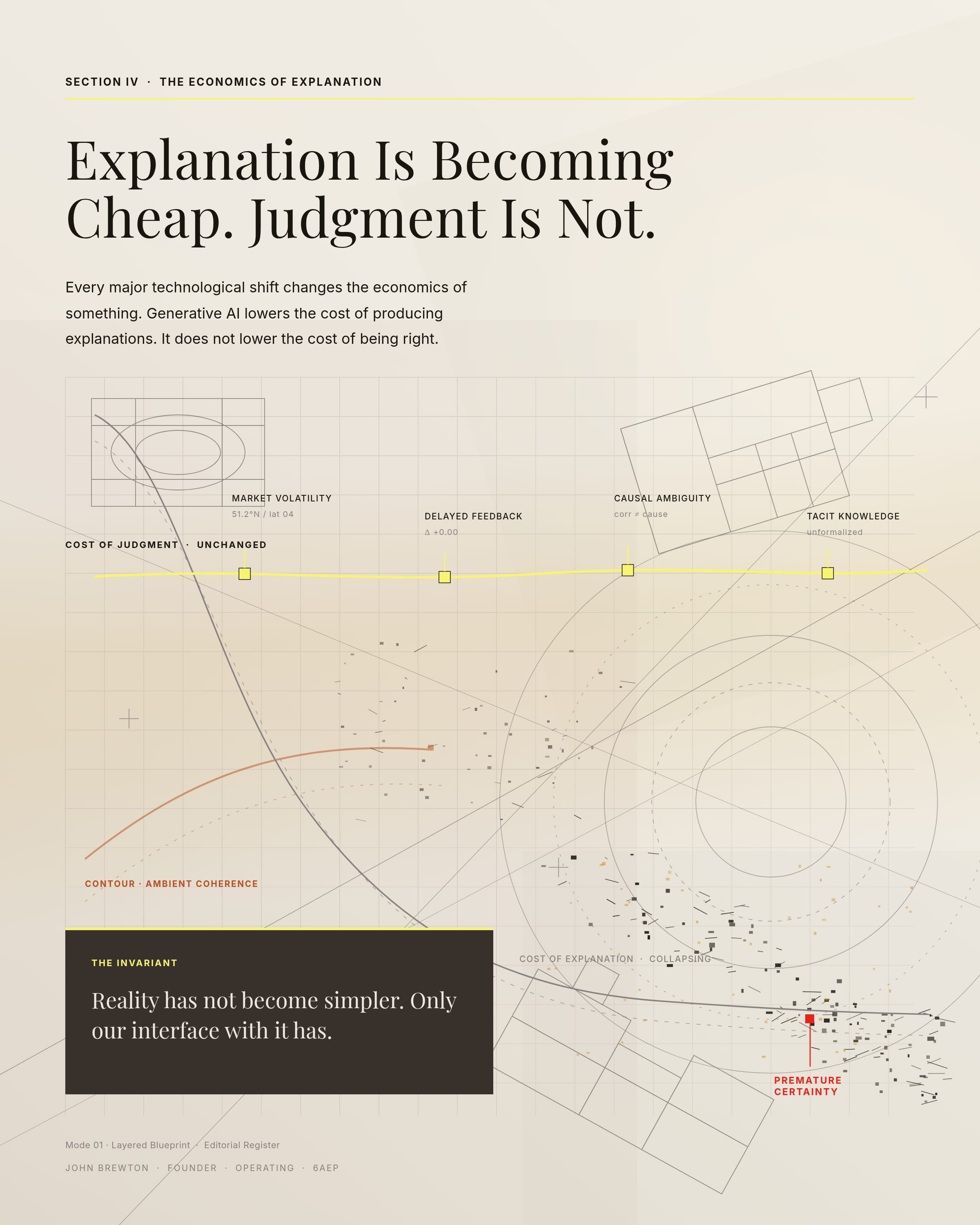
Every major technological shift changes the economics of something. The steam engine reduced the cost of physical labour. Industrial manufacturing reduced the cost of production. Computing reduced the cost of calculation. The internet reduced the cost of accessing information.
Generative AI appears to be changing something altogether different. It dramatically lowers the cost of producing explanations.
That distinction deserves careful attention because explanations occupy an unusual position within organizations. They satisfy a deeply human need to make events appear coherent. A strategy failed because the market shifted. A customer left because pricing was too high. A competitor succeeded because its product was superior. Most organizational life is surrounded by narratives that transform complex, multidimensional events into stories that feel understandable enough to support action.
The problem is not that explanations are inherently misleading. Organizations cannot function without them. Every roadmap, investment proposal, product strategy and board presentation depends on a shared interpretation of reality. The difficulty lies elsewhere. Coherence and accuracy are related, but they are not identical. A persuasive explanation may still overlook critical variables, underestimate uncertainty or mistake correlation for causation. History is filled with decisions that appeared perfectly reasonable because the underlying narrative was internally consistent, only for reality to reveal later that the organization had misunderstood the problem from the very beginning.
Generative AI introduces a fascinating dynamic into this relationship because it produces coherence with remarkable ease. Faced with an unfamiliar question, the system does not experience hesitation, uncertainty or intellectual discomfort. It generates a plausible interpretation almost immediately, drawing together patterns from enormous volumes of text into a response that feels structured, complete and often highly persuasive. Even when the underlying reasoning is imperfect, the explanation itself carries many of the characteristics that humans naturally associate with understanding: fluency, confidence, logical progression and linguistic precision.
From the perspective of organizational psychology, this matters because human beings rarely experience uncertainty as an abstract philosophical concept. We experience it emotionally. Uncertainty creates tension. It interrupts momentum. It delays decisions. It exposes the possibility that our current understanding may prove inadequate. Throughout history, that discomfort encouraged investigation. The effort required to reduce uncertainty often became the mechanism through which better knowledge emerged.
AI changes that emotional sequence.
The question is asked.
An explanation appears.
The feeling of uncertainty recedes.
Whether uncertainty itself has actually diminished remains an entirely separate question.
This difference between objective uncertainty and subjective certainty may become one of the defining management challenges of the coming decade. Organizations have always operated in environments characterised by incomplete information, delayed feedback and complex causal relationships. None of those conditions disappear because explanations become easier to generate. Markets do not become more predictable because summaries become more elegant. Customers do not become more consistent because presentations become more convincing. Competitive advantage does not emerge because every employee can now produce a beautifully written strategic analysis in under five minutes.
Reality has not become simpler.
Only our interface with it has.
Perhaps the most significant consequence is not technological but social. Every organization depends on countless small signals that reveal where understanding remains incomplete. Someone asks another department for help. An engineer escalates an issue to an architect. A consultant admits they need to investigate further before making a recommendation. A physician requests another opinion. These interactions do more than exchange information. They reveal where uncertainty currently resides inside the organization, allowing expertise to flow toward it.
If explanations become permanently available, many of those signals begin to disappear. Employees no longer need to expose uncertainty before receiving a plausible answer. Teams become increasingly capable of operating independently, but independence and understanding are not synonymous. An individual equipped with an excellent language model may appear highly informed while remaining disconnected from colleagues whose experience would have fundamentally altered the interpretation of the problem. Knowledge becomes more accessible at precisely the moment collective sensemaking risks becoming less frequent.
This is an irony worth reflecting upon. Organizations adopted digital collaboration platforms to connect people more effectively across functions and geographies. Generative AI may inadvertently reverse part of that dynamic by allowing individuals to resolve questions privately that previously required conversation. The immediate productivity gains are obvious and, in many cases, entirely justified. The longer-term organizational effects are more ambiguous. Every question answered without conversation is also a conversation that never takes place, an assumption that is never challenged and a perspective that never enters the decision-making process.
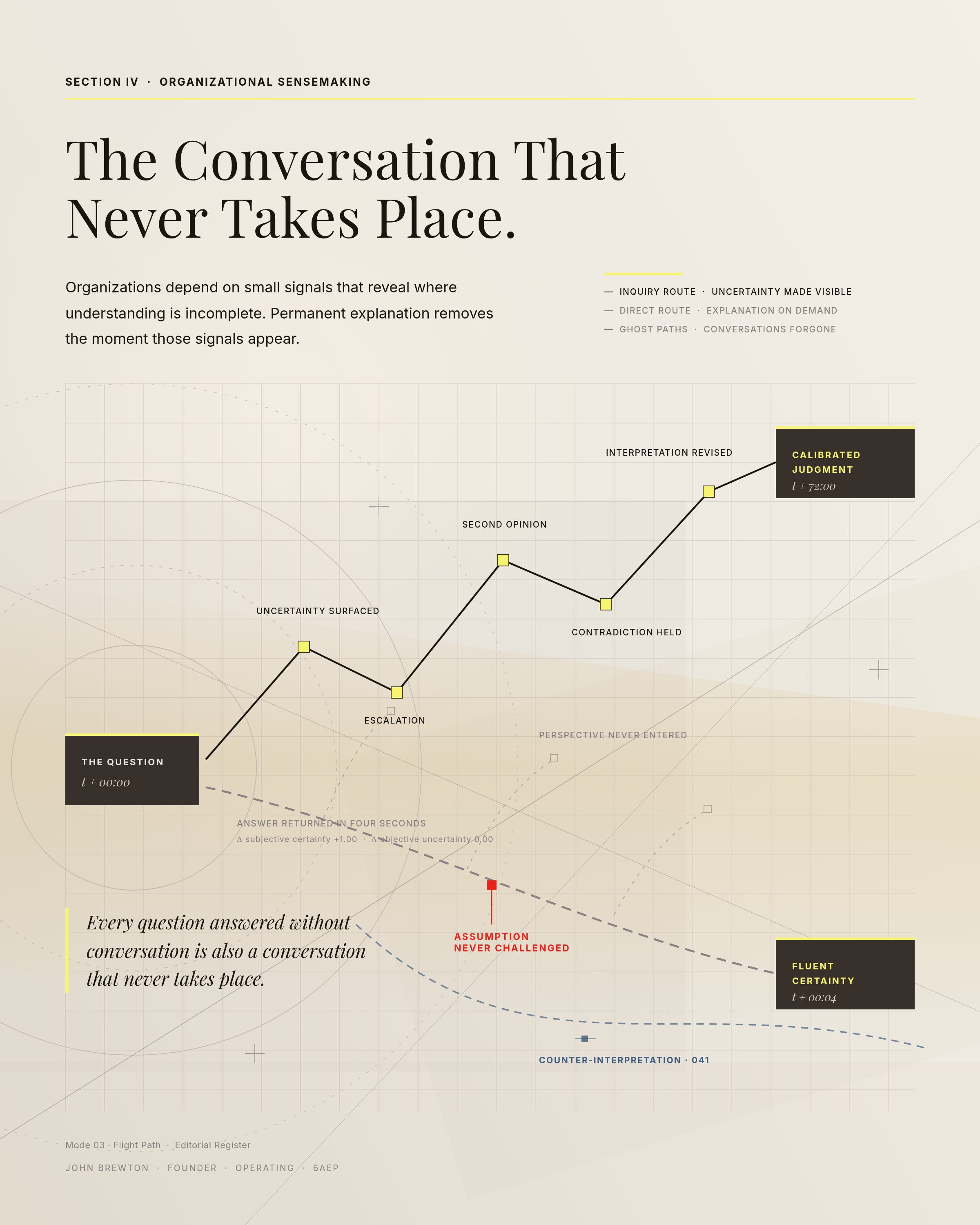
The implications extend beyond collaboration into the architecture of organizational learning itself. Much of what organizations know is not stored in documents, databases or process manuals. It exists in the interactions through which people compare interpretations, negotiate meaning and gradually refine their understanding of ambiguous situations. Organizational theorists have long distinguished between explicit knowledge—the things that can be documented—and tacit knowledge—the intuitions, experiences and contextual judgments that resist formalization. AI dramatically improves access to the former. Its influence on the latter remains far less certain.
Perhaps the greatest risk, then, is not that AI produces incorrect answers. Incorrect answers have always existed. Organizations have developed countless mechanisms for discovering and correcting them. The more subtle possibility is that explanations become so immediate, so abundant and so persuasive that they quietly reduce the number of occasions on which people realise they have reached the boundary of their own understanding. If that boundary becomes less visible, organizations may discover that they have become exceptionally efficient at producing explanations while simultaneously becoming less effective at recognising when explanation should give way to further inquiry.
V. Designing Organizations That Preserve Uncertainty
The discussion surrounding agentic AI often begins with capability. How many tasks can an agent perform? How many systems can it connect? How much human intervention can be removed from a workflow? These are sensible engineering questions, but they say surprisingly little about organizations themselves. Enterprises have never struggled because they lacked the ability to execute instructions. They struggle because they repeatedly execute assumptions that later turn out to be incomplete.
Viewed through that lens, the next generation of organizational design may depend less on what AI can accomplish autonomously and more on the role it plays within the organization’s broader process of judgment. Every technology eventually becomes embedded in an institution, and institutions shape technology at least as much as technology reshapes institutions. The real design challenge, therefore, is not simply building more capable agents. It is deciding which organizational functions those agents should strengthen and which human capabilities they should deliberately leave intact.
Current development trends reveal a strong preference for completion. Agents draft reports, prepare presentations, write code, summarize meetings, coordinate workflows and increasingly orchestrate other agents. The underlying objective is remarkably consistent: reduce the amount of work that remains unfinished. Yet completion has never been the defining characteristic of high-performing organizations. A completed analysis that frames the wrong problem creates more risk than an unfinished one that still invites challenge.
That distinction suggests a different design philosophy.
Instead of asking how an agent can replace the next human task, organizations might begin by asking which forms of uncertainty disappear too early in their existing decision processes. The objective shifts from maximizing automation toward improving the quality of organizational sensemaking.
An agent designed around that principle behaves very differently.
Rather than presenting a single recommendation, it identifies competing interpretations.
Rather than optimizing for confidence, it estimates the quality and completeness of the available evidence.
Rather than summarizing agreement, it highlights disagreement.
Rather than producing the shortest path to execution, it identifies where additional observation would meaningfully change the decision.
The result is not a slower organization.
It is an organization that allocates its attention more intelligently.
That distinction becomes easier to appreciate when viewed through familiar organizational practices.
Conventional Agent
Epistemic Agent
Produces answers
Maps uncertainty
Completes tasks
Identifies missing evidence
Optimizes efficiency
Optimizes decision quality
Reinforces existing assumptions
Challenges existing assumptions
Maximizes confidence
Calibrates confidence
Ends the workflow
Decides whether the workflow should continue
This is not merely a different interface.
It represents a different philosophy of organizational intelligence.
Much of today’s AI landscape assumes that knowledge work consists primarily of producing outputs. Reports, presentations, analyses and recommendations become the measurable products through which productivity is evaluated. Yet organizations rarely derive competitive advantage from documents alone. They compete through the quality of the decisions those documents support. A beautifully written recommendation based on an incomplete understanding of the environment remains strategically inferior to a less polished analysis that exposes uncertainty before resources are committed.
Seen from this perspective, the role of agentic systems begins to resemble something closer to institutional architecture than digital labour. Good institutions have never existed to eliminate disagreement. Their purpose has been to ensure that disagreement appears early enough to improve judgment. Constitutional courts, scientific peer review, investment committees and aviation safety investigations all slow the journey from observation to action in carefully chosen places because experience has demonstrated that unchecked certainty becomes extraordinarily expensive.
Perhaps AI should be designed with the same principle in mind.
Instead of asking whether an agent can make a decision independently, organizations might ask a different set of questions.
Which assumptions is this recommendation built upon?
What evidence would most likely change this conclusion?
Which perspectives are currently absent?
Where does confidence exceed available evidence?
Which part of this decision still depends on human judgment rather than computational capability?
Notice that none of these questions reduce the value of automation. They simply recognize that automation and judgment solve different organizational problems. One increases operational capacity. The other determines whether that capacity is directed toward the right objective.
This distinction becomes increasingly important as organizations evolve from isolated AI tools toward networks of collaborating agents. A single language model answering questions for an employee introduces one set of challenges. Hundreds of specialized agents coordinating product development, legal review, procurement, finance and customer operations introduce another. Once agents begin exchanging conclusions with one another, organizations face the possibility of creating systems that reinforce certainty at machine speed. If every agent accepts the outputs of every other agent without introducing mechanisms for challenge, contradiction or independent verification, the organization risks scaling coherence faster than understanding.
Perhaps the most valuable agent inside an enterprise will therefore not be the one that writes the report, negotiates the contract or schedules the meeting.
Perhaps it will be the one that interrupts.
The agent that notices conflicting assumptions between departments before anyone else does.
The agent that detects unusual confidence unsupported by evidence.
The agent that identifies the missing customer perspective in an otherwise compelling strategy.
The agent that quietly asks whether the organization has begun answering a question it never properly understood.
Those responsibilities sound remarkably familiar because organizations have always depended on people who performed exactly that role. The difference is that they rarely occupied positions of formal authority. They were the experienced architect who challenged an elegant design, the analyst who questioned the assumptions hidden inside a financial model, the physician who requested one additional test despite overwhelming consensus, or the strategist who noticed that everyone had become unusually comfortable with the current narrative.
The future of agentic AI may ultimately depend on whether we choose to replicate only the visible work those people performed or whether we also preserve the invisible function they served within the organization. The first path produces faster execution. The second strengthens institutional judgment itself.
VI. Judgment as Competitive Advantage
Every generation tends to believe that the defining technologies of its time fundamentally alter the conditions under which organizations compete. Sometimes they do. Railways changed geography. Electrification transformed manufacturing. The internet redefined distribution. Artificial intelligence will undoubtedly reshape many aspects of organizational life in ways we can only partially anticipate today.
What history also suggests, however, is that enduring competitive advantage rarely emerges from technology alone. Technologies diffuse. Best practices spread. Capabilities that once distinguished a handful of organizations gradually become available to everyone else. What remains difficult to replicate are the institutional habits through which organizations interpret reality, revise their assumptions and make decisions under conditions that remain fundamentally uncertain.
This observation deserves greater attention because it changes the way we think about intelligence itself. The coming decade will almost certainly produce organizations capable of generating extraordinary volumes of analysis, recommendations, simulations and strategic options. Access to explanation will continue to expand, while the cost of producing sophisticated reports, market assessments and technical evaluations will continue to fall. In many industries, these capabilities will become expected rather than exceptional. They will shape the baseline from which organizations operate, not the advantage that separates one organization from another.
The differentiator will increasingly shift elsewhere.
Not toward who has the most explanations.
Nor toward who automates the largest number of workflows.
But toward those organizations that remain capable of recognizing when their own explanations have become inadequate.
That capability has always occupied an unusual position within strategy. Markets rarely reward organizations for answering yesterday’s questions more efficiently than their competitors. They reward organizations that notice emerging questions while others continue refining outdated answers. Every major strategic inflection point contains this asymmetry. One organization continues optimizing an existing model because the evidence still appears internally coherent. Another begins questioning assumptions that have not yet visibly failed. Looking backward, these moments are often described as innovation or visionary leadership. Looking more closely, they frequently begin with something less dramatic: an institution preserving enough epistemic humility to recognise that reality may already have moved beyond its current understanding.
Seen in this light, judgment begins to look less like an individual attribute and more like an organizational capability. It is embedded in governance structures, decision processes, incentive systems and cultural norms that determine whether uncertainty is explored or suppressed. Organizations do not become adaptive simply because they employ intelligent people. They become adaptive because they create environments in which intelligent people can revise their thinking without treating revision as failure. Learning is not the accumulation of correct answers; it is the continuous recalibration of mental models as reality changes around them.
Generative AI enters this landscape as both an extraordinary opportunity and a subtle design challenge. It dramatically expands humanity’s capacity to produce explanations, synthesize information and coordinate increasingly complex work. Used well, these capabilities can elevate the quality of organizational decision-making in ways that were previously unimaginable. Used without careful attention to organizational design, they may also encourage institutions to mistake fluency for understanding and completion for judgment. The technology itself remains neutral. Its consequences depend on the architecture into which it is introduced.
Perhaps that is the deeper lesson emerging from this moment.
Organizations have spent decades investing in systems that improve access to information. We are now entering an era in which access to explanation is becoming equally abundant. The question quietly moving toward the centre of management is no longer whether people can obtain answers. Increasingly, everyone can. The more consequential question is whether organizations continue to preserve the conditions under which answers are challenged, refined and occasionally abandoned altogether.
That challenge reaches beyond management practice. It touches the way societies organize expertise, distribute authority and cultivate trust. Universities, scientific communities, engineering disciplines and democratic institutions all evolved around the recognition that certainty benefits from structured disagreement. Their objective was never to eliminate uncertainty but to prevent confidence from outrunning evidence. As organizations become increasingly AI-native, they inherit the same responsibility. The technologies may be unprecedented, yet the institutional challenge remains remarkably familiar: preserving the quality of judgment while expanding the scale of intelligence.
John and I approached this question from different directions. One of us spends much of his time thinking about how organizations build strategic capability, how decisions shape competitive advantage and how institutional learning becomes an enduring source of resilience. The other explores the architecture of agentic systems, orchestration and the operational models that will increasingly define AI-native enterprises. Those perspectives converge on a common conclusion. The future of organizational intelligence will not be determined solely by the sophistication of the systems we build, but by the quality of the environments into which we introduce them. The design of an agent and the design of an institution are becoming inseparable questions.
Perhaps that is where this conversation ultimately leads.
The defining organizations of the AI era will almost certainly produce better analyses, faster recommendations, and more efficient workflows than any generation before them. Those achievements will matter, but they are unlikely to be sufficient. Long after explanation becomes inexpensive and ubiquitous, organizations will continue competing through something that cannot be downloaded, prompted, or automated in isolation: the collective discipline of recognizing where their understanding remains incomplete, resisting the temptation of premature certainty, and creating institutions in which better questions continue to emerge before better answers are accepted.
Subscribe to Alex’s Substack, The Strategy Stack, here.
I've definitely been in situations where a confident-sounding answer made me stop asking questions, and I didn't realize it until later. The idea of building an agent that challenges assumptions instead of just producing answers is interesting, even if it's not what anyone's actually building right now.