Laszlo Bock spent a decade proving five operating principles at Google. He scaled the company from 6,000 to 72,000 people using systems rooted in one belief: people are fundamentally good, and if you build transparent systems around that belief, everything else compounds.
What Bock didn’t explicitly write: these principles work better at small scale. They work better when there’s no organizational buffer, when every decision cascades immediately, when the person making the hire is also the person absorbing the cost of a bad hire.
They work best when you’re the team.
Most creator operating advice optimizes for growth, more content, more products, more revenue streams. This is backwards. The constraint isn’t volume. It’s systems. You need the same operating principles that scaled Google, adapted for a team that’s currently just you.
Here’s how Bock’s five principles apply when you’ve left corporate and decided to build something yourself.
What Bock Learned: Schmidt and Hunter’s 85-year meta-analysis shows structured interviews predict job performance at 26% accuracy. Unstructured interviews—what most companies use, what most hiring sounds like—predict at 7%. This isn’t marginal. This is an 3.7x difference in decision quality.
Yet Google, for all its sophistication, had to fight its own biases to implement this. Managers wanted to hire based on instinct. Structured evaluation felt robotic.
Your Application: You hire constantly. VAs, designers, writers, developers, consultants. Each hire is either a multiplier or a time sink. The math is brutal: a bad $500/month VA hire costs you 20+ hours of supervision and rework. Over a year, that’s a $10K+ opportunity cost.
Your gut feeling on contractors is not more reliable than Google’s gut feeling on engineers. It’s actually worse because you have less hiring volume to calibrate on.
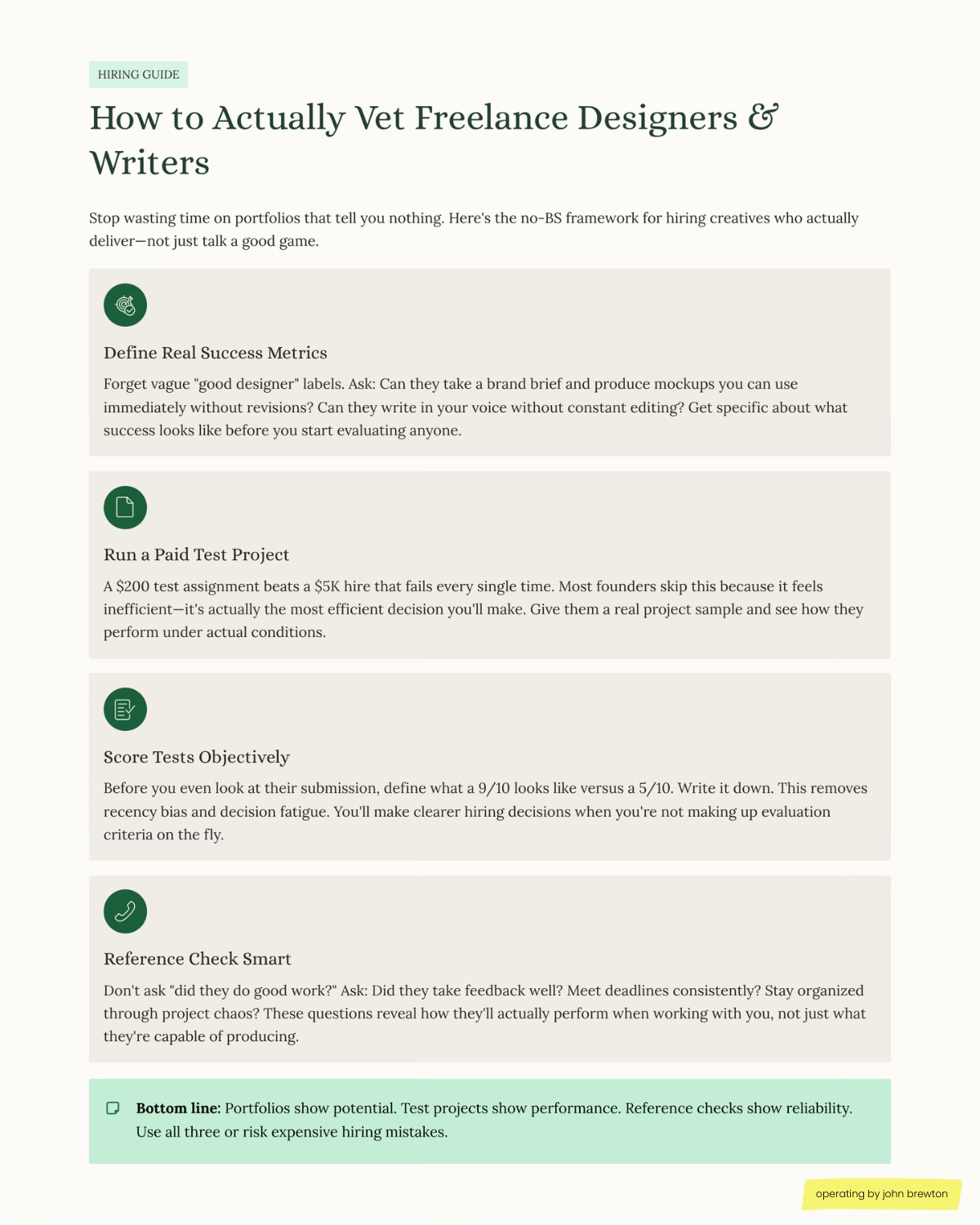
The solution is mechanical. When you’re evaluating contractors, don’t rely on portfolio alone. Structure it: