Do. Fail. Learn. Grow. Win. | My 5-Step (How-To) Framework To Succeed At Anything.
My 5-step framework for learning from failure and Ivy League research that underpins it. The exact weekly loop I run on everything to keep growing and winning no matter what.
Work w/ John
TL →DR
I have 1 framework: Do. Fail. Learn. Grow. Win. It carried me through a PhD program, a family distribution business, a consulting firm, and a creator business built from an audience of 0 to over 50,000.
Research says learning from failure is not automatic. A 10-year study of 71 cardiac surgeons found they learned from their own successes and other surgeons’ failures, not their own failures.
Failure alone is nearly worthless. Venture-backed founders with a prior failure succeed 23 percent of the time. First-timers succeed 22 percent of the time. The value is the lesson, not the failure.
The extraction tool is 1 written sentence naming why the miss happened. In a Harvard field experiment, 15 minutes of written reflection beat additional working time by about 23 percent.
Run 1 loop per week: ship 1 thing by Friday, name the miss, change 1 behavior, ship again. Count wins at week 12, not week 1.
Who the heck is John Brewton, where did this framework come from, and why should you care?
16 years ago, I was working to complete a PhD in economics at the University of Chicago when a professor gave me the best advice of my career. Take a year off, he said. Go get some experience actually operating a business. My parents owned an industrial distribution company and were working toward selling it. He thought I should go help. I had grown up in that entrepreneurial household and talked about the company through my entire graduate education, so I went.
The 1 year became 12.
I learned to operate by operating. We sold the company in 2021, and starting a consulting firm on the back of those relationships was the next logical step. So that is what I did. For that entire period, I had no LinkedIn, no newsletter, no “brand.” I produced zero content. It never occurred to me. I was head down, building a business, thinking about nothing else in the world but how to use our operational efficiencies to grow margin and razor thin market.
Then, almost 4 years ago, my life changed at once. I met my wife. We fell in love, got married, and had our daughter. The weekend we found out we were pregnant, my mother passed away. I am an only child. I had spent 12 years building a business beside my parents and stayed very close through these, often difficult, years. The largest loss of my life arrived the same weekend as the news of my greatest happiness.
Life is extraordinarily not linear.
That was the year I stopped expecting it to be.
Or maybe it was just the moment I realized that it had never been.
I moved to Northern Virginia to become a husband, a stepfather, and a father. That November I decided the business had to change to match the life. I wanted to be available for all of it, every experience of being a father, of being a Girl Dad. So I took a page from Gary Vaynerchuk’s playbook and made 1 simple commitment: post on LinkedIn every day for a year, starting from an audience of 0. I completed the year and have posted every day since. Today the audience across LinkedIn and the newsletter is over 50,000. Operating by John Brewton became a Substack bestseller. And my total business operations now span across 6 revenue streams, consulting being primary, courses, a paid newsletter, coaching, advisory work, and some content design work for projects I find especially inspiring.
I had wanted a content business for years and never started one. I admired Gary Vee and Casey Neistat from a distance while my ego managed credentials, attaching names and institutions to my work so it would look smarter to the outside world than I sometimes felt on the inside. Becoming a father ended that negotiation. Meeting other people’s expectations was the last thing I cared about when that period of my life began.
The life I have today looks nothing like the one I planned. I work more than I ever have. I love the consulting. I learn so much from clients each and every week. Opportunities are plentiful. None of it matches the picture I once drew, and 1 thing explains how it all got built anyway.
The DNA of every win is found in some loss and some failure along the way. I have 1 framework. It is 5 words long, and it has run every chapter of this story.
How I Built a $200,000 Newsletter Business From a Substack Nobody Was Reading
The Five Moves That Turned My Substack Into a $200,000 Business
The Operating Project: Most Coaching Ends With Notes. This Ends With a Machine.
How to Produce World-Class Research with Perplexity Computer & Claude -> Fable 5
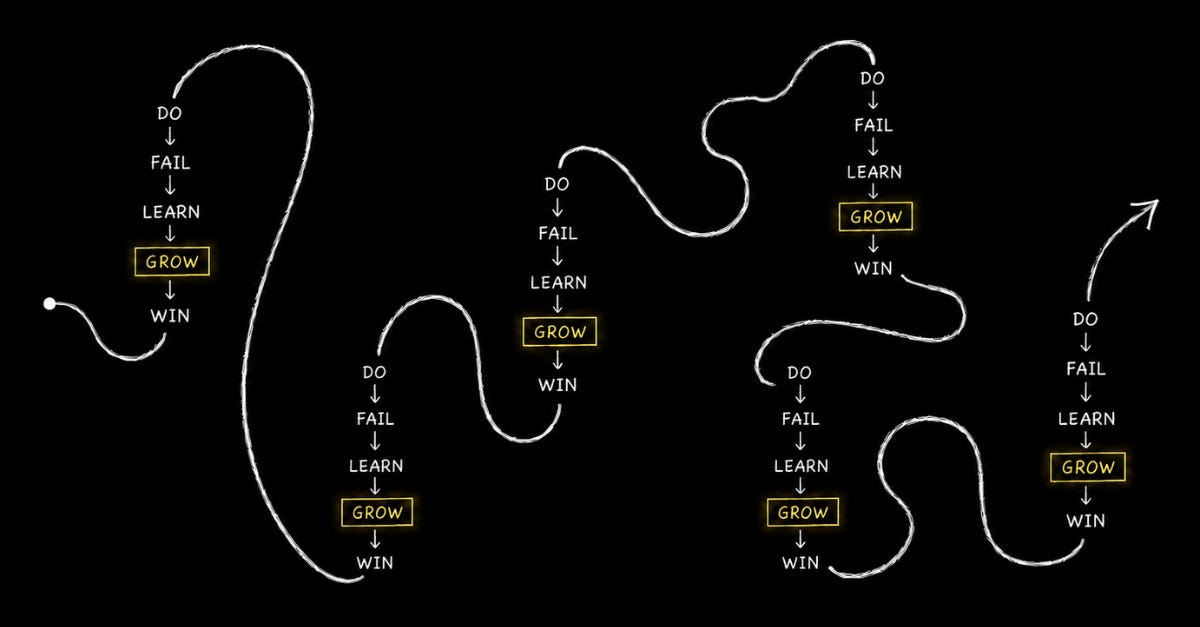
What is the Do. Fail. Learn. Grow. Win. framework?
Do. Fail. Learn. Grow. Win.
When the cycle completes, it’s back to doing more.
That is the entire system.
No software, no certification, no 2-by-2 matrix.
One warning before the steps, because the research here is humbling. Learning from failure is not automatic. A 10-year study of 71 cardiac surgeons across 6,500 procedures found that surgeons improved after their own successes and after other surgeons’ failures, but not after their own failures. Their own misses got filed under bad luck. If surgeons with lives on the line do not learn from their own failures by default, neither do you and neither do I. It is imperative that the loop exists to force what does not happen on its own.
How do you run each step of the loop?
1. Do: Ship something real. A draft, a newsletter issue, a proposal, a post. The framework does not begin with planning. It begins with output. Most people invert this and spend the doing budget on preparing to do. Volume is the entry fee. My version was 1 LinkedIn post a day, every day, starting from an audience of 0.
2. Fail: Some of what you ship will not work. This is not a defect in the system. It is a component of it. The issue nobody opens. The proposal that dies in review. Do not route around this step. Treat each miss as data arriving on schedule.
3. Learn: Failure only pays if you collect. Name the mechanism of the miss in 1 sentence. Not “the post flopped” but “the post buried its one idea in paragraph 4.” A loss you cannot articulate is a loss you will repeat. This step is not a journaling habit. In a Harvard Business School field experiment, trainees who spent the last 15 minutes of the workday writing down what they learned performed about 23 percent better than trainees who spent those minutes doing more work. Reflection converts doing into learning. Reflective writing is an essential tool.
4. Grow: Growth is the lesson applied, not the lesson admired. Change the template. Rewrite the opening. Reprice the offer. If your next attempt is identical to your last, no learning happened.
5. Win: The win usually arrives smaller than expected and later than planned. Take it anyway. A win is not a finish line. It is funding for the next round of doing. Bank it, then return to step 1 with more ambition.
Does failure actually make you more successful?
No. This is the uncomfortable part, and the data is blunt. A Harvard study of venture-backed founders found that previously successful founders succeeded 34 percent of the time on their next company. First-timers succeeded 22 percent of the time. Previously failed founders, 23 percent. Failure by itself bought 1 point. The failing was never the value. The lesson you extract from it is, and most people skip the extraction.
That is why the framework has 5 steps and not 2. Do and Fail happen to everyone who tries. Learn, Grow, and Win only happen to the people who commit to running the full loop.
How do you run multiple loops at once?
The first version to master is to simply run 1 loop at a time. The magic happens when you’re running the loop against is 6 revenue streams, 6 competing client interests, all at 6 different stages of the cycle on any given day. When that many loops run at once, no single failure can take you out of the game.
The framework survives every context switch because it assumes nothing about the domain. It assumes only a sequence.
Action produces information.
Information produces adjustment.
Adjustment produces results.
That sequence held for me at Harvard, as a PhD candidate, in a messy distribution business, across all consulting engagements and right in the glow of an analytics dashboard for my newsletter business.
I will never know the outcome or the final destination. Neither will you. The job is to keep executing, put one foot in front of the other, and build the life from whatever luck arrives and whatever realities show up. That is the nature of the work for every consultant, creator, founder, and operator trying to figure this out.
How do you start the framework this week?
Start small and start now.
Pick 1 project. Ship 1 real unit of work by Friday: a post, a proposal, a prototype, whatever the project calls for. When part of it misses, and part of it will, write 1 sentence identifying the reason. Change 1 behavior before the next attempt. Then ship again next week.
Run this framework for 12 weeks and count the wins at the end.
Download the worksheet I’ve built to help you get started here:
The best state you can be in is a continuous state of learning from what has not worked. That is where the growing comes from.
That is where all your future wins live.
Do. Fail. Learn. Grow. Win.
That is my framework, and I am sticking to it.
You should try, too.
I so sincerely hope this helps.
- j -
Work w/ John
I run this operating system inside real businesses: consulting engagements, advisory work, and coaching for founders, operators, and creators. If you want to build your version of the loop for your work or company, message me and tell me what you are building.
What else do people ask about the framework?
Is “fail fast” good advice? Not by itself. The founder data shows failure alone improves your odds by 1 point. Fail small, on purpose, with a hypothesis, then write the lesson down. Extraction is the value, speed is not.
What if nothing failed this week? Something did. “Nothing missed” is almost always a collection failure, not a clean week. Look at what underperformed, what ran late, and what you avoided. Name 1 mechanism anyway. A dry week with a named lesson is progress.
How long before the loop produces wins? Run it for 12 weeks before judging it. Weeks 1 to 4 produce volume and misses. Weeks 5 to 8 produce lessons and behavior changes. Weeks 9 to 12 produce the wins the first 8 weeks paid for.
Does this work outside of business? Yes. The framework assumes nothing about the domain, only a sequence: action produces information, information produces adjustment, adjustment produces results. School, sports, music, parenting, work. Same loop.
Where do I get the free field guide? The Loop Field Guide is free for subscribers. It is 2 pages: the framework on 1 page and the 5-blank weekly sheet on the other. Fill the sheet once a week in 5 minutes. Subscribe and it lands in your inbox.
Where does the research behind the loop come from?
Appendix. Every study referenced in this article, organized by the step it supports.
Do
Arrow, K.J., “The Economic Implications of Learning by Doing,” The Review of Economic Studies (1962). The founding economics of experience-driven improvement. https://academic.oup.com/restud/article-abstract/29/3/155/1539235
Thompson, P., “How Much Did the Liberty Shipbuilders Learn?” Journal of Political Economy (2001). Productivity rose with cumulative output, and gains decayed when the doing stopped. https://www.journals.uchicago.edu/doi/abs/10.1086/318605
Ericsson, Prietula, Cokely, “The Making of an Expert,” Harvard Business Review (2007). Repetition without feedback plateaus. Practice targeted at weaknesses improves. https://hbr.org/2007/07/the-making-of-an-expert
Fail
Kahneman and Tversky’s prospect theory, confirmed by a 2024 meta-analysis: losses weigh roughly 1.9x gains, which is why shipping feels risky and preparing feels safe. https://www.sciencedirect.com/science/article/pii/S0167487024000485
Golman, Hagmann, Loewenstein, “The Demand for, and Avoidance of, Information.” People dodge feedback that might sting, even when it is free and useful. https://www.cmu.edu/dietrich/sds/docs/golman/the-demand-for__and-avoidance-of__information.pdf
Edmondson, A., “Strategies for Learning from Failure,” Harvard Business Review (2011), and “It’s OK to Fail, but You Have to Do It Right” (2023). Only intelligent failure teaches: new territory, goal-driven, hypothesis-informed, small. https://hbr.org/2011/04/strategies-for-learning-from-failure · https://hbr.org/2023/07/its-ok-to-fail-but-you-have-to-do-it-right
Learn
KC, Staats, Gino, “Learning from My Success and from Others’ Failure,” Management Science (2013). 71 cardiac surgeons, 6,500 procedures, 10 years. No learning from own failures. https://pubsonline.informs.org/doi/10.1287/mnsc.2013.1720
Eskreis-Winkler and Fishbach, “Not Learning From Failure — the Greatest Failure of All,” Psychological Science (2019). 5 experiments, 1,600+ participants. Failure feedback taught less than success feedback because people tune out. They learned normally from others’ failures. https://journals.sagepub.com/doi/abs/10.1177/0956797619881133
Di Stefano, Gino, Pisano, Staats, “Learning by Thinking,” HBS working paper. 15 minutes of written end-of-day reflection beat additional working time by about 23 percent. https://papers.ssrn.com/sol3/papers.cfm?abstract_id=2414478
Finkelstein and Fishbach, “Tell Me What I Did Wrong,” Journal of Consumer Research (2012). Experts seek negative feedback. Novices avoid it. https://academic.oup.com/jcr/article-abstract/39/1/22/1823160
Grow and Win
Weick, K., “Small Wins: Redefining the Scale of Social Problems,” American Psychologist (1984). Small, winnable units are the reliable path to large change. https://psycnet.apa.org/record/1984-25682-001
Amabile and Kramer, “The Power of Small Wins,” Harvard Business Review (2011). 12,000 diary entries from 238 professionals. Progress in meaningful work is the top motivator. https://hbr.org/2011/05/the-power-of-small-wins
Edmondson, A., “Psychological Safety and Learning Behavior in Work Teams,” Administrative Science Quarterly (1999). Teams that surface errors outlearn teams that hide them. https://journals.sagepub.com/doi/10.2307/2666999
The market evidence
Gompers, Kovner, Lerner, Scharfstein, “Performance Persistence in Entrepreneurship,” Journal of Financial Economics (2010). Success rates: prior success 34 percent, first-timers 22, prior failure 23. https://www.nber.org/papers/w12592
Bessemer Venture Partners, the Anti-Portfolio. A top venture firm’s public log of the great companies it passed on, and why. The loop log at institutional scale. https://www.bvp.com/anti-portfolio


I like this. Reflection is where experience becomes wisdom. Without taking time to understand why something worked or failed, it's easy to repeat the same patterns.
5 steps is often all you need!