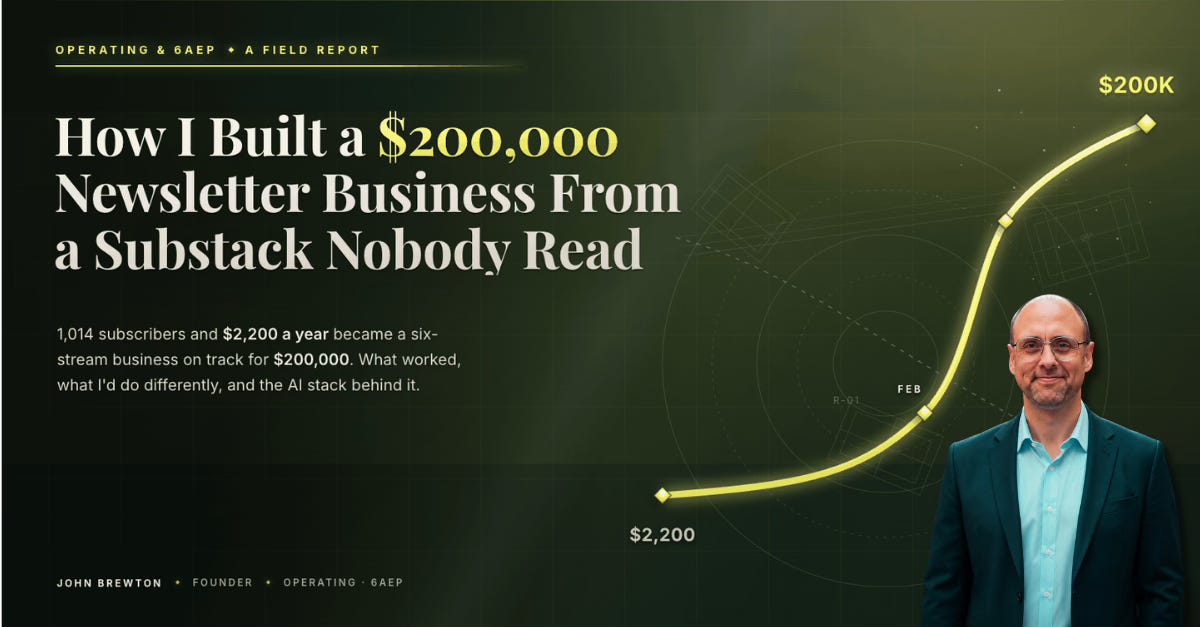
How I Built a $200,000 Newsletter Business From a Substack Nobody Was Reading
What worked, what I would do differently, and what you can copy
TL → DR: How did a newsletter nobody read become a $200,000 business?
I started 2026 with 1,014 subscribers and about $2,200 a year. By June 1st I had 5,861 subscribers and 266 paying members.
The business will generate +$200,000 this yeara across six streams: Advisory, Coaching, the Operating Founder program, Courses, Subscriptions, and a Community.
The inflection point came on February 2. One post, “0 to 55,000,” drove 85 paying members in a day and sold 100 coaching seats in 12 days.
My growth from the start has been more than 90% organic to Substack. I imported zero subscribers.
What drove it: high-frequency publishing, a proof post timed to an offer, using scarcity to drive conversions, collaborations, clear not clever headlines, willingness to give generously of my time, and an AI stack that has enabled me as one person to do the work of a team.
On January 1, 2026, my newsletter, Operating by John Brewton, had 1,014 subscribers and was on track to generate about $2,200 in ARR. I had built that audience over nine months of publishing, to my small readership and to little engagement. My average post receive 500 to 800 views, and my 30 day views hung around 2,000 to 2,500.
Today my newsletter is the foundation of a multi-tiered divsion of my larger consulting work:
Content and Brand Advisory brings in $10,000 a month.
Coaching brings in $4,000 to $5,000 a month.
The Operating Founder program has collected $22,000.
My first course earned $15,000.
The newsletter now has 5,861 subscribers and 266 paying members.
Together these revenue streams will generate +$200,000 this year and have become a wonderful source of diversification to my larger business. It is likely that these elements will become primary revenue drivers of a much larger business and company over the next several years.
Here is what happened, in the numbers:
The six streams: Advisory and coaching are shown as what they earn over a full year at today’s pace. The rest is money earned so far.
How did the newsletter start?
Before Substack, I spent 18 months building a LinkedIn following of 25,000 professional and operators (today that audience sits at 40,000). When I launched on Substack in April 2025, I started clean. I did not import an email list or extract follower emails from LinkedIn. I wanted to grow completely organically on Substack.
My first article received 197 views.
Over the next nine months I published 81 posts and built a following of 1,014 subscribers. Readership stayed low the whole time. Average views per post grew from 173 in April to 675 in November. By January 2026 the newsletter was on track to generate about $2,200 of ARR.
I picked Substack on purpose. I thought it had a cool factor, seemed like a nicer place than X to public, and most critically, I wanted the network effects of being on a social platform. I ran an experiment: grow with zero imported subscribers and see how far the platform alone could carry the work. Over 90% of the growth that followed came organically from Substack itself.
The early post did one job. They gave later readers a back catalog, a library of content, ideas, tools and perspective on the immediate world of what it means to operating and build companies. When more people arrived in 2026, 81 posts were waiting, that would become crucial.
What you can do: publish on a schedule before anyone reads. Build the back catalog first.
Subscribers reached about 1,014 by January 2026, then climbed to 5,861 by June after the launch.
When did readers start paying?
The same kind of writing began turning readers into paying members.
Jan 16, a post on AI and work: 1,080 views, 12 paying members.
Jan 19, a post on JP Morgan and AI with Hodman Murad: 1,500 views, 19 paying members.
Jan 25, “Winning the Loser’s Game”: 2,450 views, 34 paying members.
Jan 27, the weekly note “The Operating Creator”: 20 paying members.
Jan 30, “Building Your One-Person Creator Business”: 25 paying members.
Jan 31, “Personal Brand is the Human Differentiator”: 24 paying members.
Posts that once reached a few hundred readers started reaching a few thousand. I had not launched a paid product yet, but I was honing in on what my audience wanted and was experimenting with different paid subscription offers.
One point worth mentioning, that might already be clear, is that I turned paid subscriptions on from the start, receiving my first founding member subscriber for $120 in April of 2025. That subscriber has become a wonderful friend and colleague.
What happened when the offer launched in February?
On February 1, I launched the Operating Founder offer: $99 for four 60-minute coaching sessions. Yes, that’s an absolutely insane, unscalable offer. We’re going to talk more about that below. Keep reading.
On February 2, I published “0 to 55,000 — The First 90 Days Playbook”. It got 4,210 views, 107 likes, 33 comments, 85 new paying members, and a 30% open rate.
That one post drove more paying members than any other. WIth that as my jumping off point, I sold 100 coaching seats in 12 days. The program has since collected $22,000 in total revenue and amassed over 200 members.
A terrific added benefit of this growth in attention was that I became a Substack bestseller once I crossed the 100 paid subscriber mark. During this period, I was regularly in the top 5, top 10, and top 20 charts for technology and for business newsletters on Substack. Posting about these successes and talking about what was happening for my Substack continued to fuel the growth.
What you can do: write the post that shows what you know, and publish it the same week you make your offer. Another idea worth considering is to develop the too-good-to-pass-up offer you want to make and keep it in your back pocket until you have a post that significantly outperforms. Then flood the zone with your offer and with additional content related to the offer and the topic of the post(s) that overperformed.
New paying members from single posts. “0 to 55,000” drove 85. The next best drove 34.
Why does a small, unscalable offer work?
The offer was $99 for four 60-minute 1:1 sessions. That is about $25 a session. It does not scale, and my time is arguably worth more than $25/hour. A number of much larger creators that I had the privilege of being able to talk to over the last couple of years regularly spoke to the value of doing the unscalable, of creating an offer or doing something relative to your content that is clearly not scalable, not an efficient use of your time, but that gives a lot of value to your audience. That was the entire driver behind my Operating Founder Offer.
The price removed the price question for two kinds of readers at once:
For readers who could easily afford it, $99 was nothing. Their only question was whether four hours with me were worth it.
For readers for whom $99 was real money, the math still worked. Four 1:1 sessions at that price was an easy yes, and felt too good to pass up for those who saw value in what I was doing.
Because every seat was 1:1, every buyer got direct access to me. That produced trust, testimonials, and referrals. Recommendations from readers and members now drive most of my new subscribers.
The unscalable part paid off twice: It sold 100 seats in 12 days, and it taught me what people needed across 400 hours of coaching sessions. I turned those lessons into a well develope coaching offering, the Operating Project, a course and a paid community, which are all much more scalable.
What you can do: make your first offer small, direct, and easy to say yes to. Use what you learn to build the thing or things that come next are more scalable.
How did you keep the paying members?
I published multiple times per week, increased the number of paid posts that delivered actual working assets and tools to help my subscribers grow their businesses and careers.
On March 26, I opened a private Skool community for paying members, the Operating Founder Community. The primary enticement behind the community was a weekly group AMA Office Hours session with me via Zoom, and a set of three curriculums I put together for people to build the operational infrastructure for their one-person businesses, develop their brand identity, and then build their social content engine.
While I have launched the Skool into a tiered paying community, this is not something that has taken full shape yet, but will be a real focus for me between now and the end of the year. If you’d like to become a member of the Skool community, take a look at my paid offers here on Substack. For as long as the community exists, I will continue hosting the weekly office hours.
What you can do: Give paying members something free readers do not get. Direct access works.
How can I build my own AI employee, live and free?
I run a free 60-minute class with Wessal Khader. We build an AI employee that reads your calendar and inbox and hands you your top 3 moves each morning. You build yours in the room and keep it. No code. No replay.
Wednesday, June 24. 1:00 PM ET / 10:00 AM PT.
What are the 7 things that drove the growth?
Volume: I published more than 155 posts in 157 days.
Timing: I released my best post the same week as my offer.
Scarcity: “Seats left” beat “join now” every time.
Collaboration: I co-wrote with more than 10 people. In the last 30 days, recommendations from other writers brought 95 of my new subscribers.
Clear headlines: “AI Is Not Killing Jobs. It Is Killing Excuses.” A headline that takes a side earns higher click throughs.
Access: Making my coaching offerings affordable and the weekly group access via the office hours in the community are major drivers of continued renewals and growth.
Where new subscribers came from in the last 30 days. The Substack network drove 76.79%, LinkedIn 12.5%. Over 90% of all growth has been organic to Substack, with zero imported subscribers.
What would I do differently?
I priced the offer too low. $99 for four sessions is about $25 a session. It sold out in 12 days. That arguably means it was underpriced.
I left LinkedIn on the table. I have 40,000 followers there, and it drove only 12.5% of new subscribers. Growing Substack organically was the experiment, so this was a choice, but I could have converted more.
I ignored referrals. Readers sent 41 gift subscriptions. Only 2 became paying members. I did not build a successful outreach funnel around it.
I chased the wrong traffic: Facebook sent 13.4% of my visitors and only 2 subscribers were acquired. Huge miss on my part.
How can you build a newsletter business like this?
Publish on a schedule before anyone reads. Build the back catalog.
Pick one clear idea. Mine was a thesis: We have spent our careers doing work that computers couldn’t do yet. Companies are beocming tech stacks. We are all becoming companies.
Sell access, not just posts, products and content.
Release your proof the same week as your offer, if possible.
Build the systems: pricing, referrals, community, and your own following.
How can I work with you directly?
Everything above is the playbook. If you would rather build it with me, that is the Operating Project. Learn more here:
What AI tools did you use to scale a service business?
A service business used to need a team. Advisory, coaching, content, and design all ran on people’s hours. These tools let one operator do that work and serve more people without adding headcount. Each tool removes hours from work I used to do by hand, and those hours become capacity I can sell.
Here is the stack.
Claude is the engine. I run it through Cowork, Claude Code, and its design work. I make content, build voice and brand skills, write code, and design assets with it. I teach this in my course, The Compound Content Studio.
Perplexity and the Comet browser do the research. I use them to find sources fast and to pull the data behind pieces like this one.
Midjourney makes the images. Canva finishes them. Midjourney generates the visuals, and Canva turns them into posts and graphics.
Notion holds the work. Plaud captures the meetings. Plaud records and transcribes my calls, so the notes land in Notion without me writing them.
Calendly runs scheduling. It keeps coaching and advisory time booked without back-and-forth email.
Attio is my AI-first CRM. It tracks every relationship and deal in one place.
Substack and Skool are the home base. Substack is where I publish, take payments, and reach the recommendation network. Skool is where paying members live.
What you can do: pick the tools that remove hours from work you repeat. Every hour you take out is capacity you can sell.
How can I build my own AI employee, live and free?
I run a free 60-minute class with Wessal Khader. We build an AI employee that reads your calendar and inbox and hands you your top 3 moves each morning. You build yours in the room and keep it. No code. No replay.
Wednesday, June 24. 1:00 PM ET / 10:00 AM PT.
Which posts are referenced in this article?
The posts named in this article, in order, with what each one did.
January
AI Didn’t Steal Our Greatness. AI Didn’t Steal Our Jobs. (Jan 16). The first breakout. It drew 1,080 views and 12 paying members from a list of about 1,000, and showed the audience wanted a clear take on AI and work.
Operating Leaders: How JP Morgan Chase Showed What AI Transformations Can Achieve (Jan 19). My first co-written post, with Hodman Murad. It drew 1,500 views and 19 paying members.
Winning the Loser’s Game (Jan 25). An essay on the creator economy. It drew 2,450 views, 34 paying members, and a 34% open rate.
The Operating Creator (Jan 27). My weekly note on the history and economics of the creator economy. It added 20 paying members.
Building Your One-Person Creator Business (Jan 30). A frameworks post for the solo operator. It added 25 paying members.
Personal Brand is the Human Differentiator (Jan 31). An essay on why personal brand matters in an AI market. It added 24 paying members.
February
From Snowboards to $220B: The Tobias Lütke & Shopify Story (Feb 1). A case-study post from the Operating Stories series. It added 11 paying members.
Scaling is Overrated: The Operating Founder Offer (Feb 1). The launch of the $99 four-session coaching offer.
0 to 55,000: The First 90 Days Playbook (Feb 2). The top post of the year. It drew 4,210 views and 85 paying members in one day.
Everything You Need to Build Your Creator Business (Feb 7). A resource post for building a creator business. It drew 2,850 views and 13 paying members.
5 Spots of 100 Left: $99 for Four 1:1 Sessions (Feb 8). A scarcity email for the coaching offer. It opened at 46%.
March
6 Seats Remain Before Operating Founder Admission Expires (Mar 9). A scarcity email near the close of the cohort. It opened at 34%.
AI Is Not Killing Jobs. It Is Killing Excuses. (Mar 13). An essay on AI and accountability. It drew 2,380 views.
April
Operating with Claude (Apr 20). A post on using Claude in daily operating work. It drew 2,640 views, the highest of the spring.
Links are built from each title on your base URL and need a quick verify, since Substack can truncate or de-duplicate a slug. The sandbox could not reach your domain and no browser was connected, so I could not confirm them live.
Frequently asked questions
How long did it take to grow the newsletter? I launched in April 2025 and spent nine months building 1,014 subscribers with almost no readership. The fast growth came in the five months after February 2026.
How big is it now? 5,861 subscribers and 266 paying members as of June 2026.
How much money does it make? Subscriptions bring in $9,600 a year. Across all six streams, the business is on track for $100,000 to $200,000 a year.
Did you import an email list or an existing audience? No. I imported zero subscribers. Over 90% of the growth came organically from Substack.
Why Substack instead of ConvertKit or Beehiiv? I wanted the network effects. The plan was to grow with zero imports and see how far the platform alone could carry the work.
What was the best-performing post? “0 to 55,000 — The First 90 Days Playbook,” published February 2. It drew 4,210 views and 85 paying members in one day.
What AI tools do you use? Claude with Cowork and Claude Code, Perplexity and Comet, Midjourney, Canva, Notion, Plaud, Calendly, and Attio.
How can I work with you? Subscribe for the posts and community, join the free Oper(AI)ting Live class, or take one of the ten Operating Project seats to build a system with me directly.
John Brewton · Founder · Operating & 6AEP
About the Author
John Brewton documents the history and future of operating companies at Operating by John Brewton. He is a graduate of Harvard University and began his career as a PhD student in economics at the University of Chicago. After selling his family’s B2B industrial distribution company in 2021, he has been helping business owners, founders, and investors optimize their operations ever since. He is the founder of 6A East Partners, a research and advisory firm asking the question: What is the future of companies


Fantastic work John - consistency & value = results
Haha been waiting for a post like this! I haven't turned on paid subscriptions yet but maybe I should take a look...