Operating with Claude
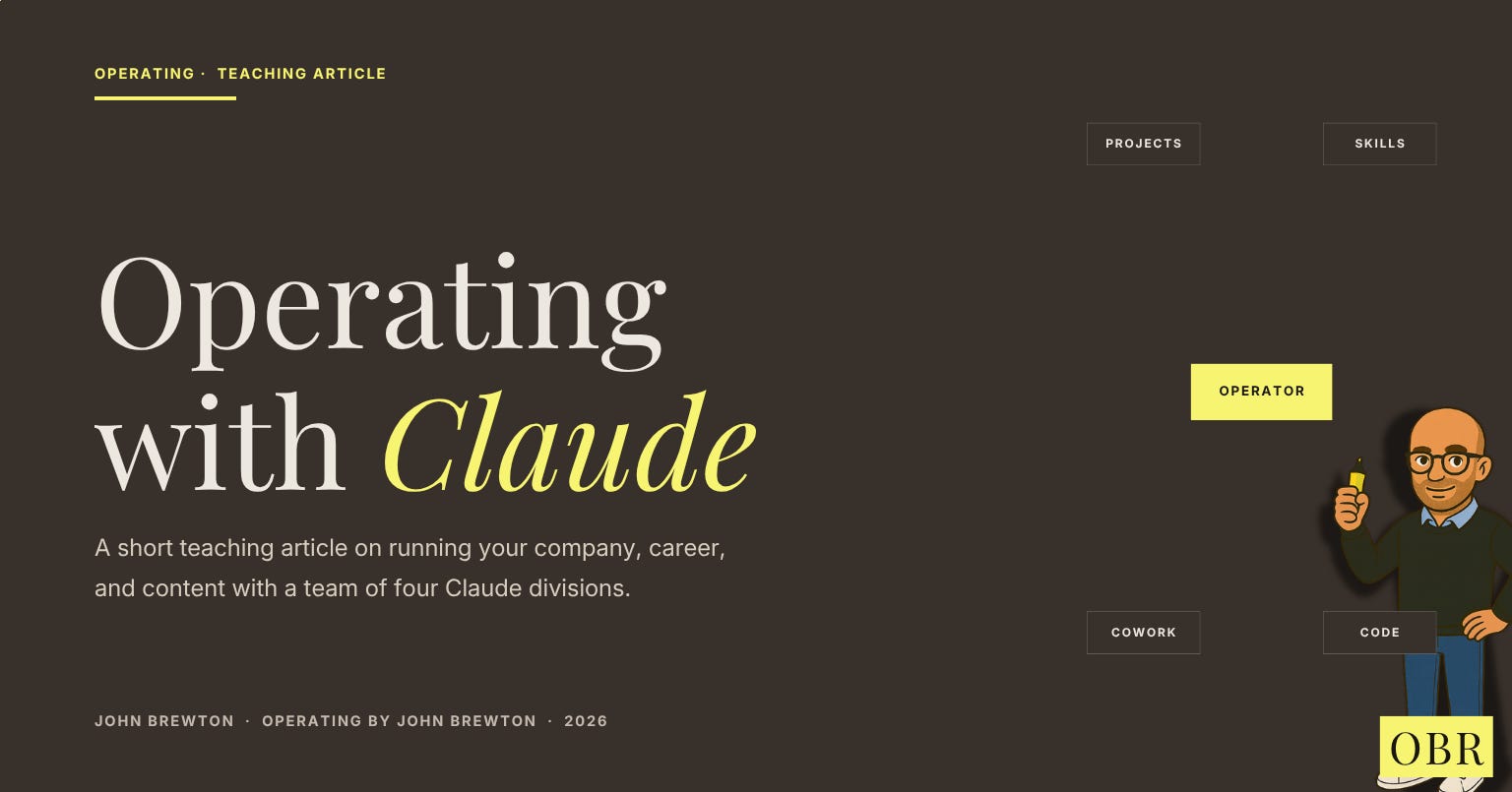
Claude is not a chat window. Claude is a four-division company.
New to Operating?
Check out these reader favorites:
Winning the Loser’s Game: The Creator Economy and the Companies We All Need to Build
0 to 55,000 - The First 90 Days Playbook - What I’d Do Differently Knowing What I Know Now
Start Here
Stop picturing a chat window. Picture a company.
A small, quiet, ferocious company with four divisions, all reporting to one person. That person is you. You are not an employee, a prompt engineer, a team member, a golden cog in a machine.
You are the CEO of a team that produces more finished work in ninety minutes than a traditional team of a dozen people produces in a week.
This is the shift most Operators have missed. Stop thinking of AI as a tool. Start thinking of it as a team.
Then, manage, run, direct, and performance evaluate the team.
Running the team has two modes…
Orchestrating and Operating
Orchestration is the meta-work. You write the playbooks. You stand up the divisions. You teach each department what “good” looks like. You wire up the systems, the APIs, the connections to the software you already live in. Orchestration is everything you do before any task arrives. It is how you raise the ceiling on what your organization can produce.
Operating is the daily work. You look at what landed on your desk. You decide which division handles it. You write the brief. You send it. You review what comes back within minutes. You edit, synthesize, and fire off the next request. Operating is the production line. It runs on rhythm, on volume, on your ability to keep it full.
Orchestration builds the production line. Operating runs it.
Most people try to do everything as an operating function. They open a fresh chat window. They dump context. They wait. They copy. They paste. They curse.
Then they do it again tomorrow from scratch.
That is not operating.
That is typing.
Real operating happens after you have orchestrated. After the divisions are standing. After the playbooks are written. After the tools are connected. Then a morning of operating looks like handing out four briefs and reading four finished outputs before lunch.
Here are the four divisions.
Projects are your Divisions
A Project is a division of your company. Each division has its own mandate, its own files, its own institutional memory, and its own standing orders.
I have a Project called Operating Stories. That division conducts my weekly research for my Operating Stories, drafts the article for me to edit and generates all of the associated digital assets and visuals. It knows my voice rules, my banned word list, my engagement data, and has access to every article in the series that I’ve published, as well as performance data.
A second division is 6A East Partners, my advisory firm. It knows the clients, meeting notes, and frameworks I implement with my corporate clients.
A third manages a client's corporate brand. And a fourth manages the assets and output for a client, for whom I advise relative to their operational strategy. A fifth handles everything relative to my personal brand.
Each division deliberately knows nothing about what the others are doing. Division-level separation is how a holding company keeps every unit sharp.
The orchestrator’s move: If you are re-explaining the same context every morning, stand up a new division.
Skills are your Playbooks
A Skill is the standard operating procedure that travels with the division that needs it. Skills are folders of instructions. They teach each division how to do a specific job the way you want it done.
I have a Skill called elite-research. When any division needs a research pass, that playbook fires. It tells Claude to only pull from the Financial Times, HBR, Stanford, Goldman, WSJ, The Economist, and the rest of my approved source list. The quality of my research is no longer a function of the hours I have available.
Meeting-intelligence turns Notion transcripts into branded client briefs. Contrarian-filter tears every draft apart before publication. An accountant friend built a Skill that closes her books. One button. Claude runs journal entries, builds the depreciation schedule, flags anomalies, and saves the workpapers. A day of work has been reduced to one hour of her time.
The orchestrator’s move: Any job you do more than three times is a Skill waiting to be written.
Cowork is your Operations Floor
Cowork is where the company actually produces the output. This is the shop floor. This is the production line.
Claude sits at your desk. Claude reads your files. Claude writes new ones. Claude opens a sandboxed Linux shell and crunches spreadsheets. Claude drafts the Word doc, formats it, saves it to the folder you picked, and hands you the link. Before it ships any work, it shows you the plan. You approve or redirect. You are the manager. Claude is the associate who has the rest of the day to finish.
Last month I pointed Cowork at six months of Substack engagement data and asked for a pattern report. Claude pulled the data, ran the analysis, drew the charts, wrote the commentary, and dropped a Word document on my desktop.
In 11 minutes.
The operator’s move: Stop copying and pasting files into chat windows. Send the folder to the floor. Let the line run.
Code is your Engineering Team
Claude Code is the engineering division. Same Claude, with full reach into the file system and a longer attention span. It writes code. It reads code. It refactors code. It also, and this is what most people miss, runs the biggest versions of the jobs the other divisions handle.
You do not have to program to staff this division. A product manager at Lenny’s Newsletter uses Code to organize his desktop, build expense reports, and sort six years of tax documents into the right folders. A writer I know uses it to maintain her book manuscript.
If Cowork is the shop floor, Code is the crew that runs the heavy machinery. Big refactors. Multi-file builds. Overnight batch jobs. You leave the work. You come back in the morning. The job is done.
I’ve personally used it to build production-ready applications for research universities and hospital environments, as well as complex client diagnostics.
The operator’s move: the moment a job touches more than five files, dispatch it to Engineering.
The systems underneath
Orchestration is not only about the four divisions. It is about the wires that connect them to the software you already use. Notion. Gmail. Google Drive. Substack. Your CRM. Claude plugs into all of it through APIs and MCP servers. Every connection you add raises the ceiling on what the company can take on.
You are not building a chatbot. You are building an operating system. Every Project, every Skill, every API, every MCP server is one more piece of production capacity. What you can produce is no longer capped by your typing speed.
It is capped by how much operational plumbing you have successfully built.
Start with one division.
Write one playbook.
Send one folder to the floor.
The rest will build itself.
We are all becoming companies.
- john -
Build it with me
If this all sounds great and you want help actually standing it up, I teach the whole system in the Unfazed Founder Sandbox.
It is a hands-on course for operators. We stand up your divisions live. We write your first Skills together. We wire Cowork and Code into the tools you already use. You leave with a real production line running.
Register for our Free Webinar, happening tomorrow (April 21st @ 1:00 PM EST) to take an intial deep dive, walk away with incredible learnings and decide if the full course offering is for you. And if you can’t attend live, just be sure to register and a reording of the event will be sent to you.
John Brewton documents the history and future of operating companies at Operating by John Brewton. He is a graduate of Harvard University and began his career as a Phd. student in economics at the University of Chicago. After selling his family’s B2B industrial distribution company in 2021, he has been helping business owners, founders and investors optimize their operations ever since. He is the founder of 6A East Partners, a research and advisory firm asking the question: What is the future of companies? He still cringes at his early LinkedIn posts and loves making content each and everyday, despite the protestations of his beloved wife, Fabiola, at times.