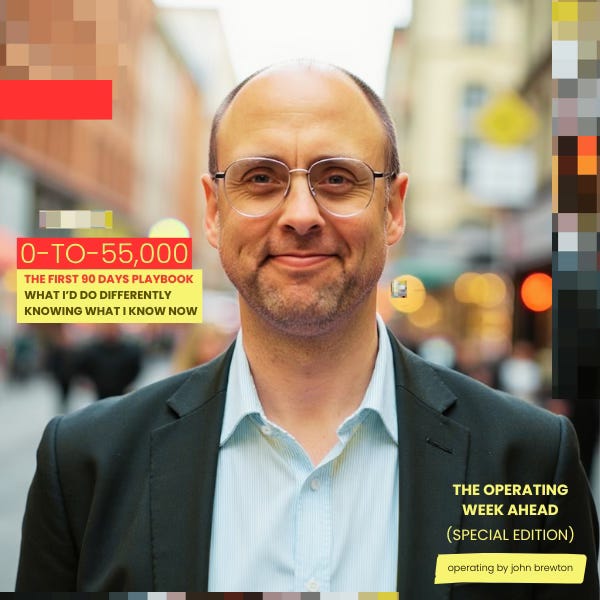
0 to 55,000 - The First 90 Days Playbook - What I’d Do Differently Knowing What I Know Now
The Operating Week Ahead Special Edition - Operating by John Brewton
In 2026, I’m working directly with 100 creators building real businesses.
I want to bring operating strategy, competitive positioning, and financial planning to a community that’s fundamentally different from my typical industrial and technology clients.
For the first 100 creator founders: Four 60-minute 1:1 advisory sessions for $95.
Context: My standard engagement starts at $10K/month. This isn’t that. This is me learning from you while helping you build something sustainable.
Limited to 100 spots. 47 of 100 have filled. Offer expires this Friday, February 6th at midnight. And once it’s gone, it will not be returning.
Most people think the hardest part of building a newsletter and personal brand is creating content. They’re wrong.
The hardest part is showing up every single day when nobody’s watching, nobody’s reading, and nothing’s happening. The hardest part is posting into a void for weeks, sometimes months, and choosing to keep going anyway.
I’ve built Operating by John Brewton from zero to over 4,000 subscribers and grown my total cross-platform following (LinkedIn, Substack, TikTok) to 55,000+ people in under two years. I’ve made nearly every mistake you can make, wasted time on strategies that didn’t work, and left money on the table because I wasn’t ready when opportunity arrived.
This playbook is the compressed version of those two years. It’s what I wish someone had handed me on Day 1, the decisions that mattered, the mistakes that cost me months of progress, and the hard truths nobody talks about when they’re selling you the dream of growing an audience and building a business of one.
If you’re in your first 90 days, or about to start, this will save you six months minimum. Maybe more.
Let’s go.
- john -
Before we talk about tactics, formats, or algorithms, we need to talk about commitment.
On Day 1, I made a decision that changed the entire trajectory: I would post every single day for one year, no matter what happened.
Not “I’ll try to post consistently.”
Not “I’ll post when I have something good.”
Every. Single. Day. For. 365. Days.
Even if I missed my morning posting window and it was suddenly 2 PM or 3 PM, I still posted.
Even if the post felt mediocre or I didn’t think anyone would care, I still posted.
Even when engagement was terrible and I wanted to quit, I still posted.
This is the decision that separates people who build something real from people who give up in Month 2.
Why Daily Posting Is Non-Negotiable (Especially Early On)
Here’s what I didn’t understand at first: social media algorithms reward presence, not perfection.
The platforms don’t care if your post is brilliant. They care if you’re active. They care if you’re engaging. They care if you’re showing up consistently enough that they can figure out who your audience is and start putting your content in front of them.
In the first 90 days, you’re training the algorithm to understand:
What kind of content you create
Who engages with it
When they engage with it
What topics resonate
If you post sporadically, three times one week, zero the next week, five times the following week, the algorithm never gets enough signal to optimize. You stay invisible.
If you post daily, the algorithm has data. And data creates momentum.
The Discipline You Actually Need
If I were starting over today, here’s the exact discipline I’d create from Day 1:
1. Post at the same time every day
Pick a time that works for your schedule and stick to it. The algorithm notices patterns. Your audience notices patterns. Consistency builds trust.
I post on LinkedIn between 6:30 and 8:30 AM Eastern most days. It’s not magic, it’s just when my audience is most active and when I can be consistent.
2. Engage with others’ content for 20-30 minutes daily
This is as important as posting your own content. Maybe more important.
Social media is social. The algorithm rewards accounts that participate in the ecosystem, not just broadcast into it.
Every day, spend 20-30 minutes:
Commenting thoughtfully on posts from creators in your niche (especially those with larger audiences than you)
Engaging during high-traffic times (early morning, lunch, early evening)
Building real relationships, not just dropping “great post!” comments
The people I spent time engaging with in my first 90 days became collaborators, referral sources, and friends. Some became clients.
3. Accept that you’ll publish into a void, and keep going anyway
Here’s the part nobody warns you about: your first 50-100 posts will feel like screaming into an empty room.
You’ll get 3 likes. Sometimes 1. Sometimes zero.
Your follower count will barely move.
You’ll wonder if anyone even sees what you’re posting.
This is normal. This is the process. This is what everyone goes through.
The difference between people who make it and people who quit is simple: the ones who make it keep posting.
Let me save you some pain. Here are the expensive mistakes I made in my first 90 days and beyond.
Mistake #1: I Didn’t Understand Post Half-Life
Early on, I thought posts “expired” after a few hours. If something didn’t get immediate traction, I assumed it was dead.
Wrong.
Posts live for days, sometimes weeks. They continue getting engagement as long as people are interacting with them. I’ve had posts gain 80% of their total impressions 2-4 days after I published them because someone with a large following commented or shared them late.
This means:
Don’t batch-schedule posts around “optimal days” thinking they’ll die after 24 hours
Pay attention to posts that have slow starts but sustained engagement
Keep responding to comments days after posting—it keeps the post alive in the algorithm
Mistake #2: I Feared Overexposure
I was terrified that if I posted every day, I’d annoy my network. I worried that my entire following would see every post and think “ugh, this guy again.”
Here’s the reality: your full network will NOT see every post you publish.
The algorithm shows your content to a small percentage of your followers initially (often 5-15%). If that group engages, it expands to more people. If they don’t, the post dies quietly.
This means:
You’re not annoying people by posting daily—most of them aren’t seeing most of your posts
The fear of “embarrassing yourself” is overblown—your awkward early posts will be seen by almost nobody
Posting frequently gives the algorithm more chances to find the people who actually care about your content
Stop worrying about overexposure. Start worrying about underexposure.
Mistake #3: I Didn’t Track My Data From Day 1
Eventually I started tracking detailed metrics on every post. I wish I’d started on Day 1.
Here’s what you should track for every single piece of content:
Content type (carousel, text post, video, infographic, etc.)
Platform (if you’re multi-platform)
Reactions/likes
Comments
Shares/reposts
Impressions
Reach
Time of day published
Simple spreadsheet. Eight columns. Fill it out immediately after posting.
After 30 posts, you’ll start seeing patterns.
After 90 posts, you’ll know your formula.
Without tracking, you’re guessing. With tracking, you’re learning.
Mistake #4: I Prioritized Audience Growth Over Monetization For Too Long
This is the big one. The mistake that cost me the most.
I spent 12-15 months obsessing over follower count and brand awareness. I thought: “Once I have 10,000 followers, monetization will be easy. Once I have 25,000, the offers will come.”
I was completely wrong.
Followers don’t equal revenue. Audience size doesn’t automatically convert to income.
I had a fundamental misconception: growing an audience would naturally lead to monetization. It doesn’t. You need an intentional business model and monetization strategy from much earlier on.
What I should have done:
Launched my newsletter and built my advisory business infrastructure 6-9 months sooner. I would have started transitioning from traditional consulting work to strategic advisory and newsletter monetization much faster.
I would have focused on:
Building an email list (owned audience, not rented from platforms)
Defining my offers clearly
Creating conversion systems and communication
Developing client intake processes
Setting up monetization infrastructure
Instead, I kept doing traditional consulting while building a big audience with no clear path to serve them or convert them into clients. It created stress and delayed the business model that actually works.
The lesson: Don’t wait until you have a “big enough” audience to build your business. Build the business model whileyou build the audience. When opportunity arrives—including viral moments—you’ll be ready to convert it.
I’ve had multiple viral posts on LinkedIn. The early ones, I left money on the table because I didn’t have systems and offer communication in place. When tens of thousands of eyeballs arrived, I couldn’t convert them. Don’t make that mistake.
About one month into daily posting, I published a post about Andy Grove’s book High Output Management.
It wasn’t just a book summary. I made it vulnerable. I talked about my own mistakes managing teams in my company at the time—the things I was getting wrong, the lessons I was learning the hard way.
The post got hundreds of reactions. I got my first reposts. I added followers. Intel commented on the post, which pushed it out to their entire employee network.
That was the moment I realized how audience growth actually works:
Credible source material + personal vulnerability + external amplification = breakthrough
I’d found the formula.
Then nothing similar happened again for six months.
That’s the part nobody tells you. You’ll have an early win that shows you what’s possible. Then you’ll go right back to the grind, posting into the void, wondering if it will ever happen again.
It will. But only if you keep going.
The early win isn’t proof you’ve “made it.” It’s proof the formula works. Now you just have to execute it 100 more times until the pattern becomes consistent.
Looking back at the entire journey from 0 to 4,000+ subscribers and 55,000+ followers, these are the decisions that had outsized impact. Not tactics. Not hacks. Strategic decisions.
1. The One-Year Commitment to Daily Posting
I’ve already covered this, but it bears repeating: committing to 365 days of daily posting, no matter the results, changed everything. It removed the option to quit when things got hard.
2. Joining Ship 30-for-30
This was the first course I took, a community of writers committing to publish high-quality long-form content every day for 30 days.
The accountability and community were transformative. I wasn’t just learning how to write better—I was surrounded by people doing the same hard work, which made it feel possible.
If I were starting today: I’d take this course (or something similar) almost immediately—within the first month or two—rather than posting on my own without educational direction for six months. The structure and feedback accelerated my learning curve dramatically.
3. Investing in a High-Ticket Cohort ($5K)
After Ship 30, I joined a more intensive cohort focused on visual content design (infographics and carousels) and advanced platform strategy.
I invested 40+ hours per week, nights and weekends, while working my primary consulting job. It was brutal. I was working 80-90 hours a week total.
But I learned and built the following:
Learned how to design high-quality visual content that stopped the scroll
Built relationships with creators who had far larger audiences than me
Got direct feedback on my content from people who knew what worked
This was the skill-building accelerator. Worth every dollar and every late night.
The caveat: I took one additional cohort after this that I could have skipped. After the first 10-week intensive program, I knew what I needed to know. The next one was me being eager to keep learning when I should have shifted to execution.
Don’t over-consume courses.
After you have the fundamentals, it’s about reps, not more education.
4. Platform Mastery Over Platform Diversification
I made a deliberate choice: go deep on one platform (LinkedIn) rather than spread myself across multiple.
I studied how LinkedIn’s algorithm worked. I learned what content formats performed best. I optimized my posting times, engagement strategy, and content mix specifically for LinkedIn’s ecosystem.
This is counterintuitive advice in the “be everywhere” era, but it’s right.
Mastering one platform beats being mediocre on five platforms. Once you have momentum and systems on Platform 1, you can expand. But early on, focus wins.
5. Prioritizing Comment Engagement
I spent hours every day responding to comments on my own posts and engaging thoughtfully on other creators’ content.
Not just “thanks!” or “great point!” replies. Real engagement. Substantive comments that added value. Questions that started conversations.
This did two things:
Built real presence and relationships on the platform (not just broadcasting)
Signaled to the algorithm that my content was generating sustained engagement, which boosted reach
Social media is social. If you’re only posting and not engaging, you’re using 50% of the tool.
6. 150+ Unpaid Zoom Coffee Chats
Over my first year, I scheduled more than 150 thirty-minute Zoom calls with other creators I met on LinkedIn.
None of these were paid. None were sales calls. They were pure learning conversations: What are you doing? What’s working? What business are you building?
These calls taught me more about the creator economy, content strategy, and business models than any course. They also built a network of peers who became collaborators, referral sources, and friends.
Don’t underestimate the power of genuine curiosity and relationship building.
Reach out to people doing interesting work. Ask thoughtful questions. Learn from their experience. The ROI on these conversations compounds over years.
Enough about my mistakes.
Here’s the exact playbook I’d follow if I were starting from zero today.
Week 1: Foundation
Action 1: Optimize your profile FIRST
Before you post anything, make sure your profile is fully optimized for the platform you’re building on:
Profile picture: High-quality, recognizable, professional (or personal, depending on your brand)
Headline/description: Clear, keyword-rich, communicates what you do and who you serve
Banner image: Optimized for platform specs, reinforces your positioning
All biographical fields: Completed strategically, not left blank
Your profile is your landing page. When someone discovers your content, they’ll click through to see who you are. If your profile is incomplete or unclear, you lose them.
Action 2: Research what’s working on the platform RIGHT NOW
Don’t assume you know what performs well. Study the platform:
What content types are currently popular? (Carousels? Short videos? Text posts?)
What new features is the platform aggressively pushing? (The algorithm favors new features to drive adoption)
Who are the top creators in your niche, and what are they doing?
Platforms evolve. What worked six months ago might not work today. Do current research.
Action 3: Start posting daily + engage 20-30 minutes per day
From Day 1:
Post daily at a consistent time
Use platform-favored content types (from your research)
Tell YOUR story (not generic content—make it personal and specific)
Post as frequently as you can while maintaining quality
Spend 20-30 minutes daily engaging with larger accounts in your niche
This is your foundation. Everything else builds on this.
Weeks 2-4: Building the Habit
Your only job is consistency.
Keep posting daily
Keep engaging daily
Start tracking your data (the 8 metrics listed earlier)
Don’t worry about follower count yet
Don’t expect virality
Just show up
What “good” looks like in the first 30 days:
If you’re doing it right, you should see:
Slight upticks in engagement on certain posts (signals you’re finding patterns)
A few comments from people you don’t know (signals you’re reaching beyond your immediate network)
Variability in performance (some posts get 5 reactions, some get 15—this is the algorithm testing)
What “struggling” looks like:
If you’re seeing zero engagement across the board—literally 0-1 reactions on every post for 30 days straight—something’s wrong:
Your content might be too generic (not differentiated enough)
Your profile might not be clear about who you serve
You might not be engaging with others enough (the algorithm notices if you only broadcast)
Your content format might not match what the platform favors right now
Adjust based on data. Double down on what’s getting any traction at all.
Weeks 5-8: Pattern Recognition
By Week 5, you should have 30+ posts tracked in your spreadsheet. Now you can start identifying patterns:
Which content types perform best for you?
Which topics generate the most engagement?
What time of day gets the best reach?
Are longer posts or shorter posts working better?
This is where you start optimizing.
Don’t just keep doing the same thing. Look at your top 5 performing posts and ask:
What did these have in common?
Can I replicate this format/topic/hook?
Look at your bottom 5 performers and ask:
What should I stop doing?
What didn’t resonate?
Double down on what works. Cut what doesn’t.
Weeks 9-12: Building Momentum
By Week 9, you’re not a beginner anymore. You have 60+ posts of data. You’ve found formats that work. You’re starting to build relationships with other creators.
Now it’s about compounding:
Keep posting daily (this never stops)
Increase engagement time if you can (30-45 minutes instead of 20-30)
Experiment with new formats based on what’s working
Start building your newsletter infrastructure (even if you don’t launch yet)
What “good” growth looks like at Day 90:
This is highly platform-dependent, but here are rough benchmarks:
LinkedIn: 100-300 new followers in 90 days if you’re posting daily and engaging consistently
Substack: 50-150 email subscribers if you’ve been promoting your newsletter in your bio and posts
Engagement rate: 3-8% on your better posts (reactions + comments + shares / reach)
What “great” growth looks like:
300-500+ new followers
150-300+ email subscribers
One or two posts that significantly outperformed your average (early viral signals)
Inbound messages from people asking about your work or wanting to collaborate
What “struggling” looks like:
Fewer than 50 new followers after 90 days of daily posting
Consistently low engagement (under 2%) with no upward trend
No inbound interest or messages
If you’re struggling at Day 90, something needs to change:
Your niche might be too broad or too crowded
Your content might not be differentiated enough
You might need to engage more actively with others
You might be on the wrong platform for your audience
Don’t quit at Day 90. Adjust and keep going.
Let me end with the things I wish someone had told me straight.
1. Virality Doesn’t Matter If You’re Not Ready For It
I’ve had multiple viral moments. Early on, they felt amazing—thousands of new followers overnight!
But I couldn’t convert them. I didn’t have:
A clear offer
A newsletter to capture emails
A funnel to move people from follower to client
Systems to handle inbound interest
So the followers came, scrolled my profile, and left. Wasted opportunity.
Build your monetization infrastructure BEFORE virality, not after.
When the eyeballs arrive, you need to be ready to serve them and convert them. Otherwise, it’s just a vanity metric.
2. Small Audiences Can Be Highly Monetizable
Thanks to interest-based algorithms (a TikTok innovation), it’s easier than ever to build small, highly engaged audiences in specific niches.
You don’t need 100,000 followers to build a real business. You need 500-2,000 people who genuinely care about what you’re building and will pay for your expertise, products, or services.
Stop chasing size. Start chasing engagement and business model clarity.
3. If You’re Not Expert Enough Yet, Document The Learning Process
Here’s an Alex Hormozi line I think about constantly: “Go do more epic shit” if the shit you’ve done isn’t epic enough for people to be interested.
Translation: If you’re not an expert yet, go become one, and document the journey.
Document the learning process. Share what you’re discovering. Be honest about what you don’t know yet.
People will follow the journey. And by the time you ARE an expert, you’ll have an audience ready to buy from you.
4. The First 90 Days Are Just The Beginning
If you think 90 days is enough time to “make it,” you’re going to be disappointed.
90 days is enough time to:
Build the habit
Learn the basics
Find formats that work
Start building relationships
Prove to yourself you can do this
But real momentum takes 6-12 months of consistent execution. Real business results take 12-24 months.
This is a long game. Commit accordingly.
If I could go back to the very beginning and give myself one piece of advice, it would be this:
The consistency matters more than the content.
Your first 100 posts won’t be great. They’ll be awkward and unpolished.
You’ll cringe when you read them a year later.
Post them anyway.
Because the only way to get to post 500, the one that wildly grows your audience or sells through on your offer, is to publish posts 1 through 499 first.
The people who win aren’t the most talented. They’re the ones who keep showing up when it’s hard, when nobody’s watching, when nothing’s happening.
Show up every day.
Track your data.
Build relationships.
Learn from what works.
Build your business model while you build your audience.
And don’t quit in Month 3 just because you’re not viral yet.
The compound interest is coming.
You just have to stay in the game long enough to collect it.
Now go build.
Your first 90 days start today.
- j -
This essay is part of the Operating by John Brewton - Operating System for One-Person Businesses, a collection of frameworks, playbooks, and lessons from building a creator business from zero to $10K+ MRR. Available exclusively to paid subscribers of Operating by John Brewton.
In 2026, I’m working directly with 100 creators building real businesses.
I want to bring operating strategy, competitive positioning, and financial planning to a community that’s fundamentally different from my typical industrial and technology clients.
For the first 100 creator founders: Four 60-minute 1:1 advisory sessions for $95.
Context: My standard engagement starts at $10K/month. This isn’t that. This is me learning from you while helping you build something sustainable.
Limited to 100 spots. 47 of 100 have filled. Offer expires this Friday, February 6th at midnight. And once it’s gone, it will not be returning.
John Brewton documents the history and future of operating companies at Operating by John Brewton. He is a graduate of Harvard University and began his career as a Phd. student in economics at the University of Chicago. After selling his family’s B2B industrial distribution company in 2021, he has been helping business owners, founders and investors optimize their operations ever since. He is the founder of 6A East Partners, a research and advisory firm asking the question: What is the future of companies? He still cringes at his early LinkedIn posts and loves making content each and everyday, despite the protestations of his beloved wife, Fabiola, at times.


John, I really hope everyone on Substack reads this playbook, as it is genius. For me, the key is consistent posting, and on Substack I struggle to do a post every day, but certainly notes every day is possible. Also, really easy to forget about the half-life of our most valuable content. For example, today a best-selling Substack with tens of thousands of followers restacked something I wrote five months ago. It just shows that the algorithm does eventually reward excellent content once you've built the readership in the first place. Thanks as ever for sharing so openly and building with such great humility.
Sharing this for free is crazy, greatly appreciated!