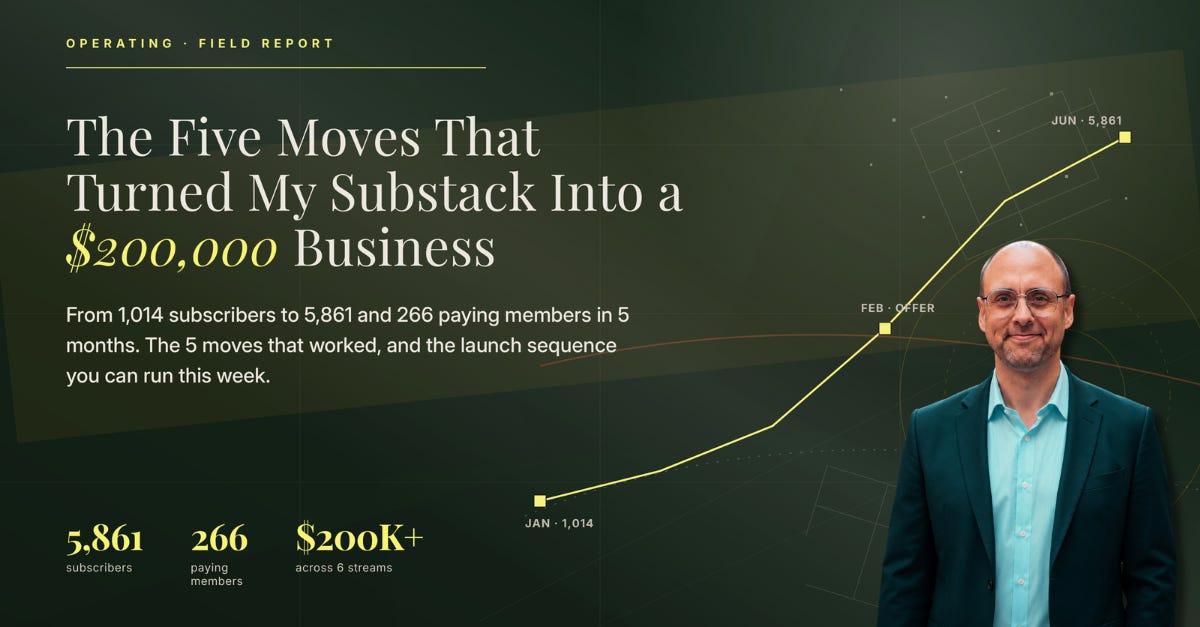
The Five Moves That Turned My Substack Into a $200,000 Business
A short, action-first guide supplement for everyone ready to start building
A few days ago, I published the full account of how I built my newsletter business over the last 6 months: How I Built a $200,000 Newsletter Business From a Substack Nobody Was Reading. It reached more readers than anything I have written, and the replies asked one question more than any other: What are the actual steps?
This is the answer.
The full piece tells the whole story. This one strips it to the 5 moves that worked and gives you the launch sequence to start building and execute yourself.
Read it in 3 minutes.
Start building this weekend.
The Numbers: I started 2026 with 1,014 subscribers and about $2,200 a year. By June 1 I had 5,861 subscribers, 266 paying members, and 6 revenue streams on track for more than $200,000.
Move 1: Build the back catalog before anyone reads
I published 81 posts in 9 months to a small list and low engagement. By the time traffic arrived in 2026, 81 posts were waiting. New readers found a library, not an empty page.
Publish on a schedule before anyone reads. Build the back catalog first so that when your discovery mechanism starts workings, your new readers are delighted by what they find.
Move 2: Make one unscalable offer
On February 1 I launched the Operating Founder offer. It was $99 for four 60-minute 1:1 sessions, about $25 a session. It sold 100 seats in 12 days. Across 400 hours of those sessions I learned what a valuable coaching offer and course structure would look like for my audience.
Make your first offer small, direct, and 1:1. Use what you learn to build what scales.
Make it an easy offer for people to say yes to.
Move 3: Release your proof the same week as your offer
On February 2 I published “0 to 55,000: The First 90 Days Playbook.” It got 4,210 views and 85 new paying members in one day. The offer was already live. The proof landed on top of it.
Write the post that shows what you know. Publish it the same week you make your offer. Spend less time theorizing and philosophizing and more time talking about what you have credibly done, built, and learned from what has worked and what hasn’t.
Move 4: Use scarcity
My scarcity emails opened at 46 percent and 34 percent as the cohort filled and closed. “Seats left” outperformed “join now” every time.
State a real cap and a real deadline. Then close it when you said you would.
Studying how luxury brands use scarcity to sell their products is immensely valuable in building the strategic capacity for your business. Check out these articles for more on this concept:
Move 5: Sell access, not posts
Subscriptions bring in $9,600 a year. Coaching, the founder program, and a private community with weekly office hours bring in the rest. Paying members get direct access free readers do not.
Sell access to you. Use your AI stack to make this more efficient than it would be otherwise.
The 12-Day Launch Sequence
The Tools
Pick the tools that remove hours from work you repeat. Every hour you remove is capacity you can sell.
The Newsletter to Revenue Workbook
The Operating Workbook turns these five moves into four worksheets you fill in: name your one idea, design your offer, plan your 12-day launch, and track your first 90 days. Print it, work through it, and you leave with your own plan instead of my notes.
The Operating Project
The 5 moves above are the plan, but it’s easy for a plan to stay that and nothing more.
If you’d like to work together to build your newsletter business, the Operating Project is for you! We take one problem in your business across 4 sessions, from diagnosis to a finished system, plus the machine that runs it inside Claude or ChatGPT. You own it. It lives in your account.
It regularly sells at $999, but I have opened 20 founding seats at $499 (9 of which have already filled). Each seat includes a year of VIP access to the Operating Founders community and the weekly Friday office hours. Run your 4 sessions any time through December 31, 2026.
Pick the problem. I will help you solve it, and build the machine that keeps your business growing for months into the future.
For the full story behind these moves, read the original article.
- j -
About John
John Brewton documents the history and future of operating companies at Operating by John Brewton. He is a graduate of Harvard University and began his career as a PhD student in economics at the University of Chicago. After selling his family’s B2B industrial distribution company in 2021, he has been helping business owners, founders, and investors optimize their operations ever since. He is the founder of 6A East Partners, a research and advisory firm asking the question: What is the future of companies


Thanks for this brilliant post John. I am so fortunate to have you as someone to follow to learn how to actually sell my expertise without shame. Thanks for genuinely giving us one of the only playbooks I actually use.
The transition from a low-ticket, unscalable offer into a full ecosystem is a great blueprint for anyone trying to monetize a audience. Appreciate you laying out the actual mechanics instead of just the high-level theory.