Operating by John Brewton

Operating by John Brewton

Operating Stories

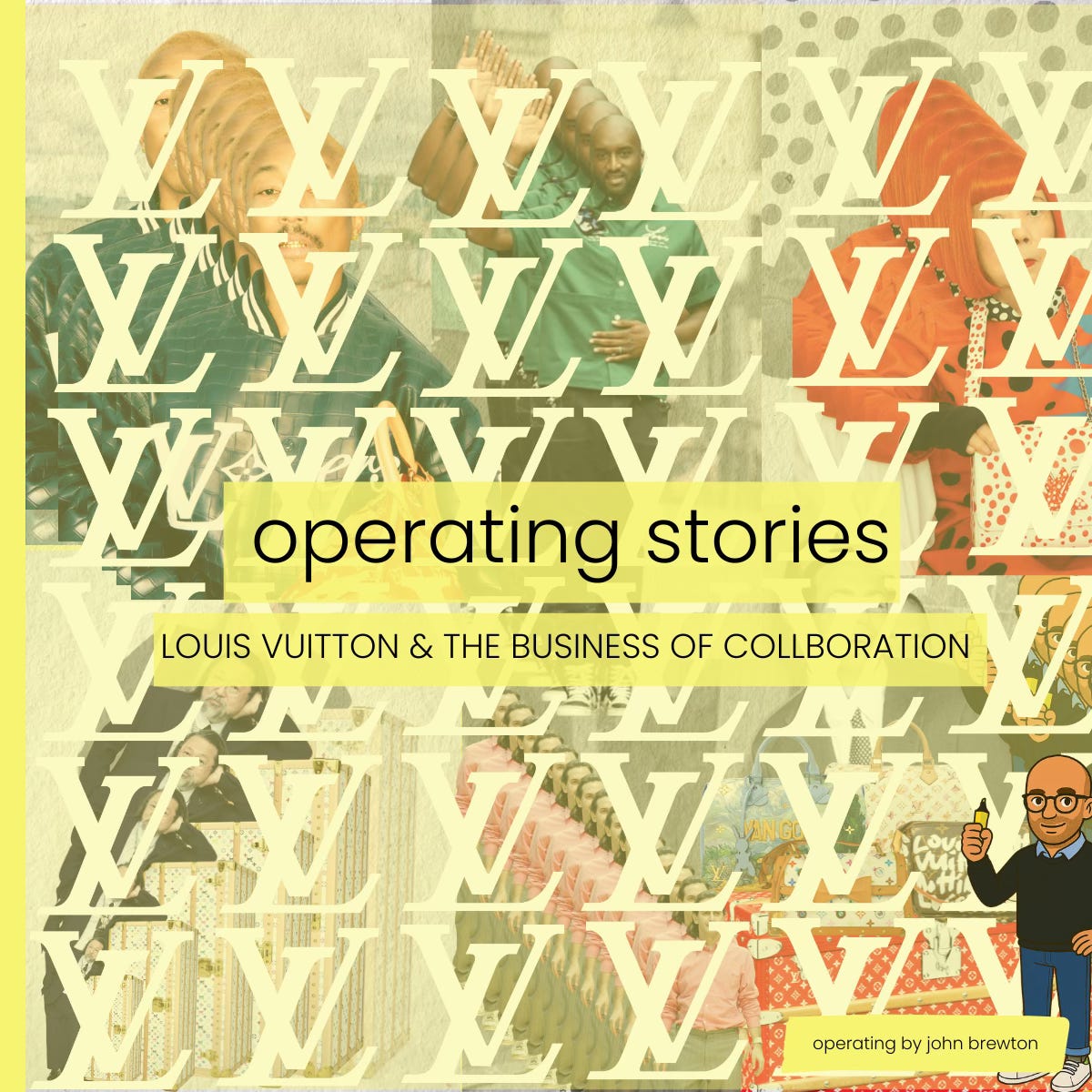
Operating Stories: Louis Vuitton and the Business of Collaboration

A Weekly Series From Operating by John Brewton Making Business History Actionable for Creators, Founders and Small Business Builders

John Brewton's avatar
John Brewton
Feb 15, 2026
∙ Paid

Are you new to Operating?

You Might Enjoy These

(Access the entire library of articles and resources for $7.99 per month)
  • 0 to 55,000 - The First 90 Days Playbook - What I’d Do Differently Knowing What I Know Now

  • The Operating by John Brewton Resource Library - No Filler. All Killer.

  • WINNING THE LOSER’S GAME: The Creator Economy and the Companies We All Need to Build

  • Operating Stories: Hermès and the Manufacturing of Scarcity

  • Operating Economics: Building Antifragile Companies

  • How Three Decades Rewrote the Economics of Companies

Become a paid subscriber to access all the content ($7.99 / month) or get to work with us and become a member of the Operating Founder cohort for $99 (annual).

What Creators, Solopreneurs, and Small Firms Can Learn From the House That Turned Collaboration Into a Money Machine


This article is designed to meet you wherever you learn best. Free subscribers get the thesis and the six principles above. Paid subscribers get the full financial analysis, era-by-era breakdown, branded charts, and the LV Collaboration Playbook, plus a downloadable AI Prompt Pack with sixteen structured prompts you can run in ChatGPT, Claude, Gemini, or any AI tool to apply these principles directly to your own business. As an experiment, I've also built a NotebookLM notebook with the full article and all of my underlying research, so you can ask your own questions, generate an audio summary, or go deeper on any section at your own pace (this asset is only able to be accessed by my paid community given sharing restrictions from NotebookLM/Google). Since this is the first time I’m trying this approach, I’m releasing the notebook to all subscribers (future edtions will be solely for my paid audience).

Become a monthly paid subscriber for $7.99 / monthly → $55 / Annually


Start Here

In the last installment of Operating Stories, I wrote about Hermès and the manufacturing of scarcity. My thesis was simple: Hermès builds its entire business model around saying no. No to faster production. No to wider distribution. No to the customer who wants a Birkin but hasn’t earned the relationship.

Louis Vuitton is the inverse.

Where Hermès restricts, Vuitton absorbs and expands into the larger cultural market. Where Hermès guards the gates, Vuitton opens them, selectively, strategically, and on its own terms. For nearly three decades, collaboration has not been a marketing tactic at LV. It has been the operating system. And the numbers prove the system works.

Louis Vuitton is the largest luxury brand on earth. Analysts estimate roughly €22–25 billion in annual revenue. Kantar BrandZ has ranked it the world’s most valuable luxury brand for eighteen consecutive years, with a current valuation of approximately $130 billion.

But here’s the part most people misunderstand: the clothes are not the business. The runway shows, the celebrity creative directors, the fashion-week spectacles, these are not the profit center either. They are the attention infrastructure. The actual business is leather goods and accessories. Analyst models allocate roughly two-thirds to three-quarters of LV’s revenue to bags, wallets, trunks, and small leather goods. According to a Reuters report referencing LVMH Chairman Bernard Arnault, classic monogram canvas bags generate gross margins of approximately 90%. Ready-to-wear represents only about 10–15% of sales.

The runway is the customer acquisition cost.

The monogram bag is the lifetime value.

Every collaboration LV has run over three decades, from Takashi Murakami’s $345 million first-year sales to Supreme’s resale frenzy to Pharrell’s billion-view debut show, serves a single strategic purpose: get new people into the funnel while reinforcing the brand codes that keep existing buyers loyal. And the brand codes never change. The monogram was there before Marc Jacobs. It survived Sprouse, Murakami, Prince, Koons, Kusama, Supreme, Virgil Abloh, and Pharrell.

It will survive whoever comes next.

What I found, studying three decades of LV’s collaboration history, is that the system runs on six hard principles:

  1. Signature first, collaborators second: Your brand’s core identity is the non-negotiable anchor. If your signature can’t survive reinterpretation, it isn’t strong enough.

  2. Collaborate to absorb culture, not decorate product: Choose collaborators for the communities and cultural lanes they bring, not just for aesthetics or clear parallel.

  3. Scale through breadth of collaborators, not reinvention of identity. One set of codes, many interpreters.

  4. Runway and collaborations are marketing engines for the core business: High-concept work is a line item in CAC. Know what your “bag” is, the offer that actually pays.

  5. Design with communities, not just for them: Bring your target communities onto the stage, into your content, into your process, not just into your audience.

  6. Build a curated network, not a collaboration calendar: Long-term “friends of the house” compound brand equity. Random one-offs create noise.

Those six principles are visible in every era of the house’s modern history. Jacobs proved the monogram could survive radical reinterpretation. Murakami proved collaboration could move a P&L. Supreme proved a single drop could compress years of audience acquisition into one cultural moment. Abloh proved that embedding community into leadership was more powerful than any product partnership. Pharrell is proving that a creative director’s outside network can function as the brand’s distribution channel.

The full article below traces how each of these principles showed up across each era, with the verified financial data behind them, sourced from LVMH annual reports, earnings releases, Kantar BrandZ rankings, and trade-press estimates where LVMH doesn’t disclose. I also cover the risks: what happens when collaboration becomes fatigue, how LV manages that tension through guardrails and IP enforcement, and what the 2024 luxury slowdown reveals about the limits of cultural capital as a business strategy.

If you operate a business, build a brand, or create content, the lesson is not to copy Louis Vuitton. It is to understand the system underneath the spectacle.

Hermès shows what happens when you say almost no to the world.

Louis Vuitton shows what happens when you say yes constantly, but only on your own terms.

The full article, financial analysis, charts, and collaboration playbook continue below for paid subscribers.


🔒 The full Operating Stories deep dive continues below — including era-by-era financial breakdowns, the LV Collaboration Playbook infographic, and actionable frameworks for applying these principles to your own business. [Upgrade to paid to continue reading →]

Become a paid subscriber to access all the content ($7.99 / month) or get to work with us and become a member of the Operating Founder cohort for $99 (annual).

What Is Louis Vuitton’s Business Model?

User's avatar

Continue reading this post for free, courtesy of John Brewton.

Or purchase a paid subscription.
© 2026 John Brewton · Privacy ∙ Terms ∙ Collection notice
Start your SubstackGet the app
Substack is the home for great culture