

New to Operating? Start with The Star Acquisition Company, Claude and the Three Decisions, and The Challenger’s Playbook.
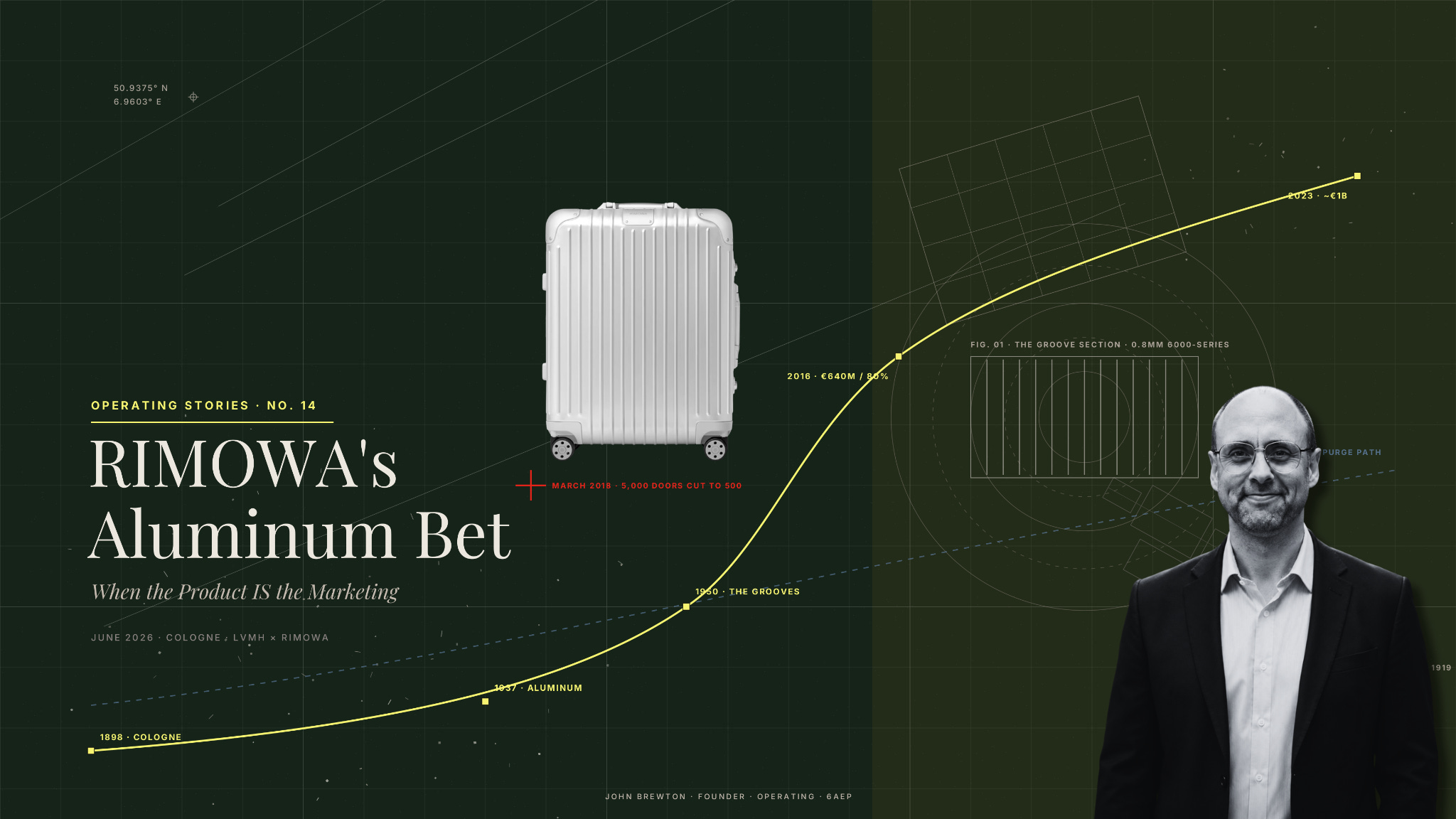
RIMOWA’s Aluminum Bet was a 1937 material decision that became a 1950 engineering decision that became a 1980s manufacturing footprint that became a 2016 €640 million acquisition that became, by 2023, an estimated billion-euro business.
TL →DR
In October 2016, LVMH paid €640 million for 80% of RIMOWA, a 118-year-old Cologne suitcase maker doing roughly €440 million in revenue. The multiple was 1.8 to 2.0× revenue.
The asset was 1 physical feature: parallel grooves pressed into 0.8mm aluminum since 1950, copied from the corrugated skin of the Junkers F13 aircraft. The grooves are structure that doubles as recognition. You cannot separate the two.
Alexandre Arnault, 24, cut distribution from 5,000 doors to roughly 500, raised prices 20%, deleted the logo ornament, and moved 100% of ad spend to digital. Revenue dipped for 2 years, then nearly quadrupled to an estimated €1 billion by 2023.
The research backs the mechanism. Berger and Ward showed the most expensive products carry the fewest logos. Visibility research shows visible, differentiated products earn outsized word of mouth. The grooves pass every test in the literature.
The out-of-sample proof: RIMOWA grew through the 2024–2025 luxury downturn while the market shrank and sector margins fell to 2009 levels.
4 principles transfer: find the 1 feature only you can do, subtract everything that competes with it, make wear an asset, and put the product where buying decisions happen.
On October 4, 2016, LVMH paid €640 million for 80% of an 118-year-old German suitcase company with 3 factories, roughly 3,000 employees, and 1 engineering decision dating to 1950 (Reuters).
The implied enterprise value was roughly €800 million. The multiple was 1.8 to 2.0× revenue (Business of Fashion). The Cologne factory was making suitcases the same way it had for 7 decades, feeding 0.8mm aluminum sheet through a proprietary rolling die that pressed parallel grooves into the metal before bending it into a half-shell (factory video).
LVMH did not buy the factory. It bought the grooves.
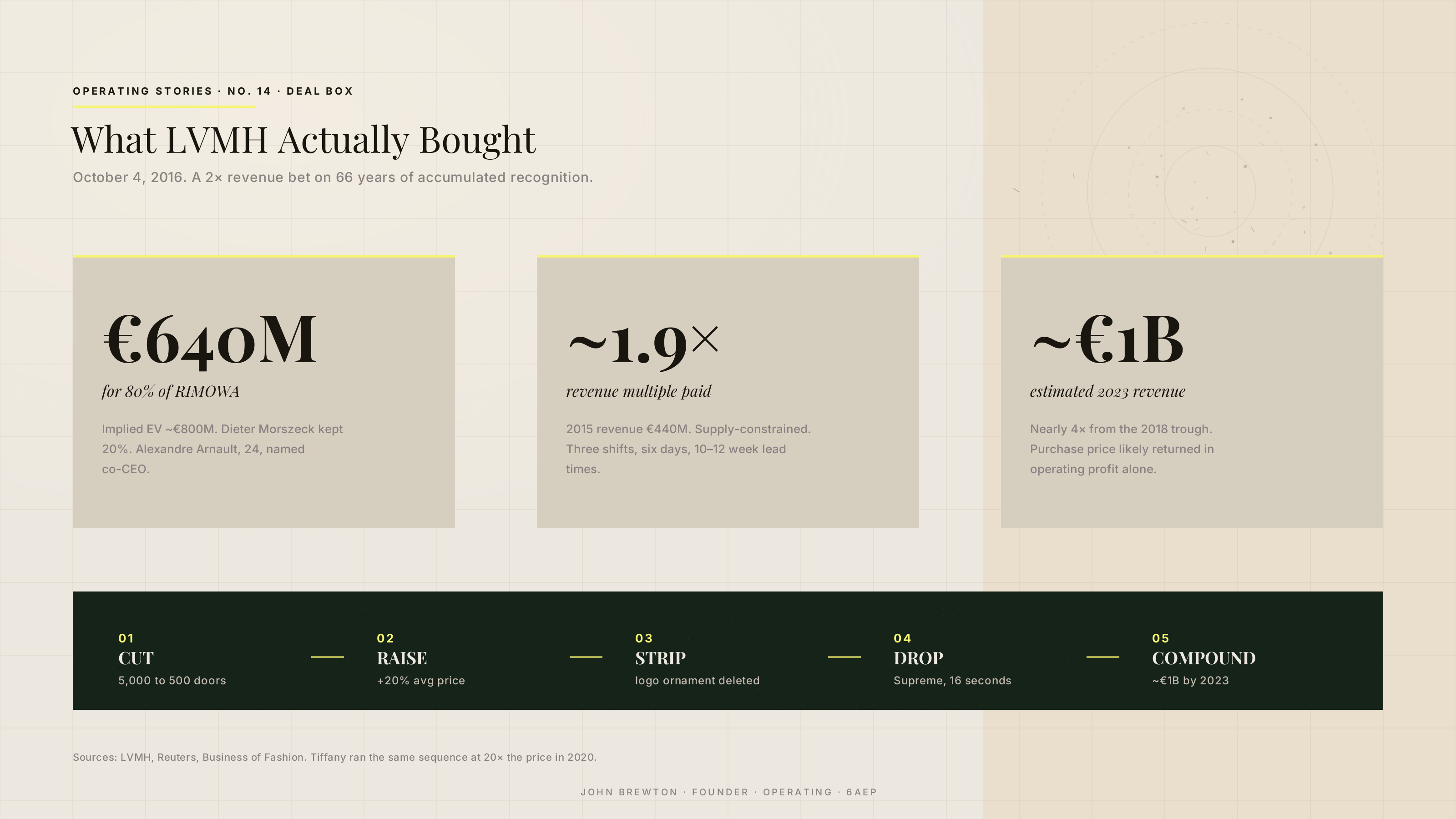
The deal box. €640 million for 80%, roughly 1.9× revenue, and the five-move sequence that followed. Tiffany ran the same playbook at 20× the price four years later.
The Operating Thesis: RIMOWA Is Not a Luggage Company
RIMOWA is an 85-year case study in artifact design. Make the physical object so visually distinctive that the product becomes the brand’s primary marketing channel. That is the whole thesis.
The grooves are not decoration. They started in 1950 as a structural fix borrowed from the corrugated duralumin skin of the Junkers F13, the world’s first all-metal commercial aircraft (Forbes). The ribbing let Richard Morszeck use thinner aluminum without losing rigidity, the same principle that let Hugo Junkers’s aircraft fly. RIMOWA claims that the corrugation increases panel stability and impact resistance by up to 50% compared with a flat sheet of the same gauge (MightyTravels).
Function came first. Recognition followed. Recognition built the business.
By 2016, the grooves were doing work no advertising budget can buy: making the suitcase legible from 20 meters in any airport on earth, in any light, with zero typography. Taiwan’s IP courts later weighed whether the parallel grooves constituted a protectable trade identity, confirming in law what travelers already recognized at a glance (Managing IP).
The grooves are the brand. No wordmark required.
LVMH paid €640 million for that fact.
What the academic research says about products that advertise themselves
The mechanism has a literature behind it. 3 findings matter the most:
First, the inverted-U. Berger and Ward documented in 2010 that the most expensive products in a category carry the fewest explicit brand markers. Insiders decode subtle signals. Outsiders cannot. The grooves are the textbook case: legible to the knowing, invisible as branding to everyone else.
Second, costly signaling. The theory requires a signal to be observable, hard to fake, and tied to a real underlying quality (Nelissen and Meijers, 2011). The grooves clear all 3 bars: visible across a terminal, inseparable from a forming process RIMOWA calls “a highly coveted secret,” and tied to measurable engineering performance. A 2017 replication found the status payoff of luxury logos weakens in some settings. The grooves dodge that fragility because they signal competence and miles traveled, not wealth alone.
Third, visibility drives conversation. Berger and Schwartz showed across 300+ products that publicly visible, environmentally cued products earn more word of mouth, immediately and over time. Lovett, Peres, and Shachar added that differentiated brands earn outsized conversation. A grooved aluminum case in an airport stacks all 3 effects.
The grooves pass every test the literature sets. RIMOWA built the signal in 1950 and never diluted it. The discipline is the point.
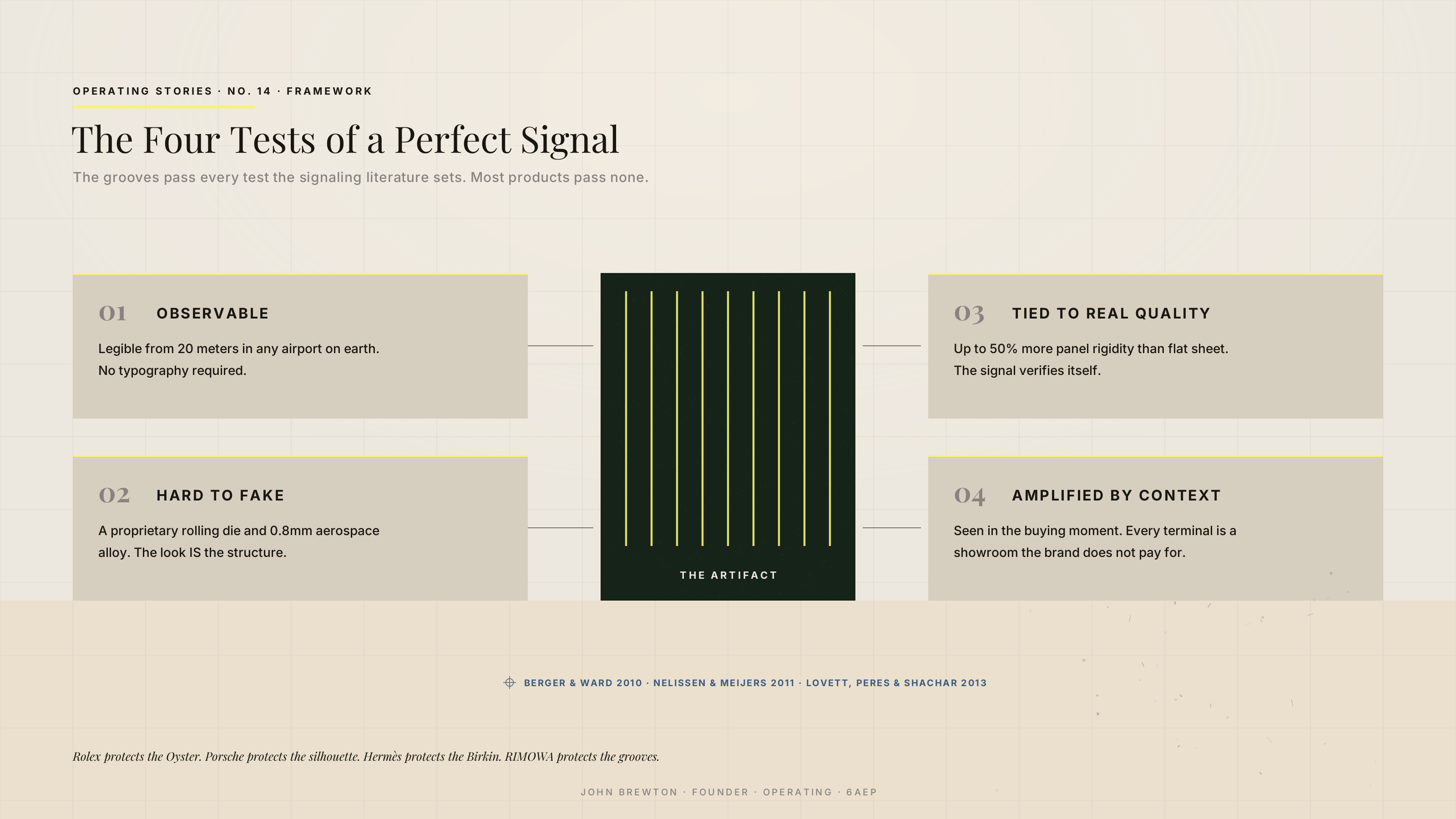
The four tests of a perfect signal. Observable, hard to fake, tied to real quality, amplified by context. The grooves pass all four. Most products pass none.
3 Decisions That Made RIMOWA
Most heritage brands have 1 origin story and a long tail of incremental choices. RIMOWA’s history rests on 3 discrete operating decisions, each separated by roughly half a century and defining the next era.
