

New to Operating?
Check out these reader favorites:
What is Operating Stories?
This series is built differently. It comes in two speeds.
The primary article, above the fold, gives you the essentials of the story being told, the charts, and the four operating principles in under five minutes.
But the article is just the center of a larger system designed to meet you wherever you are in your operating journey. If you run a company doing $50 million, the Operating Audit will score your business against the same playbook that built Nike, On Running, and New Balance, and the Prompt Pack will turn your favorite AI tool into a working session partner that produces a 90-day action plan specific to your business.
If you are a solopreneur selling your first product out of a metaphorical car trunk, the same frameworks scale down to your level because the principles are the same ones Phil Knight used when his total capital was $500 and his distribution strategy was a Plymouth Valiant.
And if you are the kind of operator who wants to see the raw research, the five Research Briefs give you every number, every source, and every data table so you can build your own analysis on top of mine, or just gain a better understanding of a fascinating piece of business history.
The goal is not to hand you a newsletter you read once. It is to hand you a system you use until the principles become embedded in your thinking and operating strategy.
For the first week’s release of this new design, I’m making the Operating Audit and Prompt Pack available for free, here and here.
- j -
Start Here
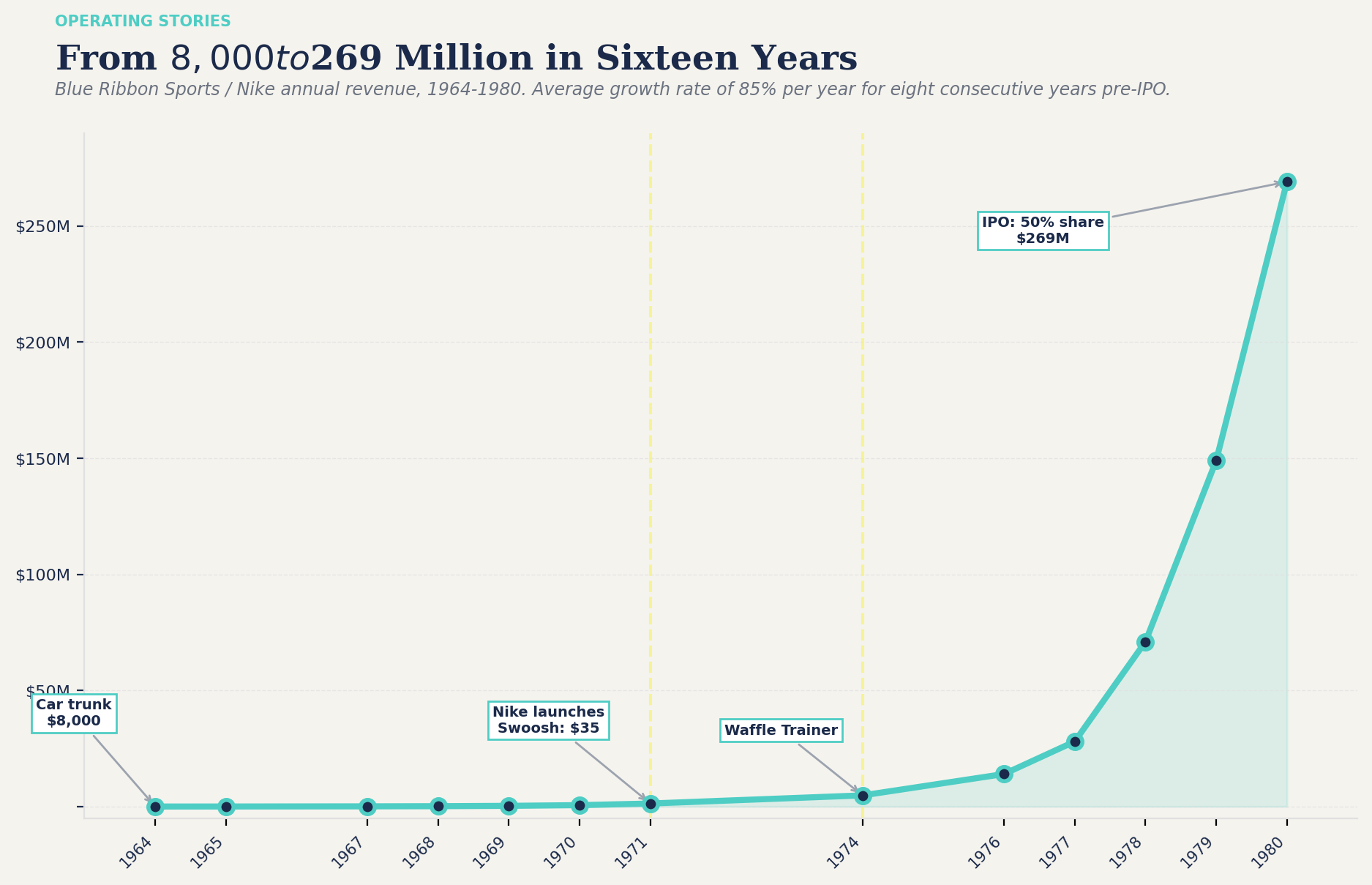
In 1964, Phil Knight sold 1,300 pairs of Japanese running shoes out of a Plymouth Valiant and grossed $8,000. His total startup capital was $500. He kept his day job for five years. By 1980, Nike commanded 50% of the US athletic shoe market with $269 million in revenue. Sixteen years to acquire and 50% of the market. That’s the first operating lesson.
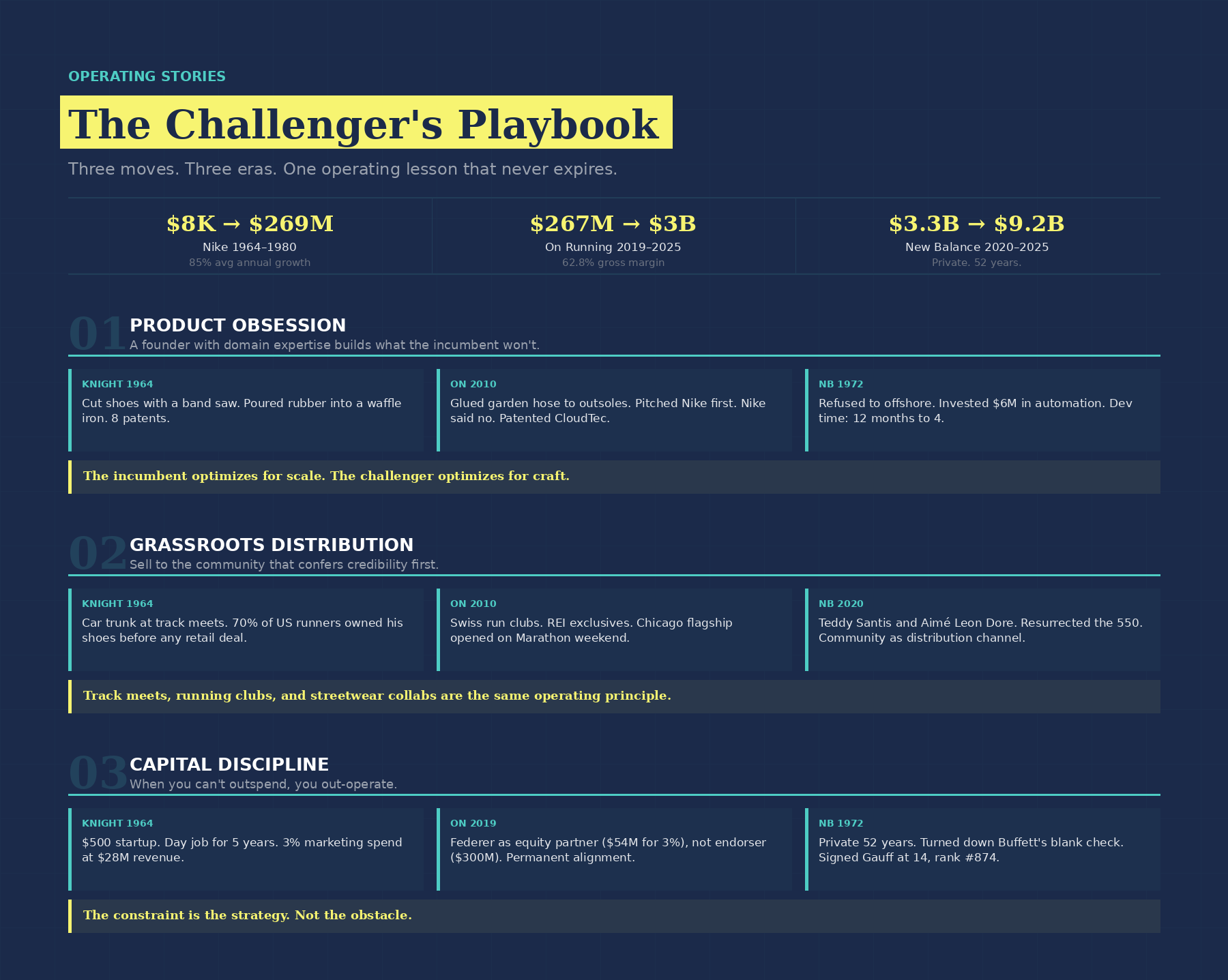
The playbook was three moves.
Product obsession: Bill Bowerman cut shoes apart with a band saw and poured rubber into a waffle iron.
Grassroots distribution: Knight sold at track meets because that is where runners were.
Capital discipline: 3% of revenue on marketing in 1977. Every dollar earned its place.
Sixty years later, two companies are running that same playbook. Against Nike.
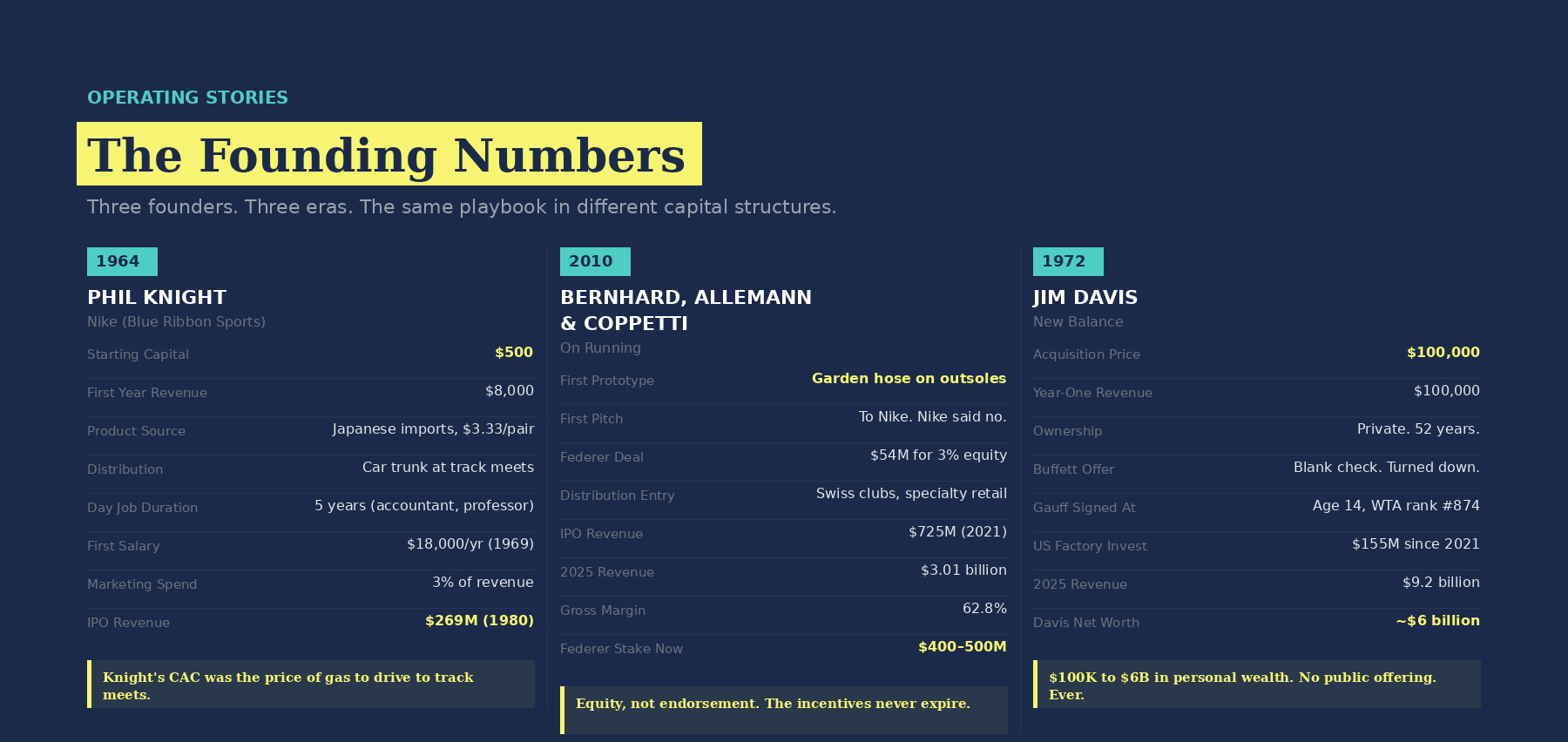
On Running started in 2010 when a retired Swiss triathlete glued garden hose segments to shoe outsoles. He pitched the idea to Nike first. Nike said no. On hit $3 billion in revenue in 2025 with a 62.8% gross margin. Roger Federer invested $54 million for 3% equity in 2019. That stake is now worth $400-500 million.
New Balance has been privately owned since Jim Davis bought it for $100,000 in 1972. He turned down a blank-check acquisition offer from Warren Buffett. The company reached $9.2 billion in revenue in 2025.
Its fifth consecutive year of double-digit growth.
Both challengers grew because Nike opened the door. Between 2017 and 2025, Nike made three strategic mistakes that map precisely to the three moves of its own founding playbook.
It stopped obsessing over product. Nike replaced sport-category teams with demographic silos. The innovation pipeline thinned. Nike disappeared from the top five in US performance running specialty.
It abandoned grassroots distribution. Nike cut its wholesale partners from 30,000 to 40. It dropped DSW, Macy’s, Urban Outfitters, Zappos, and dozens more. Challengers walked into the vacated shelf space.
It traded capital discipline for franchise extraction. Nike flooded the market with Air Force 1, Jordan 1, and Dunk colorways until the cultural equity collapsed.
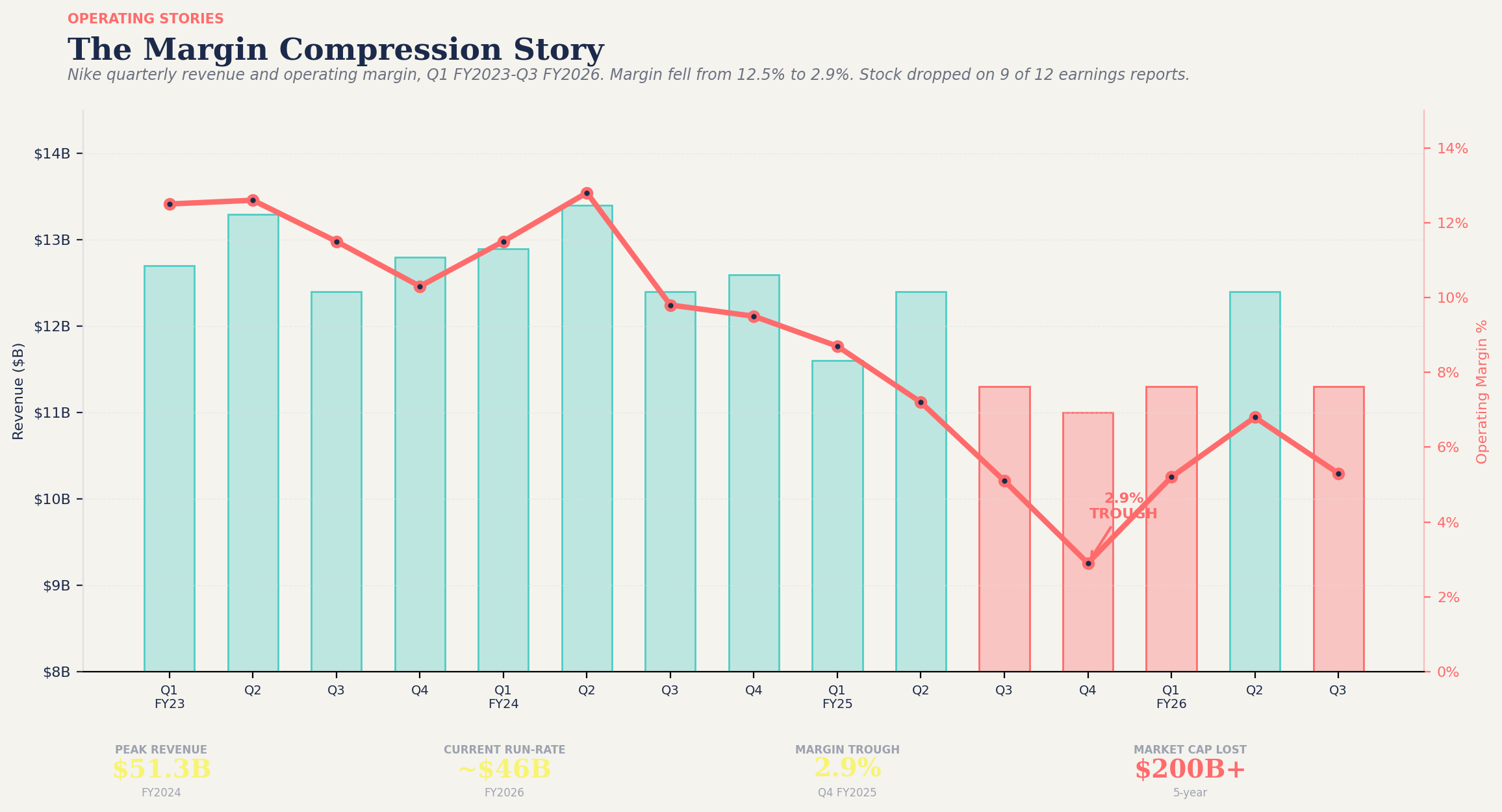
Revenue fell from $51.3 billion to a $46 billion run-rate. The stock dropped 56% over five years. More than $200 billion in market capitalization erased.
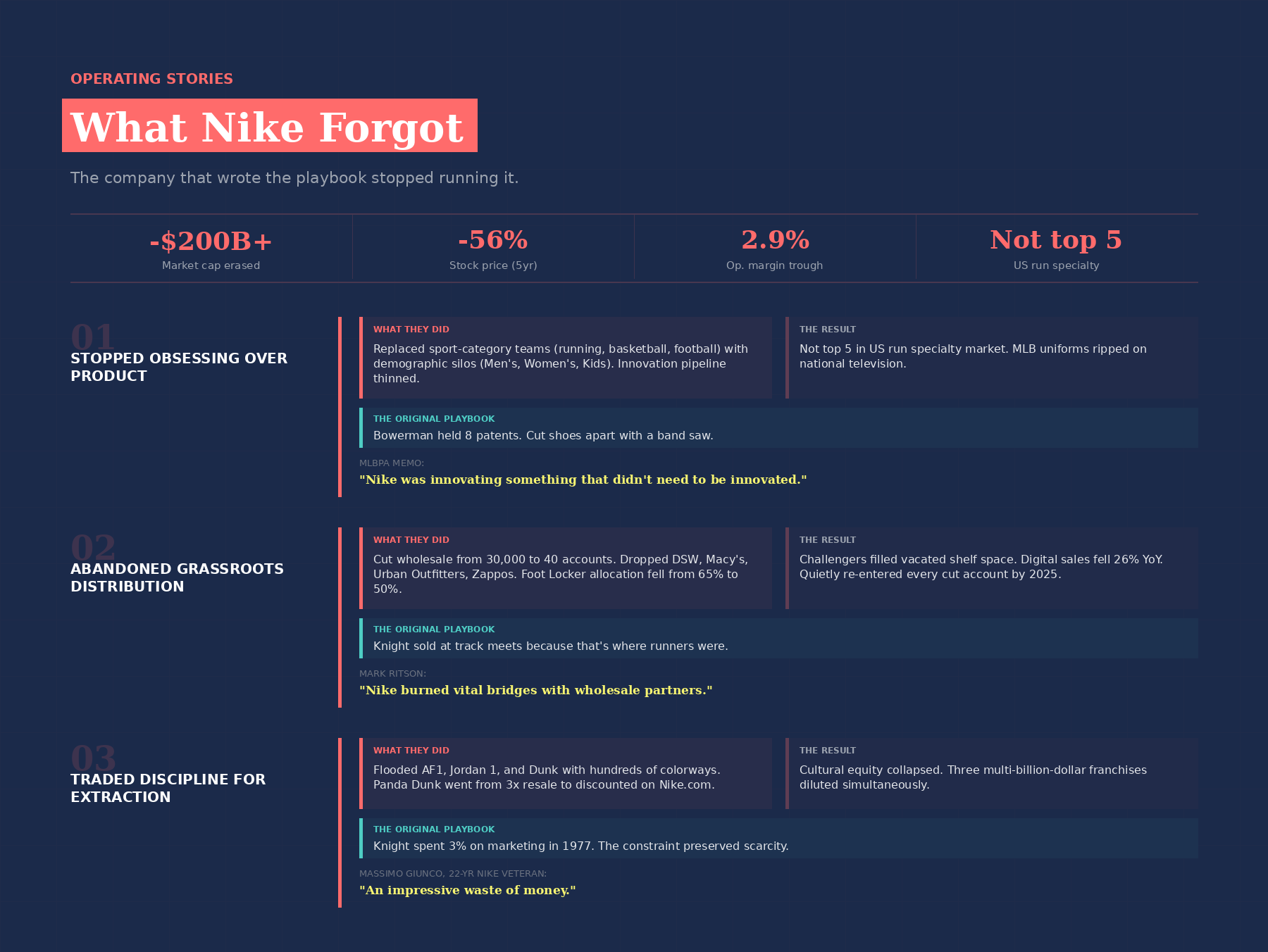
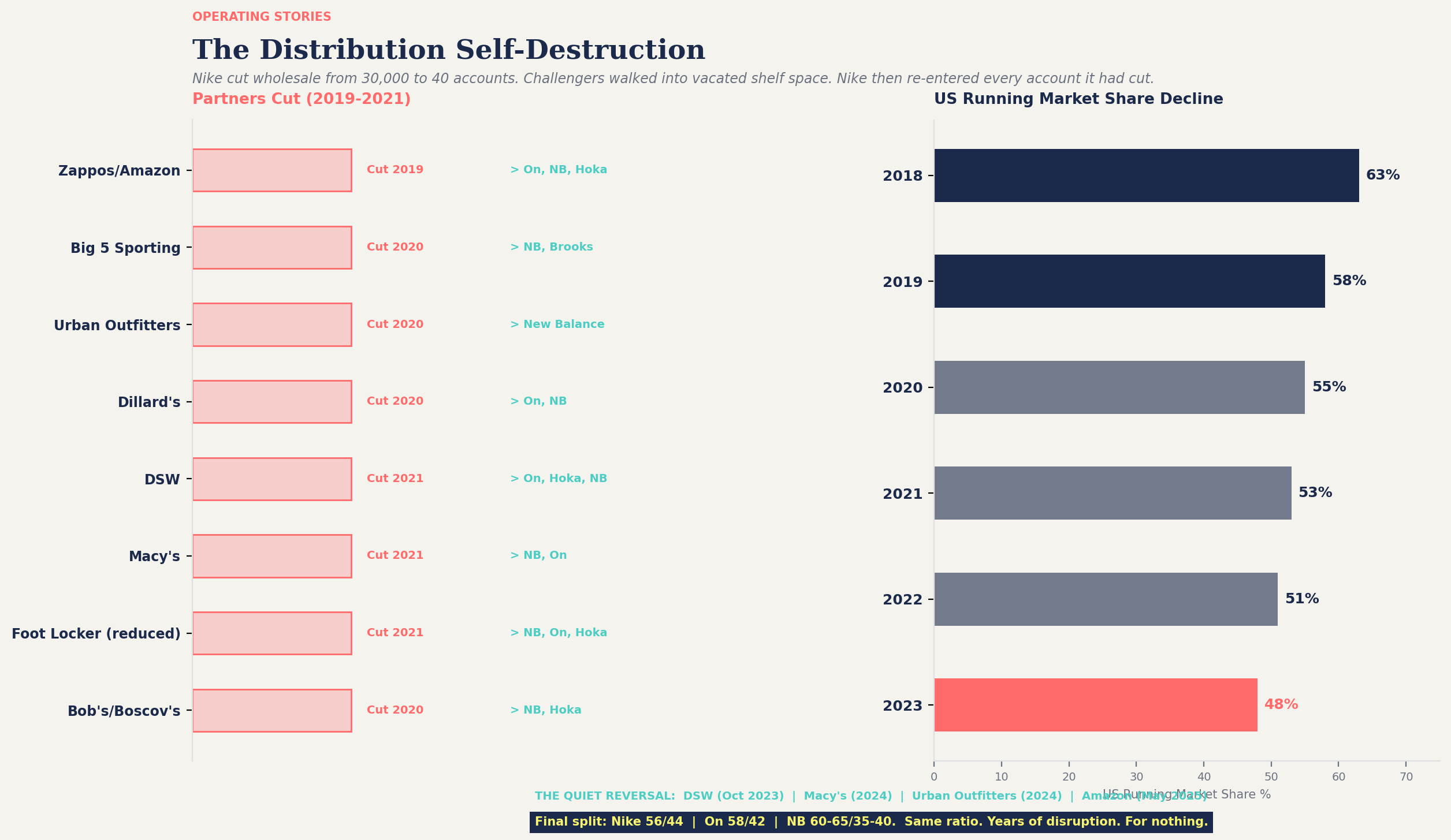
The company that invented the Challenger playbook became the incumbent that the playbook was designed to beat.
The Challenger Playbook 4 Operating Principles
1. Sell to the community that confers credibility before you sell to anyone else. Knight sold at track meets. On launched through REI exclusives and run clubs. New Balance partnered with Teddy Santis and Aimé Leon Dore. Find the smallest, most influential community that cares about what you are building. Serve them first.
2. Product obsession is a founder’s job, not a department’s job. Bowerman’s waffle iron. Bernhard’s garden hose. Davis’s domestic factory investment. The product advantage was created by a founder with domain expertise making decisions that a professional management team would not make.
3. Capital constraints are a competitive weapon, not a disadvantage. Knight spent 3%. On gave Federer equity instead of a $300 million endorsement deal. New Balance stayed private for 52 years. Every constraint forced a better decision.
4. Distribution is brand strategy expressed operationally. Every distribution decision is a brand decision. Choose channels that tell the story you want told. Track meets told the story that Nike was for serious runners. DSW never told a story anyone remembers.
Score your business against the Challenger Playbook. Take these three questions to ChatGPT, Claude, or Gemini with your own business context:
Name the last three product changes you made based on direct feedback from your most demanding customers. If you cannot, your Product Obsession score is low.
Rank your distribution channels by credibility with your core customer. If your highest-volume channel is your lowest-credibility channel, your Distribution Credibility score needs work.
What percentage of revenue do you spend on paid customer acquisition? Knight spent 3%. If yours is above 15%, your Capital Discipline is renting attention instead of building equity.
The full Operating Stories Deep Dive continues below for paid subscribers, including the complete Nike origin story, the On Running and New Balance operating profiles, running boom market analysis, the Challenger’s Operating Audit worksheet, a 16-prompt AI working session pack, and three branded research briefs you can use for your own strategic planning.
- john -
