

All visuals for this article were produced in my Claude studio. If you’d like to be able to do the same, make sure you register for the Compound Content Studio, launching this Friday.
The Compound Content Studio™ is a live, 2‑week AI immersion where we build your Claude-powered content system that multiplies your ideas into an endless stream of on-brand content.
We kick off May 1st, and there are only 50 spots (25 of which have already been sold). If you want your content to compound rather than reset to zero every day, this is where you build the system that finally makes it happen.
This is the system I built to create all of my content across social platforms. Jumpstart and scale your brand and content this May!
48 Hours
On February 13, 2026, Anthropic publicly launched Cowork, a Claude-powered collaborative workspace that can read, write, and operate across a user’s applications simultaneously. Within 24 hours, the combined market capitalization of the ten largest US enterprise software companies fell by $285 billion. Adobe, Salesforce, Intuit, Microsoft. They all moved the same direction.
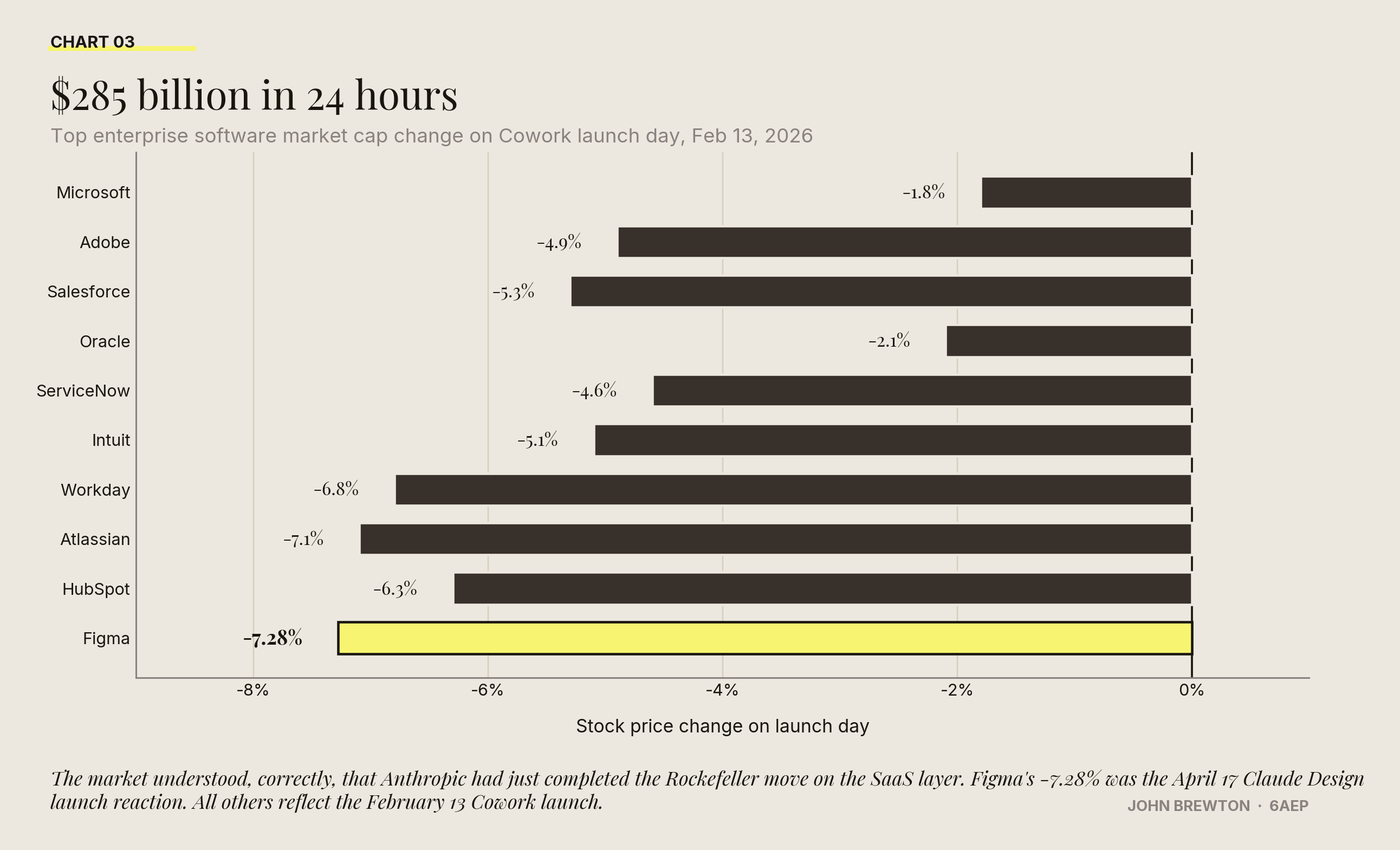
That $285 billion is not the most interesting number. The most interesting number came eight weeks later. On April 16, 2026, Anthropic released Claude Opus 4.7. On April 17, it released Claude Design, an Anthropic Labs product that lets a founder describe a pitch deck in plain English and produce a working prototype. Figma’s stock dropped 7.28% on the day. Three days before the launch, Anthropic’s Chief Product Officer, Mike Krieger, had quietly resigned from Figma’s board. The market missed the signal. The operating lesson is that Krieger did not resign because he was getting uncomfortable. He resigned because he already knew what was about to ship.
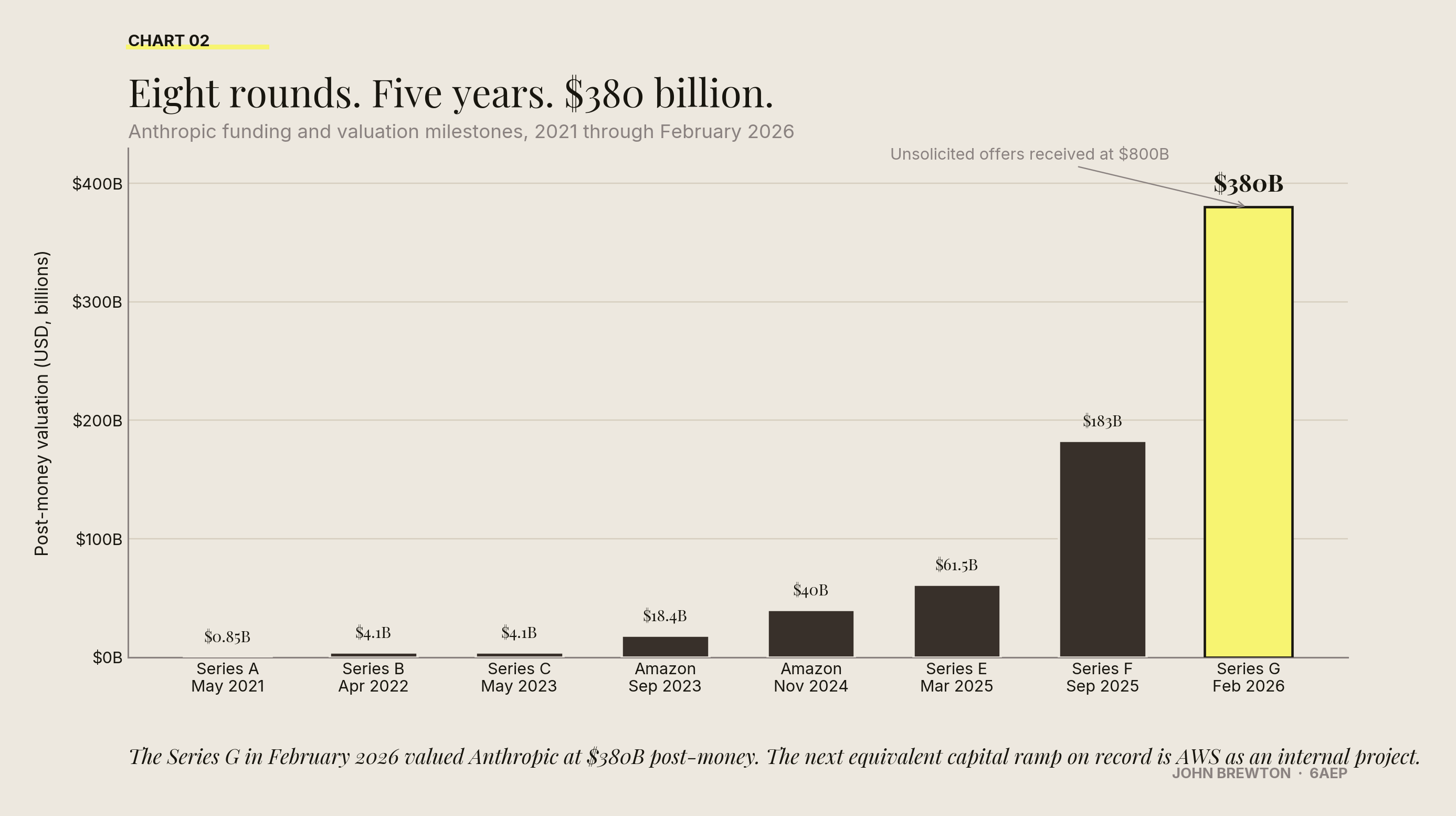
Anthropic now generates $30 billion in annualized revenue. It carries a $380 billion valuation and has received unsolicited offers at $800 billion. It has raised $65 billion across eleven funding rounds in five years. Eight of the ten Fortune 10 companies are customers. More than 500 businesses spend over $1 million per year on Claude. Claude Code went from zero to $2.5 billion in annualized billings in nine months.
For an operator, the right question about Anthropic is not how they did this. The right question is what they chose correctly that their competitors chose incorrectly. The answer is three things. A method decision. A constraint decision. A vertical integration decision. Every other operating outcome flows from those three.
Operating Thesis
First, Anthropic treated safety as the product, not a constraint on the product. Constitutional AI, the Responsible Scaling Policy, and the Long-Term Benefit Trust were not brand elements. They were the technical and governance foundation on which enterprise trust compounded. Every pharmaceutical company, bank, and public-sector buyer that runs Claude in a regulated workflow runs it because Anthropic’s safety disclosures made procurement possible.
Second, Anthropic built from the model up, not from the chatbot down. Every product release, in sequence, is a move up the stack from the model to the workspace to the outcome. Claude 1 sold capability. Claude 3.5 sold a workspace. Claude Code sold a developer. Cowork sold a department. Claude Design sold a designer. Each move captured more of the value that used to flow to the application layer.
Third, Anthropic treated each capability release as a governance decision first and a revenue decision second. When a model was too dangerous to ship broadly, it did not ship broadly. Claude Mythos, announced on April 7, 2026, was restricted to forty cybersecurity partners because its capabilities threatened operating systems globally. A normal company would have sold it. Anthropic withheld it and gained trust instead.
Three decisions. Five years. $380 billion. The pattern maps to three historical operators who made the same three decisions in their own eras.
Velocity
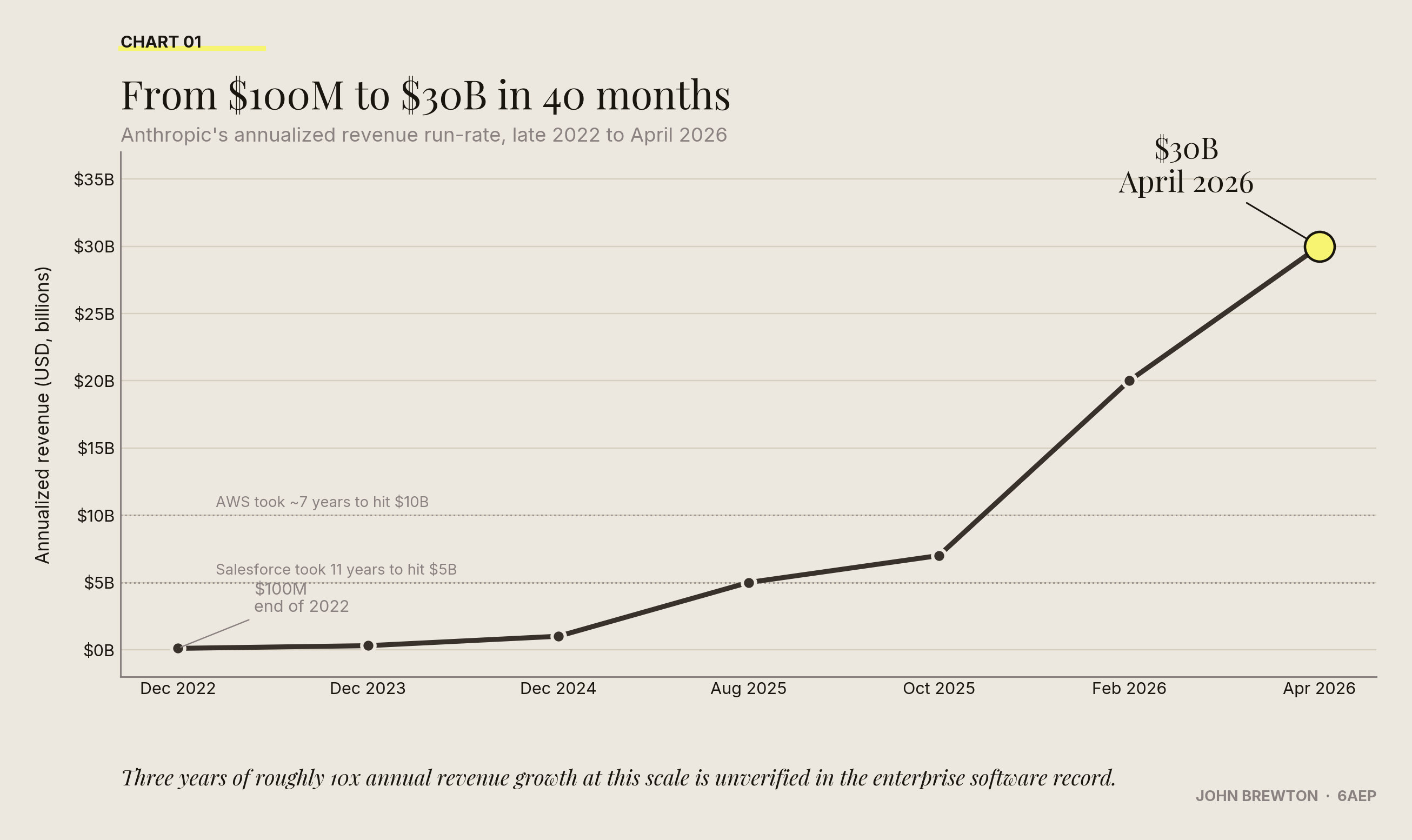
The revenue arc is what it is. $100 million annualized at the end of 2022. $1 billion by December 2024. $5 billion by August 2025. $7 billion by October 2025. $30 billion by April 2026. Three consecutive years of roughly 10x annual revenue growth at this scale is unverified in the enterprise technology record. Salesforce took eleven years to hit $5 billion in revenue. Amazon Web Services took about seven years to hit $10 billion. Anthropic hit $10 billion in roughly 24 months after crossing $1 billion.
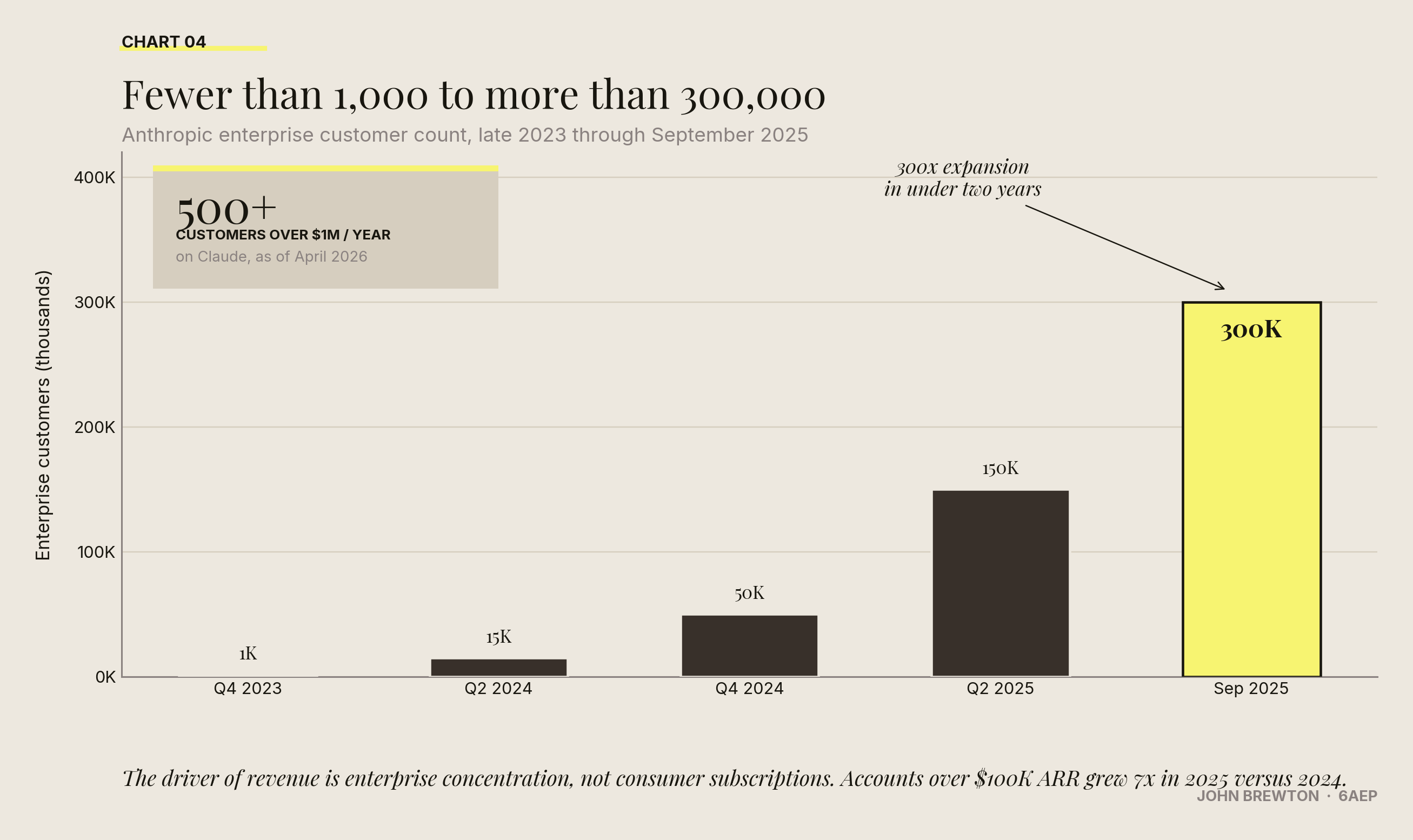
The driver is enterprise concentration, not consumer subscriptions. Accounts generating more than $100,000 in annual recurring revenue grew 7x in 2025 over 2024. The total enterprise customer base grew from fewer than 1,000 in late 2023 to more than 300,000 in September 2025. That is a 300x expansion in under two years.
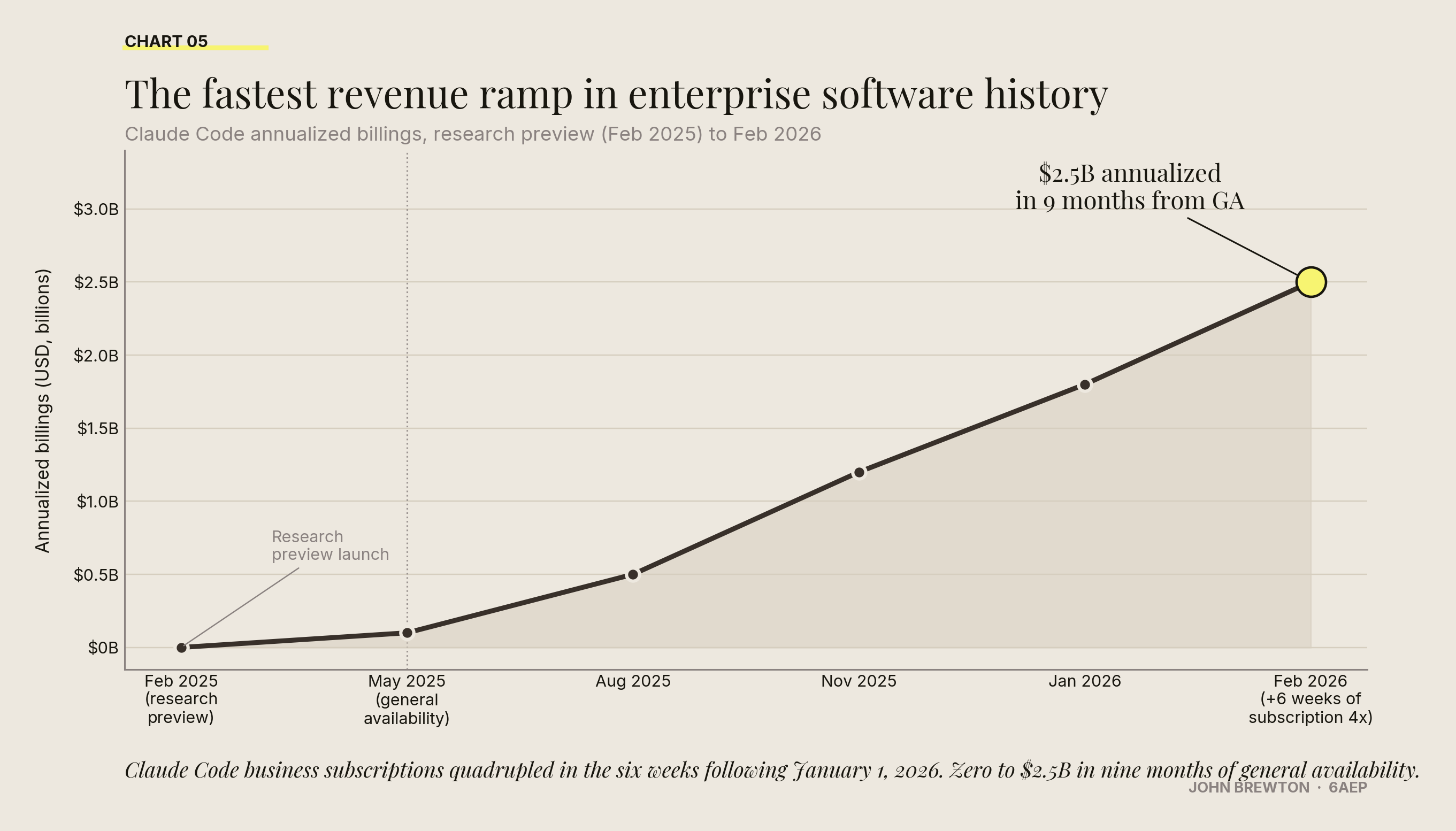
Claude Code is the inside story. It launched as a research preview in February 2025 and hit general availability in May 2025. It went from zero to over $2.5 billion in annualized billings in roughly nine months. Business subscriptions on Claude Code quadrupled in the six weeks following January 1, 2026. That is the fastest revenue ramp of any product in enterprise software history.
Here is the paradox. Anthropic will spend more than $50 billion on compute infrastructure in 2026 alone against $30 billion in annualized revenue. Dario Amodei publicly said in February 2026 that a 12-month delay in AI progress would make him personally bankrupt. The company is simultaneously one of the fastest-growing technology companies in history and one of the largest consumers of capital per dollar of revenue ever. Both things are true. The flywheel requires it.
New to Operating?
Check out these reader favorites:
Winning the Loser’s Game: The Creator Economy and the Companies We All Need to Build
0 to 55,000 - The First 90 Days Playbook - What I’d Do Differently Knowing What I Know Now
Become a paid subscriber to join the Operating Skool community and attend our weekly live Office Hour Q&A’s w/ John.
Three Product Inflection Points
The full product history has fifteen releases. Three of them mattered most.
Constitutional AI, December 2022. Before Anthropic shipped a product, it published a paper. “Constitutional AI: Harmlessness from AI Feedback” described a method for training large language models to critique and revise their own outputs against a written set of principles, replacing most human annotation with a principled self-improvement loop. The technique cut human labeling costs by 10x to 100x while producing models that were simultaneously more helpful and less harmful than prior approaches. Every Claude model since has been trained on this foundation. The strategic implication was procurement, not research. Constitutional AI gave Anthropic’s enterprise sales team verifiable, documented claims about model behavior that pharmaceutical, financial, legal, and public-sector buyers required before deploying AI in consequential workflows. It turned safety into a product feature.
Model Context Protocol, November 2024. Anthropic released MCP as an open standard for connecting AI systems with external data and tools. MCP replaced fragmented, bespoke API integrations with a universal protocol. Any AI agent built on MCP could connect to any MCP-compatible data source without custom connector code. In December 2025, Anthropic donated MCP to the Agentic AI Foundation, a directed fund within the Linux Foundation. This was the platform move. By establishing MCP as the standard, Anthropic positioned itself as the architect of the infrastructure layer through which AI agents operate. The economics are analogous to controlling HTTP or the dominant JDBC driver.
Cowork and Claude Design, February and April 2026. Cowork is a collaborative workspace where Claude reads, writes, and acts across applications simultaneously. A Claude-powered agent inside Cowork can open a user’s email, pull data from a spreadsheet, run analysis, draft a response, and file a follow-up task, all without handoffs. Claude Design lets a founder or product manager describe a design in plain English and produce a functional interactive prototype. Inputs include text prompts, uploaded images, DOCX, PPTX, XLSX files, and a web capture tool for grabbing live UI elements from existing websites. Claude Design is included at no extra charge for Claude Pro, Max, Team, and Enterprise subscribers. Cowork is the vertical move into the business user’s deliverable. Claude Design is the vertical move into the designer’s deliverable. Both are Rockefeller moves.
Three Parallels
Every high-velocity operating company has antecedents. Anthropic’s three most useful antecedents are the Traitorous Eight who founded Fairchild Semiconductor in 1957, Andy Grove’s memory-to-microprocessor pivot at Intel in 1985, and John D. Rockefeller’s climb up the Standard Oil stack from 1870 to 1890. Each one made a method decision that looked wrong in the short run and built an industry in the long run. Each one matches a specific Anthropic move, year for year.
The Traitorous Eight: method over hierarchy
In September 1957, eight scientists walked out on William Shockley. In late 2020 and early 2021, eight researchers walked out on OpenAI. The parallel is not the number. It is the substance. Shockley believed authority and hierarchy produced scientific output. Robert Noyce and the other seven believed peer review and diffusion of authority produced it. The eight who left OpenAI, Dario Amodei, Daniela Amodei, Jared Kaplan, Tom Brown, Sam McCandlish, Jack Clark, Benjamin Mann, and Christopher Olah, believed scaling compute alone was insufficient without a parallel rigorous focus on alignment. Both walkouts were method disagreements. Both founder cohorts built the company that was right about the method.
Fairchild’s alumni went on to found more than 65 companies including Intel, AMD, and Kleiner Perkins. Anthropic’s diffusion effect is already visible in year five. Model Context Protocol, donated to the Linux Foundation in December 2025, is the integrated circuit of the agent era. The Long-Term Benefit Trust is the governance equivalent of Fairchild’s stock option plan.
Andy Grove at Intel: trust as the moat
By 1985, Intel faced commodity pressure from Japanese DRAM manufacturers. Memory margins collapsed to 1%. Grove and Gordon Moore had the conversation. If the board replaced them, a new CEO would exit memory. So they walked out the door, came back in, and did it themselves. Revenue fell from $1.63 billion in 1984 to $1.27 billion in 1986 before recovering to $3.13 billion in 1989. By 1992, Intel was the largest semiconductor company in the world. Grove documented the framework in Only the Paranoid Survive.
Anthropic ran the Grove move twice. First in mid-2022 when it withheld Claude as OpenAI was about to release ChatGPT. Anthropic walked away from the quarter’s revenue because it had correctly identified the constraint was trust, not speed. Second in April 2026 when it restricted Claude Mythos to forty cybersecurity partners through Project Glasswing. Anthropic had a model capable of hundreds of millions in annual revenue if released broadly. It released it narrowly. Both decisions made trust the product. The enterprise perception that Claude is the only frontier model you can safely deploy in regulated contexts is the moat. That moat is worth more than Mythos revenue would have been.
Rockefeller and Standard Oil: the stack climb
Rockefeller did not build Standard Oil by refining oil better than his competitors. He built it by controlling the stack above and below refining. By 1890, Standard Oil controlled 88% of refined oil flows in the United States, most of the pipelines, a material share of rail bulk freight, and the retail distribution network that ended at the customer’s kerosene lamp.
Anthropic’s playbook is a compressed Standard Oil. The model is the refinery. Claude.ai is the retail distribution. Memory and Projects are the storage tanks. Skills are the refined products. MCP is the pipeline network. Claude Code is the vertical move into the developer’s output. Cowork is the vertical move into the business user’s output. Claude Design is the vertical move into the designer’s output.
The Standard Oil pattern is why the Cowork release wiped $285 billion in market cap in 24 hours. The market understood, correctly, that Anthropic had just completed the Rockefeller move on the SaaS layer. Every enterprise software category charging per-seat for a specific UI on top of specific data had just been informed that the UI was optional and the data was accessible through a new control layer.
For the full business history underneath these three parallels, including the Cleveland Massacre’s six-week timeline, Grove’s six-force framework for strategic inflection points, and the structural reasons the Fairchild diaspora produced 65+ companies, see the Historical Parallels Compendium in the asset hub below.
Four operating principles
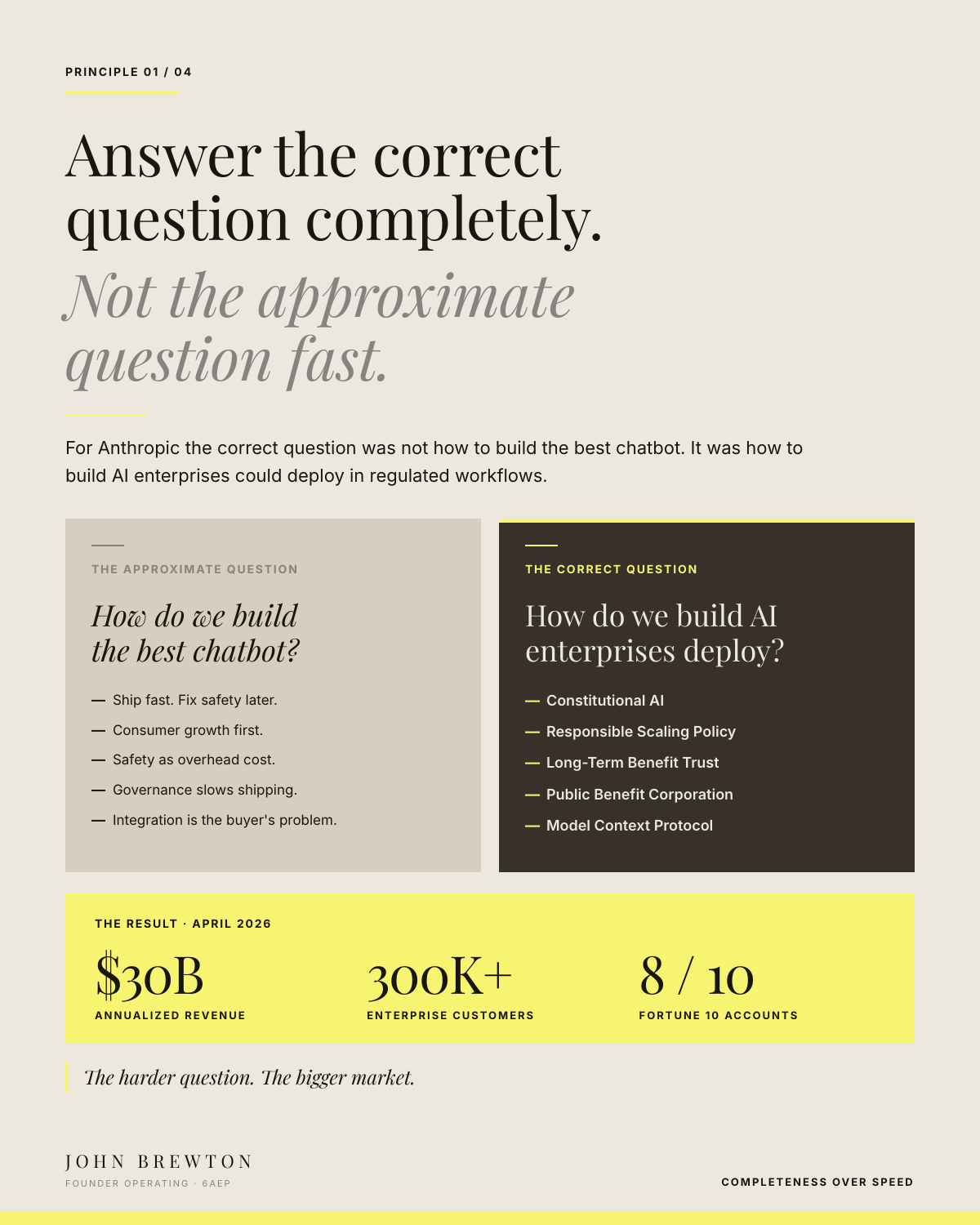
Answer the correct question completely, not the approximate question fast. The operating discipline is to identify the correct question before anyone else does. For Anthropic, the correct question was not how to build the best chatbot. The correct question was how to build AI that enterprises can actually deploy in regulated workflows. Constitutional AI, the Responsible Scaling Policy, the Public Benefit Corporation structure, the Long-Term Benefit Trust, and the MCP protocol are all different angles on the same correct answer. Each took longer than the equivalent ChatGPT feature would have taken. Each produces more durable value.
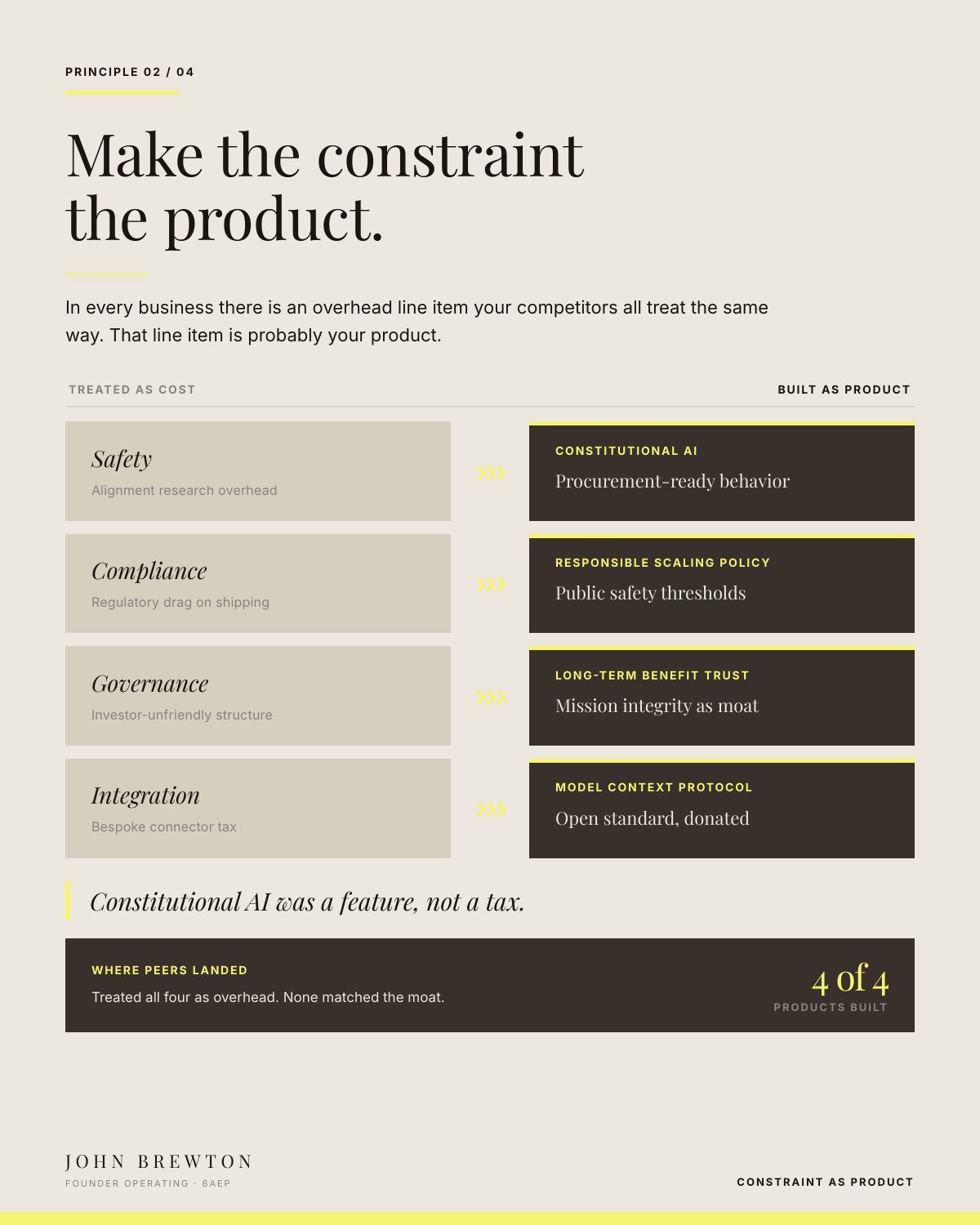
Make the constraint the product. In every business there is a constraint competitors treat as a cost that you can treat as the product. For Anthropic, safety was that constraint. The received wisdom in AI in 2021 was that safety was an overhead, a drag on capability that you had to accept because regulators would eventually demand it. Anthropic inverted the assumption. Safety became the thing enterprises were buying. Constitutional AI was a feature, not a tax. The Responsible Scaling Policy was a selling point, not an apology. Find the overhead line item in your own business that your competitors all treat the same way. That line item is probably your product.
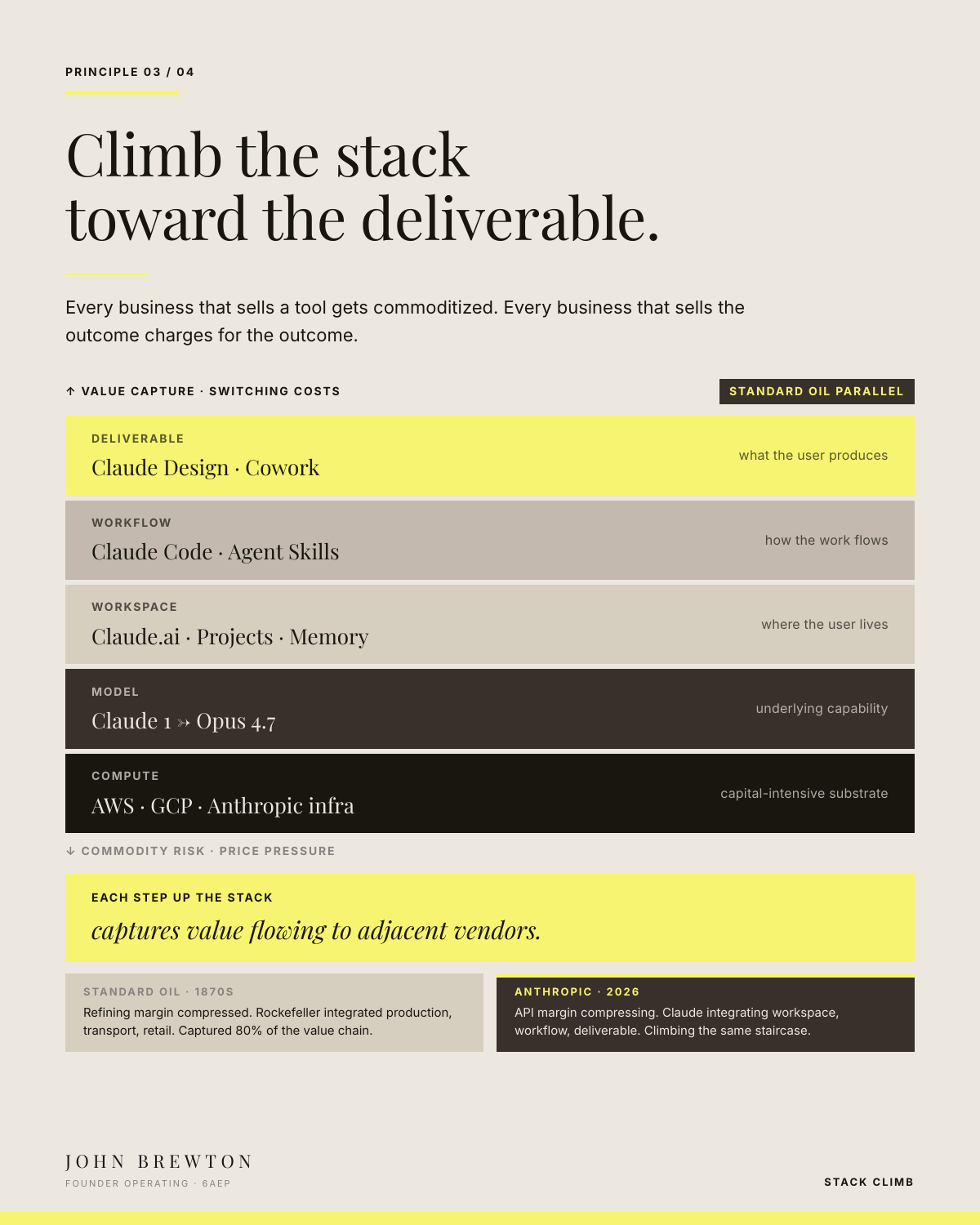
Climb the stack toward the deliverable. Every business that sells a tool gets commoditized. Every business that sells an outcome gets to charge for the value of the outcome. You start by selling the tool. You add a workspace that captures the user’s state. You add integrations that make the workspace the default. You climb down the stack to the deliverable the user was going to produce with your tool anyway. Each step up the stack increases switching costs. Each step down the stack captures value that was flowing to adjacent vendors. For Anthropic, the climb from Claude 1 (tool) to Cowork (outcome) is the most compressed version of that pattern on record.
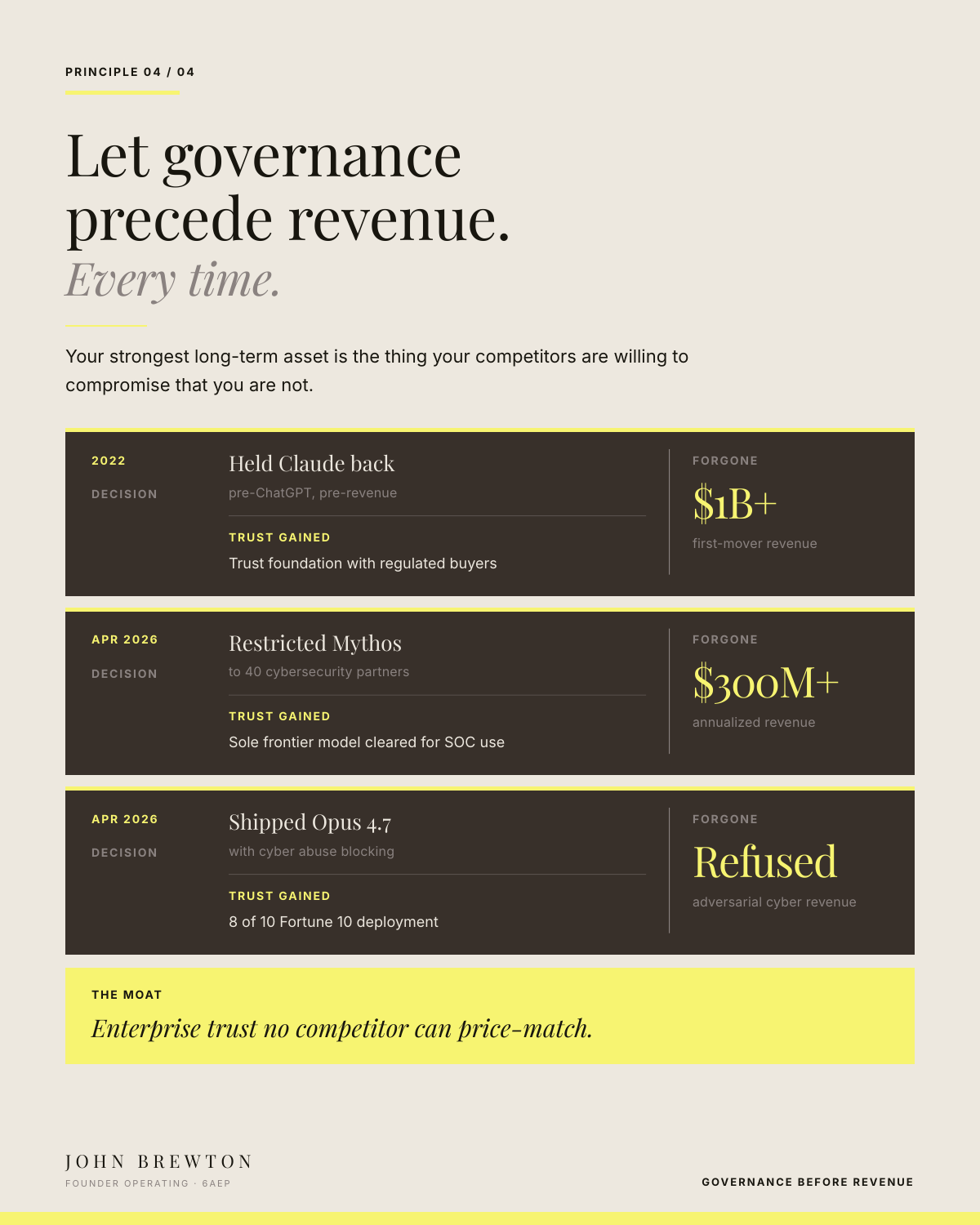
Let governance precede revenue, every time. Every time Anthropic has gained a new capability, it has made a governance decision before making a revenue decision. Claude 2022 was held back. Mythos 2026 was restricted to forty partners. Opus 4.7 shipped with automatic detection and blocking of high-risk cybersecurity requests. Each decision was made against a public, specific, and auditable written standard. Each decision forewent short-term revenue to reinforce a long-term trust position. Your strongest long-term asset is the thing your competitors are willing to compromise that you are not.
The Operating Stories analysis continues below for paid subscribers, including the broader implications for professional services, the operating lesson for founders, and the full asset hub: three research compendiums (Product and Capability, Financial and Strategic, and the Historical Parallels business history compendium covering the Fairchild founding, Grove’s DRAM exit, and Rockefeller’s stack climb in full), the five single-page operating guides for Claude Projects, Skills, Cowork, Claude Code, and Claude Design, and the complete primary sources appendix.
