

Historically, every time a tool made ideas cheaper to share, the people who had mastered the older, slower way treated it as a threat to defend against rather than a shift to move with. The scribes who spent their lives copying manuscripts did not celebrate the printing press. They saw a craft and a livelihood going to zero. Plato warned that writing itself would ruin memory and hollow out real understanding.
That was around 2,400 years ago.
Civilization grew anyway.
We are running the same fear-based reflex again. Our social feeds and inboxes are full of people litigating whether AI writing counts, whether it is cheating, whether the craft is dying. The scribes and the press are at it again. And while this argument burns, the enabling machines that create distribution for our ideas, work, products, and services are moving faster than they have in 500 years.
Here’s our current reality: The cost of producing words just fell to zero, and the only things left worth owning are the idea you choose and the distance it travels.
How I Built a $200,000 Newsletter Business From a Substack Nobody Was Reading
The Five Moves That Turned My Substack Into a $200,000 Business
The Operating Project: Most Coaching Ends With Notes. This Ends With a Machine.
How to Produce World-Class Research with Perplexity Computer & Claude -> Fable 5
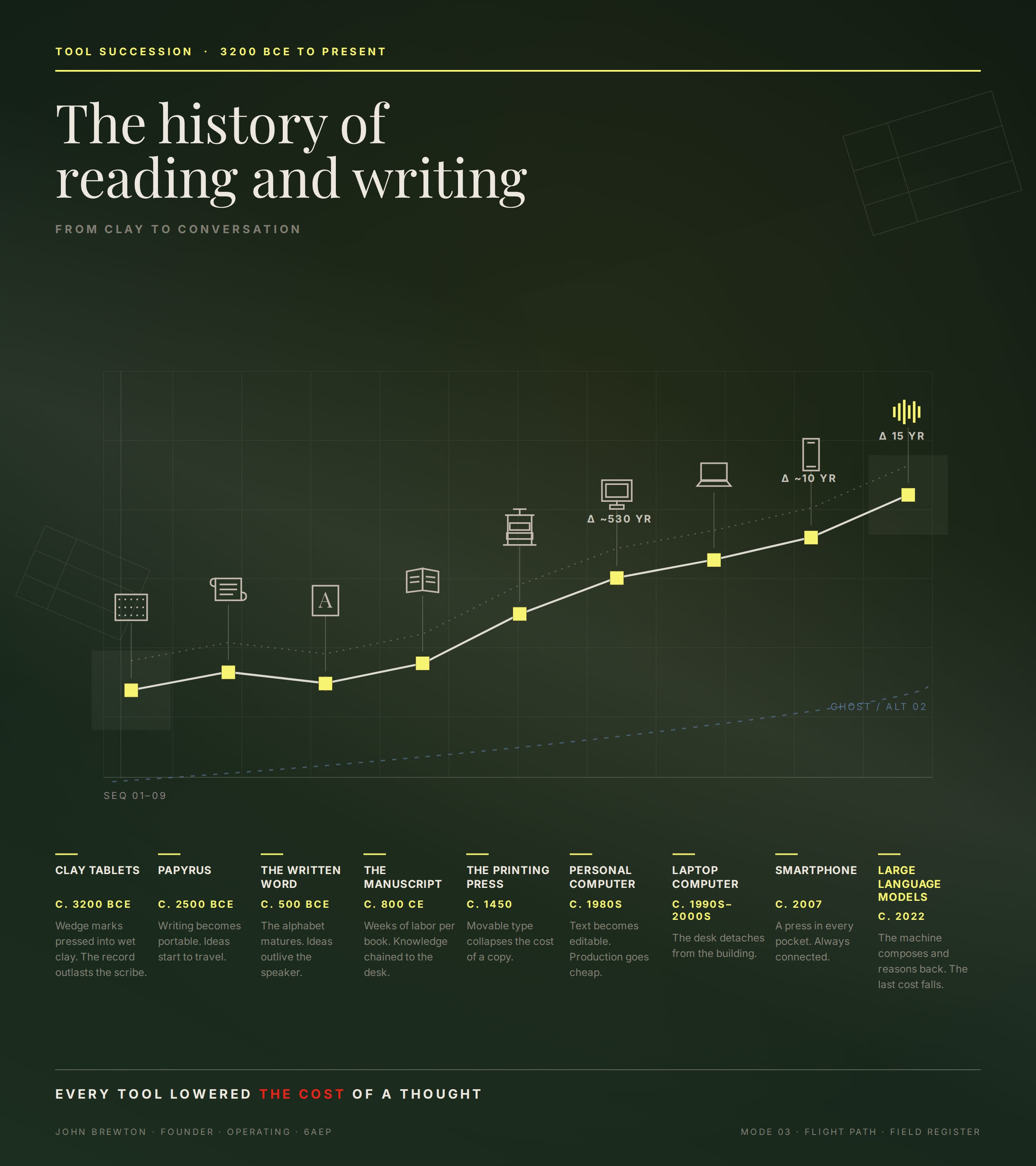
Five thousand years of the same job
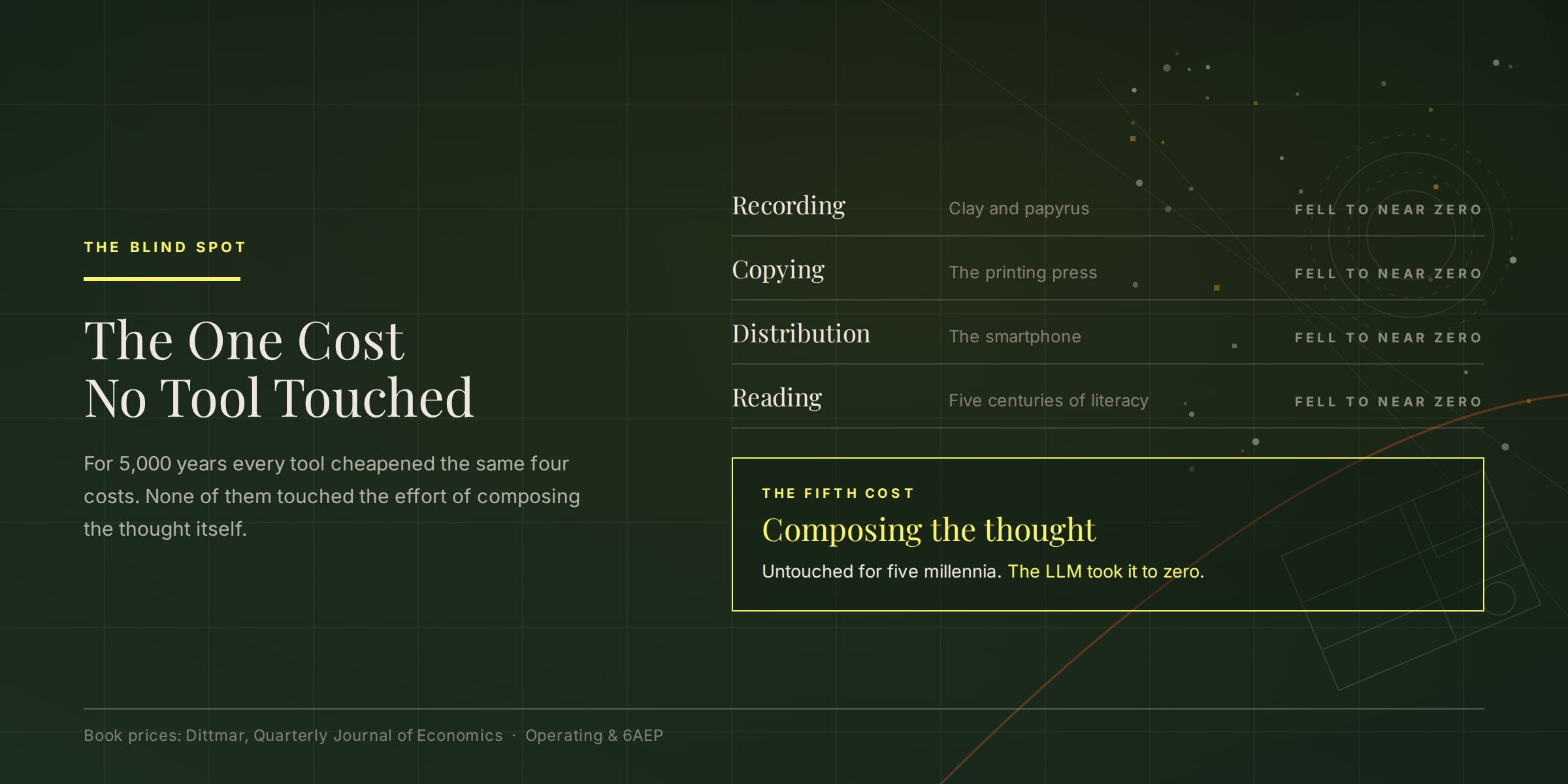
For 5,000 years, every writing tool did one thing successfully.
It made ideas cheaper to share.
Clay tablets held temple receipts, not poetry.
A medieval book took weeks of skilled labor and got chained to the desk because it was worth more than the room it sat in.
Then the printing press cut the price of a book by two-thirds within 50 years.
Each drop did the same work.
More people could read, and more people could write.
This cycle of payoffs compounded for centuries.
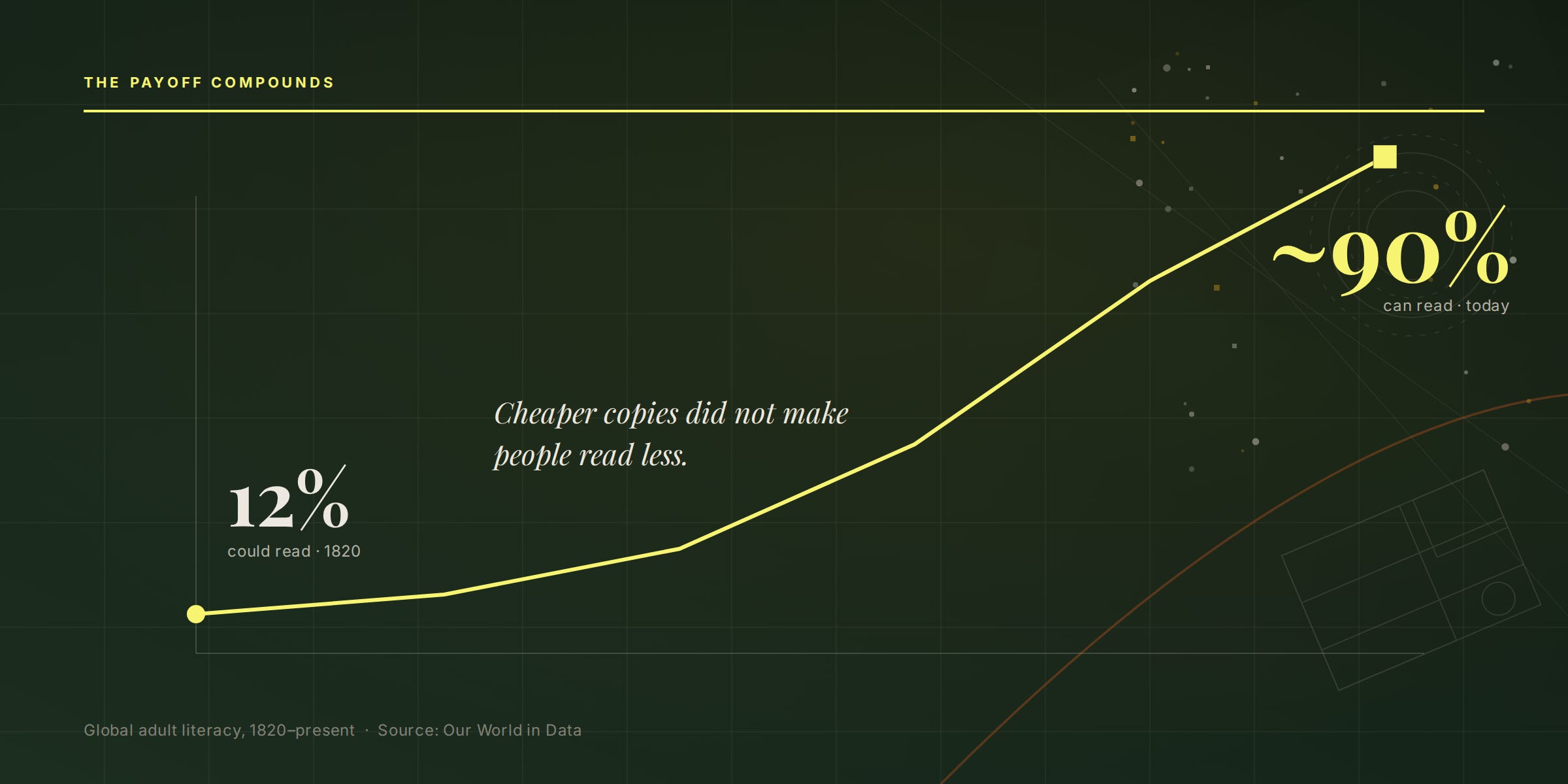
In 1820, 12 percent of the world could read. Today it is roughly 90 percent. Cheaper copies did not make people read less. This innovation turned reading from an elite privilege into a basic human skill.
Every one of those tools shared a blind spot. The personal computer and the laptop made producing and editing words faster, and none of it touched the oldest cost of all, the effort of composing the thought itself. You still had to sit down and produce the words. That is the cost ChatGPT and Claude just took to zero. These are the first tools that compose and reason back. They draft, they read, they research across sources in minutes instead of weeks.
What actually got scarce
When a cost falls to zero, value moves to whatever sits next to it and is still expensive.
Composition is now cheap. So look at what it sits between. Upstream is the choice of what is worth saying. Downstream is getting it to the right people and being believed once it lands.
Judgment and distribution.
Those are the survivors.
Everything the AI-writing debate is fighting over is the one output that now fails to be scarce. The question was never how fast you can write. Speed is solved. The new question we should be centering our collective, ambitious, entrepreneurial gaze on is what you choose to think about, and how far you can move it.
The gate is gone
Here is my take on the opportunity we should all be aligned behind, but very few actually are.
For most of the internet’s life, reach was a function of accumulation. You built a list, a following, a set of contacts, and your ideas reached roughly the people you had already collected. That is the social graph. If you were small or new, you stayed small. Distribution was gated by who you already knew.
That gate is gone. A recommendation model now reads the content itself, scores it against what each person actually engages with, and serves it to strangers who have never heard your name. Follower count stopped being the gate and the metric to chase. The quality of your idea and what you can use the new stack to produce, distribute and build with it is the new hurdle, the new gate.
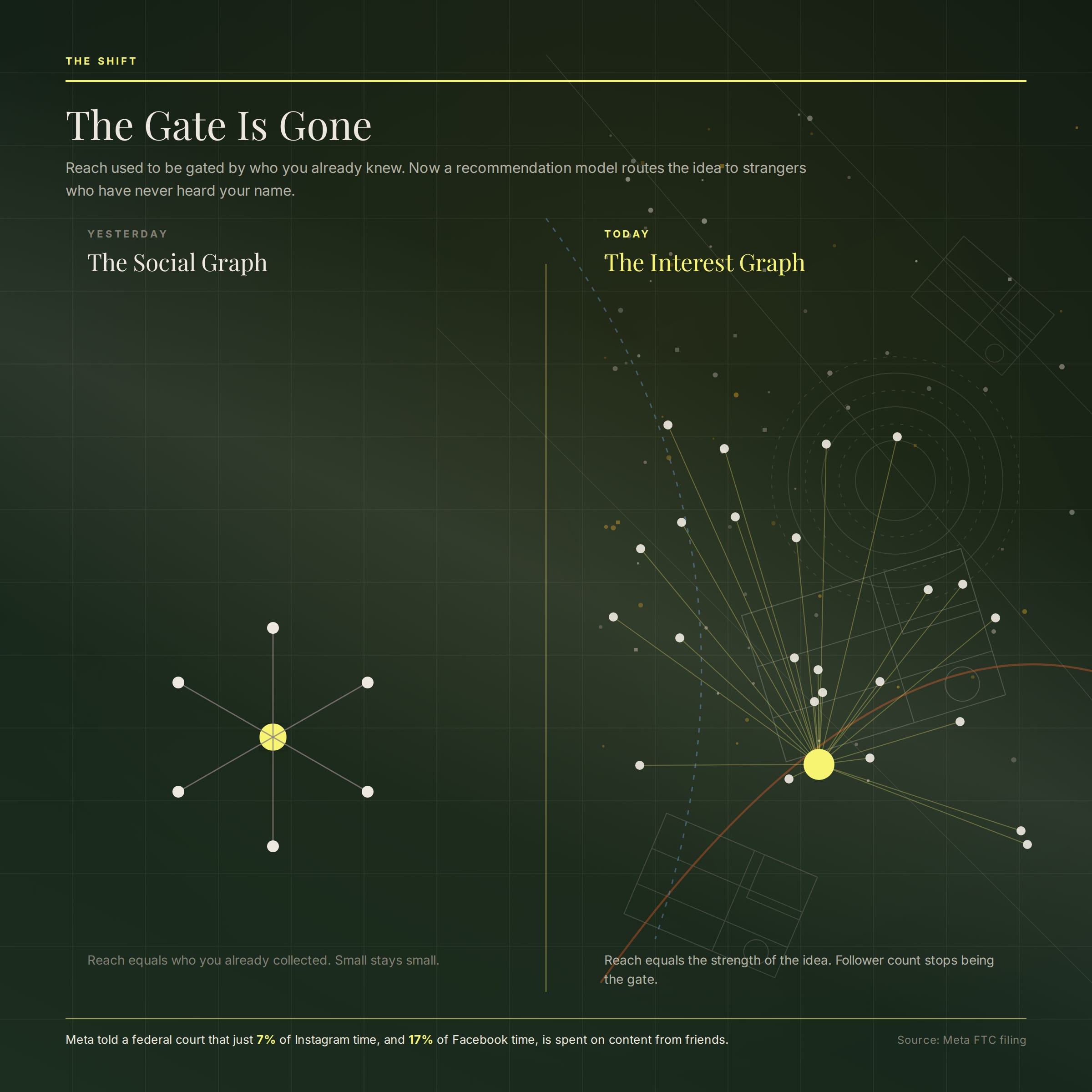
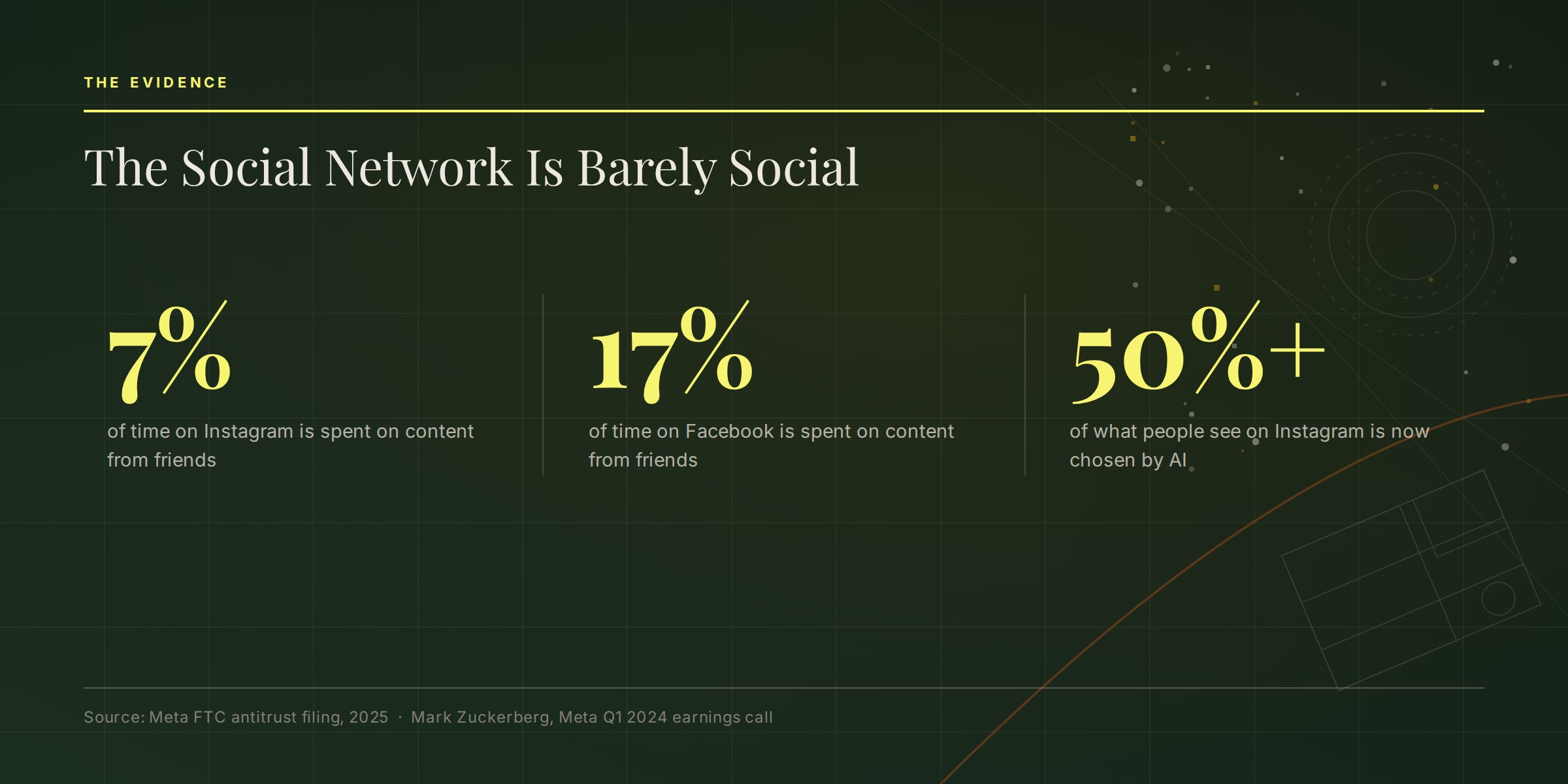
This is not a forecast I’m making as some Substack author you’ve never heard of befroe. Meta told a federal court, in its own antitrust filing, that just 7 percent of the time people spend on Instagram, and 17 percent on Facebook, is spent on content from friends. Zuckerberg has said more than 50 percent of what people see on Instagram is now chosen by AI, not by who they follow. The man who built the social graph testified that Facebook is no longer the culture, and floated wiping everyone’s friend connections to reset the platform around interests. The social network is barely social. The algorithm runs the room.
Social media is dead. AI-enabled, interest-based media is the replacement.
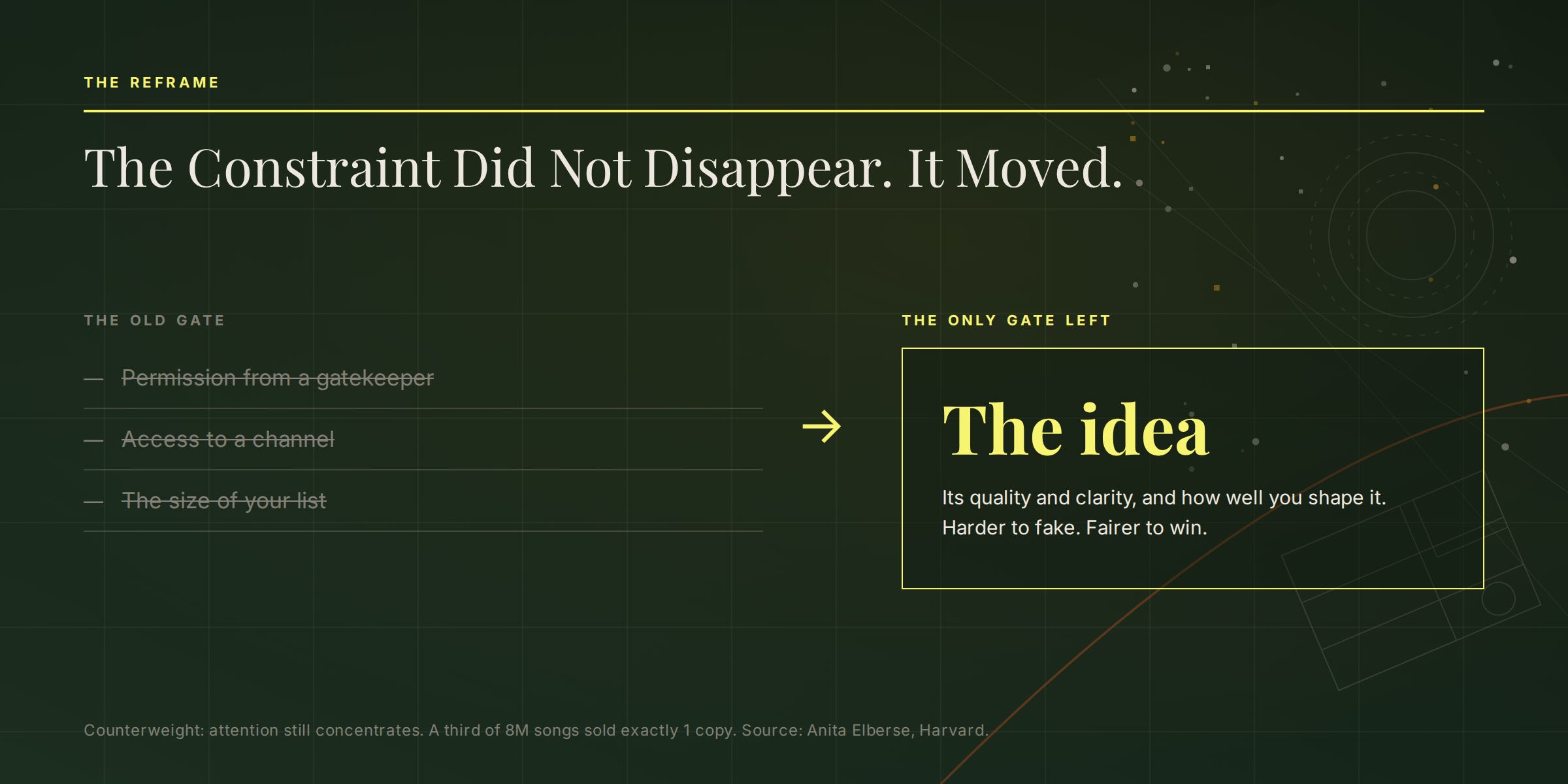
So yes, the interest graph removed the gate, but it did not remove the competition. Cheap distribution does not spread attention evenly. Anita Elberse at Harvard studied this directly. In one set of 8 million songs that each sold at least 1 copy, roughly a third sold exactly 1 copy. Attention still stacks on whatever earns it. A model serving your idea to strangers is a momentary shot, not a guarantee, by far.
So the constraint did not disappear. It has just moved to a new place in the supply chain. It used to sit on permission, on access, on the size of your list. Now it sits entirely on the quality and clarity of the idea and how well you shape it. That is a harder game to fake and a fairer one to win. For the first time, a small company with a sharper idea can out-reach an incumbent with a giant list, because the list no longer decides.
Voice is the accelerant
If the interest graph decides who gets heard, voice decides how fast you can feed it.
Voice is the most information-dense form of human communication, and for the first time it is programmable. Andreessen Horowitz calls it the first and primary way people will now interact with AI, and 22 percent of the most recent Y Combinator class were voice-agent companies. You speak, the machine drafts and researches, and the loop from raw thought to finished asset closes to near real time. The cost of running these models fell about 280 times in 18 months, so the constraint is no longer money or minutes. It is what you point them at.
The reading side moved the same way. Most Google searches now end with no click at all. People take the answer, not the source. The idea that the machine surfaces matters more than owning the page it came from.
What to do with this
The uncomfortable part is that none of this rewards the skill most knowledge workers spent 20 years building. Fast, clean production is now table stakes a machine clears for free. What it rewards instead is judgment, and judgment is harder to fake.
So we need to focus our operating energies on the part that pays.
First, spend your scarce hours choosing ideas, not producing words. Keep a running list of the few ideas you want to be known for. That choice is now the work that pays most.
Second, move at conversation speed. Talk your thinking out loud, let the model draft and research, then you cut and judge. Do not type what you can speak.
Third, publish into the interest graph on purpose. Turn each idea into something consumable and teachable, ship it on a schedule, watch what the algorithm carries, and make more of that.
Fourth, own a few ideas in public until your name is attached to them. Repetition around a tight set of ideas is how you get known for them. Do not scatter.
Fifth, convert reach into revenue. Distribution is not a vanity metric. The point is to become known, sell more product, and sell more service off the back of the ideas.
Let other people spend the decade arguing about whether how the idea was written or produced matters. Don’t want to give away the ending, but none of that is going to matter one bit. Pick 1 idea worth being known for and publish it every week for the next 52. The writing was never the asset. What you choose to think about, create from those ideas, and how far you can push those concepts into the world of products, serrvices, subscriptions, VALUE FOR YOUR AUDIENCE, is the only thing that matters.
Stop worrying about debates that don’t matter.
Stop letting irrelevant online voices shame you.
Get to work, Substack.
- j -
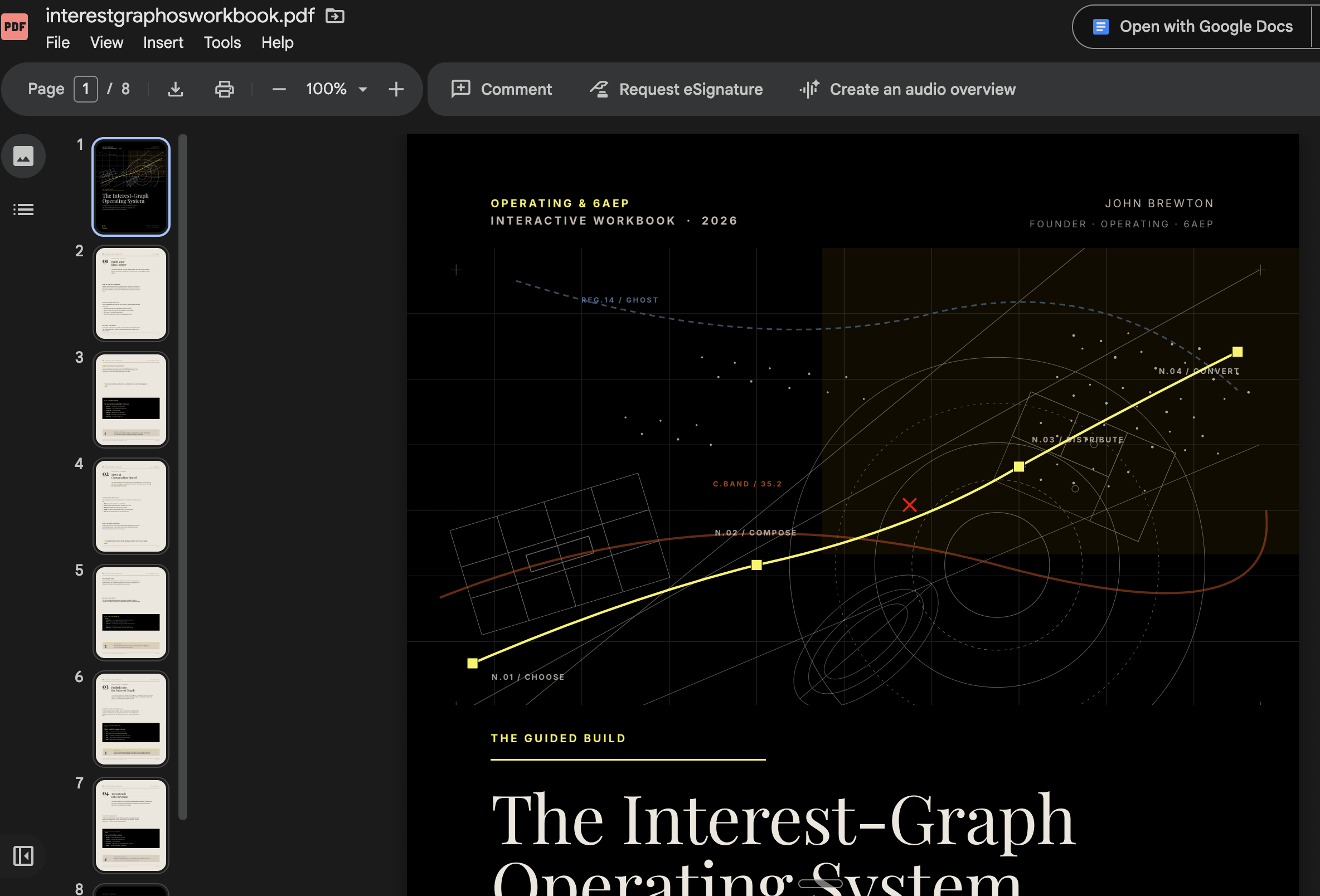
The Interest-Graph Operating System
I built the system that is the logical, operating approach for this set of ideas. And my paid subscribers get it. The Interest-Graph Operating System is a workbook you paste into your own model (anyone you like or prefer), which then turns into your facilitator and walks you through the four moves: choosing the ideas worth owning, composing them at conversation speed, publishing them into the interest graph, and turning reach into revenue.
You answer its questions in your own words. It compiles the answers into a system you can run this week: your idea ledger, your prompt pack, your publishing plan, and the four key numbers that tell you if it is working.
If you’re just starting to understand these ideas, this workbook is the place to begin building the AI-fluent machine to architect your new professional future and business ambitions.
DOWNLOAD BELOW AFTER THE PAYWALL, FOLLOWING THE APPENDIX AND FAQ SECTION.
Appendix: Sources
Opening and the history of writing tools
Plato, Phaedrus (Socrates on writing and the loss of memory), Perseus Digital Library, Tufts University. https://www.perseus.tufts.edu/hopper/text?doc=Perseus:text:1999.01.0174:text%3DPhaedrus:page%3D275
Jeremiah Dittmar, “Information Technology and Economic Change: The Impact of the Printing Press,” Quarterly Journal of Economics, 2011 (book prices fell by roughly two-thirds; cities that adopted the press grew about 60 percent faster). https://academic.oup.com/qje/article-abstract/126/3/1133/1855353
Jeremiah Dittmar, plain-language summary, CEPR / VoxEU. https://cepr.org/voxeu/columns/information-technology-and-economic-change-impact-printing-press
“Literacy,” Our World in Data (global literacy 12 percent in 1820 to roughly 90 percent today). https://ourworldindata.org/literacy
The distribution shift: social graph to interest graph
“Facebook is Dead; Long Live Meta,” Stratechery by Ben Thompson, 2025, citing Meta’s FTC antitrust filing (7 percent of Instagram time and 17 percent of Facebook time spent on content from friends). https://stratechery.com/2025/meta-earnings-meta-turns-the-dial-social-network-r-i-p/
Mark Zuckerberg, Meta Q1 2024 earnings call, reported by Benzinga (more than 50 percent of Instagram content is now AI-recommended). https://www.benzinga.com/news/24/04/38420928/meta-ceo-mark-zuckerberg-more-than-50-of-the-content-people-see-on-instagram-is-now-ai-recommended
“The AI behind unconnected content recommendations on Facebook and Instagram,” Meta AI, 2023 (recommendation of content from accounts users do not follow). https://ai.meta.com/blog/ai-unconnected-content-recommendations-facebook-instagram/
“Spinning off Instagram, the decline of friending, and other takeaways from Mark Zuckerberg at the FTC monopoly trial,” CNN Business, April 16, 2025. https://www.cnn.com/2025/04/16/tech/mark-zuckerberg-testimony-meta-ftc-trial/index.html
Anita Elberse, Blockbusters, Harvard Business School, via “The Way of the Blockbuster,” Harvard Magazine, 2013 (market concentration; a third of 8 million songs sold exactly 1 copy). https://www.harvardmagazine.com/2013/12/the-way-of-the-blockbuster
Voice and the reading side
“AI Voice Agents: 2025 Update,” Andreessen Horowitz (voice as the first and primary interface; 22 percent of the latest Y Combinator cohort). https://a16z.com/ai-voice-agents-2025-update/
“The 2025 AI Index Report,” Stanford Institute for Human-Centered AI (inference cost fell roughly 280x in about 18 months). https://hai.stanford.edu/ai-index/2025-ai-index-report
“Google zero-click searches study,” Search Engine Land, 2026 (most Google searches end without a click). https://searchengineland.com/google-zero-click-searches-2026-study-479717
Frequently Asked Questions
On “Stop Arguing About AI Writing” and the interest-graph shift
Isn’t most AI writing just slop? Some of it is. Slop is a production problem, and production is the part that got cheap. The point of the piece is that arguing about whether a machine drafts well is the wrong fight, because the value moved to the two things a machine does not do for you: choosing the idea and judging what comes back. Quality still matters. It just stopped being about who typed the words.
Does this mean writing skill no longer matters? Writing skill matters less as production and more as judgment. Fast, clean production is now table stakes a model clears for free. What pays is taste, the ability to choose what is worth saying and to cut what is not. That is a harder skill than typing, and it is the one worth building.
What is the interest graph, in plain terms? The social graph reaches the people you already follow or already know. The interest graph reaches strangers, because a recommendation model reads your content and serves it to whoever is likely to care. Follower count stops being the gate and the idea becomes the gate. Meta told a federal court that only 7 percent of time on Instagram, and 17 percent on Facebook, is now spent on content from friends.
I have a small audience. Can this actually work for me? Yes, and that is the opportunity. The interest graph does not ask how big you are. It asks how good the idea is. A sharper idea from an unknown account can out-reach an incumbent with a large list, because the list no longer decides who gets seen.
If everyone can produce, isn’t the competition infinite? The competition is real, and attention still concentrates on a few winners. Anita Elberse at Harvard showed that digital markets are more concentrated, not less. The gate moved. It did not vanish. Removing the permission barrier does not hand you the crowd. It gives you a shot you did not have before, and the idea is what earns it.
Isn’t building on someone else’s algorithm risky? It is a real risk, and it is the cost of the reach. Manage it two ways. Convert algorithmic reach into assets you own, an email list and paying customers, so a platform change cannot erase you. And do not depend on one platform. Publish where the idea travels and move with it.
Do I need to use voice and AI to do this? No, but they are the accelerant. Voice is the most information-dense way to get an idea out of your head, and the model turns it into a draft you judge and cut. The loop from raw thought to finished asset closes to minutes. You can do the work by typing. You will just be slower.
How do I make money from this, not just collect reach? Attach an offer to every idea you choose to own. Publish the argument free so it travels, and gate the system, the template, or the service that acts on it. Track four numbers every week: reach, email subscribers, paid subscribers, and revenue. If a week moves none of them, change the idea, not the effort.
How is this different from telling me to post more? Volume without a chosen idea trains the algorithm on nothing and trains the reader on nothing. This is the opposite. Own 3 to 5 ideas, repeat them in new forms until your name attaches to them, and let the schedule do the compounding. One flagship a week for 52 weeks beats 12 brilliant pieces shipped on mood.
How much time does the weekly system take? The cadence is one flagship and five short cuts a week. Monday you choose the idea, Tuesday you compose with the prompt pack, Wednesday you ship, and the rest of the week you distribute and log the numbers. The initial build takes about 40 minutes. The upkeep is a few focused hours a week.
What is the Interest-Graph Operating System, and how do I use it? It is a workbook you paste into your own model. The model becomes your facilitator, asks you one question at a time, and compiles your answers into a finished system: your idea ledger, your prompt pack, your publishing plan, and your scoreboard. You build it once, then you run it every week. Subscribers get it with this piece.
