

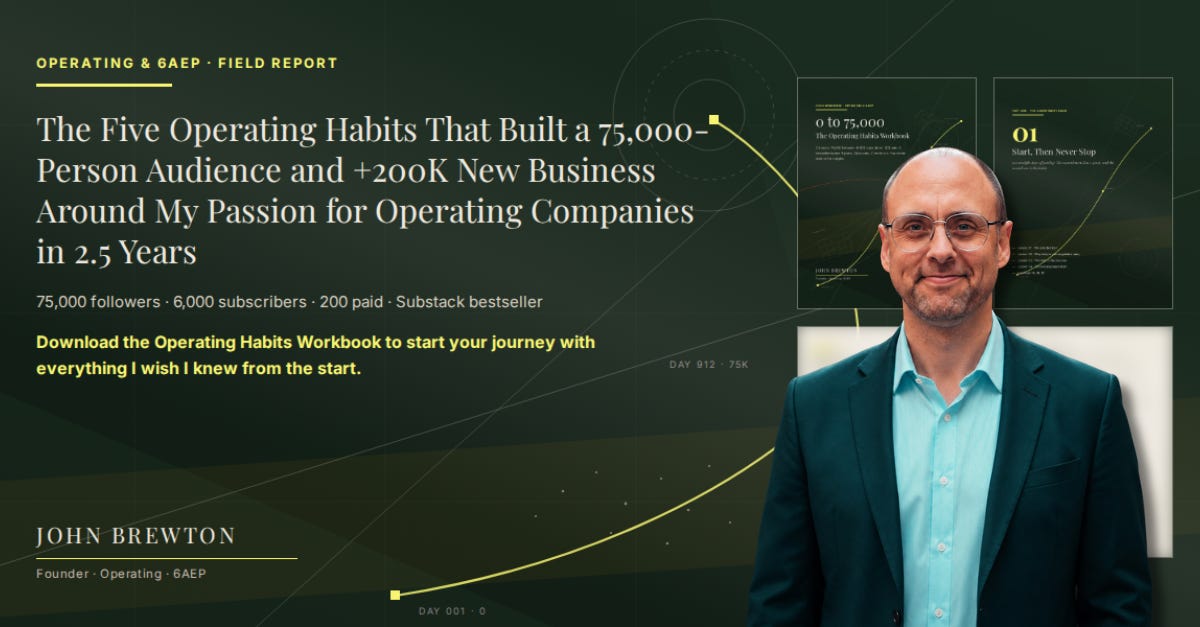
75,000 followers. 6,000 Substack subscribers. 200 paid. A Substack bestseller badge. And a new +$200,000 business vertical.
Over the last 2.5 years, I built an online audience of 75,000, a Substack with 6,000 subscribers, a Substack bestseller badge, + 200 paid members. Five essential operating habits created these outcomes.
Here’s how I learned and adopted them.
Habit 1: Start, then never stop
2.5 years ago I committed to posting on LinkedIn every single day.
I have not stopped since.
Some days the content was not ready. I posted. Some days I woke up late. I posted. In some weeks, the prior 7 posts underperformed. I kept posting.
The commitment has 2 parts: Start, and never stop. Most people manage to begin step one, but struggle to realize step 2.
What you can do: Pick 1 platform. Post daily for 90 days before you judge any of it. Do not negotiate or mentally manipulate your way around the committment.
How I Built a $200,000 Newsletter Business From a Substack Nobody Was Reading
The Five Moves That Turned My Substack Into a $200,000 Business
The Operating Project: Most Coaching Ends With Notes. This Ends With a Machine.
How to Produce World-Class Research with Perplexity Computer & Claude -> Fable 5
Habit 2: Audit every post and every week
Every post gets reviewed. Every week’s batch gets reviewed. Auditing all of your work is essential and falls across three categories within the feedback loop:
Topic: Check whether the subject is something your audience wants from you and whether it aligns with your profile. Note whether it rode a broader conversation or was specific to you. Note who engaged early and propelled reach inside the algorithm.
Packaging: Carousel, infographic, hero image, video, or photo. Check the design: the fonts, the readability, how the post rendered in a mobile feed and on desktop. Log which formats won and which lost in a Google sheet and keep pushing forward.
Copy: My hooks run 8 to 12 words across 2 sentences. Check whether the hook stopped the scroll. Check the CTA length. Check whether the CTA matched the body of the post and moved the reader to the action you wanted.
What you can do: Build a log. 1 row per post, 3 columns: topic, packaging, copy. Review it every Sunday. The log will tell you what to make next before your instincts do.
Habit 3: Stop caring what people think
Criticism arrived early, and it never stopped. Haters are going to hate. Laughers are going to laugh. The people not doing the work, who wish they were doing what you’re doing, are the loudest.
None of it touched the numbers.
In 2.5 years, no critic has cost me a follower, a subscriber, a single piece of my happiness.
What you can do: Publish anyway, every day. Read comments for signal about where the value is in your work, not for opinions about you.
Habit 4: Create for the audience, not the ego
Curiosity is a habit: Reading constantly, studying what the audience responds to (and doesn’t), and constantly asking what would help them next. The audience tells you what it wants in the comments, in DMs, in which posts get saved and shared.
Teach them what they’re asking for, based on their feedback on why they show up each day for your work, not on what your ego imagines makes you look the smartest or appear most professionally or intellectually attractive.
The filter on every piece is whether the audience will find it valuable, not whether it makes me sound smart or look cool.
Those 2 filters produce different content.
They produce content that actually grows a business.
What you can do: Keep a running list of audience questions. Turn each one into a post.
Habit 5: Upgrade the production line, then reinvest the time
When I started, a LinkedIn carousel took 2.5 to 3 hours to build in Canva. Today, with Claude handling the design, the same carousel takes under 20 minutes once the concept, idea, and copy are set. Editing takes longer now than it did then, and it matters more, but that has also become my favorite part.
Every time a new model or new tool ships, I test it against my production process. If it makes the work faster or better, it goes in the stack.
The saved time goes back into the work. More posts, richer resources, more value shipped to the audience. Not shorter workdays.
What you can do: audit your production process once a quarter. Test 1 new tool each cycle. Spend every saved hour on output.
The system, in 5 lines + 1
Post every day.
Audit every week.
Ignore the noise.
Serve the audience.
Upgrade the tools and reinvest the time.
Start today.
The Operating Habits Workbook
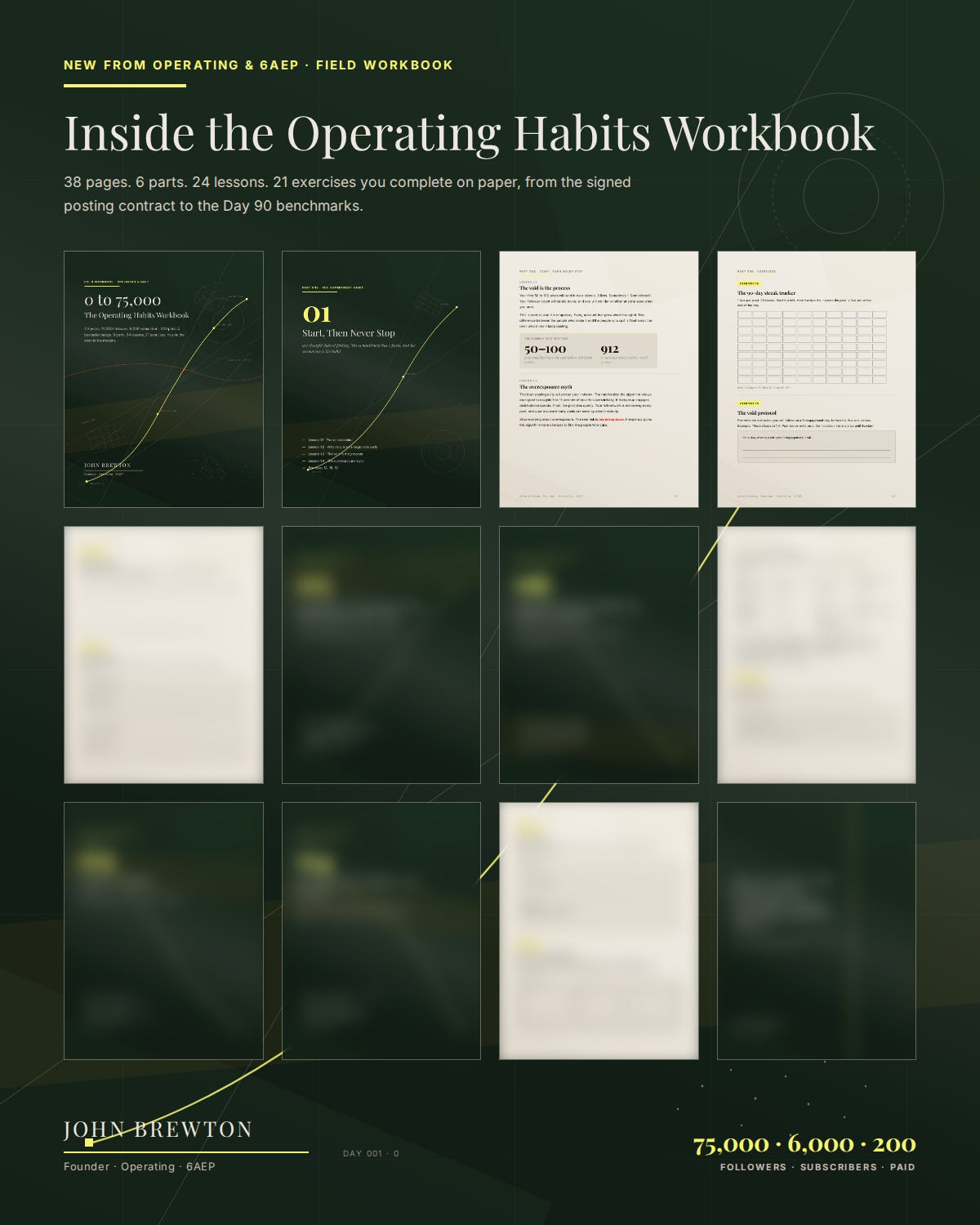
0 to 75,000: The Operating Habits Workbook expands the 5 habits into 38 pages: 6 parts, 24 lessons, and 21 exercises you can complete at your desk, in a notebook, or with your favorite LLM. The 6th lesson covers material outside the habits and focuses on building the business while you build the audience.
The lessons report covers what happened in my data across the 912-day run.
The exercises turn each lesson into an artifact you produce this week: a signed posting contract, a 90-box streak tracker, the 8-column data tracker, a Sunday review ritual, a critic ledger, a chat pipeline, a production map, an offer sheet, and a conversion path map.
It closes with the 90-day execution plan and the Day 90 benchmark tables, which show whether it is working.
Commit to one part per week for the next six weeks. By Week 6, you will have a running streak, tracked data on every post, a daily engagement block, a quarterly tool test, and an offer a stranger can buy. These are the same assets in tools that took me 2.5 years to build by trial and error. The workbook puts you at a profoundly better starting line than I was.
Become a paid subscriber to access below.
Become an Operating Founder for $399, and receive a 60-minute review of your content, business, and strategy. Additionally, you will be invited to join my weekly Operating Founder Office Hours, where I answer any and all of your questions and share what I’m working on and learning from building my business.
