

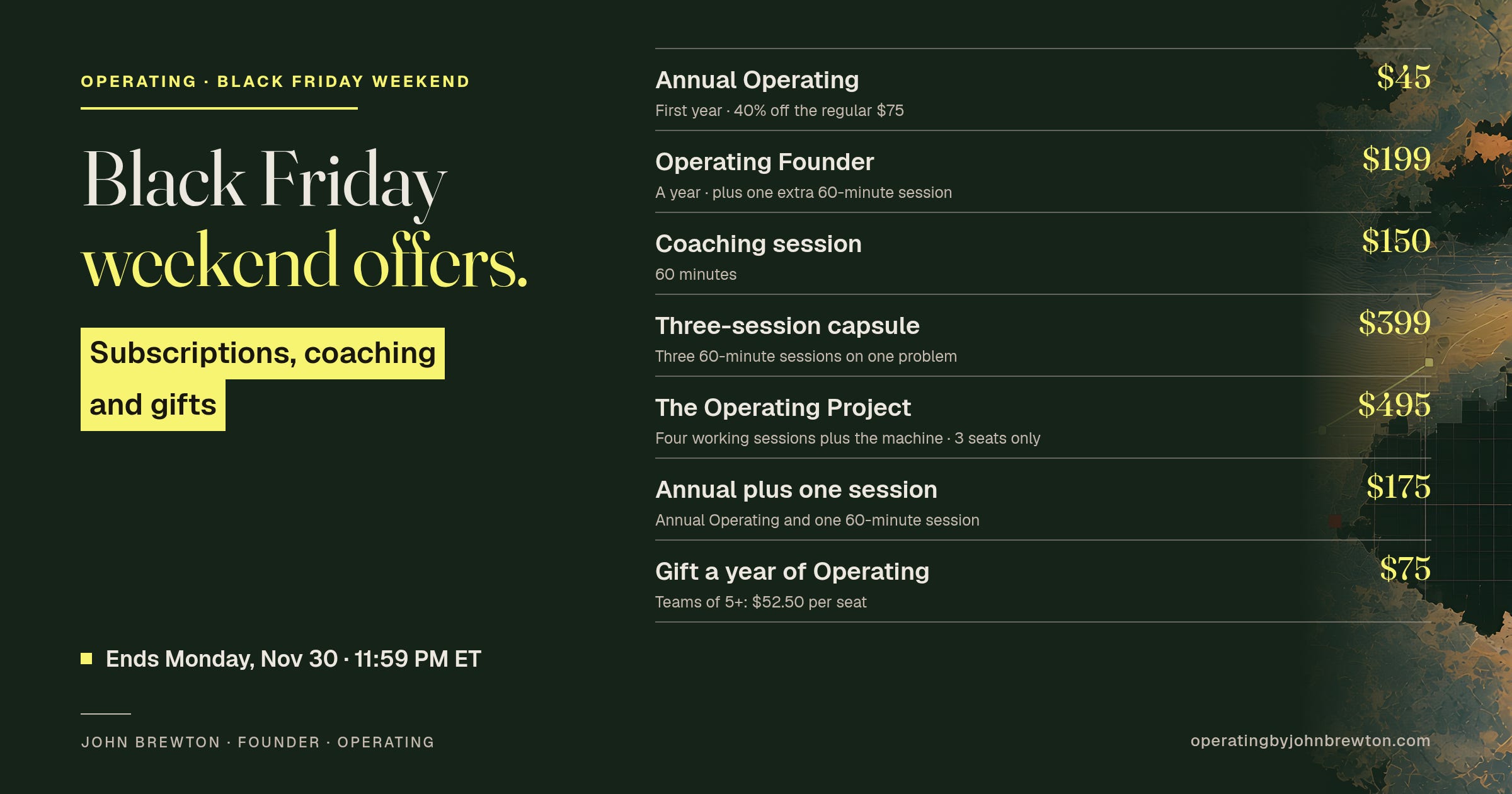
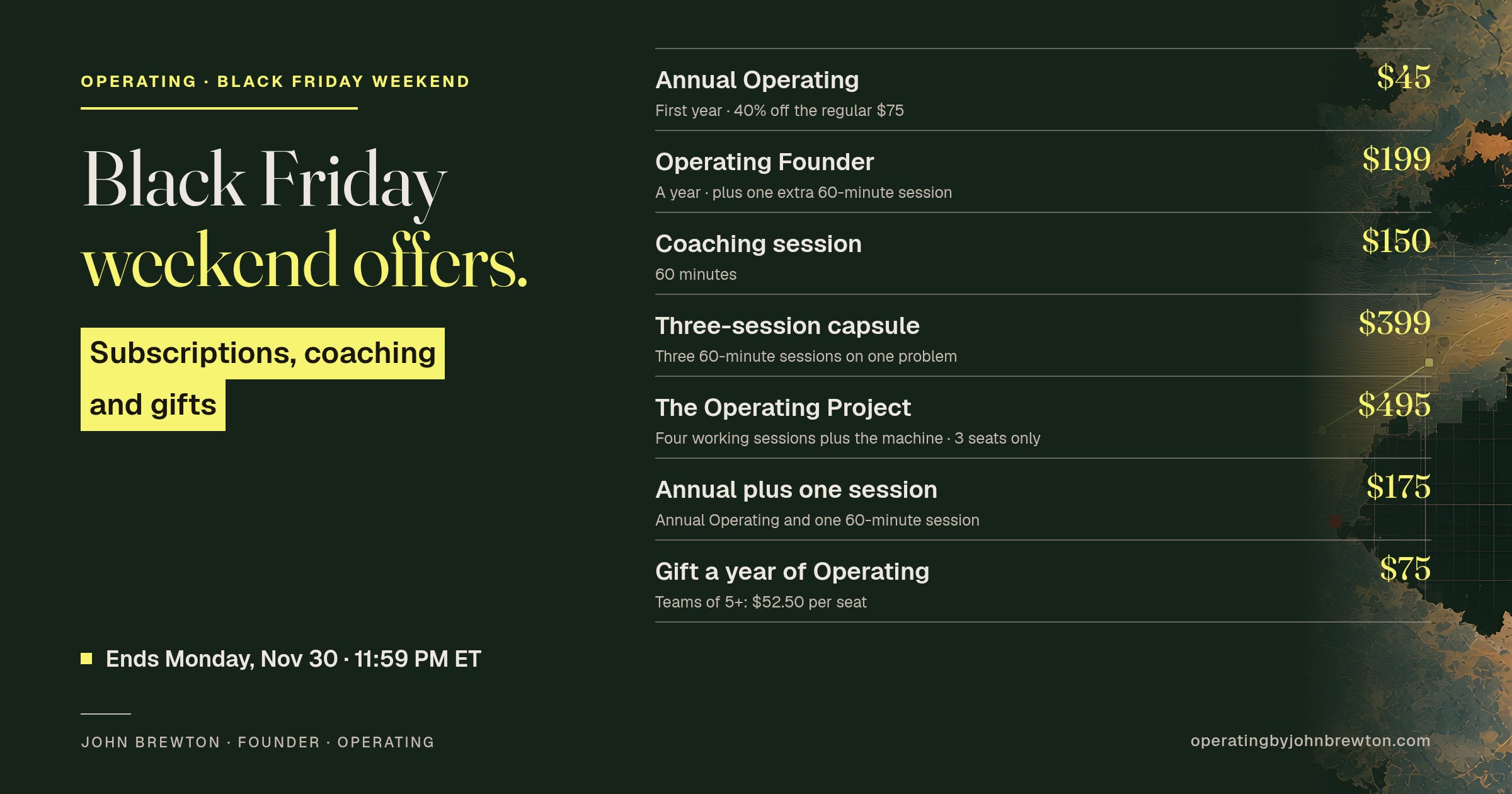
The Operating Black Friday sale runs through Monday night, and it’s the best price I’ll offer on Operating this year. Pick the level that fits where your business is right now:
Annual subscription, $45 for the first year: That’s 40% off the regular $75, and it gets you every paid essay and the full archive.
Founder membership, $199 a year, plus a bonus session: You get weekly office hours and a 60-minute review, and I’ll add a one-on-one working session on top.
Working sessions with me: One session is $150, or you can get three for $399.
The Operating Project, $495: It’s a small 1:1 build, across 4-5 sessions, where we set up your operating system together (only three seats available). Click here to learn everything you’d want to know about the Operating Project.
Gifts and teams: A gift subscription is $75, and teams of 5 or more pay $52.50 a seat.
Hello Operators!
"It's very likely that pretty much all humans on Earth will become permanently unemployable and will need to strictly rely on government welfare to sustain themselves."
Tao Lin said that on the Palisade Research podcast. Lin works on safeguards at Anthropic. I came across it this week in a LinkedIn post from Guillermo Flor that kept showing up in my feed. Guillermo was fair to him. He noted it's Lin's personal view and not an Anthropic forecast, and that Lin expects a long gap while billions of robots get built. Then he asked whether the bottleneck is model intelligence or how fast the physical world can absorb it.
Read Lin's sentence again. He isn't talking about entry-level jobs or one industry. He's talking about everyone on Earth, and he works inside one of the companies building the technology.
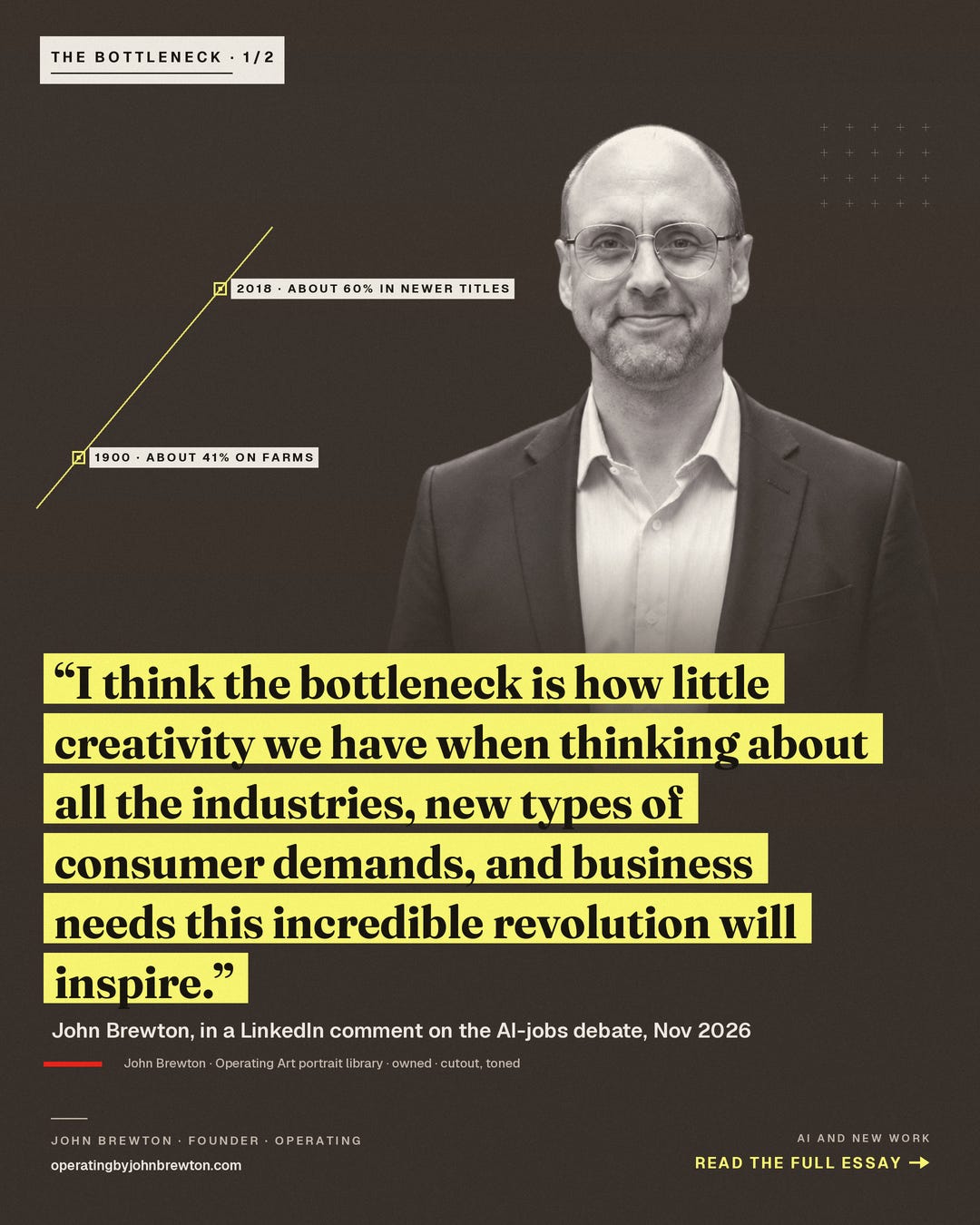
Every time this debate comes up, it runs the same way. Someone lists the work AI can do, and the conversation turns into a countdown. I think the bottleneck is how little creativity we bring to thinking about the industries, new consumer demands, and business needs this incredible revolution will inspire. So much of the prognostication about this issue conveniently leaves out everything we've learned about creative destruction and the new worlds that economic revolutions create.
Lin Has A Lot of Company
Lin’s boss has been making a version of this case for a year and a half. In May 2025 Dario Amodei, Anthropic’s CEO, sat down with Axios, and Axios reported his warning that AI could wipe out half of all entry-level white-collar jobs and push unemployment to 10% to 20% within one to five years. Axios quoted him directly on the scenario that worries him: “Cancer is cured, the economy grows at 10% a year, the budget is balanced — and 20% of people don’t have jobs.”
The next night Anderson Cooper read that scenario back to him on CNN. Amodei said he agreed with “all the positive potential,” and that the hopeful view of past transitions was “maybe too sanguine about the ability for people to adapt.” Earlier in the same interview he put it this way: “people will adapt, but they may not adapt fast enough.”
On 60 Minutes last November, Cooper read him the Axios numbers. Amodei said “Yes,” and then, “that is the future we could see, if we don’t become aware of this problem now.” At Davos in January he described AI taking us to “a world where we have very high GDP growth and potentially also very high unemployment and inequality.”
Geoffrey Hinton, who shared the 2024 Nobel Prize in Physics for the early work underneath all of this, gave career advice on The Diary of a CEO that June. “A good bet would be to be a plumber,” he said. “Until the humanoid robots show up.” In his view, a legal assistant or paralegal is “not going to be needed for very long.” I don’t disagree.
Elon Musk took it the furthest last November in a long conversation with Nikhil Kamath. “My prediction is in less than 20 years, working will be optional. Working at all will be optional, like a hobby, pretty much.”
These are serious people, and most of them pair the warning with something hopeful. Amodei talks about cures and growth, Musk about abundance.
What bothers me is that every one of these forecasts is a subtraction problem. List the tasks people do today, estimate how many a model can do, and subtract.
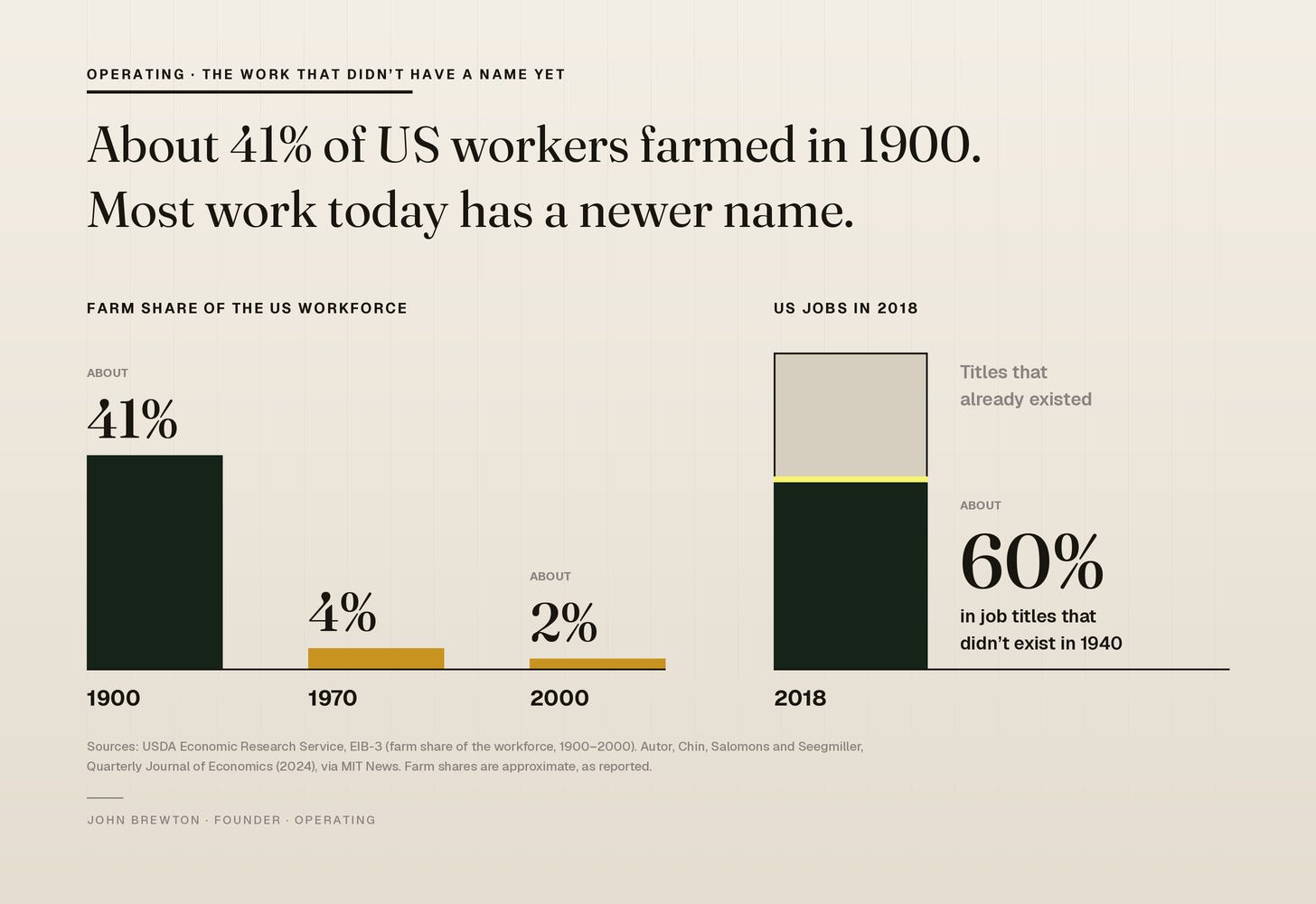
In 1930, John Maynard Keynes wrote about “technological unemployment,” the fear that saving labor would outrun “the pace at which we can find new uses for labor.” In 1900, about 41% of American workers worked on farms, and by 2000, that figure was about 2%. David Autor and his colleagues at MIT found that about 60% of US workers in 2018 were in job titles that didn’t exist in 1940.
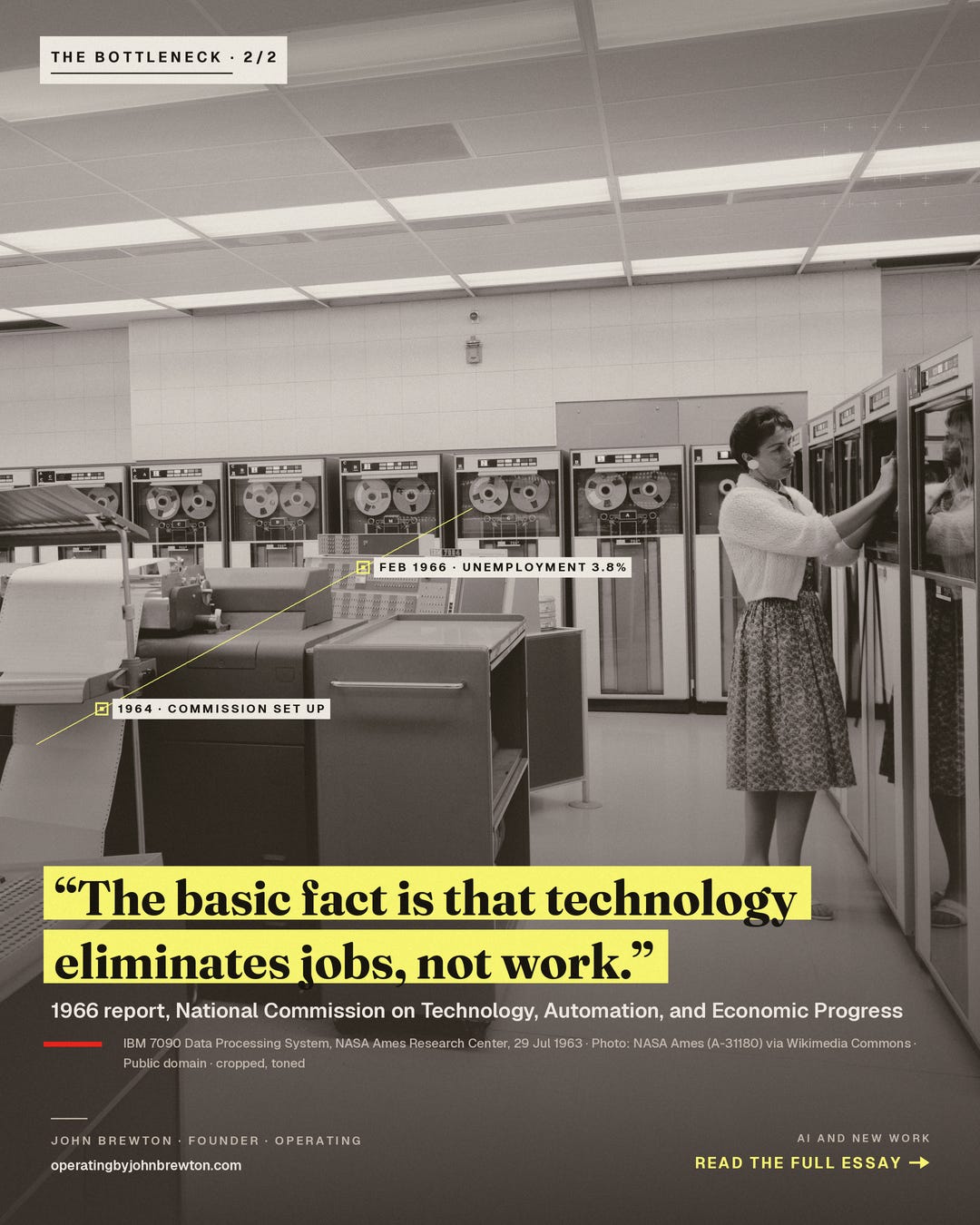
Earlier this month I wrote about bank tellers in The Cash Machine Opened More Branches. ATMs in the US went from about 100,000 to 400,000 between 1995 and 2010, and teller jobs grew from about 500,000 in 1980 to about 550,000 in 2010. Each branch needed fewer tellers, so banks opened 43% more branches in cities. In 1966, a national commission on automation reported unemployment at 3.8% and wrote, “technology eliminates jobs, not work.” The same report said the displacement was real, and it was.
Sam Altman said at a Federal Reserve conference in July 2025: "there are cases where entire classes of jobs will go away. There are entirely new classes of jobs that will come." Amodei thinks that kind of optimism underrates how hard the adjustment will be. I think the second sentence is the one history supports.
I’m not naive about the cuts, and I have enabled plenty of them through my work. On a panel last week, I said I had underestimated how many roles companies I work with could eliminate. That is a hard fact.
The same work shows me the other half. When I build a new enterprise system for a client, and the output goes out in minutes, the team doesn’t run out of work. The frustration shifts to the next step in the production line that hasn't received the same treatment. In a healthy company, the conversation turns to what this department could be doing for the customer now that the old work is handled. That is an exercise in creativity, and it’s the part all this forecasting (bloviating?) conveniently skips.
Several times this year, people who were never slotted for management turned out to be the clear best choice to lead a team's new version, in companies I’ve worked with. And I’ve never met more entrepreneurs who have accrued +$100K in year one than I have in this past year. The technology dramatically lowers the barrier to starting a company, bringing an offer to market, and making your first dollar. And oh yeah, by the way, you can sell globally, instantaneously.
AI shrinks the distance between having an idea and testing it. More ideas get tested, more small companies get started, and customers get served in ways that weren’t worth anyone’s time before. I wrote about that shift in Companies Are Becoming Tech Stacks. We Are All Becoming Companies. and about what one consultant can now deliver in The AI-Fluent Consultant.
Anthropic’s own research makes the case too. Its October survey found that more than half of 1,334 staff expect AI to do at least 80% of their work by 2030, compared with 5% of US workers. Its March study found no systematic rise in unemployment in AI-exposed jobs since late 2022, though hiring of young workers may have slowed. In computer and math jobs, AI could theoretically cover 94% of tasks and is used in about 33% in practice.
The gap between 94% and 33% is deciding what to do with that capability, and it’s the work I do with clients every week. I’m optimistic because optimism changes what we do next.
We must believe more in human creativity, human ambition, and human willingness to work hard, learn new things, and create new things from what we learn. We need to think more highly of ourselves as a species, everything that has come before in our history, and what we can create with the new production capabilities technology is giving us. Just as earning potential compounds for people who have best leveraged these new tools, so too does our production capacity and frontier as individuals. It’s not as sexy as talking about money, but it’s the lever that creates all the financial opportunity.
Don’t be discouraged, friends. And if you’re an Operator or a Builder. I hope the work we do at Operating is helpful.
- j -
The Operating Black Friday sale runs through Monday night, and it’s the best price I’ll offer on Operating this year. Pick the level that fits where your business is right now:
Annual subscription, $45 for the first year: That’s 40% off the regular $75, and it gets you every paid essay and the full archive.
Founder membership, $199 a year, plus a bonus session: You get weekly office hours and a 60-minute review, and I’ll add a one-on-one working session on top.
Working sessions with me: One session is $150, or you can get three for $399.
The Operating Project, $495: It’s a small 1:1 build, across 4-5 sessions, where we set up your operating system together (only three seats available). Click here to learn everything you’d want to know about the Operating Project.
Gifts and teams: A gift subscription is $75, and teams of 5 or more pay $52.50 a seat.

John Brewton documents the history and future of operating companies at Operating by John Brewton. He is a graduate of Harvard University and began his career as a PhD student in economics at the University of Chicago. Since selling his family’s B2B industrial distribution company in 2021, he has been helping business owners, founders, and investors optimize their operations.
Hi John! Your description of what happens after a system goes live matches what I see, because easing one constraint tends to expose whichever part of the chain nobody has got to yet. What interested me most is the people who were never earmarked for management turning out to be the obvious choice to lead what those teams became next.
Wonderful article! Whenever I read an interview or article predicting AI making everyone permanently unemployable, I wonder why they're never asked their own plan for unemployment