

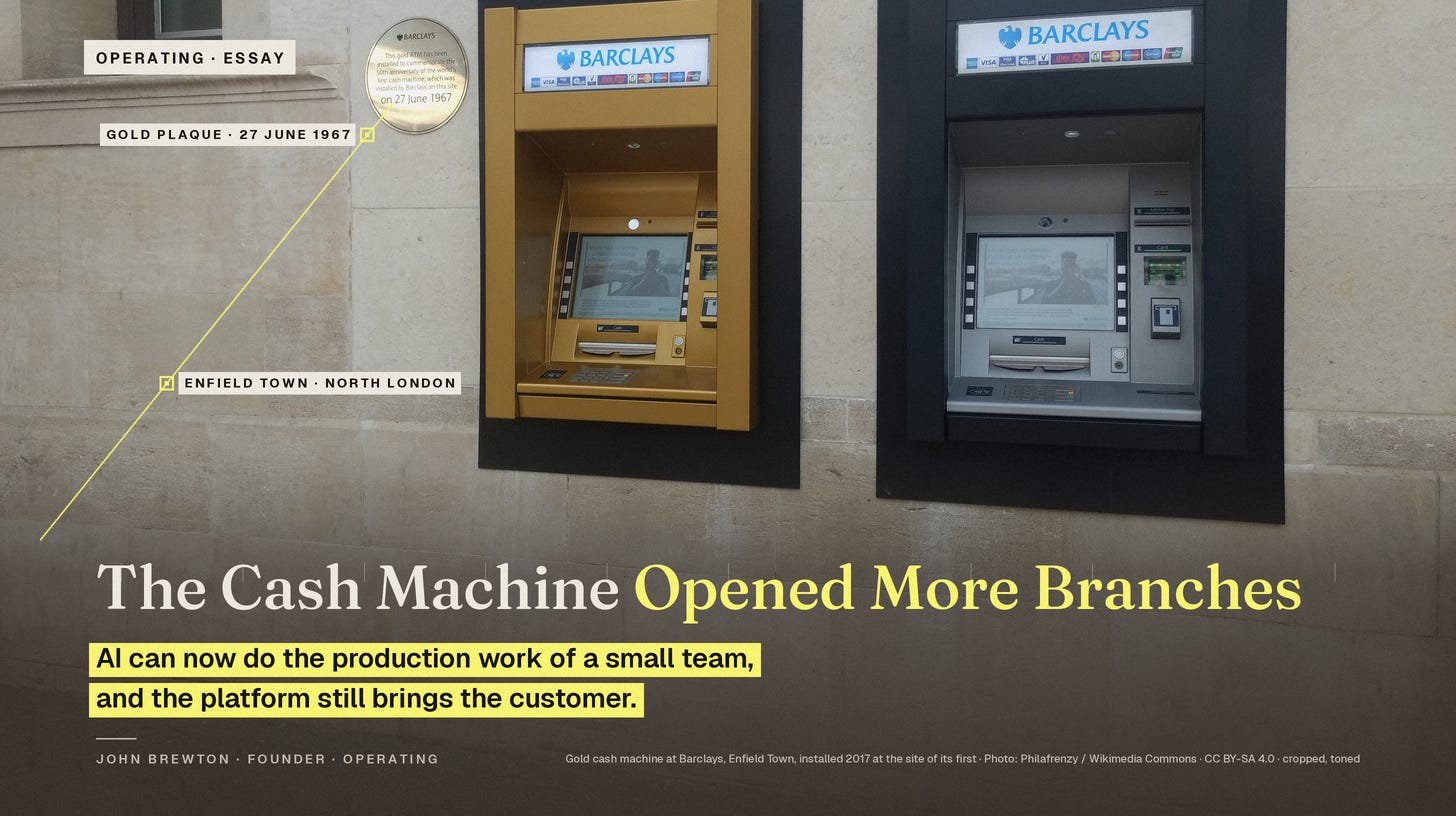
The gold cash machine Barclays installed in 2017 at its Enfield Town branch, the site of its first cash machine, 27 June 1967. Photo: Philafrenzy / Wikimedia Commons, CC BY-SA 4.0.
Hello Operators!
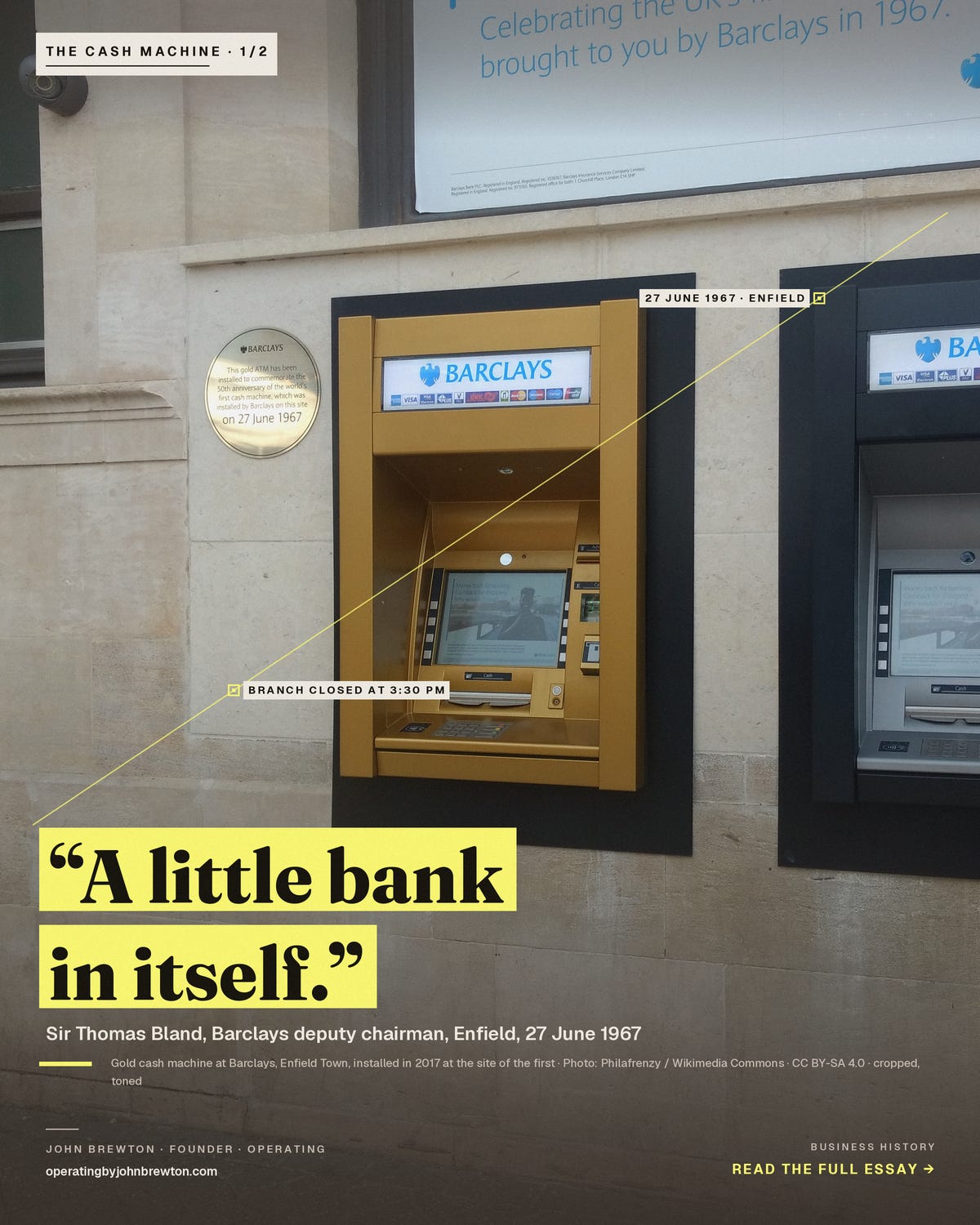
I have a fascinating story for you this week. On June 27, 1967, Barclays drew back a velvet curtain on the wall of its Enfield branch in north London, and actor Reg Varney withdrew £10 from Barclays' first cash machine. Barclays' deputy chairman, Sir Thomas Bland, called it "a little bank in itself." Carol Greygoose was an 18-year-old teller at the branch that day. Fifty years later, she told Barclays that the bank was only open until 3:30 in the afternoon back then, so the machine let customers get cash after the doors closed.
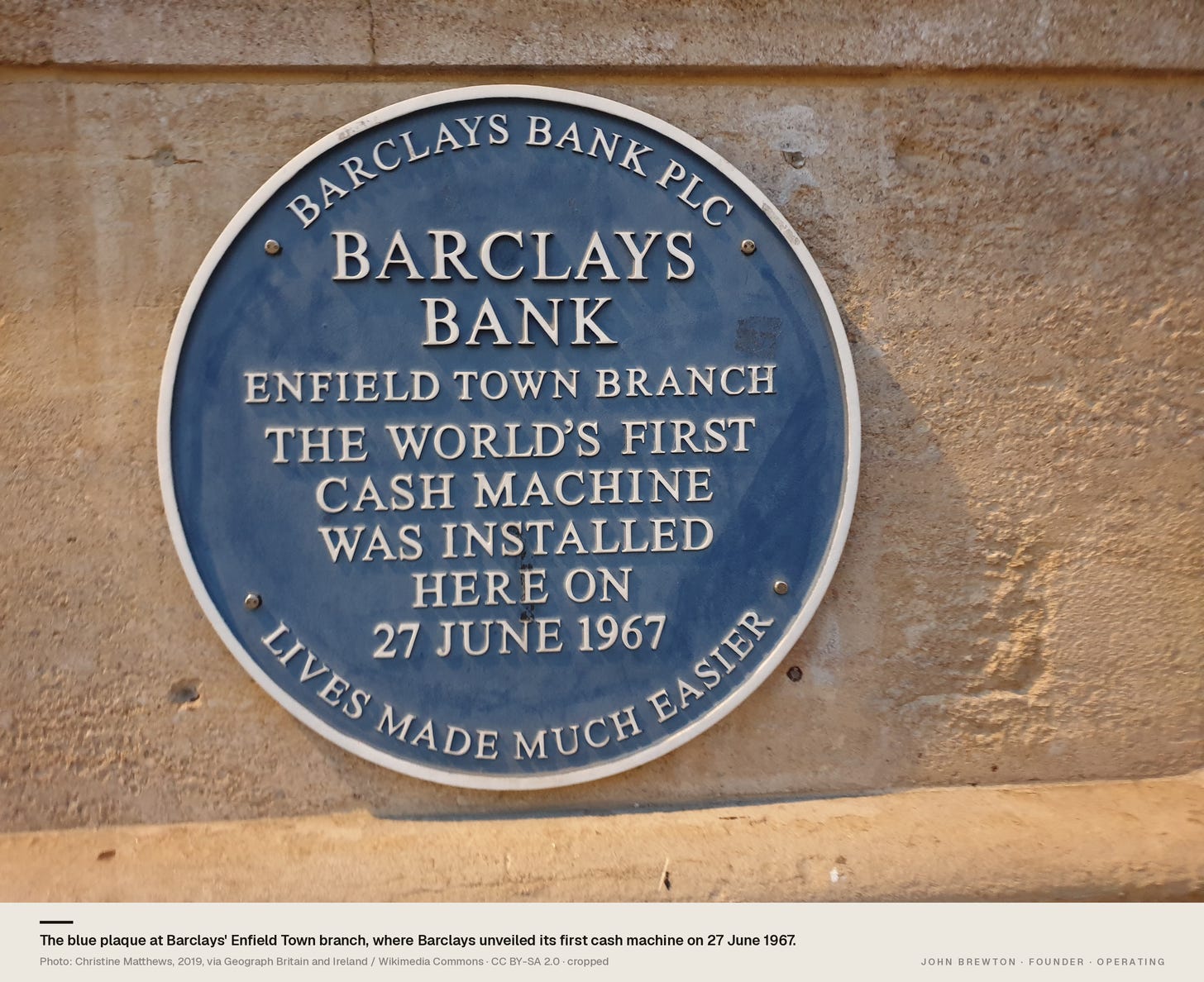
The blue plaque at Barclays’ Enfield Town branch. Photo: Christine Matthews / Geograph, CC BY-SA 2.0.
A little bank in the wall that works all night is an easy thing to read as the end of the teller. It did the most common part of the job, handing out cash, without a break and without a salary.
How to Build an AI Operating Team in Grok Bot: The Field Manual
You Don’t Have a Software Problem. You Have a Database Problem.
AI Was Supposed to Kill Consulting. Instead It Has Started a Golden Age.
The Quiet Builders Are Coming. Great Companies Will Build Around Them.
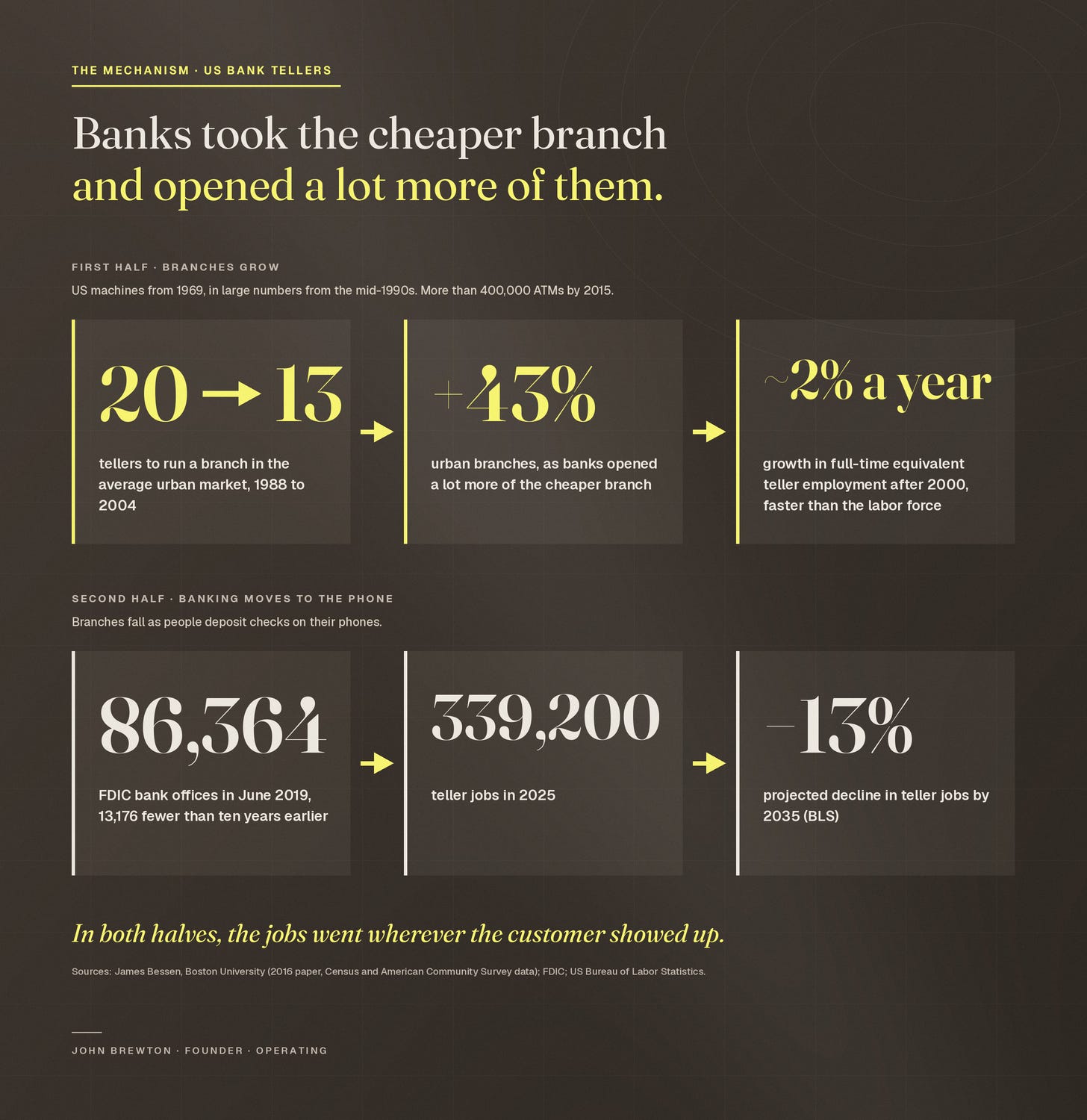
The US got its first machines in 1969, and banks started installing them in large numbers in the mid-1990s. James Bessen, the Boston University economist, has done the most careful work on what happened next. By 2015 the US had more than 400,000 ATMs. Between 1988 and 2004, the number of tellers it took to run a branch in the average urban market fell from 20 to 13. Banks opened more branches because they were cheaper, and urban branches rose 43%. In a 2016 paper using Census and American Community Survey data, Bessen found that full-time equivalent teller employment grew about 2% a year after 2000, faster than the labor force as a whole.
The job changed along the way. Counting cash mattered less, and time with customers mattered more, especially small business customers who needed something a machine couldn't give them. Bessen describes tellers becoming part of the relationship-banking team, selling higher-margin products.
The second half of the story matters just as much. The FDIC counts bank offices every June, and the number has fallen since 2009. By June 2019, there were 86,364, which was 13,176 fewer than ten years earlier. The Bureau of Labor Statistics puts it plainly in its outlook for the occupation: teller job growth was historically driven by the expansion of bank branches, and branches are now declining as people deposit checks on their phones. Tellers held about 339,200 jobs in 2025, and BLS projects a 13% decline by 2035.
So teller jobs grew as branches grew, but they started falling once customers moved their banking to their phones and branch counts fell with them. In both halves, jobs followed customers wherever they went.
This week's version
On Saturday, CNBC's Barbara Booth wrote about America's newest small business owners, the ones starting without employees. The piece leans on research from Liya Palagashvili, a labor economist at George Mason University's Mercatus Center. Using Census business application data, she found that in the industries most exposed to AI (professional services, information, education, and finance and insurance), applications with no early signs of hiring rose 26.8% from the first quarter of 2024 to the first quarter of 2026. CNBC puts that at roughly 222,000 to 281,000 a quarter. Over the same period, applications in those industries that looked more likely to become employers fell 6.4%. In construction and wholesale trade, her comparison group, the no-hiring applications were essentially flat.
Palagashvili is clear about what that does and doesn't show. The findings are preliminary and descriptive. They don't prove AI caused the rise, and an application without hiring signals doesn't tell you whether that business later hired anyone.
Alex Willen runs 12 e-commerce brands with no employees and expects them to bring in $2.5 million to $3 million this year. Claude helps with his bookkeeping, customer service, advertising, and inventory, and OpenAI's image tools do the work that used to go to photographers and designers. Without AI, he says, he'd need one more full-time person plus contractors for photography, design, bookkeeping, and ad management. Kristin Ginn left Microsoft in March, started an AI-adoption consultancy called trnsfrmAItn, and, seven months later, has received or contracted roughly $250,000 through year-end. She spends less than $60 a month on paid AI tools.
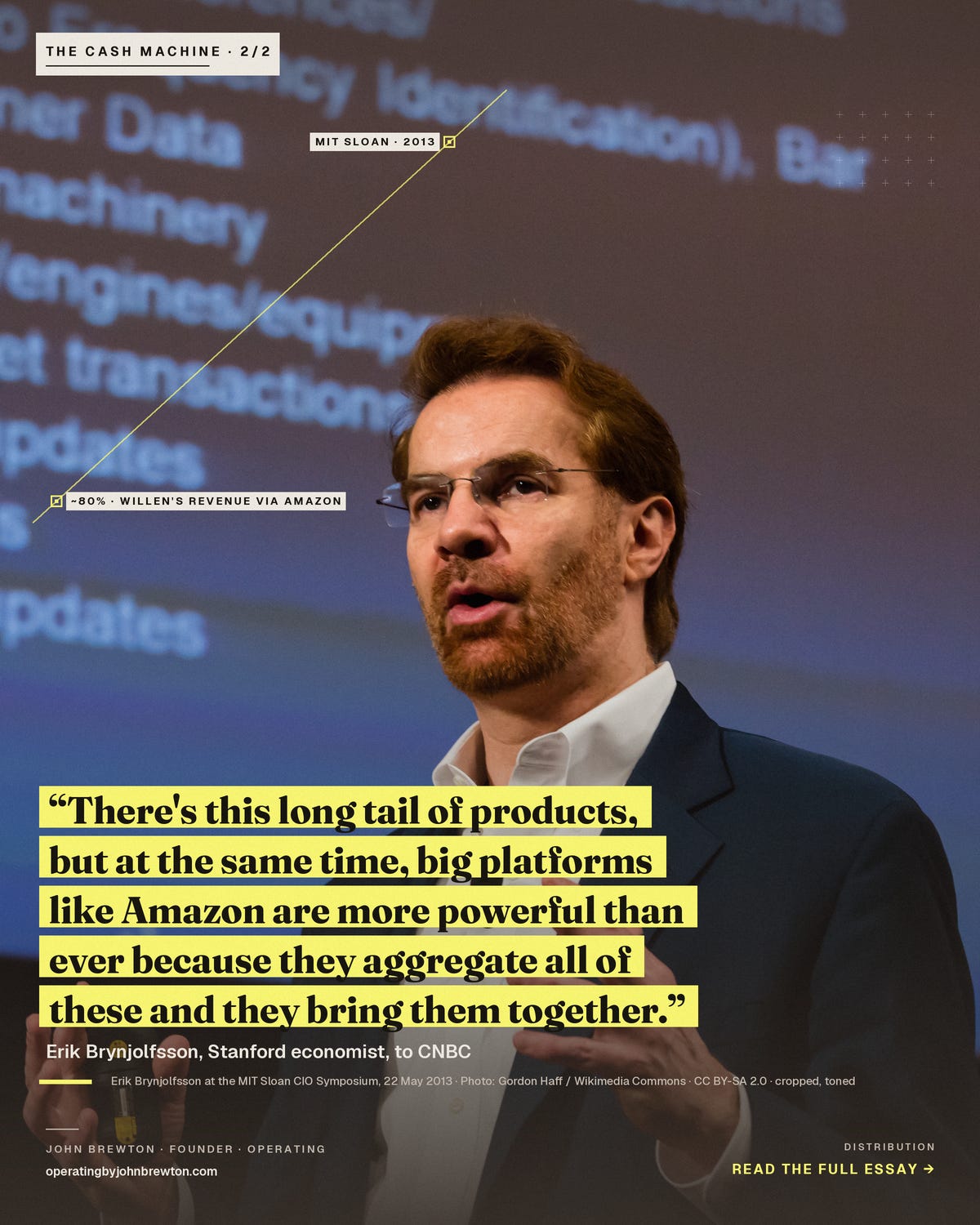
The customer side looks different. About 80% of Willen's revenue still comes through Amazon. LinkedIn has been one of the biggest drivers of customers to Ginn's consultancy. Erik Brynjolfsson, the Stanford economist, gave CNBC the other half of the picture: "There's this long tail of products, but at the same time, big platforms like Amazon are more powerful than ever because they aggregate all of these and they bring them together." His read is that as production gets cheaper, small businesses focus more on customer acquisition and distribution.
The piece also hints that the ATM pattern is already showing up. Gusto, the payroll company, tracked small businesses after they adopted AI and found their headcount was about 7% higher a year later than comparable businesses that knew about AI and hadn't adopted it. Among firms with fewer than 10 employees, adopters grew headcount about 10% more. That's one company's data, and it's early. It still points the same direction as Enfield.
Where the savings go
The banks had one thing most one-person companies don't. They owned the branch. When the ATM made a branch cheaper, the savings went straight into more of the channel the bank controlled, more locations where its own customers walked in, and its own tellers sold them the next product.
A one-person company in 2026 usually gets its customers through somebody else's front door. Amazon, LinkedIn, Meta, Substack. AI has made the work behind that door much cheaper. It hasn't replaced the door.
So the decision for a one-person company this year is where the money AI saves goes. It can go into rebuilding a channel you own, your site, your list, your own writing, and the relationships that come from it. Or it can go into buying more reach on a platform where someone else sets the terms. Both are real choices, and buying reach usually pays back faster. The banks picked the first one.
Willen is the best example in the piece of the first choice. When he bought Lone Trail, a hunting-gear brand, its Shopify site was about 1% of sales. He rebuilt the site with ChatGPT and Claude and used AI to help run Meta advertising. In a recent 30-day period, he says the site was about 30% of Lone Trail's revenue. He thinks that will end up being "at least six figures of annual revenue that would not exist without AI." He still pays Meta for the traffic, and the order lands on a site he owns.
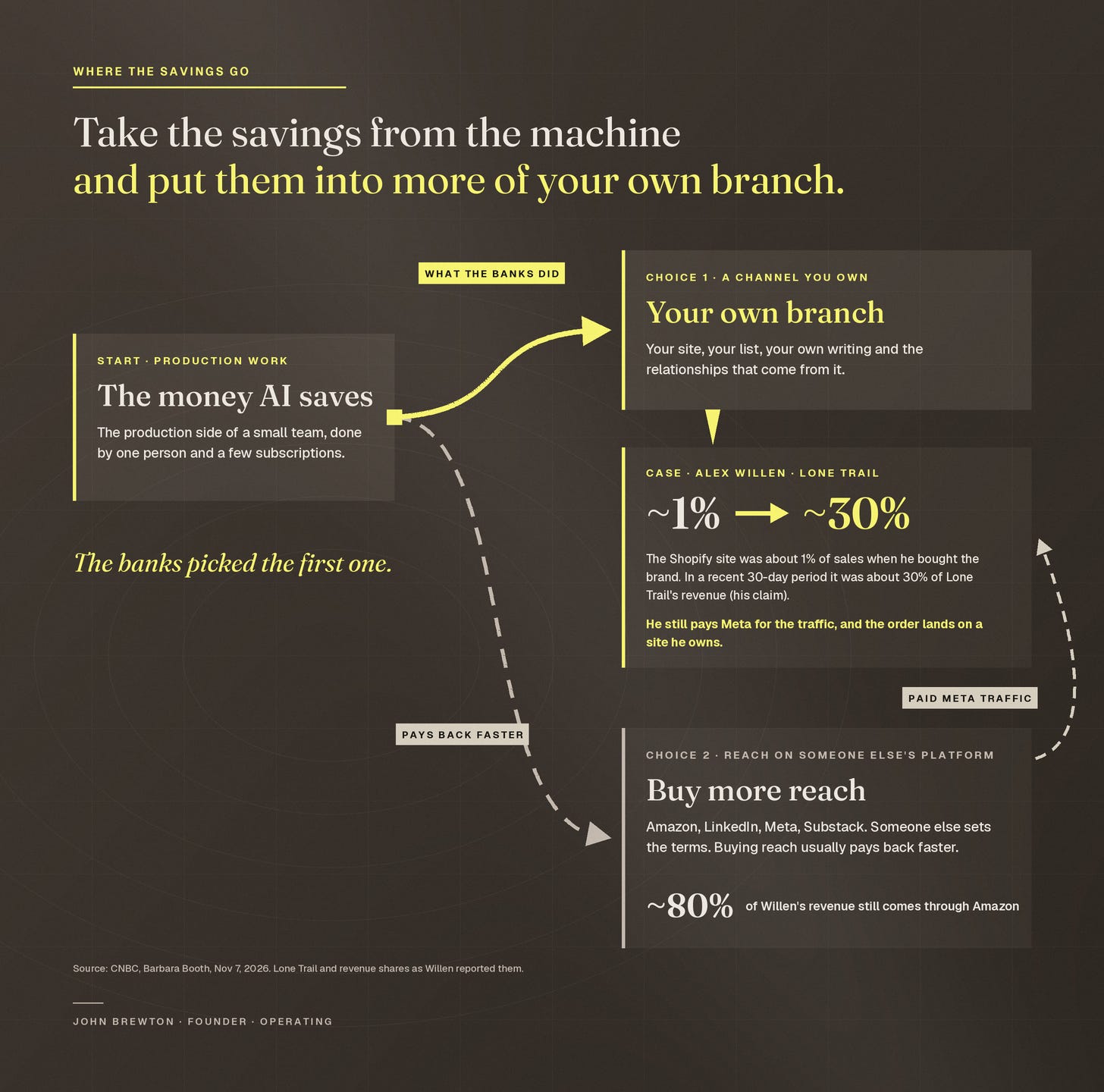
That's the bank playbook. Take the machine's savings and put them into more of your own branch.
Two weeks ago, in We Are All Becoming Companies, I wrote that you can rent the tools by the month, but an owner still needs a customer they can reach. This week's reporting puts most of the weight on that second part.
I run my business this way, so I'll be specific. The software I use to make my content costs me about $600 a month, and it replaces a VA bill I'd priced at $5,000 to $6,000 a month. I post across a lot of platforms where I have almost no audience, and the point is to bring people back to the newsletter and the email list. The one job that changed my year came from a decision-maker who'd been following my writing about operations, and it was worth about $200,000. Before Operating, I spent twelve years in my family's B2B industrial distribution company, and a distributor's whole business is being the channel between the maker and the customer.
The cash machine went into a wall in Enfield so customers could get money after the branch closed at 3:30. The banks that followed spent what the machines saved on more branches.
If you're deciding where to put your savings this year, I'd love to talk with you.
- j -
How to Build an AI Operating Team in Grok Bot: The Field Manual
You Don’t Have a Software Problem. You Have a Database Problem.
AI Was Supposed to Kill Consulting. Instead It Has Started a Golden Age.
The Quiet Builders Are Coming. Great Companies Will Build Around Them.

John Brewton documents the history and future of operating companies at Operating by John Brewton. He is a graduate of Harvard University and began his career as a PhD student in economics at the University of Chicago. Since selling his family’s B2B industrial distribution company in 2021, he has been helping business owners, founders, and investors optimize their operations.
John this is your best article yet KNICKS IN 5!!!!! Huge hug! This is so
Good!!! 💃🏼💃🏼💃🏼💃🏼💃🏼