

A Year of Building
This year, I’ve built AI-native CRM systems, company valuation software, investment and market research systems, ERP modules, company data reservoirs, and content-generation machines.
Across all of these applications, dozens of product design configurators, catalogs of thousands of parts, inventory counts, transaction counts, visual design systems, and customer orders in currencies from around the world. They all live in a variety of Postgres databases on Supabase.
Software is becoming a complex of databases designed to enable agentic queries, visual and analytical outputs, and autonomous workflow progressions.
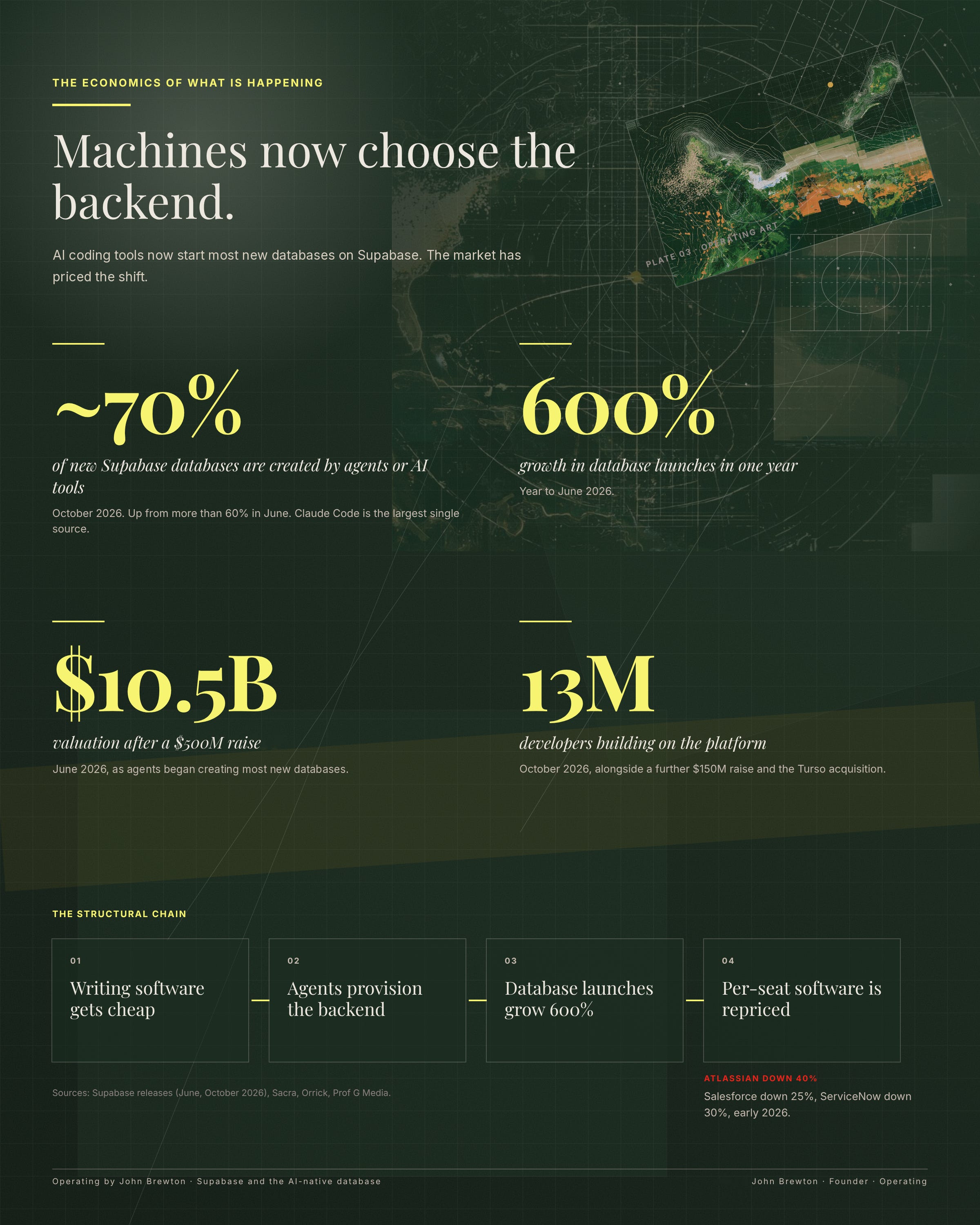
The shift that these projects have demonstrated to me is visible in how most all enterprise software is getting built. In June, Supabase CEO Paul Copplestone said AI coding tools now start more than 60 percent of new databases on the platform, with Claude Code the single largest source. By October the company put the share at roughly 70 percent. Agents are choosing the database before a person chooses the software. Supabase’s reported valuation reached $10.5 billion.
The durable asset is the company’s record of how its business works. A database gives that record a structure that people, applications, and agents can use.
Models keep changing. A clean database, with agreed definitions and controlled access, remains useful through those upgrades. I use Supabase as the foundation because it lets me build around that record without buying a separate system for every workflow.

How to Build an AI Operating Team in Grok Bot: The Field Manual
AI Was Supposed to Kill Consulting. Instead It Has Started a Golden Age.
The Quiet Builders Are Coming. Great Companies Will Build Around Them.
What is Supabase?
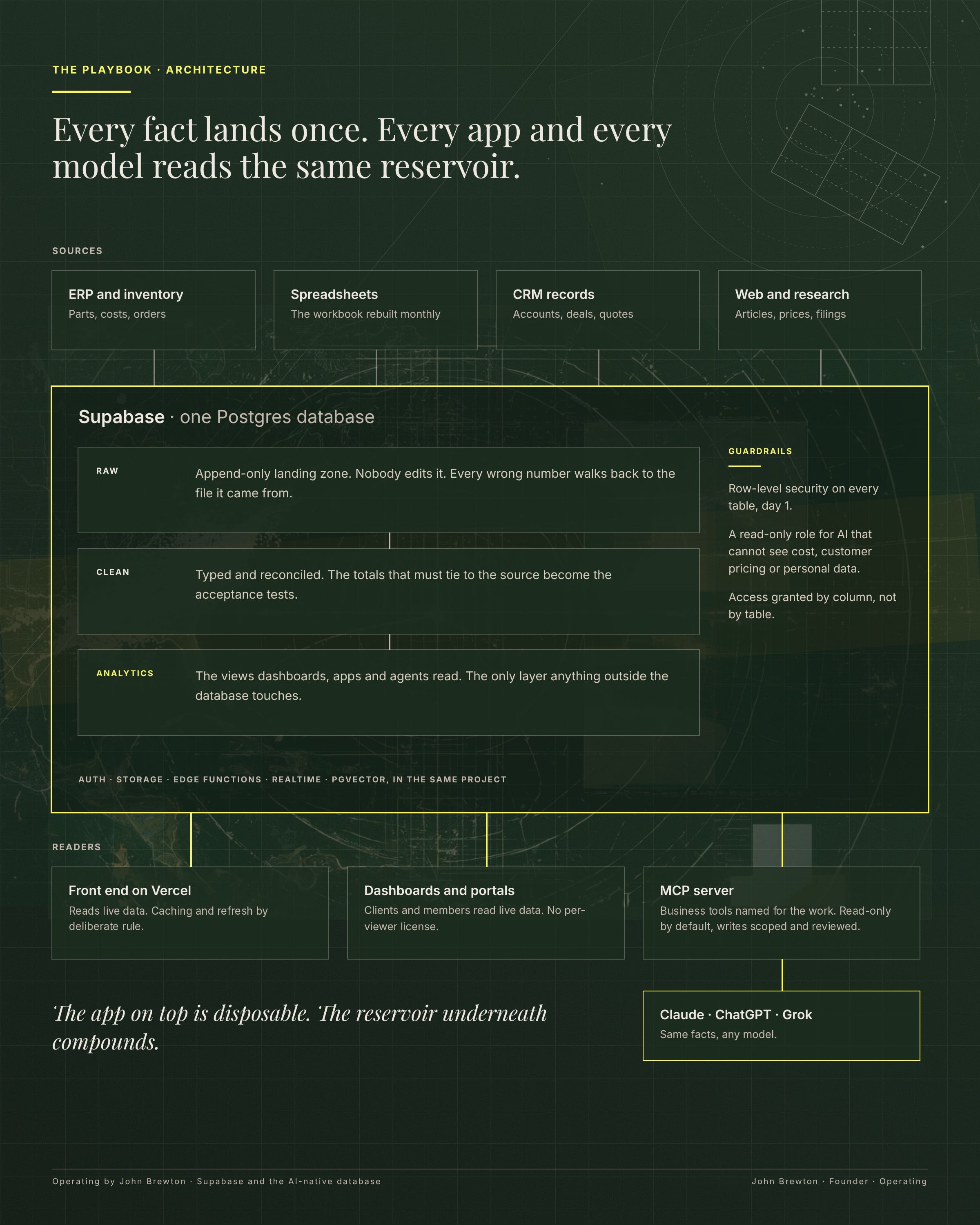
Supabase is a managed Postgres database with the parts every application needs already wired in: user login, file storage, server-side functions, real-time updates, and vector search for AI features. Those services sit around the same database.
Postgres matters more than the brand. It is a 30-year-old open-source database with a widely used query language, SQL. Engineers and coding models can work with it directly. If you outgrow Supabase, you can move your Postgres tables and SQL, though you may need to replace its other services. With a packaged application, moving the data often also means untangling the vendor’s definitions and rebuilding its workflows.
Supabase has also attracted substantial funding. Supabase raised $500 million at a $10.5 billion valuation in June 2026, then another $150 million in October alongside the acquisition of Turso, a database built for agents that spin up millions of small databases. It reports more than 13 million developers on the platform.
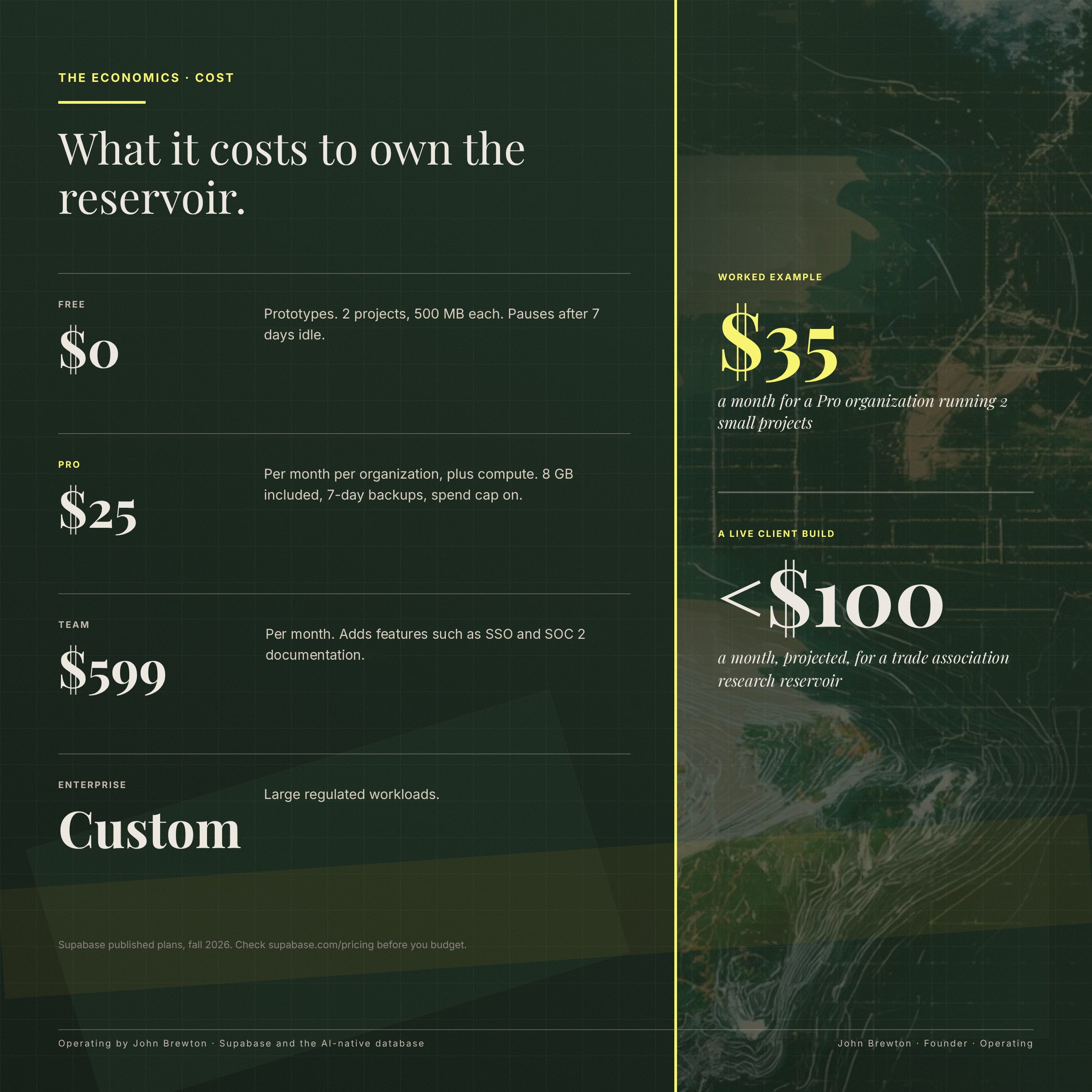
The entry cost is lower than many operators expect. Free costs $0. It is for prototypes: 2 projects, 500 MB each, paused after 7 days of inactivity.
Pro starts at $25 a month per organization, plus compute. A $10 monthly compute credit covers 1 small instance. The plan includes 8 GB of database storage, daily backups kept for 7 days, and a spend cap enabled by default.
Team starts at $599 a month and adds features like SSO and SOC 2 documentation for customer security reviews.
Enterprise has custom pricing for larger or regulated workloads.
A Pro organization running 2 projects on the smallest compute costs $35 a month. I run 5 projects for client and research work in 1 organization. For a research reservoir scoped this month, the projected all-in running cost is below $100 a month.
Why You Need to Care More About Databases
AI has cut the effort required to write an application. That makes custom software practical for work that once could not justify a development budget. Agents can provision the database as part of the build, and Supabase reported 600 percent growth in database launches through June 2026.
The market has started questioning the old economics. By early 2026, Salesforce, ServiceNow, and Atlassian were down 25, 30, and 40 percent for the year, respectively, as investors debated how AI would affect software spending. Those declines prove companies won't abandon their vendors. They make the build-versus-buy question harder to dismiss.
I talk about reservoirs more than databases now. A reservoir is the governed store of your company’s facts that every model and every app draws from. A dashboard may take an afternoon to rewrite. The underlying data can take months to reconcile, including decisions about what each field means and who can use it. A better model can use that work. It cannot make those decisions for the business.
That changes the build-versus-buy question for a mid-sized company. You buy the commodity: email, payroll, accounting. You build the layer that encodes how your business works because it captures business-specific decisions.
A vendor charging per seat to display your records now has to justify the price against an application you can own. The subscription is easy to count. Include maintenance, security, and support on the build side of the comparison.
My Five Operating Use Cases
These examples come from my own work and client engagements. The figures describe the databases as of October 27, 2026. Some support established workflows. Others support products still being built.
