

A few years ago, we became obsessed with the concept of quiet quitting.
People stopped answering emails at night. They stopped volunteering for work that was not theirs. They stopped treating every request from an employer as an opportunity to prove how badly they wanted the next promotion.
We interpreted much of this as a decline in ambition.
I think we got that wrong.
The ambition did not disappear. It shifted directionally.
The person who no longer wants to spend Saturday preparing another presentation for their employer may be spending Saturday building a product of their own.
The marketer who stopped obsessing about becoming VP may be building an audience. The accountant may be learning how to code with AI. The salesperson may be testing a consulting business. The executive may be discovering that becoming CEO of a company she owns sounds more interesting than becoming EVP of a company she does not.
This is not quiet quitting.
It is quiet building.
Quiet quitting was about withholding additional effort from someone else’s company.
Quiet building is about redirecting that effort toward your own.
And I increasingly believe that quiet building will become one of the defining professional behaviors of the AI economy.
Jobs are becoming bundles of tasks that machines can increasingly help us complete. Skills are changing faster. Organizational capability is becoming less dependent on organizational headcount. Individuals are gaining access to capabilities that once belonged almost exclusively to companies.
The professionals who recognize this have an opportunity to become dramatically less dependent on a single employer.
The companies that recognize it have an opportunity to build organizations filled with some of the most curious, commercially minded and ownership-oriented people in the workforce.
Companies are becoming tech stacks.
We are all becoming companies.
And both sides of the employment relationship need to start acting in accordance with the reality of this change.
How I Built a $200,000 Newsletter Business From a Substack Nobody Was Reading
Stop Paying For Advice. Start Investing In Operating Systems.
Quiet Quitting or Quiet Building? Our Changing Relationship With Professional Ambition
How to Produce World-Class Research with Perplexity Computer & Claude -> Fable 5

The Safe Job Is Becoming a More Complicated Idea
For most of the last century, one of the safest economic strategies available to an ambitious person was relatively straightforward.
Get educated.
Develop a valuable skill.
Find a good company.
Become increasingly valuable to that company.
Get promoted.
Earn more.
Save.
Invest.
Retire.
There is nothing wrong with that strategy. Millions of people will continue to build wonderful lives that way. But I think it is dangerous to assume the structure of the job sitting underneath that strategy will remain as stable as it once appeared.
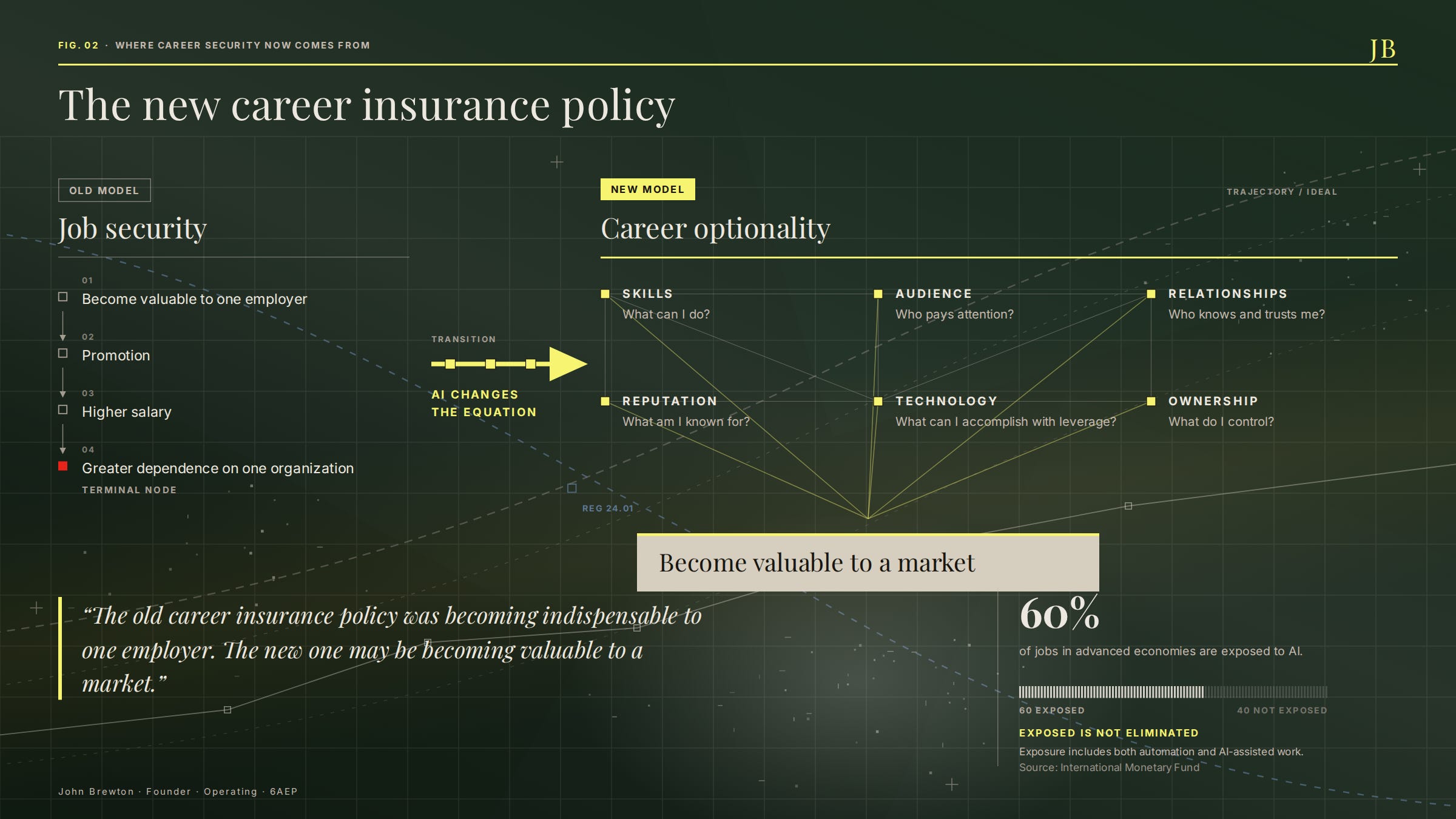
The International Monetary Fund estimates that roughly 60 percent of jobs in advanced economies are exposed to AI. Importantly, exposure does not mean elimination. In roughly half of those exposed jobs, the IMF believes AI could complement human work and increase productivity.
The International Labour Organization reached a similarly important conclusion. Its latest global work on generative AI says roughly one in four jobs worldwide has some degree of GenAI exposure, but job transformation is more likely than wholesale replacement because most occupations still contain tasks requiring human involvement.
The question employees should be asking is the following:
How much of the work currently inside my job still needs to be done by me three years from now?
The U.S. Bureau of Labor Statistics now explicitly incorporates AI into its employment projections. BLS expects AI and other automated systems to increase productivity in some occupations while reducing labor demand in portions of office support, administrative work, sales and other task-heavy categories. At the same time, it projects substantial growth in technology-intensive occupations such as data science.
I do not think the intellectually serious argument is that there are no safe jobs anymore. It is the following: It is becoming less safe to assume that today’s job description, today’s skills, and today’s workload will remain intact.
Increasingly, I think career security will be about becoming valuable to a market, not a single company.
Part of Your Job Will Disappear
We keep discussing AI at the occupational level.
Will AI replace programmers?
Will it replace marketers?
Lawyers?
Accountants?
Consultants?
Writers?
That framing misses the way work actually happens. A job is not one thing. It is a collection of things.
Researching. Writing. Scheduling. Analyzing. Calculating. Communicating. Reporting. Creating presentations. Updating systems. Answering questions. Coordinating people. Making decisions.
AI does not need to eliminate the entire collection to fundamentally change the economics of the job. It simply needs to begin compressing enough of the tasks inside it.
In one of the most important real-world studies of generative AI at work, researchers from Stanford and MIT studied thousands of customer-support workers. Access to a generative AI assistant increased productivity by roughly 14 to 15 percent, with the largest improvements concentrated among newer and less-skilled workers.
The broader Stanford AI Index now documents productivity improvements across multiple types of knowledge work, though the gains vary considerably depending on the task and the worker. That variability is important. AI is not magically making every worker twice as productive, and we should be suspicious of anyone pretending that it is.
But even modest productivity gains create an organizational question that becomes more important as the technology improves:
What happens when a role designed around 40 hours of tasks no longer contains 40 hours of economically valuable human work?
Maybe it contains 35.
Then 30.
Maybe a year later it contains 20.
The traditional organization has an instinctive response to this.
Fill the space. Add responsibilities. Add meetings. Add reporting. Add another project. Turn a productivity gain into more activity.
I think the better organizations will eventually ask a harder question.
Do we actually need this job to remain exactly what it was?
Companies Are Becoming Tech Stacks
This is the organizational transformation underneath all of this. The traditional company accumulated capabilities largely by accumulating people.
If you needed more sales capacity, you hired salespeople.
More research required researchers.
More design required designers.
More content required marketers.
More analysis required analysts.
More software required developers.
More administrative capacity required administrative employees.
There was a fairly direct relationship between the amount an organization could do and the number of qualified humans it could employ.
According to the OECD’s 2026 research on skills in the AI age, the share of firms using AI across OECD countries with available data rose from roughly 7 percent in 2021 to about 20 percent in 2025. The OECD attributes part of that acceleration to the arrival and diffusion of general-purpose generative AI tools. (OECD)
We are moving toward organizations composed of some combination of:
Employees + AI models + agents + software + data + automation + contractors + systems.
The company itself is starting to look more like a technology stack. Adding organizational capability no longer always requires adding organizational headcount.
A ten-person company can increasingly perform work that once required 20.
A five-person company can access research, design, development and marketing capabilities that once belonged to organizations with entire departments.
A single extraordinary operator can increasingly orchestrate systems that perform work previously distributed across several specialists.
If that continues, we should expect two things to happen at the same time. (1) Companies will need fewer humans for certain categories of work. (2) And the humans they do employ will need to become much more capable.
That is where the quiet builder becomes incredibly interesting.
The Employee You Are Afraid of Losing May Be Exactly the Employee You Need
Think about the characteristics companies say they want from their employees.
Ownership.
Curiosity.
Initiative.
Commercial awareness.
Comfort with ambiguity.
Problem solving.
Adaptability.
Technology fluency.
Continuous learning.
Resourcefulness.
The World Economic Forum’s Future of Jobs research found that employers expect 39 percent of workers’ core skills to change by 2030. AI and big data are among the fastest-growing areas of skill demand, but employers also place tremendous value on analytical thinking, creative thinking, resilience, flexibility, agility and leadership.
We have another word for a person obsessed with developing most of those characteristics. Entrepreneur.
Companies are desperately trying to make their employees think more like owners, yet often become deeply uncomfortable when those employees begin to act like owners.
They want entrepreneurial thinking.
Just not too much entrepreneurship.
They want curiosity.
As long as that curiosity stays within the organization's walls.
They want employees obsessed with learning AI, understanding customers, improving margins, finding opportunities and creating systems. Then the employee starts a small company on the weekend and suddenly everyone gets nervous.
I think that mentality is increasingly backward.
Because the quiet builder may be exactly the employee you want.
Would you like to work with John?

A Side Business Can Be the Best Leadership Program Your Company Never Built
Something changes when you try to build a company.
I experienced it myself as an operator, and I see versions of it constantly in the founders and professionals I work with.
Learning stops being book-based and theoretical.
You do not learn sales because someone told you sales is important.
You have to sell something.
You do not learn financial management because your company added a finance module to its leadership program.
You are spending your own money.
You begin to understand ownership by owning something.
A quiet builder starts noticing costs. They start recognizing inefficient processes. They ask why the customer wants something rather than merely completing the request. They understand that revenue does not magically appear. They start thinking about distribution. They understand the value of speed. They begin to ask whether a process really needs seven steps, because, in their own company, every unnecessary step costs them time.
Quiet building can become an employee-development program the employer does not have to design or pay for.
Yes, companies need sensible restrictions.
Employees cannot steal intellectual property. They cannot misuse confidential information. They cannot build competing products on company time. They cannot allow an outside project to destroy their performance.
Those are reasonable boundaries.
But there is an enormous gap between protecting the business and believing the business should own someone’s entire professional ambition.
The companies that understand that difference will have an advantage.
Stop Treating Every Future Founder Like a Retention Failure
Companies have spent decades becoming obsessed with retention.
In most organizations, the logic is straightforward:
Great employee stays = win.
Great employee leaves = loss.
But what if that is the wrong time horizon?
Imagine a talented employee who has spent five years at your company. During the final two years, she begins building something on the side. The business grows. Eventually she reaches the point where keeping a full-time job no longer makes sense.
The traditional company views what happens next as attrition.
I think the more interesting company asks:
What should our relationship become now?
Maybe she becomes a consultant.
Maybe her new company becomes a vendor.
Maybe you become her first enterprise customer.
Maybe she develops technology your company licenses.
Maybe she helps train your people.
Maybe she becomes a distributor.
Maybe she sends extraordinary candidates back to you.
Maybe five years later you invest in her company.
Maybe you acquire it.
The employment relationship can end without the economic relationship ending.
That suggests a different philosophy of retention. Do not retain the employment contract at all costs. Retain the relationship.
The best relationship between two people today may be between an employer and an employee. Five years from now, it may be customer and vendor. Ten years from now, it may be two CEOs sitting on each other’s boards.
Organizations built for the next era should be capable of letting that relationship evolve.
Ten Ways Companies Can Support Quiet Builders
If quiet building is going to increase, companies need more sophisticated ways to work with it.
Here is where I would start.
1. Make responsible outside building culturally acceptable
Stop automatically equating a side business with disloyalty.
Create clear rules around conflicts, intellectual property, time and competitive activity. Then give responsible adults room to build.
2. Measure output instead of theatrical busyness
AI makes this increasingly important.
If an extraordinary employee can perform excellent work in 25 hours that once required 40, do not immediately reward that person with 15 hours of invented activity merely to preserve the appearance of a full calendar.
Reward outcomes.
3. Give builders problems instead of tasks
People developing an ownership mentality should be given opportunities to use it.
Tell them what needs to become true.
Give them appropriate authority.
See what they build.
4. Teach employees the economics of the company
Show people how revenue works.
Teach margins. Pricing. Customer acquisition. Retention. Cash flow. Capital allocation.
The more employees understand how the machine makes money, the more capable they become of improving it.
5. Let curious people cross functional boundaries
A future founder should understand more than marketing or finance or operations.
Let strong people learn how the other pieces work.
The resulting employee will become more valuable to you even if they never leave.
6. Subsidize AI fluency
If AI is going to change the structure of work, your people should become unusually capable with it.
Do not limit AI education to a two-hour compliance course.
Give people models. Tools. Sandboxes. Training. Time to experiment. Problems worth solving.
7. Create places to build inside the company
Not every entrepreneurial person wants to leave.
Give employees opportunities to launch products, automate workflows, test new businesses, create internal tools and own new initiatives.
A builder with enough surface area to build may happily keep building for you.
8. Experiment with flexible employment
A full-time job does not need to be the only relationship available.
Certain roles can evolve into four-day schedules, fractional positions, reduced-hour arrangements and project-based relationships.
Not every job allows this.
More jobs will than companies currently assume.
9. Build an employee-to-vendor pathway
When a quiet builder reaches the point where the outside company deserves full-time attention, have a mechanism for asking whether your company should become a customer.
Graduating from payroll to accounts payable does not have to be a breakup.
It can be a promotion in the relationship.
10. Build an extraordinary alumni network
Today’s employee could become tomorrow’s customer, supplier, consultant, founder, investor, referral source, strategic partner or acquisition.
Think in decades.
A company that produces successful founders should celebrate that reputation, not hide from it.
Quiet Building Is Career Insurance
Your side project does not need to become a $10 million company to completely change your career.
Maybe it creates $25,000 a year in additional income.
Maybe it gives you 10,000 people who pay attention when you publish something.
Maybe it teaches you to sell.
Maybe it turns you into the best AI operator in your field.
Maybe it gives you 20 customers who know that you can solve a specific problem.
Maybe it builds relationships with people across your industry.
Maybe it establishes your reputation around an expertise that exists independently of your employer.
Maybe it eventually becomes a company.
Every one of those outcomes creates leverage. And leverage reduces dependence. For most of the industrial era, the safest career strategy was to become increasingly indispensable to a single powerful institution.
That institution had the capital, the people, the technology, the customers, distribution, and brand. You needed access to the institution to access those capabilities. That is changing.
The old career insurance policy was becoming indispensable to one employer.
The new one may be becoming valuable to a market.
We Are Already Becoming Companies
America already contains an enormous economy of companies without employees.
According to the latest U.S. Census Bureau data, there were approximately 30.4 million U.S. nonemployer businesses in 2023 generating nearly $1.8 trillion in receipts. (Census.gov)
These are businesses with no paid employees.
Consultants.
Creators.
Tradespeople.
Independent professionals.
Small merchants.
Owners of rental businesses.
Freelancers.
Specialists.
Entrepreneurs of every imaginable kind.
The important point is not that all 30.4 million of those businesses resemble the AI-powered companies I am describing. They clearly do not. The point is that operating as a company without building a traditional employee base is already an enormous part of the American economy.
Now place AI on top of it. One person can increasingly access capabilities that once required entire teams, from sophisticated research, software development, design, financial modeling, writing, and video production to marketing, automation, data analysis, customer support, sales enablement, and strategy.
And increasingly, AI agents can do more than assist with individual tasks. They can execute multi-step workflows, coordinate work across tools, and give a single operator leverage that once belonged almost exclusively to larger organizations.
You no longer necessarily need to hire a company before you can become one.
Quiet Building Is Not Quiet Quitting 2.0
There is an important difference between these ideas.
Quiet quitting says:
My employer does not own more of me than it pays for.
Quiet building adds something much more important:
And I am going to invest the rest of me somewhere.
Quiet quitting asks how much work you are obligated to give. Quiet building asks what you are going to do with the ambition, curiosity, technology and time that remain.
That is why I find quiet building so much more exciting.
It is not anti-company.
It is not anti-career.
It is not anti-work.
It is pro-ownership.
And the best companies should recognize the value they can capture by embracing this changing dynamic in the market for work.
Companies Are Becoming Tech Stacks. We Are All Becoming Companies.
This may be the larger transition hiding underneath everything else. Companies are becoming smaller collections of extraordinarily capable people orchestrating increasingly sophisticated technology stacks. At the same time, extraordinarily capable people are accumulating enough technology, distribution and expertise to function increasingly like companies.
Those two trends are going to collide.
And when they do, I do not think the future needs to become some simplistic competition between employers and employees.
A much more interesting arrangement is possible.
Companies can become places filled with people learning how to build. Some will remain employees for decades, some will build new businesses inside the organization, some will create side businesses that never become their primary work, and some will eventually become founders, vendors, customers, or partners. Occasionally, one of them will build something enormous, and the company that helped them along the way should not see that as a failure, but as evidence that extraordinary people want to spend part of their journey there.
For professionals, the lesson is equally important: do not wait until your job disappears to discover whether you can create economic value without it. Do not wait for the layoff, the reorganization, the moment your skills become obsolete, or the day your company realizes one AI-enabled employee can do what once required three people. Build, learn, experiment, create, develop relationships, and find customers while you are still employed, so you develop the muscle of ownership before your life requires you to use it.
The corporation once possessed capabilities an individual could never reasonably reproduce. Those advantages have not disappeared.
But technology is steadily unbundling many of them and making pieces available to individuals one subscription, model, agent and platform at a time.
That changes what a company can be.
It changes what an employee can be.
And I think it fundamentally changes what ambition can look like.
The safest future may not belong to the person with the safest job.
It may belong to the person with the greatest number of ways to create value.
Quiet quitting asked how little of yourself you owe your employer.
Quiet building asks a much better question:
What are you going to build to become an owner?
Are You a Quiet Builder or CEO that Would Like to Work with John?
Click Here.

Research Appendix
Artificial Intelligence and Employment Exposure
International Monetary Fund — AI Will Transform the Global Economy
The IMF estimates that almost 40 percent of global employment is exposed to AI, rising to approximately 60 percent in advanced economies. Importantly, exposure can lead to either displacement or productivity-enhancing complementarity.
Read the IMF analysis. (IMF)
International Labour Organization — Generative AI and Jobs: A Refined Global Index of Occupational Exposure
The ILO’s 2025 task-level analysis concludes that approximately one in four jobs worldwide has some exposure to generative AI while emphasizing that job transformation is generally more likely than complete occupational replacement.
Read the ILO research. (International Labour Organization)
U.S. Bureau of Labor Statistics — Industry and Occupational Employment Projections
The BLS incorporates AI-related productivity effects into its employment projections, anticipating declining demand in some occupations while projecting growth in others as AI changes the composition of labor demand.
Read the BLS analysis. (Bureau of Labor Statistics)
AI and Productivity
Erik Brynjolfsson, Danielle Li and Lindsey Raymond — Generative AI at Work, NBER
This field study examined the deployment of a generative AI assistant among thousands of customer-support agents and found an average productivity improvement of roughly 14 percent, with disproportionately large benefits for less-experienced workers.
Read the NBER paper. (National Bureau of Economic Research)
Stanford Institute for Economic Policy Research — What Is Really Happening to Jobs?
Stanford’s 2026 review separates emerging evidence from stronger claims about widespread AI unemployment. It finds substantial evidence of productivity effects alongside early employment pressure in certain AI-exposed categories, particularly among younger workers.
Read the Stanford analysis. (SIEPR)
Stanford HAI — 2026 AI Index Report
Stanford’s annual AI Index compiles research on the economic effects, adoption and capabilities of artificial intelligence, including measured productivity improvements across multiple categories of knowledge work.
Explore the 2026 AI Index. (Stanford HAI)
AI Adoption and Changing Skills
OECD — Skills in the AI Age
The OECD reports that AI use among firms in countries with available data increased from roughly 7 percent in 2021 to approximately 20 percent in 2025, illustrating how quickly AI is moving from experimentation toward ordinary business infrastructure.
Read the OECD report. (OECD)
World Economic Forum — Future of Jobs Report 2025
Based on a survey of more than 1,000 major employers representing over 14 million workers, the report estimates that 39 percent of workers’ core skills will change by 2030. AI and big data skills are among the fastest-growing areas of demand, while analytical thinking, resilience, flexibility, leadership and creative thinking remain important.
Read the Future of Jobs Report. (World Economic Forum)
The One-Person Business Economy
U.S. Census Bureau — 2023 Nonemployer Statistics and Business Owner Characteristics
The Census Bureau reports approximately 30.4 million U.S. nonemployer businesses in 2023 generating nearly $1.8 trillion in receipts, demonstrating the enormous scale of economic activity already occurring through businesses without paid employees.
Read the Census Bureau release. (Census.gov)
U.S. Census Bureau — The Small Business Story
The Census Bureau’s 2026 review reports 30,427,808 nonemployer establishments in 2023, up from 29,811,495 in 2022, with total revenue approaching $1.8 trillion.
Read the Census Bureau analysis. (Census.gov)
I've been in that position where I didn't necessarily completely stop caring about work, but I knew I needed an exit soon and started focusing on that as well.
Trying to build something of your own changes how you see work.
You start noticing where money gets wasted and why customers actually leave.
It's hard to teach that in a training session.