

By John Brewton
Operating by John Brewton
At 5:07 AM, the house is quiet. The work laptop is still closed.
On a different computer, purchased with personal money and connected to personal accounts and applications, and filled with photos from last week’s Summer vacation to the beach, someone is preparing a proposal for a prospective customer to be sent before breakfast. At 8:30 AM, the computer will be put away, and at 9:00 AM, this person will begin the job that still pays the mortgage, provides health insurance, and finances the experiment.
From the company’s perspective, something may have changed.
This employee is no longer volunteering for every optional committee. They are not looking for another internal initiative to inherit. They are not treating every evening as overflow capacity for the organization. They still do the job. They still meet their commitments. They still act professionally.
But the surplus ambition has gone somewhere else.
Corporate America may call this quiet quitting.
I think something more interesting is happening.
For generations, the standard path for an ambitious person was reasonably clear. Join a good organization. Learn its systems. Take on increasingly important assignments. Earn promotions, bonuses and stock options. Accumulate responsibility and convert extraordinary effort into a better position inside the institution.
There is nothing wrong with that path.
A strong company can provide training, mentorship, capital, infrastructure, meaningful collegial relationships, distribution and opportunities that would be difficult to assemble independently. For many people, climbing the corporate ladder will remain the most intelligent way to build a career and provide for a family.
But it is no longer the only serious route available.
Cloud software, global payment systems, digital distribution, online marketplaces, independent contractors and generative AI have dramatically reduced the amount of infrastructure a person needs to begin operating a business. Work that once required a small department can increasingly be performed by one capable operator coordinating software, automation and outside specialists.
That does not mean building a company has become easy.
It means it has become possible for more people to try.
And that changes the destination and direction of our collective ambition.

How I Built a $200,000 Newsletter Business From a Substack Nobody Was Reading
The Five Moves That Turned My Substack Into a $200,000 Business
The Operating Project: Most Coaching Ends With Notes. This Ends With a Machine.
How to Produce World-Class Research with Perplexity Computer & Claude -> Fable 5
Quiet quitting is the wrong phrase for a real shift
“Quiet quitting” became a popular term in 2022, but it has never had a stable definition.
For some people, it means refusing to work beyond the responsibilities and hours of the job. For others, it means becoming psychologically detached while continuing to collect a paycheck. For some managers, it describes any employee who stops providing an unlimited supply of discretionary effort.
Gallup’s original analysis associated quiet quitting with employees who were “not engaged.” These were people who might perform the minimum required but felt psychologically disconnected from the organization. Gallup estimated that this group represented roughly half of the U.S. workforce in 2022.
But Derek Thompson argued in The Atlantic that the supposed trend was neither statistically new nor especially revolutionary. What social media had renamed quiet quitting had previously been known as having a job without allowing it to consume your identity.
Both interpretations contain some truth.
The label may exaggerate the novelty of workplace disengagement. But the underlying tension is real. In the first half of 2026, Gallup reported that 31% of American employees were engaged and 18% were actively disengaged. Engagement remained well below its 2020 level.
At the same time, this is not a universal story of workers rejecting their careers. Pew Research Center has found that most employees, including most younger employees, remain at least somewhat satisfied with their jobs.
The phrase quiet quitting therefore collapses several different behaviors into one:
There is boundary-setting, in which an employee performs the agreed job but stops treating every optional request as an obligation.
There is withdrawal, in which an employee becomes indifferent to quality, customers, and colleagues.
And there is strategic reallocation, in which an employee continues to perform professionally but directs more of their nonworking time toward building an asset they own.
This article is about the third group.
It is not an argument for doing poor work, falsifying hours, missing deadlines, or transferring your workload to coworkers. As Anthony Klotz and Mark Bolino noted in Harvard Business Review, withdrawal can damage team relationships when colleagues must absorb the responsibilities someone else has abandoned.
That is not entrepreneurship.
That is simply failing to keep a promise.
The defensible version is much cleaner:
Do the job. Meet the standard. Keep your commitments. But stop assuming that every remaining ounce of ambition belongs to the company issuing your paycheck.
The corporation has lost its monopoly on leverage
The modern corporation became powerful partly because it could coordinate resources an individual could not afford alone.
It assembled people, information, machinery, technology, distribution and capital under one roof. If you wanted access to that leverage, you usually needed to enter the institution and rise through it.
That bargain still exists. But technology has weakened its exclusivity.
Research on digital entrepreneurship has documented how technologies including cloud computing, mobile platforms, analytics and social media have changed the boundaries of entrepreneurial activity. Founders can acquire capabilities as services, reach customers directly and reorganize ventures more rapidly than was previously possible.
Generative AI has accelerated that change, although its effects are uneven.
In a controlled experiment involving professional writing tasks, Shakked Noy and Whitney Zhang found that participants using ChatGPT completed their work about 40% faster while average output quality rose by 18%.
A large workplace study subsequently published in The Quarterly Journal of Economics found that access to an AI assistant increased productivity among customer-support agents by an average of approximately 15%, with the largest gains accruing to less experienced workers.
But AI is not a universal competence machine. Research involving 758 Boston Consulting Group professionals found a “jagged technological frontier.” AI substantially improved performance on some knowledge tasks while making people more likely to produce incorrect answers on tasks outside the technology’s capabilities.
That distinction matters.
AI can increase the reach of judgment. It cannot eliminate the need for judgment.
It can help one person research, write, code, analyze, respond to customers, and automate administration. It can also help that person make a polished mistake much faster.
The opportunity is real, but so is the obligation to verify the work.
The one-person company is no longer structurally absurd
The solo economy is already much larger than the venture-capital headlines suggest.
The U.S. Census Bureau counted approximately 30.4 million nonemployer businesses generating nearly $1.8 trillion in receipts in 2023. “Nonemployer” means a business has no paid employees; it does not necessarily mean that every business is a technology-enabled company operated entirely by one person. But the numbers demonstrate how much economic activity already occurs outside conventional employer organizations.
At the upper end, a July 2026 Wall Street Journal investigation reported that thousands of solo operators using Stripe were producing more than $1 million in annual revenue. According to Stripe’s analysis, the number crossing $1 million doubled between 2023 and 2025, while the number crossing $10 million nearly tripled.
Stripe’s customers are not a statistically representative sample of every American business. Seven- and eight-figure solo companies remain unusual. Survivorship bias is substantial, and the same tools that reduce the cost of launching a business also reduce the cost of copying one.
The point is not that everyone can build a $10 million company alone.
The point is that doing so is no longer operationally impossible.
The corporation has not become obsolete.
It has lost its monopoly on leverage.
That creates a new option for a certain kind of ambitious person.
Instead of asking, How do I become indispensable to this institution?, they can begin asking, How do I build something that can operate without the institution’s permission?
Instead of placing every discretionary hour into internal visibility, they can place some of those hours into customer relationships.
Instead of waiting for an equity grant, they can begin accumulating equity directly.
Instead of concentrating their income, status and future inside one organization, they can begin constructing an alternative.
This is not an anti-corporate argument.
It is a pro-optionality argument.
The hybrid phase is not hesitation
Researchers have a more precise name for starting a business while remaining employed: hybrid entrepreneurship.
In a foundational Management Science study, Timothy Folta, Frédéric Delmar and Karl Wennberg defined hybrid entrepreneurs as people who enter self-employment while retaining their primary wage-paying jobs. Their research found that hybrid founders represented a significant portion of entrepreneurial activity and could use the overlap period to learn before entering full-time self-employment.
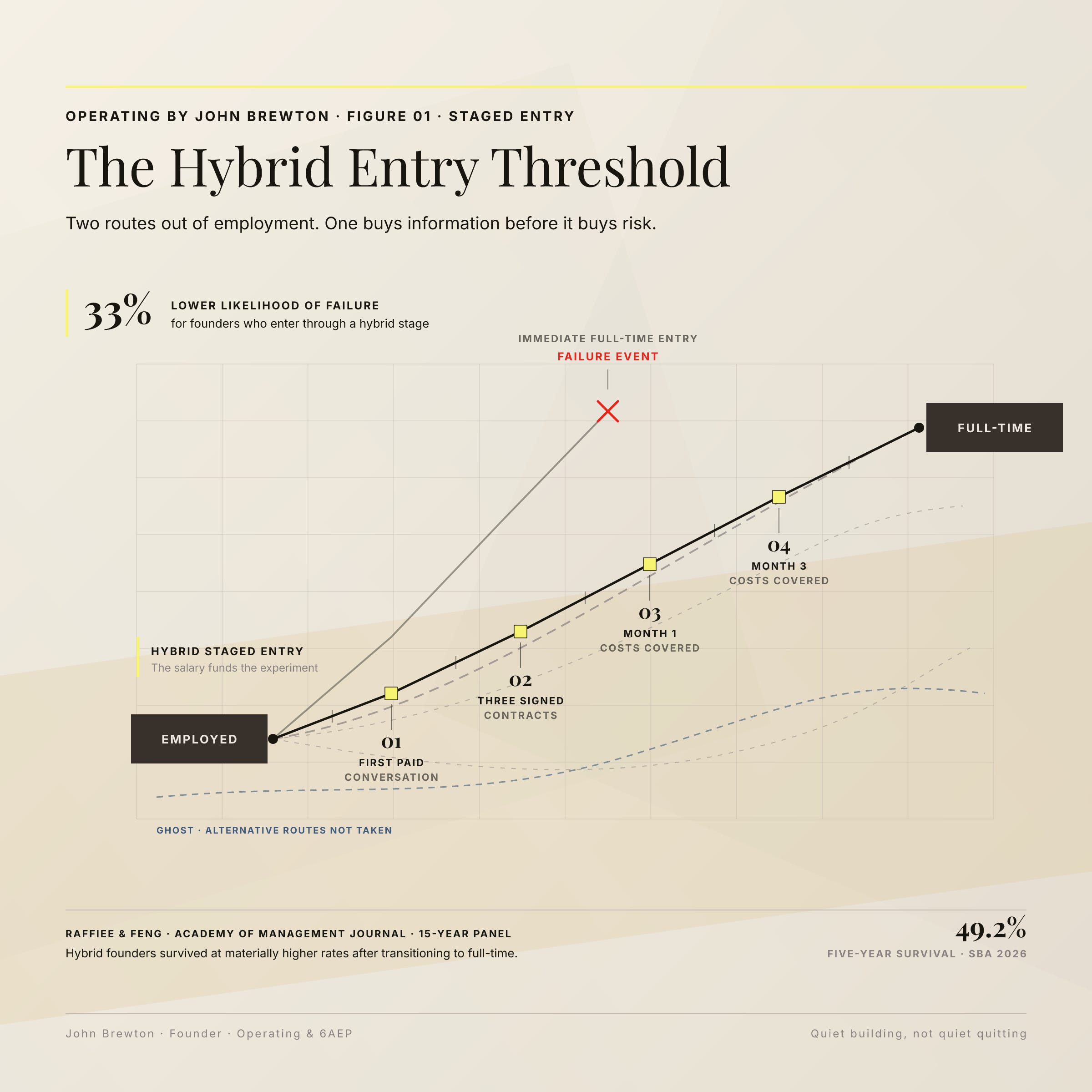
Joseph Raffiee and Jie Feng later tracked thousands of American entrepreneurs over 15 years. Their Academy of Management Journal study found that people who transitioned through hybrid entrepreneurship had substantially better venture-survival outcomes than those who immediately moved from employment into full-time entrepreneurship. The result is often summarized as a roughly 33% lower likelihood of failure.
Keeping the job is not evidence that you lack conviction. It may mean you are purchasing information before purchasing risk. The salary pays household expenses while you, the founder, learn:
Will anyone buy this?
Can I reach customers consistently?
Can I deliver the work profitably?
Will customers renew?
Is the opportunity large enough to justify leaving?
Do I enjoy operating this business once the novelty disappears?
The day job also prevents desperation from becoming the company’s first investor.
A founder who needs immediate income may accept the wrong customer, underprice the work, build for anyone willing to pay, or keep an idea alive because admitting failure would threaten next month’s rent.
A founder with a salary has more ability to say no:
A paycheck can become venture capital you provide to yourself, one deposit at a time.
This is the real opportunity inside quiet quitting.
Not doing nothing.
Building patiently.
Seven priorities while the day job still pays
The following are some operating rules, not universal scientific laws, that I’ve constructed based on my own experience making this drum in my career over a period of years.
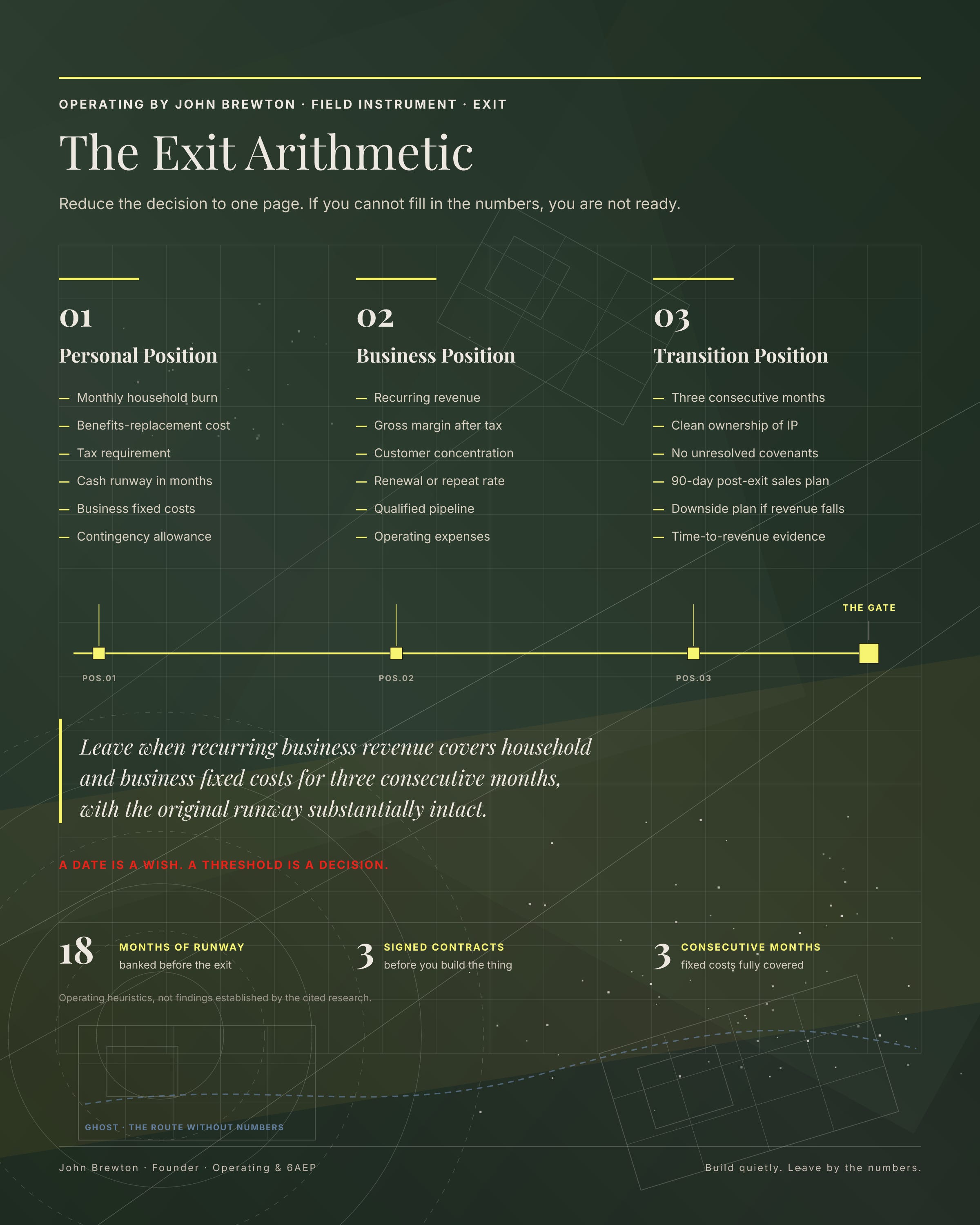
Research supports the logic of experimentation, staged entry, clear boundaries, and financial caution. It does not establish that every founder needs exactly 18 months of cash, exactly three contracts or exactly three profitable months.
Those are decision thresholds.
Their purpose is to help solo founders switch out their feelings for actual evidence.
1. Bank eighteen months of runway
Runway is not the amount of money in a savings account.
It is the number of months your household and business can continue operating without requiring optimistic assumptions.
Start with the real monthly number:
Household fixed costs
business fixed costs
replacement benefits
taxes
contingency allowance
Then multiply it by 18.
Health insurance matters. Software subscriptions matter. Equipment matters. The tax reserve matters. The expenses your employer currently absorbs matter.
Eighteen months is intentionally conservative. It is not a magical figure. Some founders with highly predictable contracts may require less. Others with dependents, debt, long development cycles or volatile markets may need more.
The reason for caution is straightforward: new businesses remain uncertain. According to the SBA Office of Advocacy’s 2026 small-business data, only about 49% of new employer establishments survive five years. That statistic covers many kinds of businesses and does not predict the fate of any one company, but it is a useful correction to launch-day optimism.
Runway gives you time to survive delayed contracts, customer churn, pricing mistakes, and slower sales cycles.
More importantly, it improves the quality of your decisions.
2. Sell before you build
Three signed contracts beat a finished product.
This does not mean accepting money for something you cannot responsibly deliver. It means testing the commercial assumption before investing months in infrastructure.
Entrepreneurship is fundamentally a process of experimentation. William Kerr, Ramana Nanda and Matthew Rhodes-Kropf argue in the Journal of Economic Perspectives that entrepreneurial success probabilities are often low, highly skewed and unknowable until resources are committed. The answer is not to eliminate uncertainty. It is to structure smaller experiments that reveal information before making larger commitments.
Research on a scientific approach to entrepreneurial decision-making similarly suggests that entrepreneurs benefit when they state assumptions clearly, test them and allow evidence to kill weak ideas rather than searching only for confirmation.
The progression should usually look something like this:
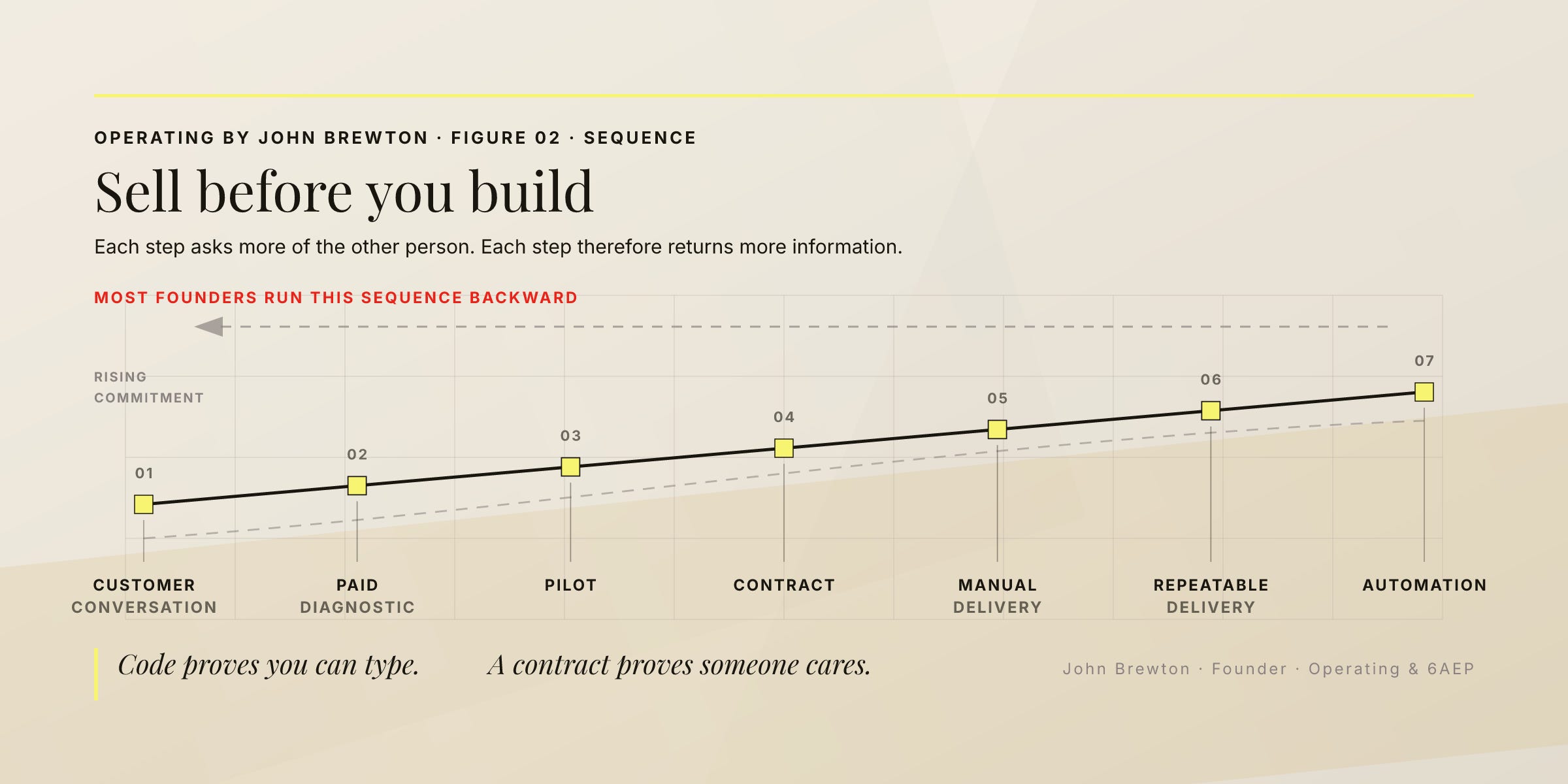
Most founders reverse that sequence.
They build the platform, design the brand, automate the workflow and prepare for scale before discovering whether someone has a sufficiently painful problem and a sufficiently large budget.
A working product proves that you can produce supply.
A signed customer proves that demand exists.
Three customers do not prove you have discovered a large market. But they prove that the idea has survived contact with someone else’s bank account.
3. Audit Your Current Employment Paper
Before building anything, read every document governing your employment.
Not the summary.
Not the onboarding slide.
The entire handbook and everything you signed.
Review the provisions involving:
Intellectual-property assignment.
Confidentiality and trade secrets.
Outside employment or moonlighting.
Conflicts of interest.
Non-solicitation.
Noncompetition.
Customer and employee relationships.
Required disclosure or approval.
Notice periods.
Ownership of inventions created during employment.
Then have an employment lawyer in your jurisdiction review the provisions that matter.
Do not assume that noncompetes are universally unenforceable. The Federal Trade Commission’s proposed nationwide rule is not in effect and is not enforceable. After a federal court blocked it, the FTC dismissed its appeals in 2025. State law and individual contracts therefore remain central to enforceability.
A founder may also have duties while still employed that extend beyond the words “noncompete.” Employment-law scholarship has examined how duties of loyalty can apply to competition, corporate opportunities and employer resources during an active employment relationship. The exact obligations vary by role and jurisdiction.
A few hours of legal review are cheaper than discovering that your employer claims ownership of the business after it becomes valuable.
Do not take legal advice from a founder whose contract, role and state are different from yours. Find a good lawyer and listen to them
4. Keep the separation clean
Use personal hardware.
Use personal accounts.
Use personal software subscriptions.
Use personal payment methods.
Work during personal time.
Do not transfer files, prompts, templates, customer lists, code, research, pricing information or internal documents from the employer’s environment into your own.
Do not recruit coworkers or approach company customers without specific legal clearance.
Do not build a competing product while sitting in a meeting, even when the meeting should have been an email.
Clean separation is not only an ethical principle. It creates an evidentiary record.
File metadata, device logs, account histories, and timestamps should tell the same story you would tell.
Your standard should not be, “Could I explain this casually?”
Your standard is:
Could I establish a clean chain of creation if every device, document and timestamp were examined?
Nothing built on company time, with company data or through company systems, is worth the future dispute.
5. Count customers, not followers
Audience is useful, and feels good to build, but having an audience does not equate to having revenue, actual money in the bank.
Ten thousand impressions may tell you that a sentence was interesting. Ten paying customers tell you that a problem is expensive enough for someone to solve, and that your solution has done just that for those ten people.
The progression of evidence is simple:
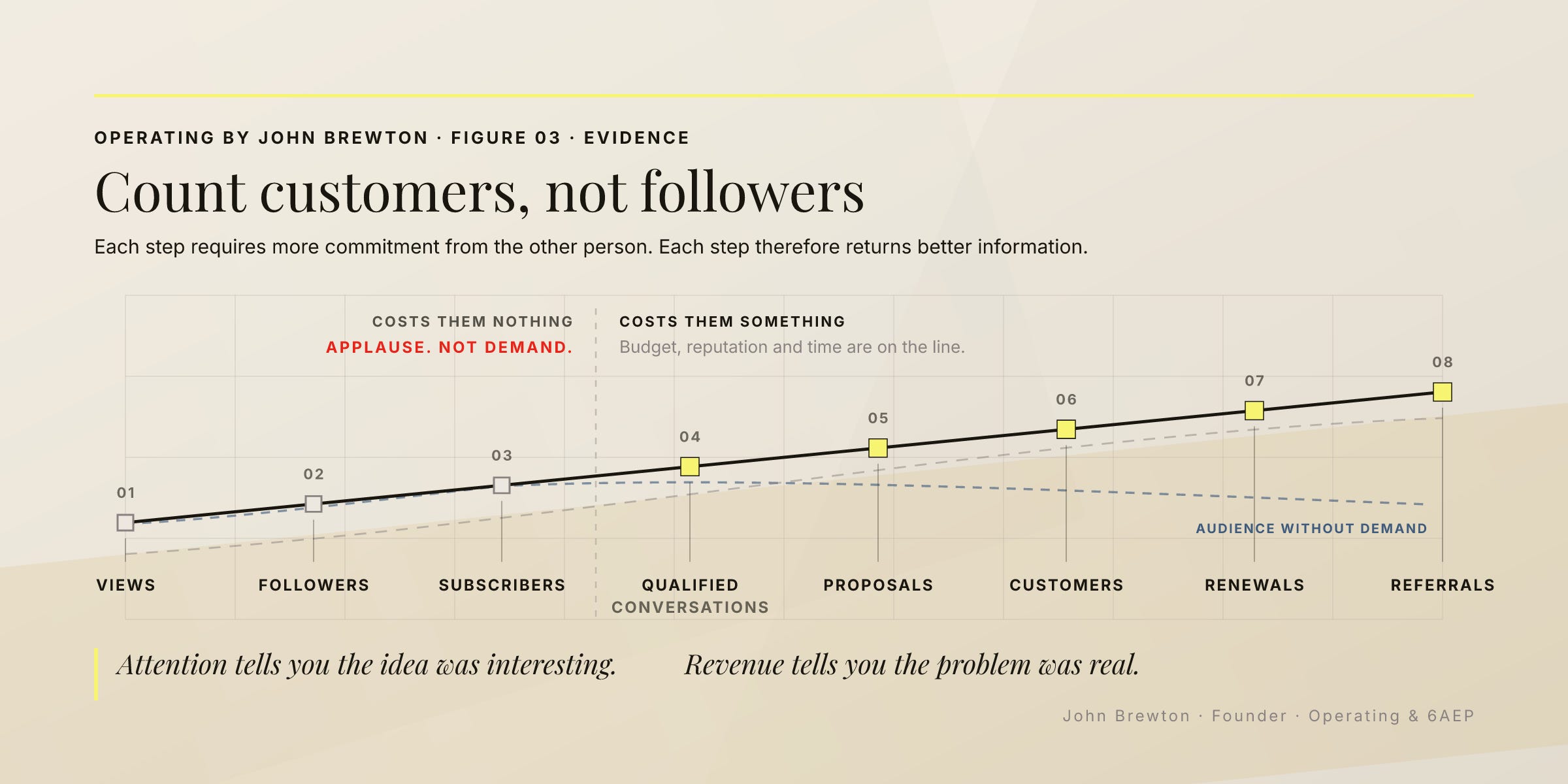
Each step requires more commitment from the other person. Each step therefore provides more useful information.
Followers can reduce future distribution costs. A respected audience can become a meaningful asset. But founders often confuse public encouragement with commercial demand because public encouragement is easier to obtain and more pleasant to measure.
A stranger commenting “This is brilliant” risks nothing.
A purchasing manager signing a contract risks budget, reputation and time.
Early in the business, optimize for learning rather than applause.
Concentrated revenue may eventually become a problem. Depending on one customer can create fragility. But zero revenue is a more immediate problem than concentrated revenue.
Win the first customer.
Then the second.
Then determine whether you can win the third without relying on luck.
6. Protect the first ninety minutes—and a defined portion of the weekend
The best time block is the one you can defend consistently.
For many employed founders, that means working before the day job begins.
The morning has an advantage that has little to do with motivational mythology. It has not yet been consumed by someone else’s emergencies. The calendar has not slipped. The difficult client has not called. The meeting has not run long. Your attention has not been divided among twelve unfinished tasks.
Research on attention residue shows that switching from one unfinished task to another can impair performance because part of our attention remains attached to the previous activity. This helps explain why fragmented evening work often feels slower than protected, uninterrupted creation. (ScienceDirect)
The side business should therefore have recurring appointments with its founder.
Protect the first ninety minutes on selected weekdays. Use one defined weekend block for deeper work, customer delivery or sales. Make the schedule visible to the people whose lives are affected by it.
But do not convert every morning, evening and weekend into work.
Research on side hustles is genuinely two-sided. An Academy of Management Journal study found that empowerment gained through outside work could enrich performance in a person’s primary job. More recent Journal of Management Studies research found both gains and costs: thriving in a side hustle can improve well-being, but attention residue and resource depletion can also damage primary-job performance. Clear segmentation between roles helps. (Academy of Management Journals)
Recovery is not laziness either. A major Annual Review of Organizational Psychology and Organizational Behavior review concluded that detachment and recovery during evenings, weekends and vacations are important for sustaining well-being, motivation and performance.
Do not finance the company with chronic sleep deprivation, family resentment or deteriorating performance at the job still funding it.
7. Set a trigger, not a date
“I will quit in June” is not a strategy.
June does not know whether customers will renew.
June does not know whether the pipeline is real.
June does not know whether your largest client will disappear in May.
A date creates emotional momentum. A threshold creates decision discipline.
My preferred core trigger is:
Leave when recurring business revenue covers household and business fixed costs for three consecutive months—with the original runway substantially intact.
That is the beginning of the analysis, not the end.
Before leaving, also examine:
Whether customers are renewing or purchasing again.
Whether the pipeline can be repeated.
Whether revenue depends excessively on one relationship.
Whether gross margins support the owner after taxes and benefits.
Whether the founder has clean ownership of the work.
Whether additional founder time is likely to create additional revenue.
The final question is especially important.
Do not resign merely because operating the business while employed has become uncomfortable.
Resign when employment has become the principal constraint on a model that has already demonstrated demand.
The difference is enormous.
In the first situation, the founder is hoping that more time will create a business.
In the second, the founder has evidence that more time can expand an existing business.
The moral contract
There is a version of this strategy that is disciplined and honorable.
There is also a version that is dishonest.
The line is not complicated.
Your employer is entitled to the professional performance it pays for. Your coworkers should not be required to subsidize your company by carrying abandoned responsibilities. Customers should not receive inferior service because you were thinking about your own sales pipeline. Confidential information is not founder capital. Paid working hours are not a private incubator.
Keep your promises.
Meet the standard.
Disclose conflicts when the agreement requires disclosure.
Leave employer information, relationships, and property alone.
But the employment relationship has a boundary, too.
An employer may purchase your labor during agreed hours. The contract and the law may impose additional obligations. None of that automatically means the institution owns every future idea, every weekend, every early morning or the permanent direction of your ambition.
The business must be built outside the job—not instead of the job.
That is why I prefer quiet building to quiet quitting.
Quiet quitting sounds like retreat.
Quiet building is deliberate preparation.
What quiet building does not guarantee
Not every disengaged employee is a future founder. There is no credible research establishing that quiet quitting has caused the growth of solo entrepreneurship.
That connection is an interpretation of two changes occurring at the same time:
Work has become less central to the identities of some employees, while technology has made independent ownership more feasible.
This strategy is not equally available to everyone. Spare time, financial reserves, predictable schedules, health, caregiving responsibilities, and access to technology are distributed unevenly. Some people need the stability of employment more than they need entrepreneurial optionality. Some people genuinely enjoy institutional leadership and can create more value inside a large organization than they would alone.
There is no moral superiority in becoming a founder.
There is also no guarantee that the business will work.
AI does not create demand. A large audience does not create willingness to pay. More hours do not repair a weak proposition. The side business may produce energy, or it may create exhaustion. A secure salary may support intelligent experimentation, or it may allow the founder to avoid making a decision indefinitely.
The point is not that everyone should leave.
The point is that ambitious people have another route available—and the first stage of that route may occur while they are still employed.
Build Quietly.
At 8:30 AM, the founder closes the personal computer.
At 9:00 AM, the employee begins the workday and keeps the promises that have been made.
The employer still receives competent, professional performance.
What the employer no longer receives is the unquestioned right to every discretionary hour and every future ambition.
The founder keeps learning.
Keeps selling.
Keeps separating the work.
Keeps accumulating cash.
Keeps watching the numbers.
The first act of entrepreneurship is rarely a job resignation.
It is the choice to learn to wait and quietly build.
Keep the salary.
Protect the dream.
Perform honestly.
Leave when the arithmetic gives you permission.
- j -
Do you want some help starting your Quiet Build?
Become an Operating Founder, receive a 60-minute review of your content, business, and strategy, and join my weekly Operating Founder Office Hours, where I answer any and all of your questions and share what I’m working on and learning from building my business.
Here’s everything you need to know about the business I have built so far.

John Brewton documents the history and future of operating companies at Operating by John Brewton. He is a graduate of Harvard University and began his career as a PhD student in economics at the University of Chicago. After selling his family’s B2B industrial distribution company in 2021, he has been helping business owners, founders, and investors optimize their operations ever since. He is the founder of Operating by John Brewton and conducts advisory and consulting work for global companies, asking the question: What is the future of companies?
Research appendix
A. Quiet quitting, engagement and the counterargument
1. Gallup: Is Quiet Quitting Real?
Gallup’s 2022 analysis defined many quiet quitters as “not engaged”: employees who perform minimum requirements while remaining psychologically detached. The article linked falling engagement to unclear expectations, fewer development opportunities and weak manager relationships.
Used for: The definition of quiet quitting as disengagement and the estimate that roughly half of U.S. employees were not engaged in 2022.
2. Gallup: Employee Engagement Remains Flat as AI Adoption Accelerates
Gallup reported that 31% of U.S. employees were engaged during the first half of 2026 and 18% were actively disengaged. It also emphasized that access to AI alone did not improve engagement; clear implementation and manager support mattered.
Used for: Current U.S. engagement figures and the argument that managerial context remains important.
3. Derek Thompson, The Atlantic: Quiet Quitting Is a Fake Trend
Thompson argued that quiet quitting was not statistically new and that modest employee disengagement had existed long before the phrase went viral. He interpreted the popularity of the term as evidence of cultural frustration rather than proof of a sudden labor-market transformation.
Used for: The counterargument that the label exaggerates the novelty of the phenomenon.
4. Anthony Klotz and Mark Bolino, Harvard Business Review: When Quiet Quitting Is Worse Than the Real Thing
The authors distinguished legitimate boundary-setting from forms of withdrawal that can damage relationships, performance and coworkers.
Used for: The ethical distinction between declining optional work and abandoning agreed responsibilities.
5. Pew Research Center: Young Workers Express Lower Levels of Job Satisfaction Than Older Ones, but Most Are Content With Their Job
Pew found that younger workers reported lower levels of strong job satisfaction than older workers, while 85% of workers overall remained at least somewhat satisfied.
Used for: Balance against the claim that an entire generation has rejected conventional employment.
B. Hybrid entrepreneurship and staged entry
6. Timothy B. Folta, Frédéric Delmar and Karl Wennberg: Hybrid Entrepreneurship
Read the Management Science abstract and publication record
The researchers defined hybrid entrepreneurship as entering self-employment while retaining a primary wage job. Using Swedish employee-employer data, they found that hybrid founders represented a significant share of entrepreneurial activity and examined how hybrid entry can facilitate later movement into full-time self-employment.
Used for: The formal definition of hybrid entrepreneurship and the concept of incremental entry.
7. Joseph Raffiee and Jie Feng: Should I Quit My Day Job? A Hybrid Path to Entrepreneurship
Read the Academy of Management Journal study
The authors studied thousands of entrepreneurs over a 15-year period and found that founders who entered through a hybrid stage experienced significantly better survival outcomes after transitioning to full-time entrepreneurship.
Used for: The claim that keeping a job while validating a venture can reduce the risk of failure.
8. Harvard Business Review: Why Going All-In on Your Start-Up Might Not Be the Best Idea
This summary describes the Raffiee and Feng result as a 33% reduction in the likelihood of failure for founders who left their employment in stages.
Used for: The accessible interpretation of the academic result.
9. William Kerr, Ramana Nanda and Matthew Rhodes-Kropf: Entrepreneurship as Experimentation
Read the Journal of Economic Perspectives paper
The authors describe entrepreneurship as experimentation under conditions in which success probabilities are low, skewed and often unknowable before investment.
Used for: The argument that founders should structure smaller learning investments before making larger commitments.
10. Arnaldo Camuffo, Alessandro Cordova, Alfonso Gambardella and Chiara Spina: A Scientific Approach to Entrepreneurial Decision Making
Read the Management Science study
In a randomized controlled trial involving Italian startups, the researchers tested whether teaching founders to formulate hypotheses and evaluate evidence changed their decisions. The study supports disciplined testing over purely intuitive or confirmatory decision-making.
Used for: “Sell before you build” and the need to design experiments capable of disproving weak assumptions.
11. U.S. Small Business Administration: Plan Your Business
The SBA emphasizes researching demand, market size, saturation, pricing and customer behavior before making major investments.
Used for: The practical importance of direct customer research and demand validation.
C. Side hustles, focus and recovery
12. Hudson Sessions, Jennifer Nahrgang, Manuel Vaulont and colleagues: Do the Hustle! Empowerment From Side-Hustles and Its Effects on Full-Time Work Performance
Read the Academy of Management Journal study
The study found that empowerment generated by a side hustle could produce positive affect and enrich an employee’s performance in their primary job.
Used for: The evidence that outside work does not automatically damage full-time performance.
13. Min Liu, Shengxian Yu, Xin Liu and Shanshi Liu: The Effect of Side-Hustle Thriving on Full-Time Work Performance
Read the Journal of Management Studies study
The authors identify two competing pathways. Side-hustle thriving can improve well-being and help employees detach from their full-time work, but it can also create attention residue and deplete resources. Boundary segmentation influences the balance.
Used for: The two-sided treatment of side hustles and the importance of separating roles.
14. Sophie Leroy: Why Is It So Hard to Do My Work? The Challenge of Attention Residue When Switching Between Work Tasks
Leroy’s research shows that people can retain cognitive attention on an unfinished task after switching to another activity, impairing subsequent performance.
Used for: The recommendation to create protected blocks instead of repeatedly switching between employer and founder work.
15. Sabine Sonnentag, Charlotte Venz and Anne Casper: Advances in Recovery Research
Read the Annual Review article
The review synthesizes evidence on recovery during breaks, evenings, weekends and vacations, emphasizing the role of recovery in sustaining well-being, motivation and performance.
Used for: The argument that weekends cannot become a second uninterrupted workweek.
D. Technology, AI and the solo economy
16. Satish Nambisan: Digital Entrepreneurship: Toward a Digital Technology Perspective of Entrepreneurship
Read the Entrepreneurship Theory and Practice article
Nambisan examines how cloud computing, mobile technologies, digital platforms and other tools alter entrepreneurial processes, agency and uncertainty.
Used for: The argument that digital technology has reduced the institutional infrastructure required to launch a venture.
17. Shakked Noy and Whitney Zhang: Experimental Evidence on the Productivity Effects of Generative Artificial Intelligence
Read the peer-reviewed Science article
In a preregistered experiment involving professional writing tasks, participants using ChatGPT completed their work approximately 40% faster and produced outputs rated approximately 18% higher in quality.
Used for: Evidence that generative AI can increase individual productivity in defined professional tasks.
18. Erik Brynjolfsson, Danielle Li and Lindsey Raymond: Generative AI at Work
Read the Quarterly Journal of Economics article
The researchers studied the introduction of an AI assistant among more than 5,000 customer-support agents. Productivity increased by approximately 15% on average, with larger benefits for less experienced employees.
Used for: Evidence that AI can transfer elements of organizational knowledge and improve certain workplace outputs.
19. Fabrizio Dell’Acqua and colleagues: Navigating the Jagged Technological Frontier
Read the Organization Science article
The field experiment involving 758 BCG consultants found that AI improved performance significantly on tasks inside its capabilities but reduced accuracy on some tasks outside that frontier.
Used for: The warning that AI leverage remains uneven and requires human verification.
20. U.S. Census Bureau: Census Bureau Data Tell the Small Business Story
The Census Bureau reported 30,427,808 U.S. nonemployer establishments in 2023, producing nearly $1.8 trillion in receipts.
Used for: The scale of economic activity conducted by businesses with no paid employees.
21. Stripe: Solo Founding Is at an All-Time High
Stripe reported growth in the number of high-revenue solo founders on its platform, while also documenting a wide and increasing gap between median and top-performing solo businesses.
Used for: Evidence of the opportunity and extreme outcome dispersion within solo entrepreneurship.
22. Te-Ping Chen, The Wall Street Journal: The Rise of Million-Dollar Companies With Just One Employee
The article reports Stripe data indicating that thousands of solo operators generated more than $1 million in annual revenue. It also presents both successful and unsuccessful founder cases and describes the cost, competition and replication risks created by AI.
Used for: Current evidence that high-revenue solo businesses are becoming more common, while remaining exceptional and risky.
E. Legal boundaries
23. Federal Trade Commission: Noncompete Rule
The FTC states that its nationwide Noncompete Rule is not in effect and is not enforceable. A district court blocked the rule, and the agency dismissed its appeals in 2025.
Used for: The warning that founders cannot assume a federal blanket ban invalidates their agreements.
24. Federal Trade Commission: FTC Files to Accede to Vacatur of the Non-Compete Clause Rule
The release documents the FTC’s decision to dismiss its appeals and accept the rule’s vacatur.
Used for: Confirmation of the current federal procedural position.
25. Deborah A. DeMott: The Restatement of Employment Law and the Duty of Loyalty
Read the Cornell Law Review essay
The essay examines when employees may owe duties of loyalty and the difficulties involved in defining those obligations.
Used for: The caution that current employees may face legal duties involving competition, employer opportunities and employer resources even apart from noncompete clauses.
F. Business survival and risk
26. SBA Office of Advocacy: Frequently Asked Questions About Small Business, 2026
The SBA reports a five-year survival rate of approximately 49.2%, a ten-year survival rate of approximately 33.9% and a fifteen-year survival rate of approximately 25.5% for new employer establishments in the periods studied.
Used for: Context on business uncertainty and the rationale for maintaining substantial financial runway.
Research and legal note: The numerical thresholds in this article—including 18 months of runway, three initial contracts and three consecutive months of cost-covering revenue—are operating heuristics, not findings established by the cited studies. Employment, intellectual-property, tax and restrictive-covenant laws vary by jurisdiction and circumstances. Readers should consult qualified legal and financial advisers before acting.
What Claude and Codex presented as a gift to many of us is the priceless feeling that you can create, you can develop from 0 to a working product or app in a mutter of weeks if not days. On top you got a strong thinking partner that makes solo entrepreneurship less intimidating
Great article, John. Thank you for providing a legitimate alternative to Quiet Quitting. (That term never sat comfortably with me).
Bring on the Quiet Build. 🌟