

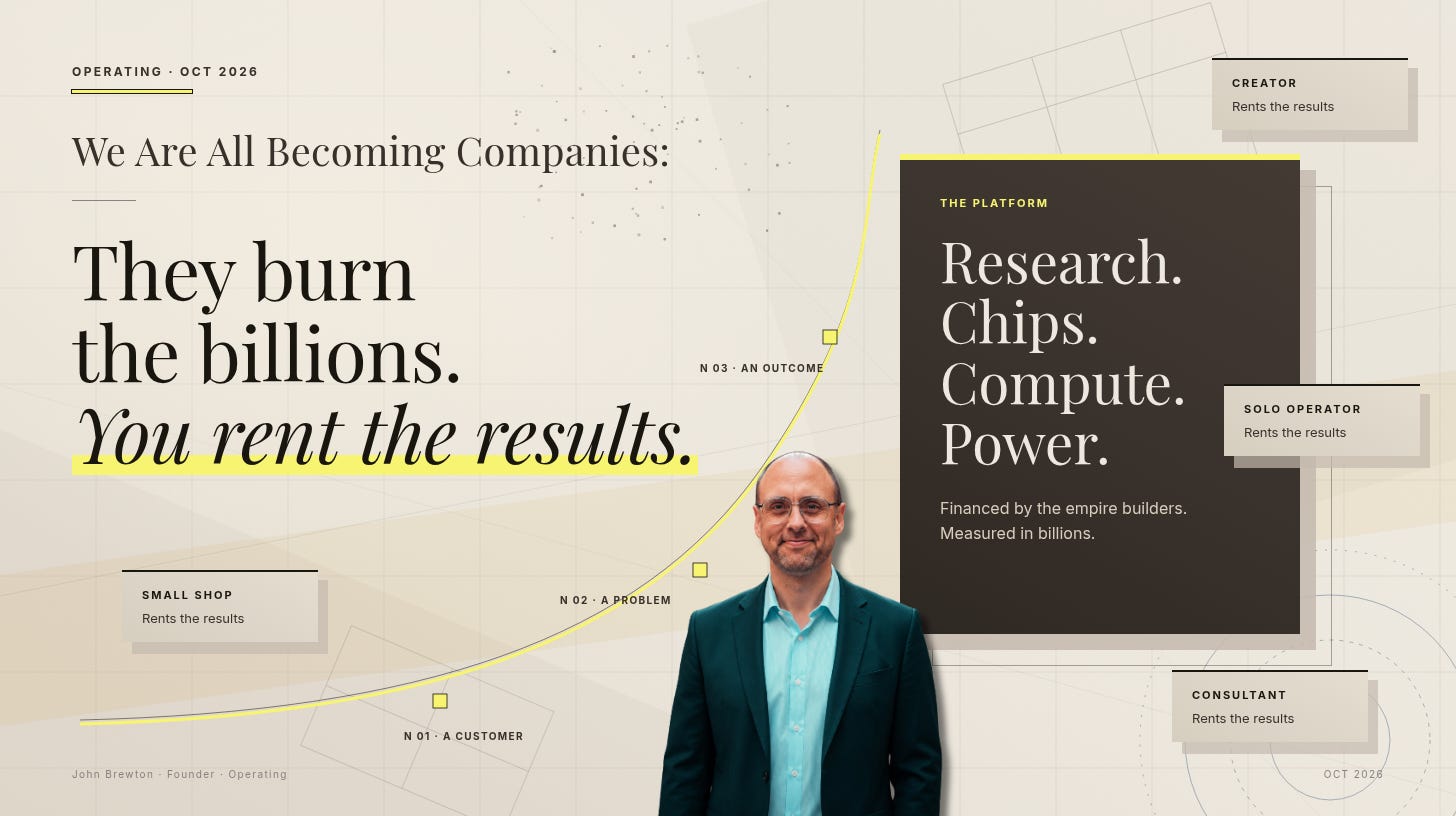
TL → DR
The platform builders are spending at historic scale. A draft of Anthropic’s IPO filing reportedly shows an $80.7 billion net loss for the first half of 2026, most of it an accounting charge, and up to $750 billion in future computing spend. [UNVERIFIED]
Big companies are still waiting on the payoff. Only 13% of 2,002 CIOs and tech executives say AI has delivered significant or transformational value.
Confidence is splitting. 68% of business leaders expect AI to leave them better off, compared with 27% of American workers, and a Princeton Ph.D. has applied to more than 2,300 jobs without landing one. The corporate bargain looks less secure.
Meanwhile, the capabilities those billions produce can be rented by the month. Creators, consultants and small businesses can build real companies on top of them, from Newpress to Pennylane.
Access alone won’t do it. Owners still need a problem they understand, a customer they can reach and an outcome someone will pay for. We are all becoming companies.
Start Here
The AI empire builders are burning through billions. At the same time, creators, consultants and small business owners are building profitable companies on top of what those billions produce.
That is the extraordinary economic moment we’re living through, and a seet of key numbers that were reported last week made the opportunity and unusual economic dynamic particularly easy to see.
The Cost Of Building The Platform
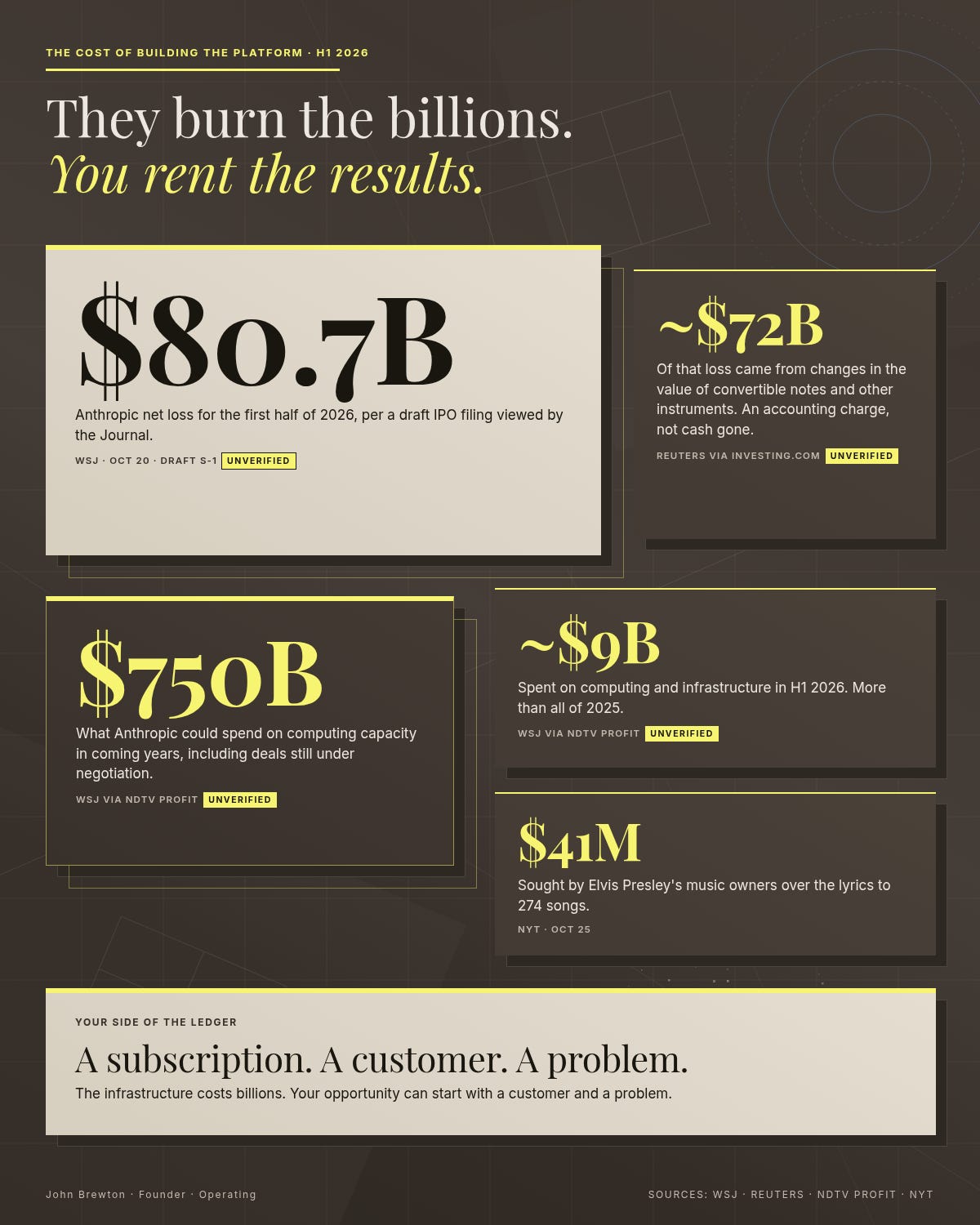
Last Tuesday, The Wall Street Journal reported on a draft of Anthropic’s IPO filing. According to the Journal, the draft shows an $80.7 billion net loss for the first half of 2026 and signals that the company could spend $750 billion in the coming years on computing capacity, including deals still under negotiation.
A clarification matters here. Most of that loss reflects an accounting charge. Reuters, summarizing the Journal’s report, says about $72 billion of it came from changes in the value of convertible notes and other instruments the company issued to raise money. It does not mean $80.7 billion went up in smoke.
The underlying investment race is still enormous. Per the Journal’s reporting, Anthropic spent close to $9 billion on computing capacity and infrastructure in the first six months of the year, more than it spent in all of 2025. Add the rest of the field and the spending on research, chips, data centers and power reaches a scale few industries have ever attempted.
The bills arrive in other forms too. On Sunday, the owners of Elvis Presley’s music sued Anthropic for about $41 million over the lyrics to 274 songs they say were used to train Claude without permission. Anthropic says it will fight the case. Whatever the outcome, legal risk is one more line item the platform builder carries so its customers don’t have to.
How to Build an AI Operating Team in Grok Bot: The Field Manual
AI Was Supposed to Kill Consulting. Instead It Has Started a Golden Age.
The Quiet Builders Are Coming. Great Companies Will Build Around Them.
Where The Profits Land, For Now
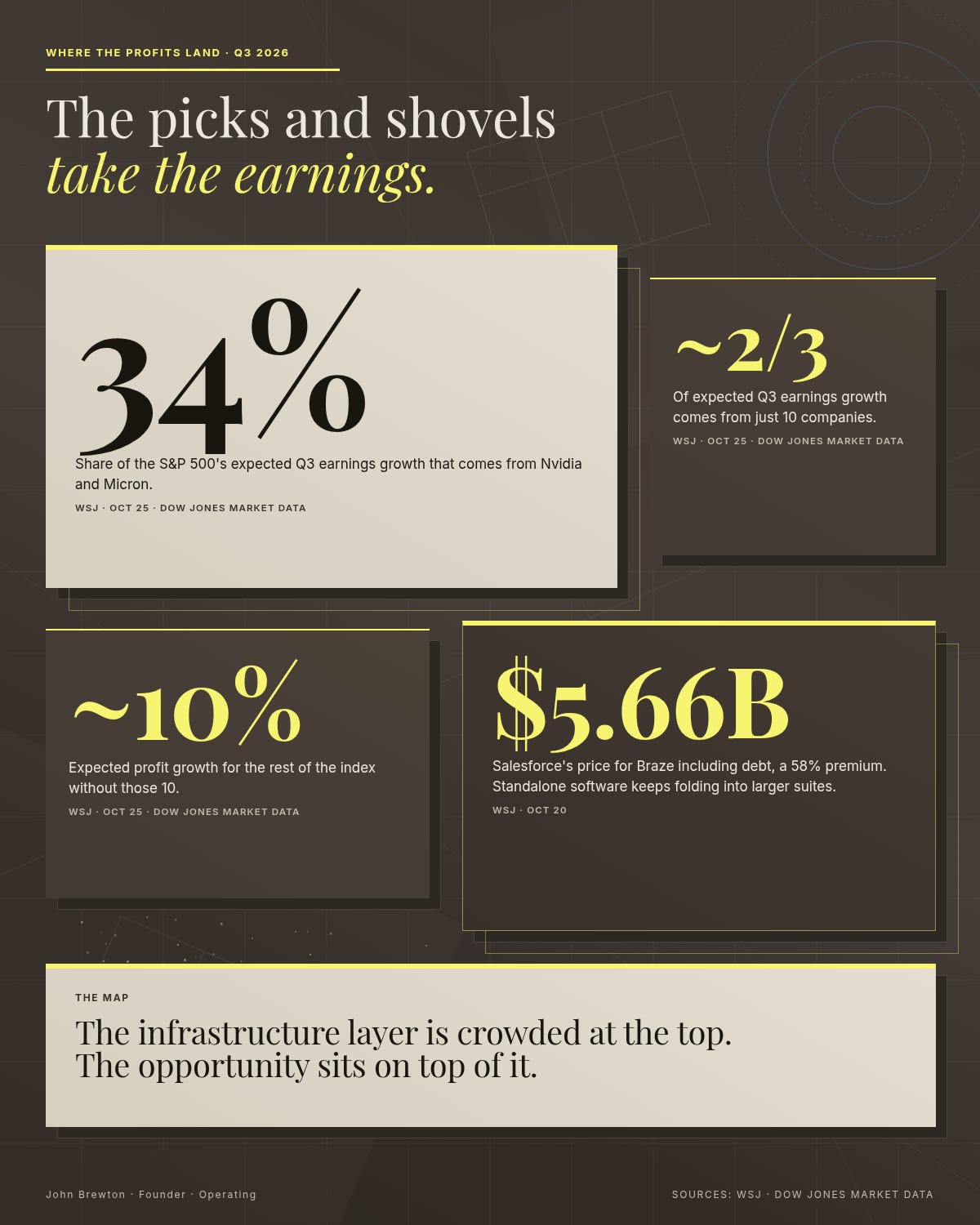
The money spent building AI shows up as revenue somewhere. Right now it lands mostly with the companies selling the picks and shovels. A Dow Jones Market Data analysis found that Nvidia and Micron account for 34% of the S&P 500’s expected third-quarter earnings growth, and 10 companies account for roughly two-thirds. Without those 10, the rest of the index is expected to grow profit about 10%.
The big platforms are also consolidating the layer above them. Salesforce agreed to buy the customer-engagement company Braze for about $5.66 billion including debt, a 58% premium. Standalone software keeps getting folded into larger suites.
Read those numbers as a map of the infrastructure layer. The bigger question for the rest of us is what gets built on top of it.
The Corporate Promise is Wobbling
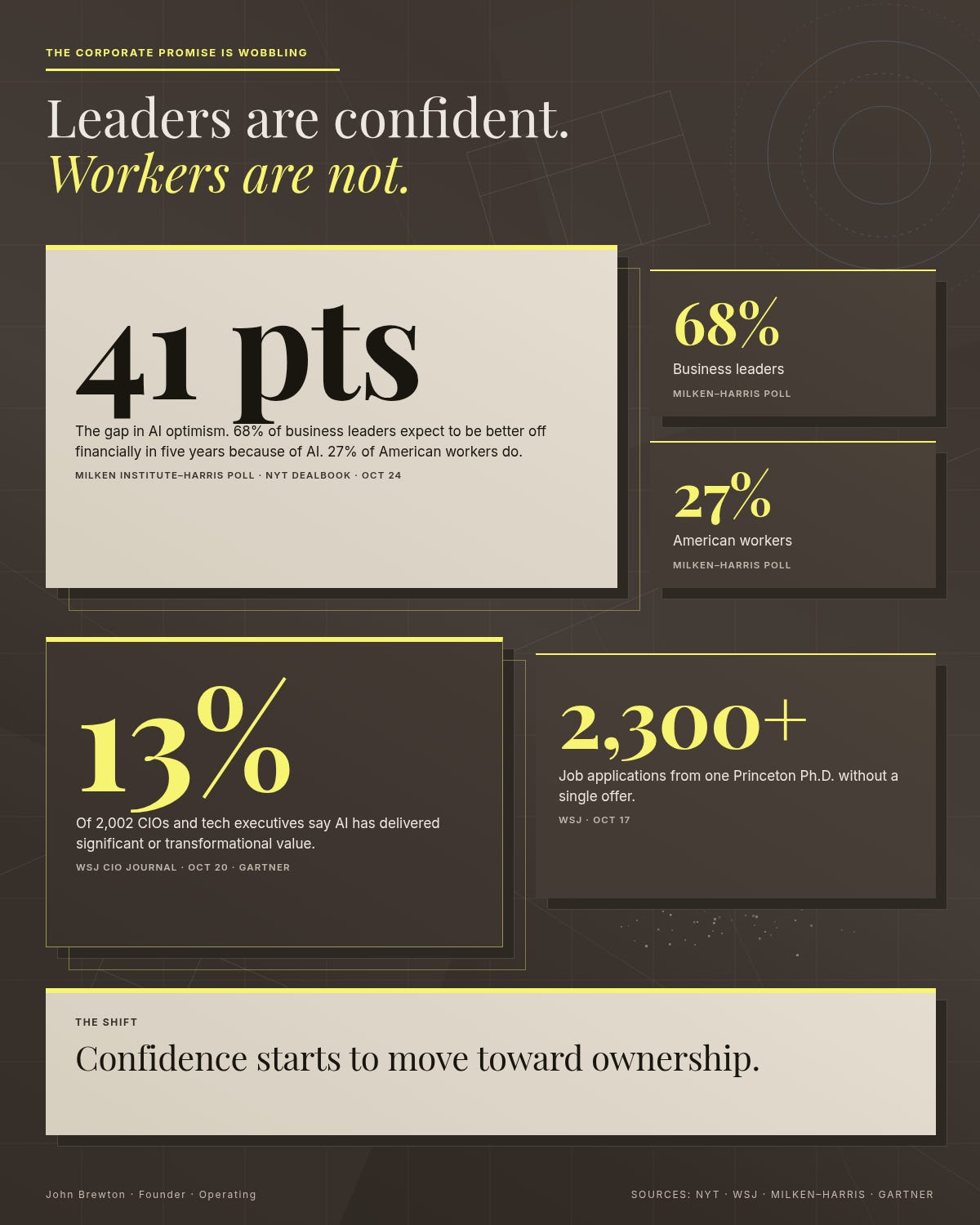
Inside large companies, the payoff is arriving more slowly than the spending. Gartner surveyed 2,002 CIOs and technology executives and found that only 13% say their organizations have gotten significant or transformational value from AI.
Belief is splitting along the org chart. In the Milken Institute–Harris Poll Listening Project, 68% of business leaders expect to be better off financially in five years because of AI, compared with 27% of American workers. That 41-point gap was the hook for a DealBook piece in The New York Times this weekend.
Young people feel it most. The FT reports that students fear AI will ruin their job prospects. The Journal recently profiled a Princeton Ph.D. who has applied to more than 2,300 jobs without landing one.
For decades, the safe path ran through a corporate job. The employer provided the tools, training, and paycheck. When executives are far more confident about AI than the people who work for them, and entry-level hiring stalls, that bargain looks less secure. Confidence starts to move toward ownership.
The Rental Economy
Here is what makes me optimistic. The platform builders are paying for capabilities that are available to almost anyone, by the month.
The infrastructure costs billions. Your opportunity can start with a customer and a problem.
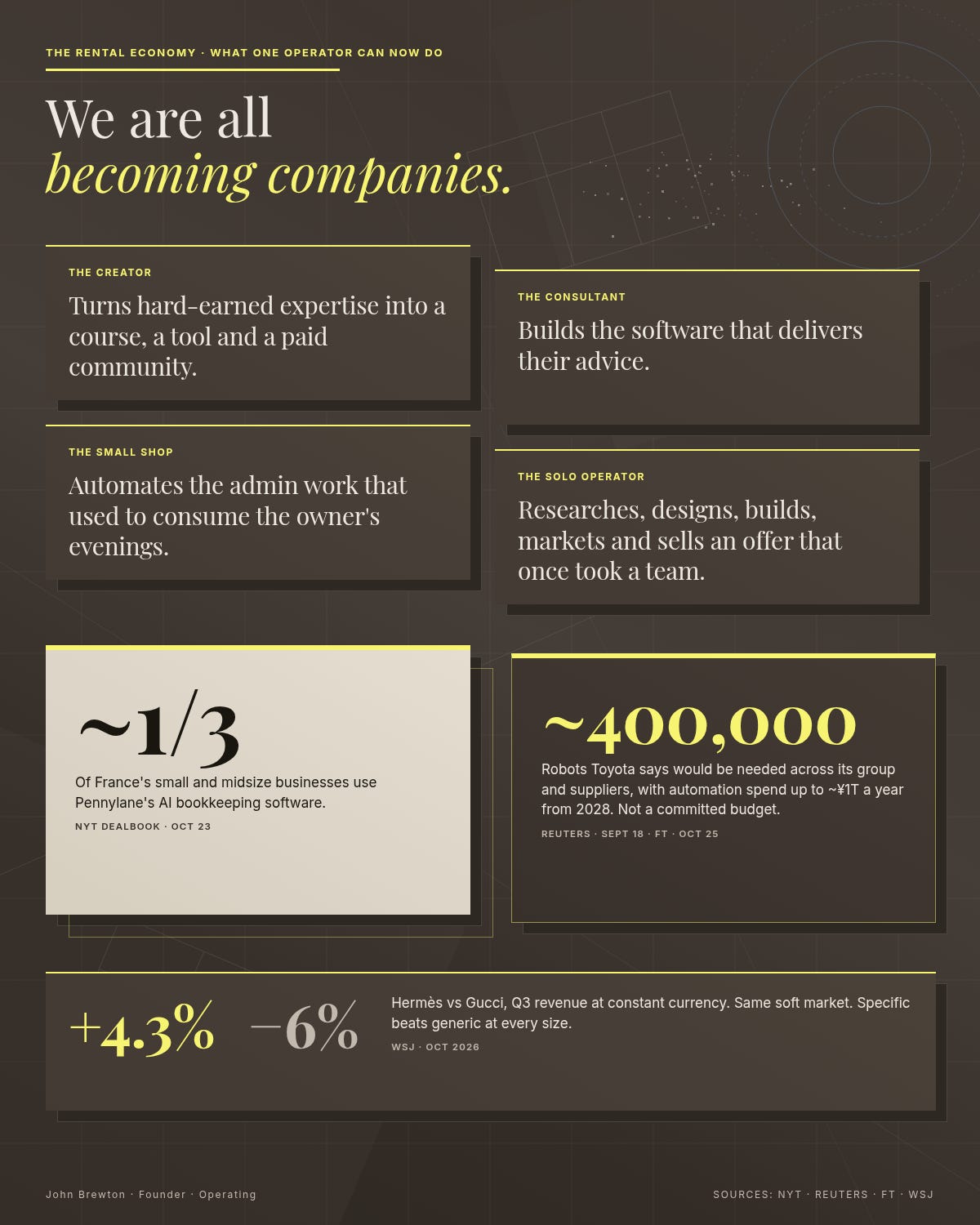
A creator can turn hard-earned expertise into a course, a tool and a paid community. A consultant can build the software that delivers their advice. A small business can automate the administrative work that used to consume its owner’s evenings. A solo, operator can research, design, build, market and sell an offer that once required an entire team.
You can see where talent is moving. Bill Owens, the former boss of 60 Minutes, is joining Newpress, a start-up that publishes creators’ video journalism on YouTube. When the person who ran one of television’s most storied newsrooms bets on creator-led journalism, the creator model has grown up.
You can see it in the tools being built for small companies. The French start-up Pennylane has won about a third of France’s small and midsize businesses with AI bookkeeping software that works alongside accountants.
At the other end of the scale, companies are building. The FT reports that Toyota is taking on Tesla and China in the humanoid robot race. Toyota has told investors that about 400,000 robots would be needed across Toyota, its group companies and major suppliers, with automation spending of up to about ¥1 trillion a year from 2028. The world’s biggest cait would needer is rebuilding itself. A one-person company can now build a small version of the same thing.
That creates a remarkable juxtaposition. The platform builder can be losing money while the business built on its platform earns a healthy profit.
Access Alone Won’t Create A Profitable Business
None of this happens automatically. Owners still need judgment. They still need customers. They still need to deliver something worth buying.
The Journal recently followed people who bought laundromats after social media promised them easy money. It was anything but. The FT looked at how YouTubers finance their videos: launching is cheap, but a channel that takes off needs working capital, and banks are wary of lending. Cheap tools lower the cost of starting. The economics of the business still have to work.
Luxury offers a useful reminder of what holds up. In the third quarter, Hermès grew revenue 4.3% at constant currency, startup costs. The brand with the clearer, scarcer offer held its ground. Specific beats generic at every size.
So the work is to combine these capabilities with something specific. A problem you understand. A customer you can reach. An outcome someone will pay for. Then use the technology to improve delivery, expand capacity and keep more of what you earn.
That is also the lesson inside Gartner’s 13%. Everyone can buy the same tools. Results come from how the work gets organized around them. A small business that redesigns one workflow well can capture more value than a large company running a hundred pilots.
Gratitude
I feel real gratitude for this moment. For the researchers doing the work. For the engineers building the systems. For the people willing to finance something this ambitious.
Their incentives are commercial. The opportunity they create for others is still extraordinary. We don’t have to own the infrastructure to build something valuable on top of it.
That is where my optimism lives. In the owner who can finally grow without adding another exhausting workday. In the creator whose knowledge can become a business. In the skilled person who can now bring an idea to market.
Companies are becoming tech stacks. We are all becoming companies.
The empire builders are financing a race for the future. We have an opportunity to build our livelihoods along the way.
What are you building on top of it?
- j -
FAQ
Do I need to build my own AI?
No. The infrastructure costs billions, and the companies racing to build it are carrying that cost. You can use their work for the price of a subscription. We don’t have to own the infrastructure to build something valuable on top of it.
Is the Anthropic loss real money?
Mostly, it’s an accounting charge. Reuters, summarizing the Journal’s report, says about $72 billion of the $80.7 billion loss came from changes in the value of convertible notes and other instruments. The underlying spending is still huge: close to $9 billion on computing and infrastructure in six months. [UNVERIFIED: these figures come from a draft filing, and Anthropic has not filed publicly.]
What should I build first?
Start with a customer and a problem. Pick a problem you understand, a customer you can reach and an outcome someone will pay for. Then redesign one workflow well, because that can capture more value than running a hundred pilots.
What if I still have a corporate job?
Keep it, and keep learning. The point is that the safe path looks less certain than it used to, so it’s worth building skills and ideas you own. You can rent the same tools a solo operator uses, and the judgment you build at work carries over.
What still can’t AI do for me?
It can’t supply judgment, find your customers or make the economics work. People who bought laundromats after social media promised easy money learned that cheap tools lower the cost of starting, but the business still has to work. You still have to deliver something worth buying.
Why does a specific offer matter so much?
Because everyone can buy the same tools. In a soft luxury market, Hermès grew 4.3% while Gucci fell 6%. The clearer, scarcer offer held its ground, and specific beats generic at every size.

John Brewton documents the history and future of operating companies at Operating by John Brewton. He is a graduate of Harvard University and began his career as a PhD student in economics at the University of Chicago. Since selling his family’s B2B industrial distribution company in 2021, he has been helping business owners, founders, and investors optimize their operations.
Sources
The Wall Street Journal, “Anthropic S-1 Shows Red-Hot Growth, Risks and Massive Computing Costs,” Oct 20, 2026. https://www.wsj.com/tech/ai/anthropic-revenue-growth-ipo-accaf0f1 [UNVERIFIED: draft S-1, not publicly filed]
Reuters via Investing.com, “Anthropic recorded net loss of over $80 billion in first half of this year, WSJ reports,” Oct 20, 2026. https://www.investing.com/news/stock-market-news/anthropic-recorded-net-loss-of-over-80-billion-in-first-half-of-this-year-wsj-reports-4960917
NDTV Profit (citing WSJ), “Anthropic May Spend $750 Billion On Computing Costs,” Oct 2026. https://www.ndtvprofit.com/technology/anthropic-may-spend-750-billion-on-computing-costs-report-says-12213014
The New York Times, “Owners of Elvis Presley’s Music Sue Anthropic for Copyright Infringement,” Oct 25, 2026. https://www.nytimes.com/2026/10/25/arts/music/anthropic-lawsuit-elvis-presley-songs.html
The Wall Street Journal, “The Earnings Boom Is Heavily Reliant on Just a Handful of Stocks,” Oct 25, 2026. https://www.wsj.com/finance/stocks/the-earnings-boom-is-heavily-reliant-on-just-a-handful-of-stocks-21decb53
The Wall Street Journal, “Salesforce to Buy Customer-Engagement Platform for Nearly $5.7 Billion,” Oct 20, 2026. https://www.wsj.com/business/deals/salesforce-to-buy-customer-engagement-platform-for-nearly-5-7-billion-aba17cfe
The Wall Street Journal CIO Journal, Gartner survey of 2,002 CIOs, Oct 20, 2026. https://www.wsj.com/cio-journal/ais-transformational-value-remains-elusive-for-most-companies-2fc0e3d3
The Harris Poll, “2026 Milken Institute–Harris Poll Listening Project” presentation, May 2026. https://theharrispoll.com/wp-content/uploads/2026/05/The-Harris-Poll-Milken-Listening-Project_Global-Conference-Presentation-2026.pdf
The New York Times DealBook, “C.E.O.s Say the A.I. Rollout Is Going Well. Employees Feel Differently.,” Oct 24, 2026. https://www.nytimes.com/2026/10/24/business/dealbook/ceos-say-the-ai-rollout-is-going-well-employees-feel-differently.html
Financial Times, “Why students in a midterm battleground fear AI will ruin their future,” Oct 25, 2026. https://www.ft.com/content/0a86d4f5-6046-4c1c-89e9-90583cff33f9
The Wall Street Journal, “A Princeton Ph.D. Applied to 2,300 Jobs. He Still Can’t Get One.,” Oct 17, 2026. https://www.wsj.com/lifestyle/careers/labor-market-freeze-phd-graduate-f8e17d7c
The New York Times, “Former ‘60 Minutes’ Boss to Join Video Journalism Start-Up,” Oct 25, 2026. https://www.nytimes.com/2026/10/25/business/media/bill-owens-60-minutes-emerson-collective.html
The New York Times DealBook, “A.I. and New Rules for Accounting Are an Opportunity for Start-Ups,” Oct 23, 2026. https://www.nytimes.com/2026/10/23/business/dealbook/pennylane-ai-accounting-france.html
Financial Times, “Toyota takes on Tesla and China in humanoid robot race,” Oct 25, 2026. https://www.ft.com/content/8bf93407-6b93-4ebb-b54b-f290ebd563e3
Reuters, “Toyota estimates factory automation could cost $6.4 billion per year from 2028,” Sept 18, 2026. https://www.reuters.com/business/autos-transportation/toyota-estimates-factory-automation-could-cost-64-billion-per-year-2028-2026-09-18/
The Wall Street Journal, “The Internet Told Them Owning a Laundromat Was Easy Money. It Was Anything But.,” Oct 19, 2026. https://www.wsj.com/business/the-internet-told-them-owning-a-laundromat-was-easy-money-it-was-anything-but-2ca220c7
Financial Times, “How YouTubers finance their videos,” Oct 18, 2026. https://www.ft.com/content/5427eed7-6cfc-4e8b-892f-efbb289e4a53
The Wall Street Journal, Hermès Q3 sales, Oct 2026. https://www.wsj.com/business/retail/hermes-sales-growth-slows-as-luxury-backdrop-remains-tough-c564ed84
The Wall Street Journal, Kering Q3 sales, Oct 2026. https://www.wsj.com/business/retail/kerings-sales-lose-steam-in-struggling-luxury-market-2154c2d6
Your gratitude section at the end was so well said and put into words how I think so many are feeling.
If you haven't already formed your single member LLC, what's stopping you?!!