

Check out these reader favorites:
The Human Capabilities
In Pillar 1, you learned to design, build, and measure AI workflows. You automated routine work, freed up time, amplified your team’s capacity.
But something feels incomplete.
The machine can execute. It can analyze. It can scale. But it can’t tell you what actually matters. It can’t read the room. It can’t inspire commitment. It can’t navigate ethical complexity. It can’t imagine what’s possible.
That’s where Pillar 2 comes in.
EPOCH
The EPOCH framework emerged from work by MIT Sloan researchers Isabella Loaiza and Roberto Rigobon, who set out to answer a deceptively simple question:
What can humans do that AI still cannot?
Their study, “The EPOCH of AI: Human‑Machine Complementarities at Work,” reframes the future‑of‑work debate away from job destruction and toward the specific human capabilities that remain stubbornly hard to automate. Drawing on ONET data covering roughly 19,000 tasks across about 950 U.S. occupations between 2016 and 2024, they identify five clusters of human abilities (empathy and emotional intelligence, presence and connectedness, opinion and ethics, creativity and imagination, and hope, vision, and leadership) and bundle them into an EPOCH index that can be measured at the task and occupation level.
This index is accompanied by two additional metrics: a risk-of-substitution score and a potential-for-augmentation score, which together quantify where AI is likely to automate work, where it is expected to complement it, and where human capabilities remain central.
Historically, most empirical work on technology and labor has emphasized exposure to automation risk; EPOCH is a deliberate pivot toward documenting human‑intensive complementarities at scale. By comparing their metrics to changes in U.S. employment from 2016 to 2023, the authors demonstrate that occupations with higher EPOCH scores have experienced faster growth, while jobs with higher measured automation risk have tended to decline, suggesting a quiet restructuring of work toward more human-centric tasks. Newly emerging tasks in the 2024 ONET update exhibit higher EPOCH scores than tasks that disappeared, reinforcing the idea that as AI diffuses, the labor market is not simply hollowed out but reweighted toward uniquely human forms of judgment, relationship‑building, and leadership. MIT Sloan has framed this as “choosing the human path for AI”: a call for organizations and policymakers to design roles, training, and AI systems around these EPOCH capabilities rather than treating them as residuals left over after machines have taken everything else they can.
In summary, EPOCH is a framework for five human capabilities that become MORE valuable in an AI era. It stands for:
Empathy – Understanding what people actually need
Presence – How you show up and build trust
Opinion – Making sound judgments under uncertainty
Creativity – Seeing non-obvious possibilities
Hope – Articulating compelling futures
These are the soft skill that are becoming hard skills. They are strategic capabilities that determine whether your AI workflows serve people or exploit them, whether your organization moves forward or stagnates, whether you lead or become obsolete.
This work is essential to understand on your Upskilling journey, thus it provides the foundation to Pillar 2.
EPOCH Tools & Downloads
All of the ideas in this piece come with concrete, ready-to-use tools. You can use these yourself, or roll them out with your team.
1. EPOCH Self-Assessment & 90-Day Practice Planner
A guided worksheet to:
Score yourself on all five EPOCH capabilities (1–5 with behavioral anchors)
Identify your strongest and weakest areas
Choose one capability to focus on for the next 90 days and commit to a daily/weekly plan
Access: [EPOCH Self-Assessment & Planner – Download]
2. EPOCH Practice Guides (Five One-Pagers)
Each guide gives you a 10-minute daily practice, a 45-minute weekly deep dive, AI sparring prompts, and weekly metrics.
Guide 1: Empathy & Emotional Intelligence
Daily pre-meeting perspective-taking + post-meeting reflection.
Access: [Empathy Practice Guide – Download]Guide 2: Presence & Networking
Daily meeting intervention planning + vocal/pause drills.
Access:[Presence Practice Guide – Download]Guide 3: Opinion & Judgment
Daily decision log + confidence calibration and ethical reasoning.
Access: [Opinion Practice Guide – Download]Guide 4: Creativity & Innovation
Daily AI idea sprint (20 options → 2 non-obvious) + design thinking / constraints work.
Access: [Creativity Practice Guide – Download]Guide 5: Hope & Vision
Daily future-state narrative + stakeholder buy-in practice.
Access: [Hope Practice Guide – Download]
3. Human-AI Collaboration Playbook
A practical playbook that shows exactly how to pair each EPOCH capability with AI:
Empathy + sentiment analysis
Presence + automation
Opinion + data analysis
Creativity + idea generation
Hope + early proof points
Includes: pairing templates, red flags, and workflow checklists.
Access: [Human–AI Collaboration Playbook – Download]
4. EPOCH Resource Library
A curated library of books, articles, assessments, and exercises, organized by:
Empathy: can’t read people / get defensive / only “get it” intellectually
Presence: invisible in meetings / anxious / unable to build authentic ties
Opinion: second-guessing / ethical uncertainty / low confidence
Creativity: only obvious ideas / stuck in convention / too wild or too safe
Hope: can’t articulate vision / people don’t believe it / skeptical by default
Access: [EPOCH Resource Library – Download]
5. 90-Day EPOCH Mastery Roadmap
A week-by-week implementation plan that shows you:
What to do each week for 12 weeks
How to structure daily practice, weekly deep work, and check-ins
How to integrate your chosen capability into real AI workflows
How to re-assess and decide what to build next
Access: [90-Day EPOCH Mastery Roadmap – Download]
How to Use These
Start with the Self-Assessment & Planner
Pick one Practice Guide for the next 90 days
Use the Roadmap to structure your weeks
Pull in the Playbook when you’re ready to integrate with AI
Dip into the Resource Library when you feel stuck or want to go deeper
All assets are Google Docs-ready. Copy them into a Google Doc and share with your team, clients, or community.
The Paradox
Most people think AI threatens the human skills in EPOCH.
As machines get smarter at analysis, reasoning, and pattern recognition, aren’t empathy, creativity, and judgment becoming irrelevant?
No. The opposite.
As routine work disappears, human judgment becomes the prime differentiator.
When AI handles data analysis, scheduling, research, and synthesis, your value shifts. You’re no longer valuable for doing what machines do faster. You’re valuable for deciding what to do with what machines or agents to produce.
Opinion, creativity, and hope.
As work becomes increasingly automated, human connection becomes scarce.
People don’t feel seen. They feel replaced. They want to work for leaders who understand them, who create psychological safety, who inspire them toward something larger than themselves.
Empathy and presence.
As organizations become more fragmented and operate at a faster pace, people need hope.
Without a compelling vision of what’s possible, people get cynical. They optimize for survival instead of thriving. They resist change instead of leaning into it.
Hope.
EPOCH is the foundation on which AI actually creates value.

Scenario 1: The Efficient Mediocrity
Leader A built amazing AI workflows.
Everything is automated. The team is incredibly productive.
But:
She doesn’t understand what customers actually need, so the workflows solve the wrong problem
She has no presence, so nobody trusts her vision
She makes decisions by metric, without judgment about ethics or values
She generates efficient solutions but no novel ones
She doesn’t inspire anyone; people just follow instructions
Result: Efficient mediocrity. Growing but not thriving. People leave. Culture decays.
Scenario 2: The Visionary Ineffective
Leader B has all the EPOCH capabilities. People love working for her. She sees possibilities nobody else sees. She makes wise, ethical decisions. She inspires people.
But:
She has no AI workflows, so she’s doing all the routine work herself
She’s overwhelmed by operational details
Her vision never scales because there’s no AI to amplify it
She’s brilliant but ineffective; impact is limited to what she can personally handle
Result: Brilliant but ineffective. Great culture but limited scale. Eventually burns out.
Scenario 3: The Amplified Leader
Leader C built both AI workflows (Pillar 1) AND EPOCH capabilities (Pillar 2).
Her AI handles routine work, freeing her to be present
She understands what people actually need (Empathy), so her workflows solve real problems
She shows up with confidence and trust (Presence), so people follow her into change
She makes wise decisions about what workflows are worth building (Opinion)
She imagines non-obvious solutions that her AI then scales (Creativity)
She articulates a compelling vision that motivates her team (Hope)
Result: Impact that scales. People who thrive. A culture that attracts talent. Competitive advantage that lasts.
Only Leader C created sustainable, compounding value.

EPOCH isn’t vague. It’s five concrete, measurable, learnable capabilities:
Empathy & Emotional Intelligence
The ability to understand what people actually need—not what they say they need—and adjust your approach accordingly.
In practice:
Before automating a process, you ask: “What does this change feel like from the customer’s side?”
You notice when someone is frustrated and needs a human touch instead of a chatbot
You read a room and adjust your communication based on what people need (reassurance, clarity, action, listening)
You separate criticism of an idea from criticism of the person
You catch problems in your AI workflows before they damage customer relationships
Why it matters: Without empathy, your AI workflows feel cold and misaligned. With it, your AI feels like it was designed with people in mind.
Presence & Networking
How you show up, the trust you build, and your ability to influence without formal authority.
In practice:
You show up prepared and engaged; people listen when you speak
You build and maintain relationships; you’re the person people want to work with
You create psychological safety so people share openly
You can influence outcomes even when you’re not officially in charge
You help shift the energy in a room from cynical to hopeful
Why it matters: Without presence, your ideas don’t get adopted. With it, people believe in you even before they believe in the idea.
Opinion & Judgment
Having a clear point of view rooted in evidence, making sound decisions under uncertainty, and reasoning through ethical complexity.
In practice:
You make decisions without needing perfect information
Your reasoning is clear and based on evidence or deep understanding
You stand by your decisions under pressure, while remaining open to new information
You think through ethical dimensions, not just outcomes
You calibrate your confidence accurately (high confidence = good track record)
Why it matters: Without opinion, you follow metrics blindly. With it, you build toward values that matter.
Creativity & Innovation
Generating novel ideas, reframing problems from unexpected angles, and exploring non-obvious options.
In practice:
You naturally see possibilities others miss
You can reframe almost any problem in multiple ways; each reframe suggests different solutions
You explore possibilities before narrowing down
You balance boldness with pragmatism
You find the non-obvious option that actually works
Why it matters: Without creativity, you optimize existing processes. With it, you innovate. You find breakthroughs that become competitive advantages.
Hope & Vision
Articulating compelling futures, convincing others they’re attainable, and inspiring commitment to a direction.
In practice:
You paint a clear picture of where things could go in 6-12 months
People understand why you’re doing what you’re doing
You connect near-term work to long-term purpose
People are inspired by your vision, not just compliant
You maintain optimism while being realistic about challenges
Why it matters: Without hope, people execute instructions. With it, they align around a direction and move mountains together.
Before you can build these capabilities, you need to know where you stand.
Here’s a quick snapshot:
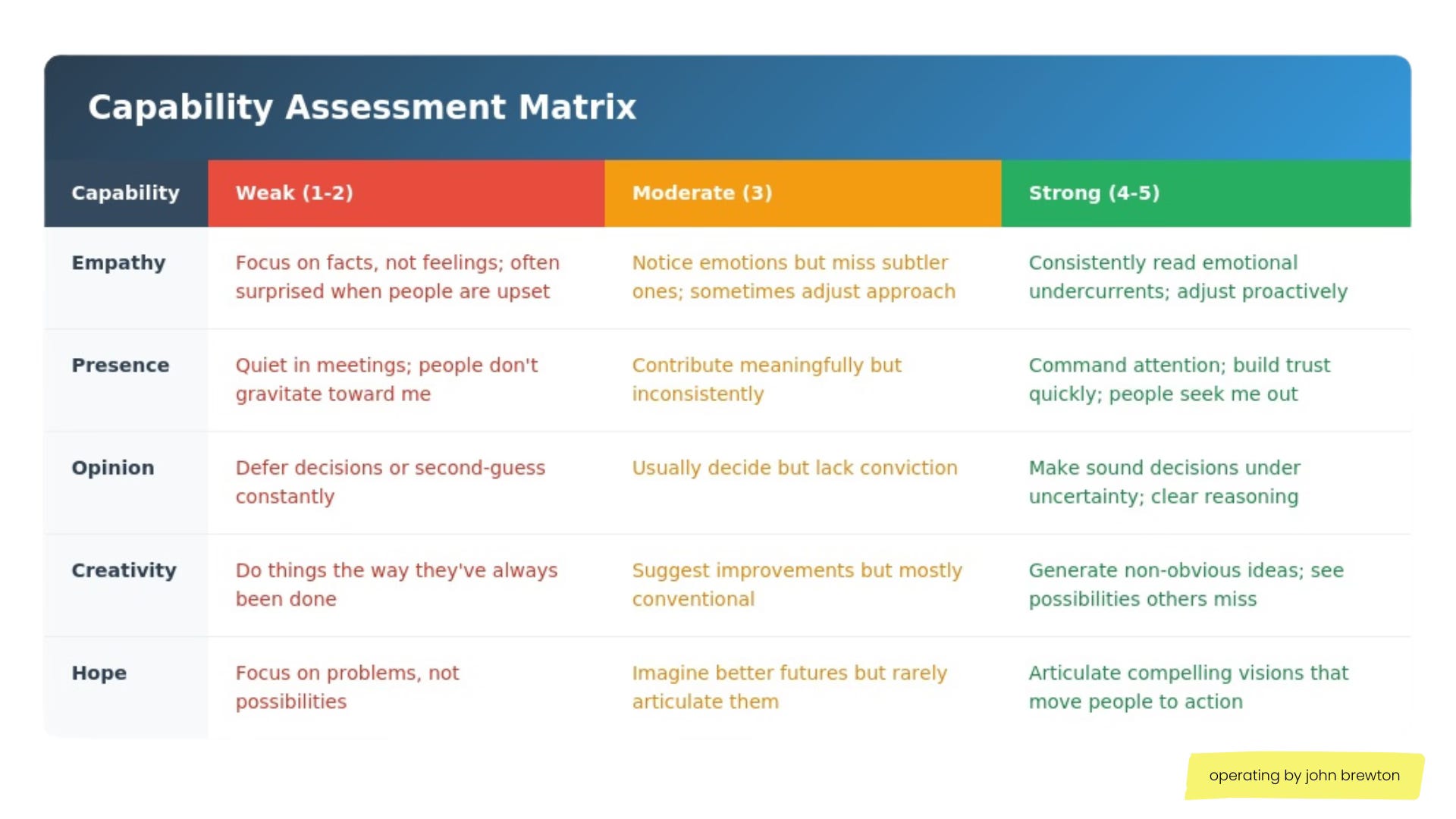
Most leaders have significant gaps. A strong leader might be 4/5 in Presence but only 2/5 in Empathy. Someone brilliant at Creativity might be weak in Opinion.
That’s not a problem. That’s your roadmap.

Here’s what most leaders get wrong: They think EPOCH capabilities develop through conferences, books, or occasional coaching.
They don’t. They develop through deliberate daily practice.
The 90-Day EPOCH Mastery Model is structured like this:
Weeks 1-2: Foundation
Complete the self-assessment
Choose one capability to focus on (pick your weakest)
Commit to daily practice
Weeks 3-8: Deep Practice
10 minutes daily: Deliberate practice on your chosen capability
45 minutes weekly: Deeper work and skill-building
Bi-weekly check-ins: Track progress and adjust
Real-world application: Use it in actual work
Weeks 9-10: Integration
Connect this capability to your AI workflows
Apply it to real projects
See how it amplifies your work
Weeks 11-12: Reflection & Mastery
Re-assess your capabilities
Celebrate progress
Plan the next capability
Then you repeat with a second capability (Weeks 13-24), then a third, until all five are built.
In one year, you go from having significant gaps to having all five at a solid 4/5 level.

Each of the five capabilities has a specific 10-minute daily practice:
Empathy: Pre-meeting perspective-taking worksheet
Before a high-stakes conversation, spend 5 minutes asking: What is this person feeling? What do they fear? What would success look like for them?
After the conversation, spend 5 minutes reflecting: Did I read it right? What did I miss?
Presence: Meeting intervention planning
Before each meeting, decide one high-value contribution you’ll make
After the meeting, reflect: Did I add value? Did I shift the conversation?
Opinion: Decision log
For each significant decision, write: What you decided, 2-3 reasons, your confidence level (0-100%)
Later, check back: Were you right? Over/under-confident?
Creativity: AI idea sprint
For one problem, use AI to generate 20 options
Pick 2 that are non-obvious but plausible
Consider testing one
Hope: Future-state narrative
Write one clear sentence about where your project could be in 6 months
Share it with one person
Notice their reaction
Simple. Concrete. Daily. The kind of thing you can do before meetings or at the end of your workday.
Here’s what most people miss: EPOCH and AI aren’t competing. They’re complementary.
EPOCH capabilities don’t diminish in an AI era.
They amplify your AI work.
Consider empathy + AI:
Your empathy tells you what people actually need
AI analyzes customer sentiment at scale
Together: You design workflows that feel human, not cold
Or creativity + AI:
Your creativity imagines non-obvious approaches
AI generates options and reframes problems
Together: You find breakthrough solutions that scale
Or presence + AI:
Your presence builds trust and credibility
AI handles routine work so you have time to be present
Together: You’re the trusted leader directing the transformation
This is the thesis: AI amplifies EPOCH capabilities, and EPOCH capabilities direct AI. Together, they’re unstoppable.

You’re building AI workflows. Good.
You’re getting efficient. Good.
But without EPOCH capabilities, you’re building efficient systems that don’t serve people. You’re scaling complexity without wisdom. You’re automating without asking if you should.
Leaders with both Pillar 1 (AI fluency) and Pillar 2 (EPOCH) will dominate the next decade.
They’ll:
Build workflows that actually serve people
Earn trust in an era of AI skepticism
Make wise decisions about what to automate and what to keep human
See possibilities their competitors miss
Inspire people to move toward something, not away from something they fear

This week:
Take the EPOCH self-assessment (30-45 minutes)
You’ll know your baseline and your biggest gap
Choose one capability to focus on (pick your weakest or your most urgent need)
Pick the corresponding daily practice and commit to 10 minutes/day for 90 days
Next week:
Start the daily practice
Schedule your weekly 45-minute deep work block
Find an accountability partner who’ll check in with you bi-weekly
Weeks 3-12:
Follow the roadmap
Daily practice + weekly deep work + check-ins
Integrate with your AI workflows in weeks 9-10
That’s it. 90 days of deliberate practice on one capability. From assessment to mastery.
After 90 days:
You’ll have moved 1-2 points on the 1-5 scale
People around you will notice the shift
You’ll have a new skill integrated into how you work
You’ll know exactly how to do this for the next capability
After one year (five 90-day cycles):
All five EPOCH capabilities at 4/5 or higher
You’ll be the kind of leader that AI amplifies, not replaces
Your AI workflows serve people, not just metrics
You’ll have built a culture that thrives, not just complies
One Final Principle
In an AI world, your job isn’t to compete with machines on speed or scale.
Your job is to bring judgment, empathy, creativity, vision, and presence to the work machines make possible.
That’s what EPOCH is.
Start with the self-assessment. Pick one capability. Commit to 90 days of practice.
The machine can execute.
You lead.
Next Week: How Pillar 1 + Pillar 2 + Pillar 3 Compound
[Coming next week: The article that ties all three pillars together and shows the complete operating system for the future of companies.]

John Brewton documents the history and future of operating companies at Operating by John Brewton. He is a graduate of Harvard University and began his career as a Phd. student in economics at the University of Chicago. After selling his family’s B2B industrial distribution company in 2021, he has been helping business owners, founders and investors optimize their operations ever since. He is the founder of 6A East Partners, a research and advisory firm asking the question: What is the future of companies? He still cringes at his early LinkedIn posts and loves making content each and everyday, despite the protestations of his beloved wife, Fabiola, at times.
Brilliant offer John! So much value from a top top advisor and operator 🎁
This read like laying stones across a stream so people can cross without getting swept away.
Not flashy, just well placed, and suddenly progress feels possible.
Through the 5 Voices lens, this approach makes real sense:
Nurturers grow when learning serves people and purpose.
Guardians grow with clear structure and repeatable habits.
Creatives grow when curiosity is given room.
Connectors grow through shared language and conversation.
Pioneers grow when learning links directly to forward movement.
When teams recognise these differences, upskilling stops being generic and starts to stick.