

TL → DR
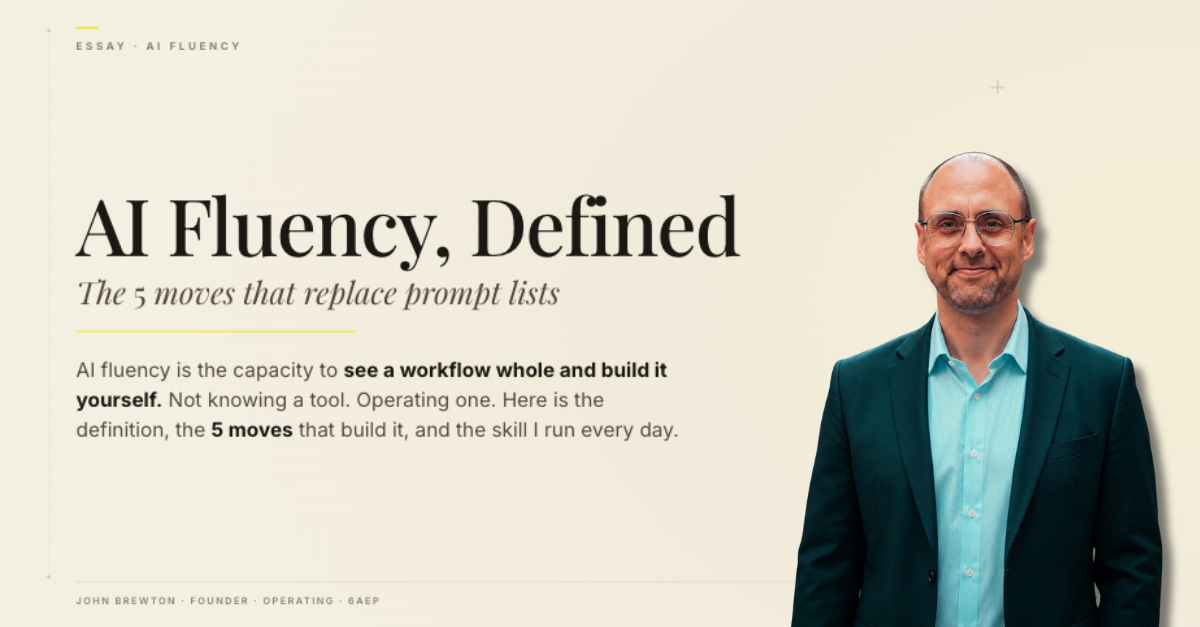
AI fluency is the capacity to see the whole workflow and build it yourself. Not knowing a tool. Operating one.
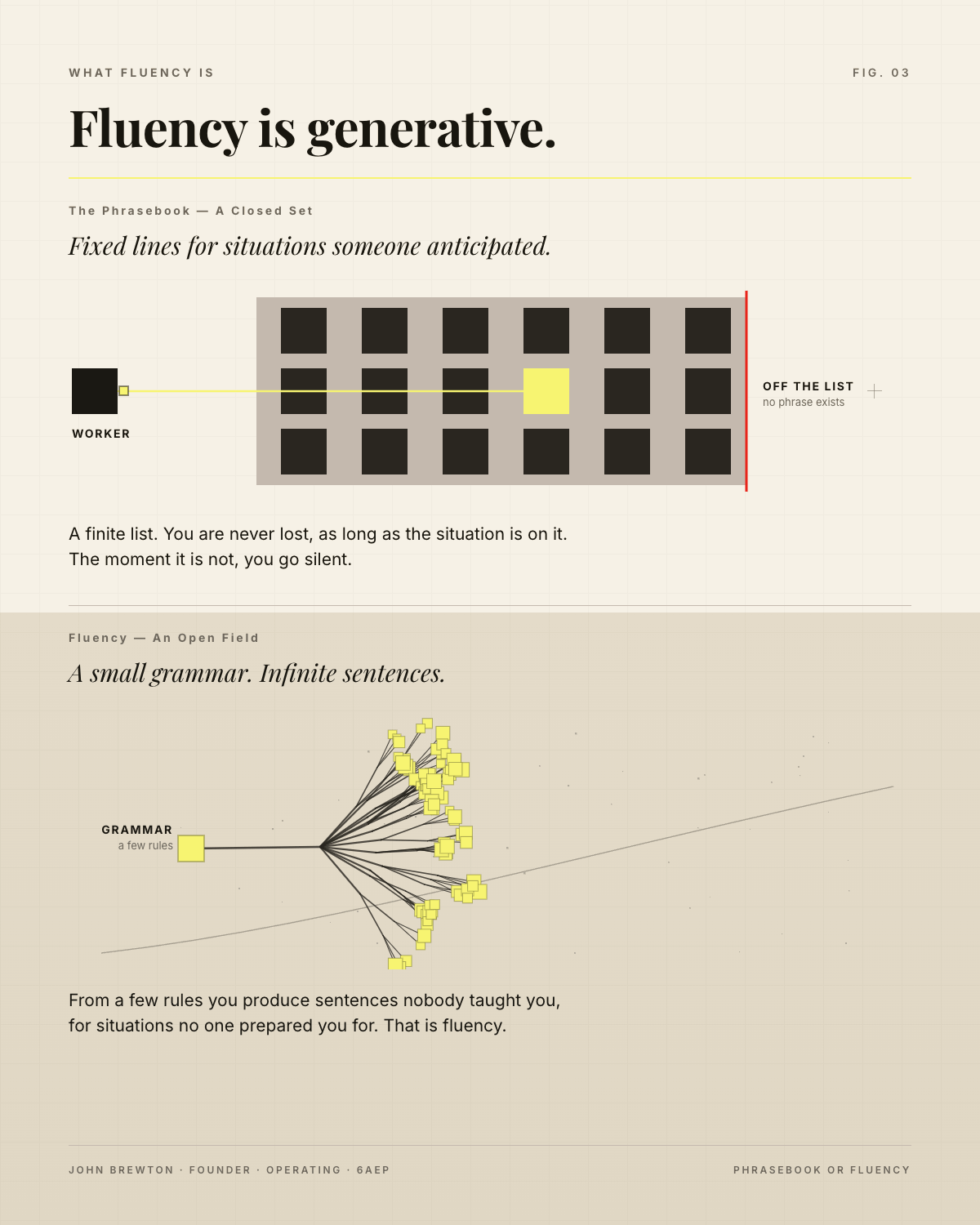
Prompt lists are a phrasebook. They run out. Fluency is a grammar. It does not.
The discipline is 5 moves: Frame, Assign, Brief, Inspect, and Iterate then persist.
You drill them on small prompts until they are automatic. Then the same 5 moves run multi-agent systems.
Paid subscribers get the tool: the Rudiments skill for Claude and ChatGPT, plus a one-page chart.
I live in a bilingual household. My wife is from Mexico; Spanish is our first language at home, and our two-and-a-half-year-old daughter is becoming bilingual day one. She moves between Spanish and English as if it’s all one language. She produces sentences no one taught her. It’s one of the most beautiful experiences of my life.
I studied Spanish for 4 years in high school and Chinese for 4 years in college. 8 years of classes, and I could not have held a conversation in either. I never became fluent. I was memorizing lists for the test and forgetting them by summer. Since meeting my wife, I have worked hard to become bilingual. I’m not quite there yet, but getting very close. What is making me fluent now is my household, my wife, our daughter, our friends, and my extended family. I speak more Spanish than English in my personal life each day.
That is how most people should learn AI, and almost no one does. They collect prompts instead. “10 prompts for marketers.” “The 50 best ChatGPT prompts.” They are building a phrasebook, and they will struggle to produce high quality outputs the first time the work is not on the list.
AI fluency is the capacity to see a workflow whole and build it yourself, which is the one thing software has spent your entire career doing for you.
Nobody has defined AI fluency, so the word floats. People feel behind without knowing what they are behind on. Companies buy licenses and wait for a result that never arrives.
The gap is not access to the tools.
The gap is a definition nobody wrote down or thought to calrify.
What does it actually mean to be fluent?
Linguists test it with 3 markers:
A fluent speaker stops translating in their head.
They route around the words they do not know instead of freezing.
They create instead of reciting.
My daughter is 2 and already does the third one. Most adults with a language app never clear the first.
The same 3 markers tell you a person is fluent with AI. They stop reaching for a saved prompt. They route around what the model cannot do instead of giving up. They compose a workflow for a problem no one has templated.
New to Operating? You Might Appreciate These Popular Articles
How I Built a $200,000 Newsletter Business From a Substack Nobody Was Reading
The Five Moves That Turned My Substack Into a $200,000 Business
The Operating Project: Most Coaching Ends With Notes. This Ends With a Machine.
Why is working with AI different from using software?
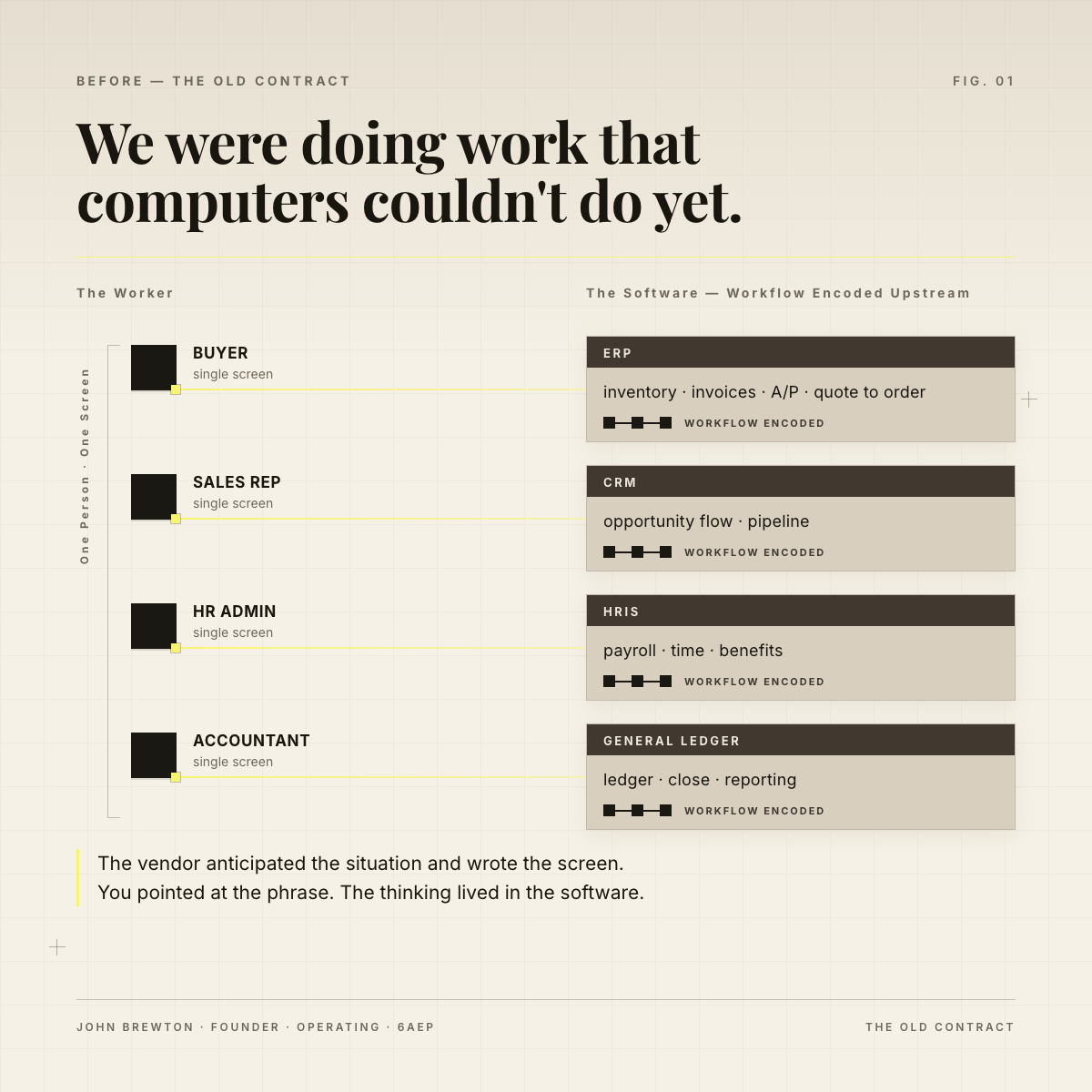
For 40 years, enterprise software has made this skill unnecessary. The ERP told you which screen to open. The CRM told you what to enter and when. The workflow was built into the software, written by a vendor who had already anticipated your situation. You pointed at the phrase.
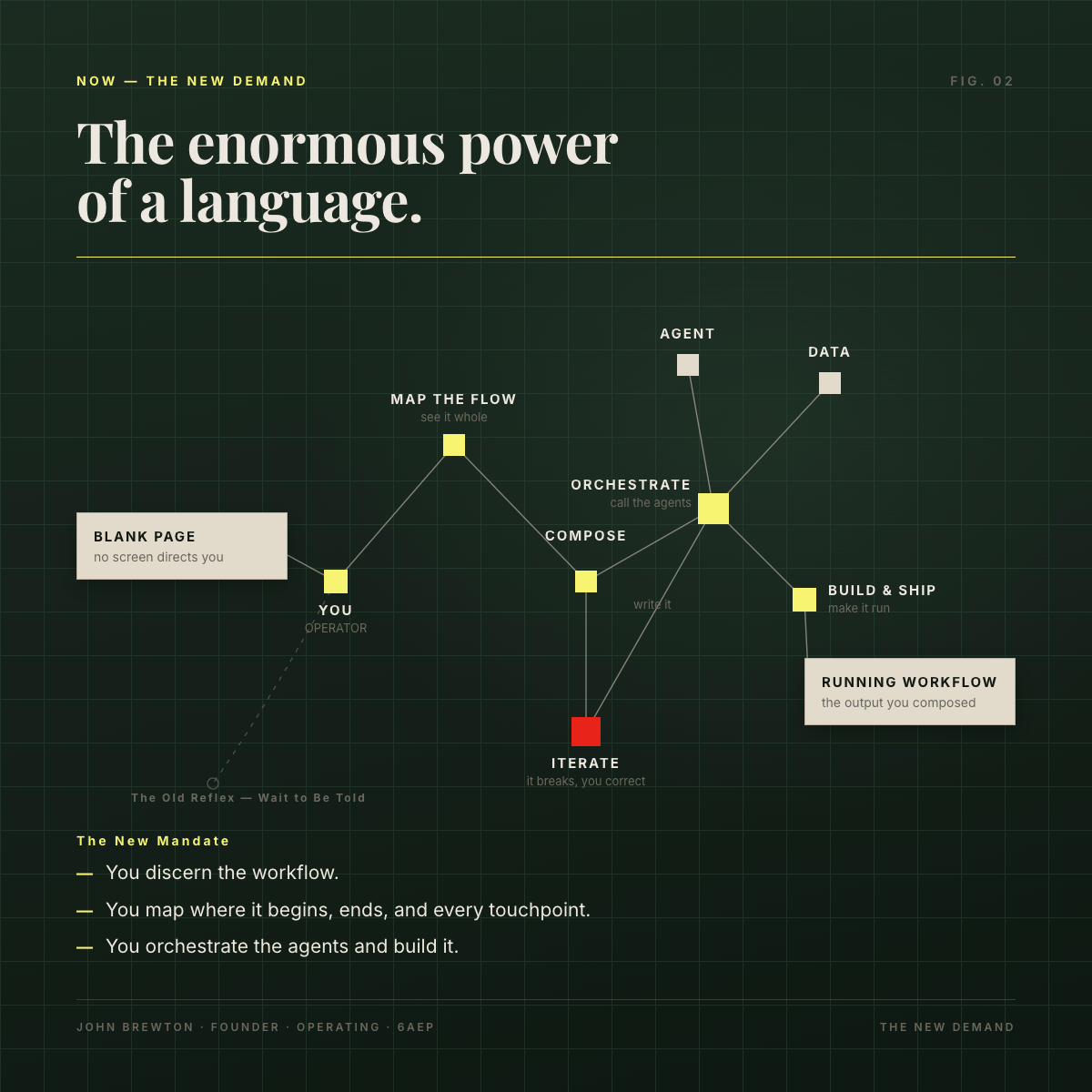
That arrangement ended in 1 step. The model does not hand you a directional form on a screen; it hands you a monumentally flexible canvas through which you can communicate to build anything, literally.
The cost of building a workflow fell to a sentence you can type. That changed what a tool is. Which changed what a worker does. This is now changing what it means to be a worker. Most people are still asking which prompt to use.
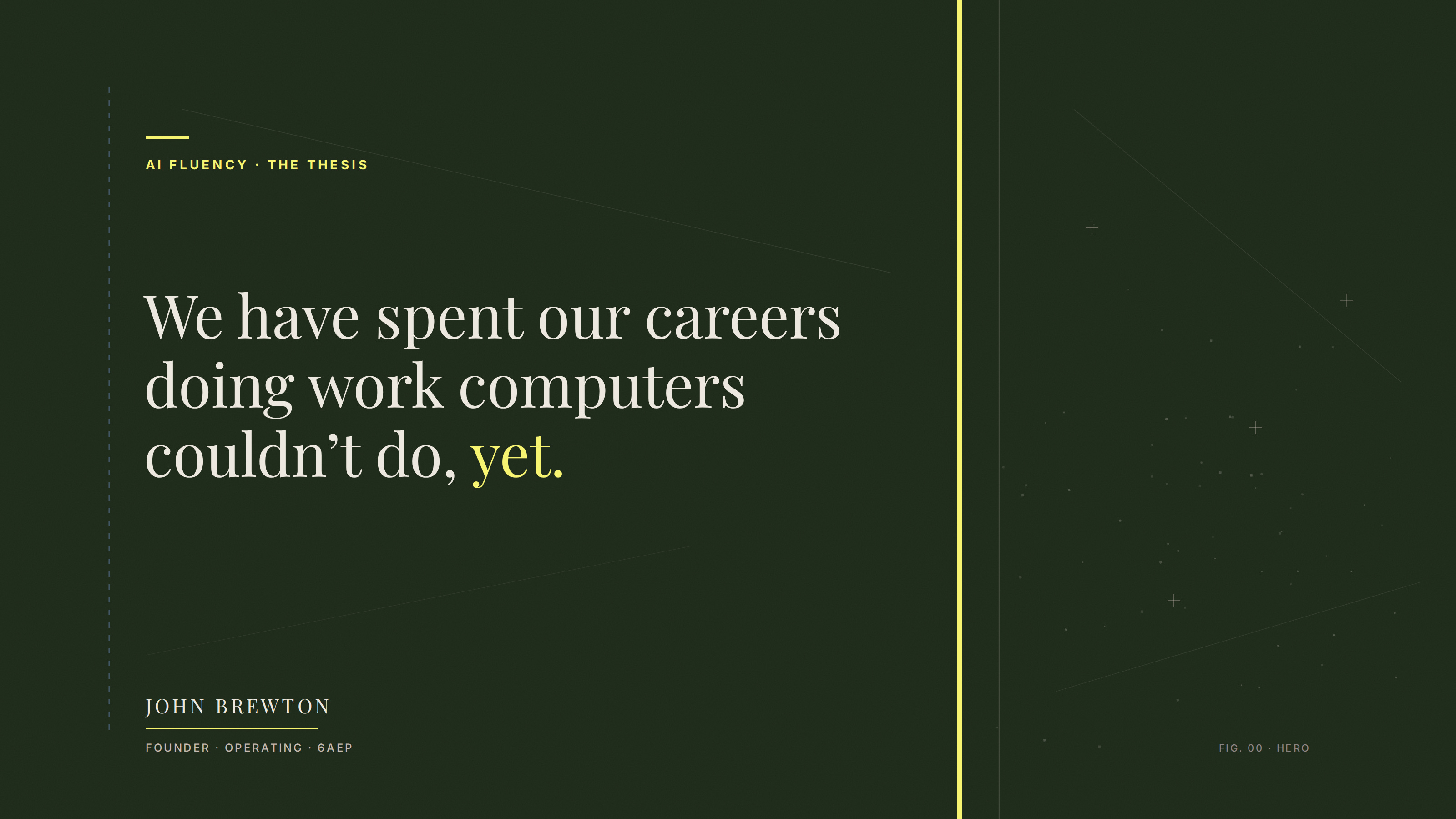
We have spent our careers doing work that computers could not do, yet. Now the computer does the work and asks us to compose and direct its intended output. That is not a smaller job. It is the work of an Operator, and very few companies, much less individuals, have been trained for this task.
Can you become AI fluent without a technical background?
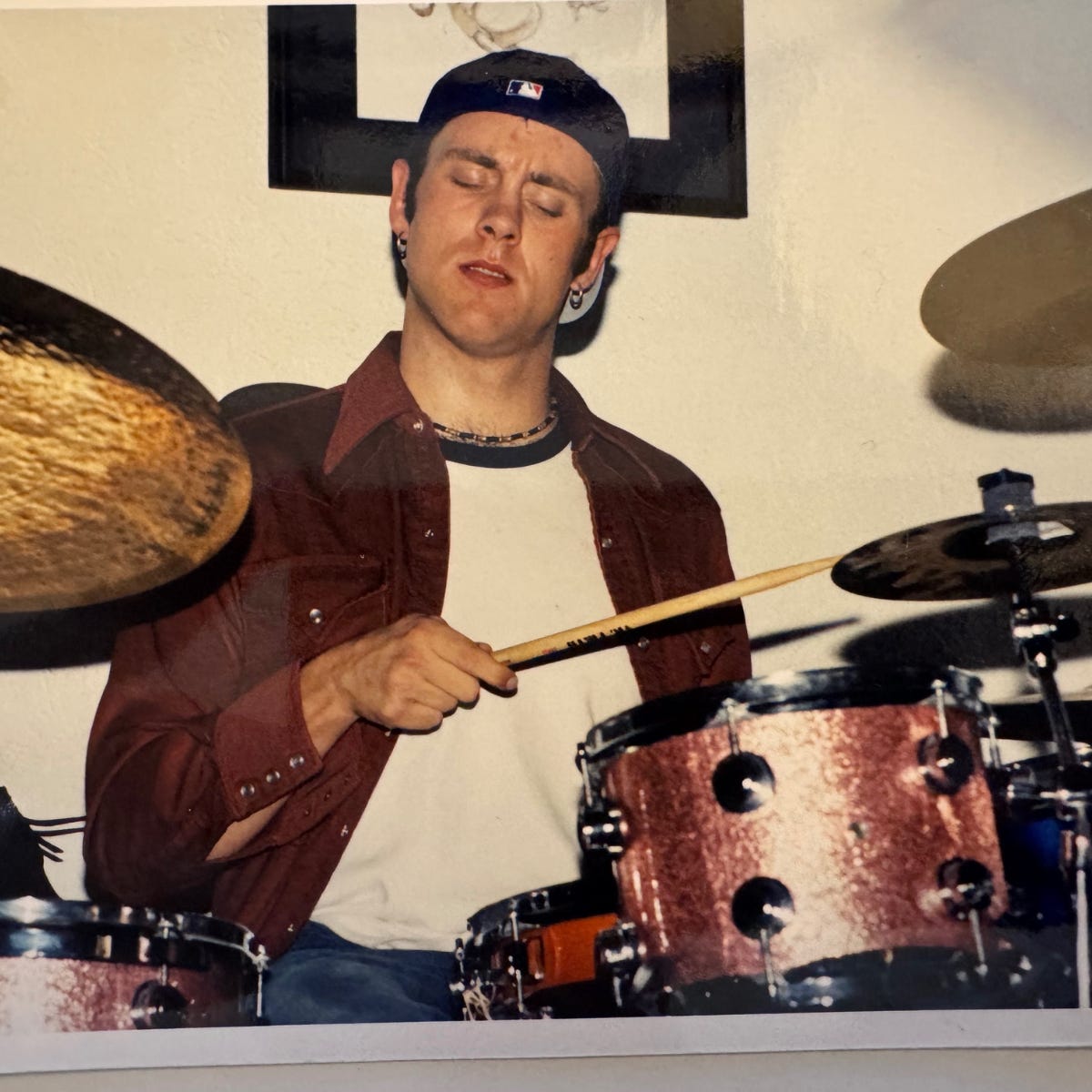
I trained as a drummer at the Berklee College of Music for a year right after high school. I obsessively drilled rudiments, single strokes, double strokes, paradiddles, slowly and cleanly, thousands of times, until my hands moved without thought.
When the rock-and-roll dream didn’t work out, I became an equally obsessive student, ultimately graduating from Harvard with a degree in Economics. The disciplines and habits that helped me master an instrument were the same tools that helped me succeed in academia.
I did it again in business. I spent a decade at a B2B industrial distributor, from the sourcing desk to the chief executive role, and grew it from $27.5M to $75M before selling in 2021. The work computers could not do yet was the work I did by hand for 10 years.
I am doing it a third time now. I am building AI-first, enterprise-grade software using tools Attio, Claude, Supabase, and Resend. I am not an engineer. I am an Operator, a buildeer, a designer, and a founder.
The discipline that produced all 3 outcomes across my life transfers and compounds with each successive iteration.
For AI Fluency, this skill-building repetitive loop has a clear shape, I call it the Five Moves. It is rudimentary, and meant to be practiced over and over again
You do not become AI Fluent by reading about reps. You achieve this new reality by building this capability across your real work, alongside colleagues who are doing the same, and by learning from leaders who have already achieved the outcome.
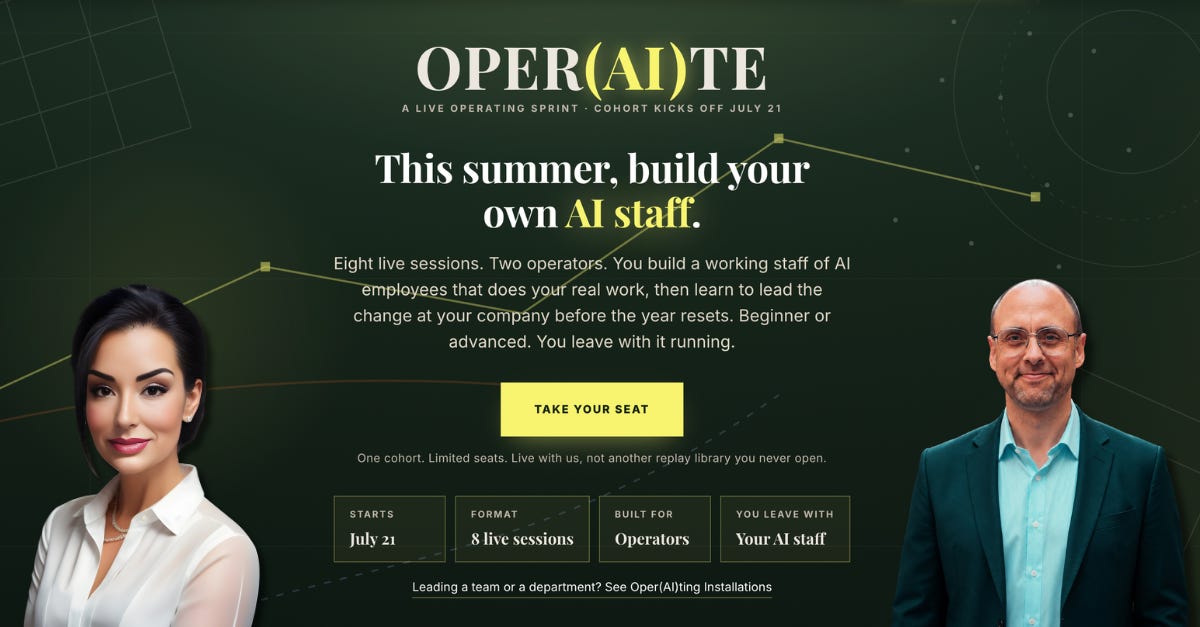
That is what I built with Wessal Khader. It is called Oper(AI)te, and it runs this summer. 8 live sessions, no theory, and no replays to watch alone. You build a working staff of AI employees that does your real work, across Claude, ChatGPT, Gemini, and Perplexity. Beginner or advanced. No coding ability required. You leave with a team of agentic AI-employees running 24/7.
The summer cohort starts July 21, and seats are limited.
Build it with us this summer to become AI-Fluent by the time Q3 ends and Q4 starts!
What are the 5 moves of AI fluency?
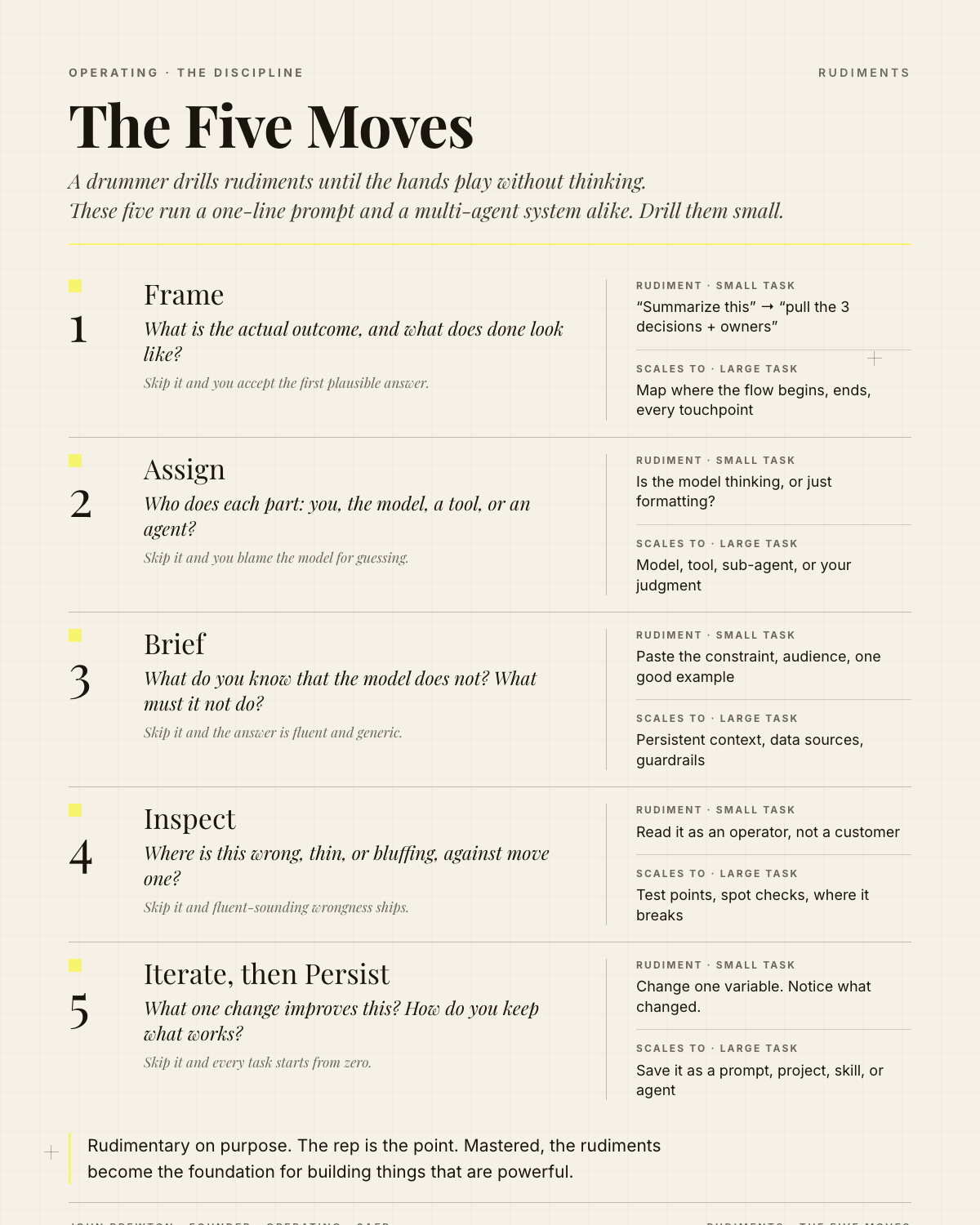
The five never change. Only the size of the task changes. You drill them on a one-line prompt the way a drummer drills a single-stroke roll, then the same 5 moves run a multi-agent system. Start small on purpose. A weak prompt costs nothing, and you can run the loop 40 times in a morning on real work.
Frame: One question: what is the actual outcome, and what does done look like? Small: “summarize this” becomes “pull the 3 decisions and who owns each.” Large: map where the workflow begins, ends, and every touchpoint between. Skip it and you accept the first plausible thing the model returns, because you never defined better.
Assign: One question: who does each part, you, the model, a tool, or an agent? Small: decide whether the model is thinking or just formatting a decision you already made. Large: the model’s job, a tool’s job, a sub-agent’s job, your judgment. Skip it and you hand the model work it cannot do, then blame it for guessing.
Brief: One question: what do you know that the model does not, and what must it not do? Small: paste the constraint, the audience, and one example of good. Large: persistent context, data sources, guardrails. Skip it and the answer comes back fluent, confident, and generic, because you described a generic situation.
Inspect: One question: where is this wrong, thin, or bluffing, measured against move one? Small: read the output as an operator checking work, not a customer accepting a delivery. Large: test points, spot checks, the places a workflow breaks quietly. Skip it and fluent-sounding wrongness ships. This is the most expensive failure in the discipline.
Iterate, then persist: One question: what one change improves this, and how do you keep what works? Small: change one variable, run again, notice what changed. Large: save what worked as a prompt, a project, a skill, or an agent, so it runs again without you. Skip it and every task starts from zero, and nothing compounds.
How do you practice AI fluency?
The cost of a mistake on a 2-line prompt is limited. The rep count is everything. Run the loop 40 times a day on real work, and the moves leave your conscious attention. By the time the task is a system with sub-agents across 4 tools, the moves are already in your hands, and your attention is free for the one thing that does not automate: judgment.
The rudiments are rudimentary. That is the point. Mastered, they become the foundation for building things that run without you.
Is there a tool that enables the 5 moves?
I built a skill that runs you through the 5 moves while you work. It is called Rudiments. When you sit down and say “help me draft the board update” or “build me a lead-routing flow,” it does not lurch into the task. It asks you the moves, calibrated to the size of the job, and it shows you the difference between your loose ask and the sharp one, so you learn the move and not just the answer. It is built to make itself unnecessary.
Here is what it does with every task you bring it:
Sizes the job. A quick rep for a one-line prompt, a full rep for real work, a build rep for a multi-agent system.
Walks you through the 5 moves as questions: Frame, Assign, Brief, Inspect, and Iterate then persist.
Shows you your loose ask next to the sharp one, so the rep teaches you the move.
Tracks the moves you skip and tells you which one to drill next.
Saves what works, so the rep compounds instead of resetting to zero.
That is the loop and the rep that will help you get one step closer to becoming AI Fluent.
You do not need to write code. You do not need a developer. You need Claude Pro at $20 a month or a Premium ChatGPT account, and 60 minutes of real work to drill against.
Paid subscribers get 3 things, attached below:
The Rudiments skill for Claude, installed in under a minute.
The same discipline written as instructions for a ChatGPT, so it runs wherever you work.
The one-page chart, print-ready.
Become a paid subscriber to download the Claude skill and the directions for how to build the same capability in ChatGPT after the frequently asked questions section below.
Frequently Asked Questions
What is AI fluency? AI fluency is the capacity to see the whole workflow and build it yourself. It is not knowing a tool. It is operating one. The test is the same as for language. You stop reaching for a saved prompt, you route around what the model cannot do, and you compose a workflow for a problem no one templated.
What is the difference between AI fluency and prompt engineering? Prompt engineering collects lines that work. AI fluency builds the workflow that those lines sit inside. A prompt list is a phrasebook, and it runs out. The 5 moves are grammatical, and they do not.
Do you need to know how to code to become AI fluent? No. I am building an AI-native CRM for a public company, and no one trained me to write software. You compose the workflow in plain language and let the model and tools handle their parts. You need judgment, not a computer science degree.
What are the 5 moves? Frame, Assign, Brief, Inspect, and Iterate then persist. Frame the outcome. Assign each part to you, the model, a tool, or an agent. Brief the context and the guardrails. Inspect the output against the outcome. Iterate one change, then save what works so it runs again without you.
How long does it take to become AI fluent? Faster than you expect, because you drill on small tasks with a high rep count. Run the 5 moves 40 times in a morning on real work, and the moves start to leave your conscious attention in weeks, not years.
Should I use Claude or ChatGPT to practice? Either. The discipline is identical on both. Claude Pro is $20 a month, and ChatGPT has a free tier. The Rudiments skill ships for Claude, and the same discipline is written as instructions for a ChatGPT Custom GPT.
What is the Rudiments skill? It is a tool that runs you through the 5 moves while you work, calibrated to the size of the task, and shows you the difference between your loose ask and the sharp one so you learn the move. It is built to make itself unnecessary. Paid subscribers get it for Claude and ChatGPT, plus the one-page chart.
