

AI Was Supposed to Kill Consulting. Instead It Has Started a Golden Age.
The Quiet Builders Are Coming. Great Companies Will Build Around Them.
Start Here
I have built this publication on a hopeful premise: companies are becoming tech stacks, and we are all becoming companies. The tools that once required a department now fit on a laptop. An individual with expertise and an offer can compete.
Andreessen Horowitz has spent the past few months putting that premise to the test. They have a better view of where the capital is going than I do, so I thought it would be interesting to dig in this week and respond to their thesis.
AI can democratize the ability to start a company while concentrating the rewards of running one. In that world, “we are all companies” describes the entry ticket. The harder question is where a solo operator or small firm can win.
Capital Can Buy Speed
David George of a16z has argued that AI strengthens the power law of technology investing: a small number of companies capture a disproportionate share of the rewards. Capital itself can reinforce their advantage by buying more compute.
Ben Horowitz makes the mechanism explicit. A company with a 2-year lead once had some protection against a competitor that tried to catch up by hiring 1,000 engineers. Adding people could create more coordination problems than progress. His example of what has changed is the model race: spend $3 billion on a computing cluster, and a challenger can close a gap that hiring alone could not.
That challenges a familiar startup advantage. Speed has often allowed small companies to beat larger ones. Where capital can purchase speed, the balance shifts toward those who can afford it.
The fundraising market is behaving as if that argument has merit. Disruptive, an investor in chip startup Groq, is targeting a fund of up to $10 billion, according to the Wall Street Journal. The firm plans to invest in roughly 10 late-stage companies over 2 years. a16z itself has raised a $1.1 billion Machine Age Fund for the physical infrastructure of AI.
If you like this article, you’ll love this one, too!

Access Is Uneven
Participation is uneven on the customer side, too. In a16z’s analysis of U.S. consumer spending, the top 1% of AI spenders averaged $903 a month in August, against a $25 median. Together, they spent more than the bottom 50% combined.
Those figures measure spending, so they cannot tell us who is earning a commercial return. They do show how widely the intensity of paid use varies. Access to the tools is only the beginning.
Andrej Karpathy has described a similar divide in access and experience. On October 11, he wrote that the gap in understanding what these models can do is “widening” into “a sharp funnel.”
By his own napkin math, about 6 billion people have barely touched a large language model. Another 1 to 2 billion use free chatbots casually. Around 20 million use frontier models professionally in math and code, and about 5,000 have access to frontier systems inside the labs. These are rough estimates, but the distinction matters: people discussing the same technology may be working with very different capabilities.
The vendor market offers another view of concentration. In Ramp’s token-spending data, Anthropic’s share fell from 69.5% in the week ending March 15 to 51.0% in the week ending September 27. OpenAI’s share rose to 44.5%. These figures cover model-attributed API spending by businesses using Ramp’s Token Spend Management product, a subset of its customers.
The shares are moving, but those 2 companies still account for more than 95% of the spending in that sample. A leader can lose ground while the market remains concentrated.
Small Teams Can Sit Inside Large Companies
Bending Spoons makes the tension between small teams and large companies concrete. In a September interview with David Senra, CEO Luca Ferrari said Evernote had roughly 350 people when it was acquired. By the time of the interview, about 20 people worked directly on it.
Ferrari also explained what makes that possible: the team benefits from technology developed across Bending Spoons’ portfolio. The group can spread the cost of that investment across multiple businesses.
On October 12, Airtable announced a move to a leaner team following its acquisition by Bending Spoons. The company believes smaller teams will help it deliver its product plans. Whether those plans succeed will have to be judged by the results.
Small teams and concentrated ownership can advance together. An independent operator looking at Evernote’s headcount also needs to account for the platform behind it.
Where A Small Firm Can Win
That is where I need to qualify the democratization story. Greater access to the tools does not give every company the same competitive position. The economics of building a frontier model are different from those of using one to serve a client.
Capital has its clearest advantage where more infrastructure or broader distribution directly improves the offer. Trust and local knowledge are harder to reproduce on demand.
When I ran an industrial distribution business, the competitor I feared most was the family owner with no exit plan and 20 years’ worth of relationship building in a new market we were entering.
That kind of business is difficult to understand through a venture-capital lens. Its owner can define success on different terms, and the customer relationship can outlast several generations of technology.
Think about the regional distributor who knows which customer always pays late and which one needs a call before a price change. The adviser who has known a family for 20 years. The specialist consultant whose judgment a CFO trusts on a deal.
In those markets, scale helps, but customers are also buying accountability from someone they know and trust. AI can make that person more productive. It does not automatically transfer the customer’s trust to whoever owns the model, nor will the models imbue that business owner with the specialized knowledge these advisors possess.
4 Choices For The Independent Operator
For a company of 1, or of 10, I would draw 4 practical conclusions.
Avoid competing on features alone. If a larger company can reproduce your offer and put it in front of an existing customer base, a development head start gives you limited protection. Give customers a reason to choose you that survives the next product release.
Compete where trust affects the buying decision. Choose a specific customer and a problem where your judgment matters. A narrow market helps when it allows you to understand the work and the people better than a general-purpose competitor.
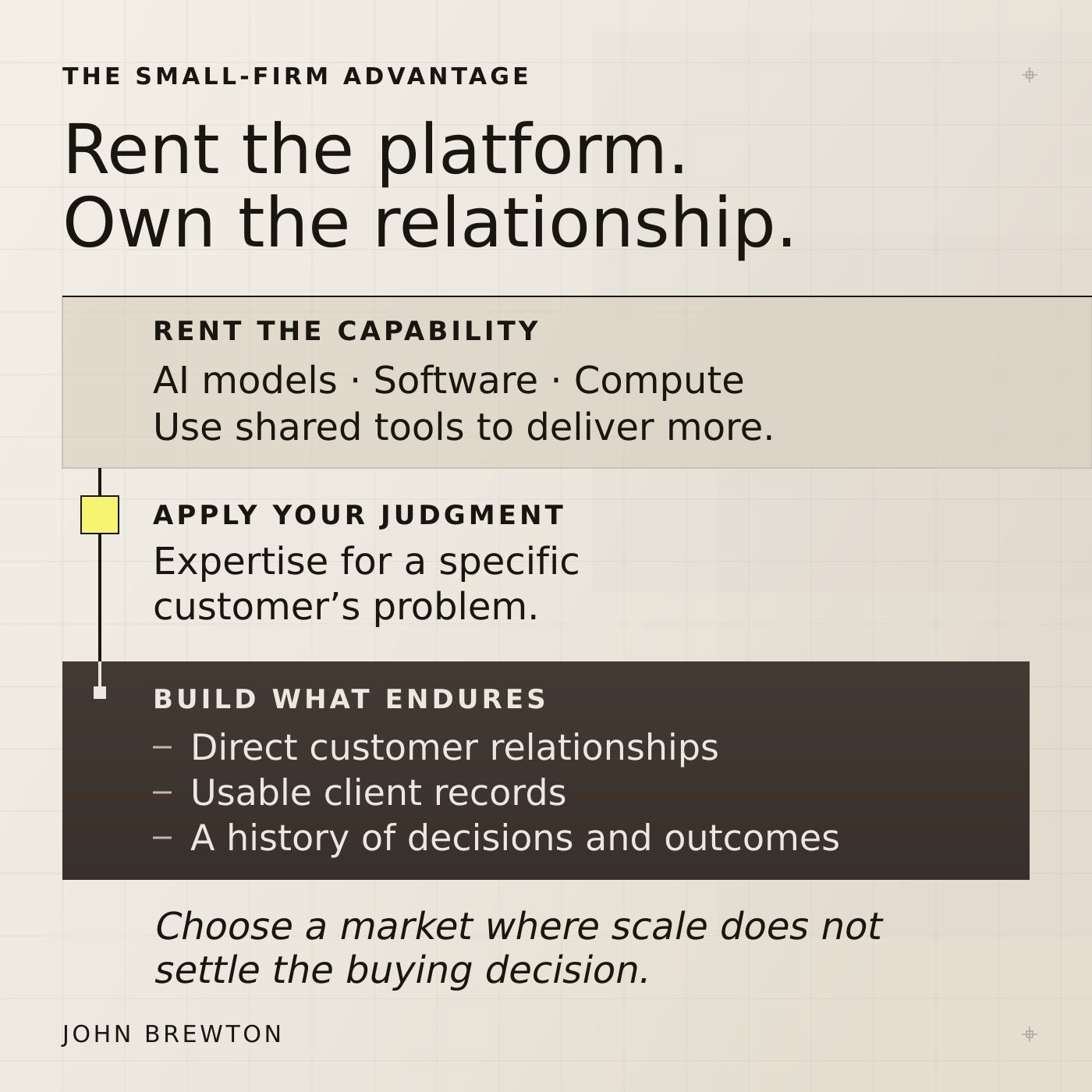
Rent the platform. Own the relationship. Use the infrastructure the giants are building, and keep direct access to your customers. Maintain usable records of their needs and your work so the business can survive a change of tools.
Build a record. Document the advice you gave, the decisions you made, and the outcomes that followed. Record when you overrode the tool and why. A competitor can buy the same software much faster than it can earn the same history of trust.
AI can lower the cost of starting a business and increase the rewards available to scale. The operator’s task is to choose a market where scale does not settle the customer’s decision.
A profitable firm that supports its owner can succeed without ever becoming large enough to interest a venture fund.
We are all becoming companies. I still believe that. Some of the giants will become much bigger, and small firms will have more capability available to them than before. Their opportunity depends on what they do with it.
Build where your knowledge of the customer changes the outcome. Use AI to deliver the work. Keep earning, building, and growing the relationship(s).
- j -

John Brewton documents the history and future of operating companies at Operating by John Brewton. He is a graduate of Harvard University and began his career as a PhD student in economics at the University of Chicago. After selling his family’s B2B industrial distribution company in 2021, he has been helping business owners, founders, and investors optimize their operations ever since. He is a career consultant and business operator, asking the question: What is the future of companies?
Appendix: Sources and notes
The sources below support the figures and attributed statements in this article. The conclusions about strategy are my interpretation. Reporting periods matter, particularly for spending shares.
David George and a16z on AI’s power law. How AI Is Rewriting the Power Law of Venture Capital, September 10, 2026. The discussion explains how capital can reinforce an AI company’s advantage by buying compute.
Ben Horowitz on capital and speed. a16z’s published excerpt contrasts hiring 1,000 engineers with funding a $3 billion computing cluster. His example concerns competition between AI models. Applying it to every software business would go beyond that example.
Disruptive’s proposed megafund. The Wall Street Journal’s report identifies Disruptive and its target of up to $10 billion. This is a fundraising target, not a statement that the full amount has been raised.
a16z’s Machine Age Fund. The fund announcement, August 28, 2026, confirms $1.1 billion raised for AI infrastructure and physical systems.
Consumer AI spending. The Top 100 Gen AI Consumer Apps, 7th Edition, October 5, 2026, uses YipitData’s U.S. consumer panels. The $903 average for the top 1% of spenders and $25 median refer to August 2026. Spending concentration does not establish productivity or profitability.
Karpathy’s capability funnel. Andrej Karpathy’s October 11 post supplies the estimates of 6 billion, 1 to 2 billion, 20 million, and roughly 5,000 people. He describes these as napkin math. They should be read as his estimates, not survey findings.
Business spending on AI tokens. Ramp AI Index: token spend by model maker. Anthropic’s share was 69.47%, rounded here to 69.5%, in the week ending March 15, 2026. For September 21–27, Anthropic held 51.0% and OpenAI 44.5%, a combined 95.5%. The dataset covers connected-provider, model-attributed API spending from businesses using Ramp’s Token Spend Management product. It represents a subset of Ramp customers, rather than the entire AI market.
Evernote and Bending Spoons. Luca Ferrari’s interview with David Senra, September 13, 2026. Ferrari describes the reduction from roughly 350 people to about 20 working directly on Evernote and explicitly acknowledges support from the group’s shared technology platform. These are the CEO’s reported figures. The 20-person count does not include all shared support.
Airtable’s team changes. An update on Airtable’s team and what we’re building next, October 12, 2026. The company announces departures and its plans for a smaller team. The announcement establishes its intended approach, not the eventual productivity result.
Cannot agree more. Small teams are a competitive advantage for AI implementation. The smoother and shorter the process, the best AI will work over it. More handoffs, more friction.