

Give the right people a reason to buy.

People can enjoy your posts for months and still have no idea what they can hire you to do. That gap between attention and a clear offer is what we’re tackling in Master LinkedIn’s New Feed and Build an Offer People Want.
On September 29, I’m joining Alicia Teltz and Wessal Khader for a free, 90-minute masterclass covering how to:
Get your content in front of relevant buyers as LinkedIn’s feed changes.
Use customer insights to identify problems your audience wants solved.
Turn those insights into an offer people understand and want to pay for.
If you’re putting time into LinkedIn and struggling to connect that effort to something you can sell, join us.
Tuesday, September 29 · 1pm Eastern / 6pm UK · Free · Online
Start Here
Dario Amodei’s Anthropic has built its Responsible Scaling Policy around catastrophic AI risks, including biological threats and systems acting beyond human control.
In an interview published September 3, Sam Altman called the next generation of models “sobering for everybody.” He later warned about 2 outcomes: humanity losing control of AI, and AI concentrating power in a single person, company or country.
Elon Musk has been sounding the alarm for years. In 2023, he signed an open letter calling for a pause in training the most advanced systems.
Getting Amodei, Altman and Musk to broadly agree on anything may itself qualify as an extinction-level event.
People often need a reason to care before they need a reason to buy…
The companies warning us about AI also have enormous commercial interests in the rules governing it. Those rules help determine who can compete and what competing will cost.
A 2023 paper coauthored by OpenAI researchers proposed registration, reporting, safety standards and enforcement for frontier-model developers. Anthropic has advocated a “regulatory ladder”, with testing and government oversight increasing as the risks grow.
Those may be sensible requirements. Depending on their design, they may also be considerably easier for an established lab to meet than for a smaller challenger.
The thresholds matter. A rule aimed at developers of the most capable models does not automatically apply to everyone building an AI app. But compliance costs can still shape who gets to challenge the leaders.
Brookings has warned that licensing can reinforce incumbents by raising the cost of entry. Separately, the Federal Trade Commission has identified how control over essential AI inputs can entrench established firms.
That is a reason to examine the incentives. It is not evidence that these executives are manufacturing fears they do not believe.
The risks can be real, the concerns sincere, and the regulations justified. The same regulations can still make life harder for future competitors.
A warning can serve the public interest and the company delivering it.
Fear can draw attention to a real problem. Attention can influence which solutions get heard. And the proposed solution can have commercial consequences of its own.
Most founders face a considerably less apocalyptic version of the first challenge: getting somebody to care.

AI Was Supposed to Kill Consulting. Instead It Has Started a Golden Age.
The Quiet Builders Are Coming. Great Companies Will Build Around Them.
Here are 10 lessons worth taking from these recent shenanigans
1. Start with the problem
Nobody wakes up hoping to learn about your proprietary methodology.
They wake up with problems.
The AI warnings begin with consequences people can understand: a cyberattack, a biological threat, a system humans cannot control. The technical explanation comes after the reason to listen.
Your customer deserves the same order.
“We offer a 6-week advisory engagement” describes something you sell.
“Your sales team cannot explain why someone should choose you” describes something a buyer might need to fix.
Start where the customer is already uncomfortable.
2. Make the stakes obvious
There is a reason nobody leads with:
AI could marginally inconvenience humanity.
A problem earns attention when its consequences become clear. For your customer, those consequences might be lost revenue, shrinking margin, wasted labor, customer churn, or another year spent solving the wrong problem.
“Our quoting process is slow” is easy to postpone. “Customers are choosing someone else while we’re still preparing the quote” gives the delay a cost.
Find that cost. Use numbers the customer can verify.
3. Make it about them
22 years of experience.
6 certifications.
A Harvard degree.
7 modules.
43 templates.
Wonderful. But nobody cares.
Your buyer is still trying to work out what changes for them.
Credentials can establish that you are qualified to help. They cannot do the job of explaining why the help matters.
“You’ll leave with a price you can defend in a sales conversation” gives the buyer something to picture. “You’ll get access to 7 modules” gives them something else to finish.
The customer should recognize their own situation before you ask them to admire yours.
4. Create tension
“AI is getting better” contains information.
“AI may become capable faster than we learn to control it” gives you a reason to keep reading.
The tension sits in the gap between progress and preparedness. In your business, it might sit between the effort a customer is making and the result they keep failing to get.
Consider a founder buying more traffic for an offer nobody understands. The useful observation is simple: more visitors will encounter the same confusion.
Now the founder has a reason to reconsider the offer before buying the next ad.
Good tension exposes something the customer needs to resolve. It earns the next sentence.
5. Get specific
Drama earns attention. Specificity gives people something to evaluate.
“We’ll transform your business” asks the buyer to supply the meaning.
Compare that with:
In 30 days, you’ll have a tested offer, a price, positioning, sales copy, and a live way for customers to buy.
Now the buyer can picture the work and judge whether it is worth doing.
A promise this specific also gives the customer a way to hold you to it. Define what “tested” means. Make sure the timeline and deliverables are ones you can stand behind.
6. Give people a way forward
This is where the psychology gets useful.
A 2015 meta-analysis covering 127 papers, 248 samples and 27,372 participants found that fear appeals had a positive average effect on attitudes, intentions and behavior. They worked better when the message also explained that the recommended action could work, or that the person could carry it out.
A 2022 meta-analysis covering 19,736 participants found stronger effects on behavioral outcomes when messages included information that the recommended response would be effective. Most of its messages concerned health, so applying the finding to sales requires judgment.
My practical reading: if you make a problem vivid, make the response credible too.
“Your sales are slipping” creates concern. A clear diagnosis, a workable first step, and evidence from a comparable situation give the customer something to do with it.
Show them the door. Explain why it leads somewhere.
7. Make the path simple
Once someone cares, don’t hand them a maze.
For an offer-building engagement, the path might be:
Find it. Name it. Validate it. Price it. Publish it. Sell it.
That is easier to follow than “participate in our iterative commercialization methodology.”
The work behind each step may be complicated. The customer still needs to understand where they start, what happens next, and what they will have when they finish.
Describe the path in words they can use without you in the room.
8. Create real urgency
If a problem costs $30,000 every month, another month of delay has a price. If a customer keeps losing bids because quotes arrive late, waiting means accepting more of the same.
That is enough to discuss urgency without installing a countdown timer.
Use the customer’s actual costs and deadlines. A season ending, a contract renewing, or another month of avoidable losses can give them a sound reason to act.
Invented deadlines teach buyers to doubt the next deadline too.
9. Make the idea repeatable
“AI might kill us.”
4 words. Try forgetting them.
Now compare that with:
“We leverage cross-functional technology-enabled capabilities to unlock enterprise transformation.”
Try remembering it.
Your customer should be able to explain what you do to someone else without reopening your website. That matters when the person you persuaded has to persuade a partner, a boss, or a budget holder.
Give them a sentence they can carry into that conversation.
10. Earn attention without betraying trust
Once you discover that threats attract attention, the temptation is obvious: make everything bigger, scarier, more urgent.
Turn every inconvenience into an emergency.
Eventually, the customer learns to discount you.
Describe a real problem vividly. Keep the scale of the claim proportionate to the evidence. Make the cost of waiting clear, then give the buyer room to decide.
Great marketing makes genuine importance difficult to overlook.
Your next claim will arrive carrying the reputation of your last one.
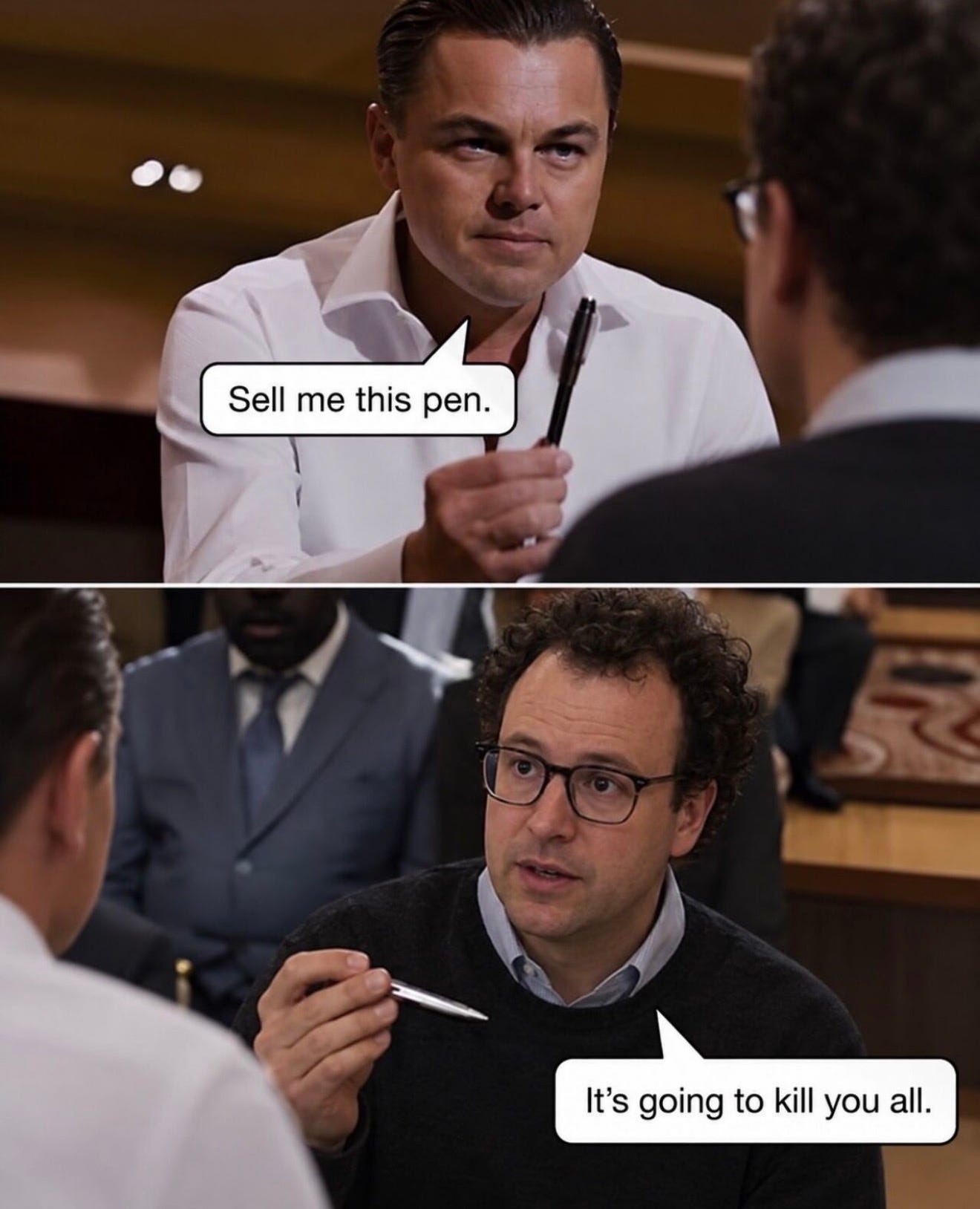
Give them a reason to use the pen
Consider the familiar sales test: “Sell me this pen.”
Most founders would start with the ink and the craftsmanship. Then the materials, the founder’s résumé, and the proprietary pen framework.
6 pen modules. A private pen community.
Meanwhile, the buyer still needs a reason to write something down.
That is the job these 10 lessons help you do. Identify a problem the customer recognizes, make its consequences clear, and offer a credible way forward. Make the message simple enough to remember and honest enough to trust.
Ideally, you can manage this without threatening the extinction of the human species.
Attention gives you an opening. You still have to earn the sale.
Before you publish your next offer, underline the first sentence that gives the customer a reason to care. Check that the consequence is real and the promised response is one you can deliver.
If you have to read halfway down the page to find that sentence, move it to the top.
Give the right people a reason to buy.
People can enjoy your posts for months and still have no idea what they can hire you to do. That gap between attention and a clear offer is what we’re tackling in Master LinkedIn’s New Feed and Build an Offer People Want.
On September 29, I’m joining Alicia Teltz and Wessal Khader for a free, 90-minute masterclass covering how to:
Get your content in front of relevant buyers as LinkedIn’s feed changes.
Use customer insights to identify problems your audience wants solved.
Turn those insights into an offer people understand and want to pay for.
If you’re putting time into LinkedIn and struggling to connect that effort to something you can sell, join us.
Tuesday, September 29 · 1pm Eastern / 6pm UK · Free · Online