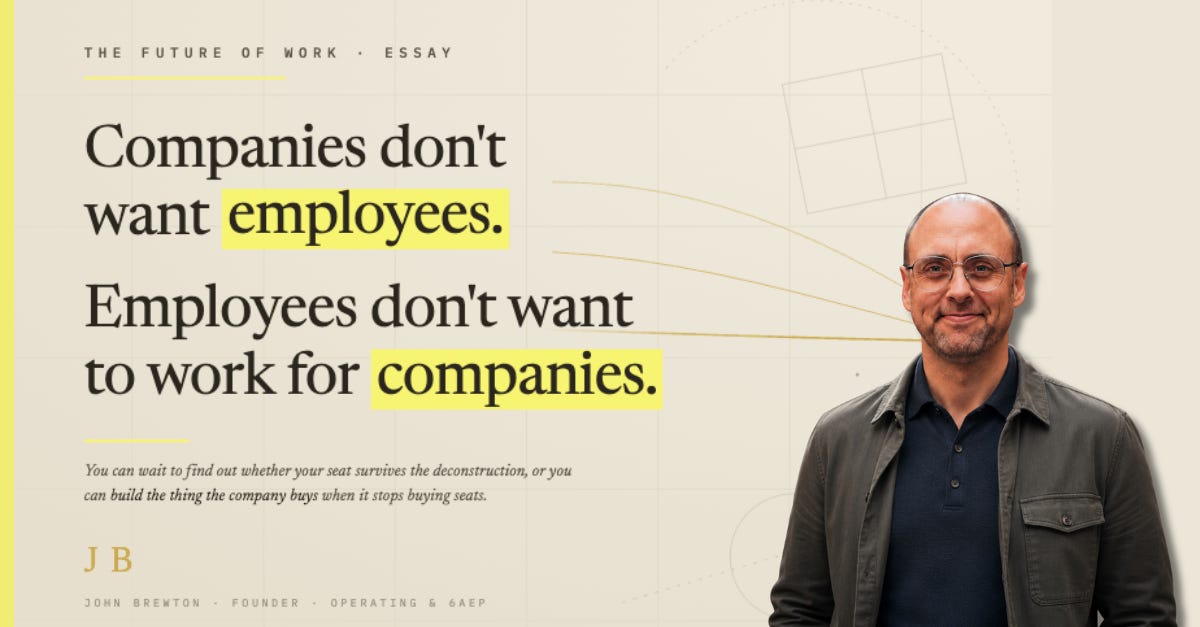
Companies Don’t Want Employees. Employees Don’t Want to Work for Companies.
TL →DR
The 100-year-old 40-hour job is being emptied from both sides. Companies want outcomes, not headcount. Workers want to sell outcomes, not hours.
Ronald Coase explained in 1937 that firms exist to lower coordination costs. AI reduces the cost of buying work on the open market, so the firm's boundary contracts. The result is large firms with fewer employees, not smaller firms.
Stanford’s Digital Economy Lab found that early-career employment in the most AI-exposed jobs fell 13 to 16 percent since late 2022, driven by weaker hiring. Companies closed the on-ramp first.
“Outcomes, not hours” was a 20-year worker demand. Once a company pays for the result, it can buy the result from anyone. That concession made the salaried employee optional.
The services market for AI, repackaged as software, is $4.6 trillion, against a $200 billion software market. Selling software and selling a service are becoming the same act.
The play at the scale of one: name the outcome you sell, price the outcome, publish the proof, own a newsletter. Claude at $20 a month and a Substack at $0 cover year one.
The bet can lose. Fewer than 5 percent of workers changed jobs in the 33 months following ChatGPT's launch. The clock may be slower than the logic.
In 1926, Henry Ford gave his workers the 40-hour week. It was a production decision, and it became the employment construct every job has been poured into for 100 years.
We are living through an era of deconstruction. Companies are pulling employees out of their companies, and workers are climbing out on their own. The same force presses from both sides, creating a surprisingly beneficial alignment for the individuals bold enough to make the jump.
The 40-hour job is ending, with companies demanding payment for outcomes, not hours, while the individuals delivering those outcomes are asking the same.
Why are companies cutting employees instead of hiring?
A full-time employee is a fixed cost with benefits, overhead, and idle capacity attached. In a volatile market, fixed labor is a liability and variable labor is insurance.
Most roles do not contain 40 hours of work that only one person can do. They contain a set of outcomes and a lot of paddling around, working around inefficiencies, and hours spent doing little work that drives the most important outcomes for the organizations.
The company wants the outcomes and it is tired of paying for the paddling.
Ronald Coase explained the padding in 1937. Firms exist to lower the cost of coordination, and a firm grows until organizing one more task within it costs as much as buying that task on the open market. AI is cutting the cost of buying it. The firm's boundary is contracting.
This does not mean firms shrink. It means building larger firms with fewer employees. The giants grow and cut headcount in the same quarter. Declining labor share is the signature of the shift. The biggest firms (at least those that will be successful moving forward) now capture more output with less payroll.
Stanford’s Digital Economy Lab found that early-career employment in the most AI-exposed occupations fell 13 to 16 percent since late 2022, driven by weaker hiring, not layoffs. Companies closed the on-ramp before they touched the exit. Hiring now sits at levels last seen in 2010.
How I Built a $200,000 Newsletter Business From a Substack Nobody Was Reading
The Five Moves That Turned My Substack Into a $200,000 Business
The Operating Project: Most Coaching Ends With Notes. This Ends With a Machine.
How did “outcomes, not hours” become the end of the salaried job?
For 20 years, workers argued for a better deal, and the best version was outcomes, not hours. Cali Ressler and Jody Thompson built the Results-Only Work Environment inside Best Buy in the early 2000s and published it in 2008. Measure people by results, not presence. It spread to Gap and IBM, sold as a workers’ victory.
It was a concession with a long fuse. Once a company accepts that only the outcome matters and the 40 hours are arbitrary, it has conceded that the employee is arbitrary too. If the result is the unit, the firm buys the result from whoever delivers it best. That is rarely a salaried generalist filling a week. It is a specialist who does one thing really well and bills for the outcome. Outcomes, not hours, were the eviction notice employees wrote themselves.
Why are more Americans becoming independent workers?
Thirty-six percent of employed Americans now do independent work, up from 27 percent in 2016, on McKinsey’s count. Full-time independents number near 27 million. The number earning more than $100,000 a year rose from 3 million in 2020 to 5.6 million today.
Independent work rose from 27 percent of employed Americans in 2016 to 36 percent in 2024. Independents earning $100,000-plus rose from 3 million to 5.6 million.
Much of the walk-away is still a hedge. People keep the paycheck for stability and stay for the healthcare. I am not predicting a stampede this year. I am simply calling out a directional shift that is well underway.
Why are software and services collapsing into one market?
The structural force runs underneath the whole shift. The line between selling software and selling a service is dissolving.
Foundation Capital sizes the services market that AI is now repackaging as software at $4.6 trillion, against a $200 billion software market. a16z says software has stopped eating tasks and started eating labor. Sequoia calls the new software services.
The services market for AI, repackaged as software, is $4.6 trillion, against a $200 billion software market. The prize is 23 times larger.
Software stopped selling the tool and started selling the outcome. That turned consultancies into software companies. That turned software companies into service companies. That erased the line between the two. Most people are still arguing about which of their tools has the best features.
The individual runs the same play at a scale of one. A person who turns expertise into a productized outcome sold to companies is doing what a consultancy does when it becomes a software company. Sam Altman’s group of tech CEOs runs a betting pool on the first one-person billion-dollar company. The endpoint of employees becoming companies is a company with one employee.
The one-person company is the endpoint of the shift.
How do you turn your expertise into a company of one?
The move has 4 steps. None of them requires a team.
1. Name the value, not the title: Find the one outcome a company will pay an outside party to deliver. Weak: operations expertise. Strong: I cut quote turnaround for industrial distributors by 60 percent in 90 days. The title is what you were. The outcome is what you sell.
2. Build one clean offering: Price the outcome, not the hour. Start where the company already outsources, because the budget line exists and the swap is clean. Replacing a vendor is a purchase order. Replacing an employee is a reorg. Be the purchase order.
3. Publish the expertise: When anyone can build, the only question left is whether anyone believes you. Content is the proof, and it compounds in public. Ship on a schedule before anyone reads.
4. Own a newsletter: It is the one channel no platform can repossess. Write about the entire world your expertise sits inside, and sell your services and your products to the companies reading it. The newsletter is the go-to market for a company of one.
You do not need funding. You do not need a developer. A $200-300-per-month tech stack is enough to get you through the first year.
What should you do this week?
The norm we were educated and motivated to accept held for 100 years because coordination was expensive. It is not expensive anymore. You can wait to find out whether your seat survives the deconstruction, or you can build the thing the company buys when it stops buying seats.
Name your outcome: Pull the one measurable result a company will pay an outside party to deliver out of your old job title, and write it as a single sentence.
Frame the offer: Fill in who buys it, what they get, the budget line you replace, your proof, and a set price for a project or a retainer.
Write the one-liner: Compress the offer into “I help [who] achieve [outcome] for [price].”
Sketch the newsletter: Define the world your expertise sits inside, who reads it, a name and publish day, and your first three post titles.
Ship this week: Work on a five-item checklist that ends with sending the offer to 5 companies that already carry the budget line.
Build your company of one with the Operating Founders
You do not have to do this alone. I have a founding-member cohort inside Operating by John Brewton that is 200 strong.
Become a founding member this week.
The community lives in Skool. It is where operators turn the 4 steps in this article into a shipped offer, a live newsletter, and a robust, growing, money-making business.
Every week, there is a live Q&A with John and the community, where you bring the one thing you are stuck on and leave with the next move. Every month, there is a Masterclass that takes one part of the build, the offer, the pricing, the newsletter, or the distribution, and goes deep enough to act on it that day.
Join the Operating Founders community, bring the one sentence that names your outcome, and start building the company that will define your future today.
Frequently asked questions
Why don’t companies want full-time employees anymore? A full-time employee is a fixed cost with benefits, overhead, and idle capacity attached. Most roles hold a few outcomes wrapped in padding, and the company only wants the outcomes. AI lowers the cost of buying those outcomes on the open market, so companies keep fewer people and rent the rest.
What does “outcomes, not hours” mean? It means paying for a delivered result instead of time on the clock. Cali Ressler and Jody Thompson formalized it as the Results-Only Work Environment at Best Buy and published it in 2008. Once the result is the unit of pay, the firm can buy that result from anyone, which makes the salaried role optional.
Is the 40-hour workweek actually ending? The direction is set, but the clock is slow. Henry Ford standardized the 40-hour week in 1926, and it has held for 100 years. Fewer than 5 percent of workers changed jobs in the 33 months after ChatGPT, so the shift is real but early rather than sudden.
What is “services as software”? It is the repricing of human services into AI-delivered products. Foundation Capital sizes that services market at $4.6 trillion, against a $200 billion software market. Software stopped selling the tool and started selling the outcome, which erased the line between buying software and hiring a service.
How do I become a company of one? Name the one outcome a company will pay an outside party to deliver. Price the outcome, not the hour, and start where the company already outsources. Publish your expertise on a schedule, and own a newsletter as your go-to-market. Claude at $20 a month and a Substack at $0 cover the first year.
Will AI replace employees or just change how they work? Both, and the first signal is in hiring. Stanford’s Digital Economy Lab found early-career employment in the most AI-exposed jobs fell 13 to 16 percent since late 2022, driven by weaker hiring rather than layoffs. Companies closed the on-ramp before they touched the exit.
What is the strongest argument against this thesis? Companies buy named outside firms for credibility and for someone to point at when a decision goes wrong. A board cannot say it relied on a model, and a company of one sells neither the credibility nor the blame absorption. The work could also stay in-house, with a thin internal core running the AI and buying from no one.
Appendix: The Research
The sources below are organized by the pillar of the argument each one supports. Tier tags follow the elite-research architecture. Sources marked outside tier sit beyond the approved source list and were used for scale or framing. Verify their figures independently before they carry weight in print.
1. The theory of the firm
California Management Review (UC Berkeley Haas) — “From Coase to AI Agents: Why the Economics of the Firm Still Matters in the Age of Automation.” Grounds the claim that firms exist to minimize transaction costs and that AI shrinks the efficient boundary of the firm.
[ACADEMIC]https://cmr.berkeley.edu/2025/04/from-coase-to-ai-agents-why-the-economics-of-the-firm-still-matters-in-the-age-of-automation/Ronald Coase, “The Nature of the Firm” (1937), via Wikipedia — The original text and its corollary that lower coordination costs also enable larger firms. The source of the “large firms, fewer employees” reconciliation.
[REFERENCE]https://en.wikipedia.org/wiki/The_Nature_of_the_Firm
2. The demand side: companies shedding employees
Yale Insights (Jeffrey Sonnenfeld) — “The Real Job Destruction from AI Is Hitting Before Careers Can Start.” Source for the 13 to 16 percent early-career decline (Brynjolfsson, Stanford Digital Economy Lab), the hiring freeze at 2010 levels, developer postings down 53 percent, and developers aged 22 to 25 down nearly 20 percent from peak.
[INSTITUTIONAL / academic]https://insights.som.yale.edu/insights/the-real-job-destruction-from-ai-is-hitting-before-careers-can-startHarvard Business Review (Fuller, Raman, Bailey, Vaduganathan) — “Rethinking the On-Demand Workforce.” HBS and BCG finding that almost all Fortune 500 firms already rent capability through talent platforms.
[EDITORIAL]https://hbr.org/2020/11/rethinking-the-on-demand-workforce
3. Outcomes not hours: the eviction notice
Monitask business glossary — Results-Only Work Environment origin. Names Cali Ressler and Jody Thompson, Best Buy, and adoption at Gap and IBM. Outside tier. https://www.monitask.com/en/business-glossary/results-only-work-environment
MindTools — “Managing in a Results-Only Work Environment.” Source for the 2008 book “Why Work Sucks and How to Fix It” and the results-over-presence principle. Outside tier. https://www.mindtools.com/agx0aqn/managing-in-a-results-only-work-environment/
Brighter Strategies — “ROWE: Results Only Work Environment.” Source for the Henry Ford 1926 40-hour-week detail. Outside tier. https://brighterstrategies.com/rowe-results-only-work-environment
4. The supply side: independent work
McKinsey (American Opportunity Survey) — “Freelance, side hustles, and gigs: Many more Americans have become independent workers.” Source for 36 percent of employed Americans doing independent work, up from 27 percent in 2016. Outside strict tier, institutional. https://www.mckinsey.com/featured-insights/sustainable-inclusive-growth/future-of-america/freelance-side-hustles-and-gigs-many-more-americans-have-become-independent-workers
99firms (aggregating MBO Partners and Upwork) — Freelance statistics. Source for roughly 27 million full-time independents, 5.6 million earning $100,000-plus (up from 3 million in 2020), and $1.5 trillion in collective earnings. Outside tier, verify against MBO Partners and Upwork primary reports. https://99firms.com/research/freelance-statistics/
5. The services and software convergence
Foundation Capital (Joanne Chen) — “AI Leads a Service-as-Software Paradigm Shift.” The $4.6 trillion services-as-software figure and the QuickBooks-to-AI-accountant framing.
[INSTITUTIONAL]https://foundationcapital.com/ai-service-as-software/Foundation Capital — “The $4.6T Services-as-Software Opportunity: Lessons from the First Year.” Contracts evolving from seats to usage to tasks to outcomes, and forward-deployed engineers.
[INSTITUTIONAL]https://foundationcapital.com/ideas/the-4-6t-services-as-software-opportunity-lessons-from-the-first-yeara16z — “Good News: AI Will Eat Application Software.” Software eating labor rather than tasks, and seat-based pricing under structural pressure.
[INSTITUTIONAL]https://a16z.com/good-news-ai-will-eat-application-software/TechCrunch (reporting a16z’s Olivia Moore and Seema Amble) — Source for the line that consultancies are now software companies, and that a firm’s TAM is no longer one or the other.
[EDITORIAL]https://techcrunch.com/2025/10/02/a-new-a16z-report-looks-at-which-ai-companies-startups-are-actually-paying-for/Sequoia Capital — “Services: The New Software.” The intelligence-to-judgment spectrum and the vendor-swap-versus-reorg wedge logic.
[INSTITUTIONAL]https://sequoiacap.com/article/services-the-new-software/PwC (Deals) — “How AI is reshaping software valuations in M&A.” Both directions of the convergence, and the roughly 30 percent software-index decline after agentic tools launched in early 2026. Outside strict tier, institutional. https://www.pwc.com/us/en/services/consulting/deals/library/ai-software-valuations-ma-private-equity.html
Madrona — “Service as Software: The Foundation of Outcome Delivery in Applied AI.” Labor spend an order of magnitude larger than the software market, and forward-deployed engineers as a fast-growing role.
[INSTITUTIONAL]https://www.madrona.com/service-as-software-the-foundation-of-outcome-delivery-in-applied-ai/
6. The one-person company
Fortune (via Yahoo Finance) — “Could AI create a one-person unicorn? Sam Altman thinks so.” The betting-pool quote, plus the Instagram (13 employees) and Plenty of Fish (one employee) precedents.
[EDITORIAL]https://finance.yahoo.com/news/could-ai-create-one-person-120000722.html
7. The playbook: become your own company
Reid Hoffman and Ben Casnocha, “The Startup of You” — The intellectual anchor for managing a career as a company: find your competitive edge, differentiate, build soft assets and network. Maps to the four-step playbook.
[REFERENCE]
https://www.startupofyou.com/
Harvard Business Review — “LinkedIn Co-Founder Reid Hoffman on Innovating for an Uncertain Future.” Hoffman on talent as the primary differentiator.
[EDITORIAL]https://hbr.org/2022/01/linkedin-co-founder-reid-hoffman-on-innovating-for-an-uncertain-future
8. Counter-evidence and the open-eyed bet
Built In (reporting the Yale and Brookings study) — Source for fewer than 5 percent of workers switching jobs 33 months after ChatGPT, below the PC and internet transitions, and the finding that AI’s aggregate labor impact is so far limited. Supports the “right direction, wrong clock” counter. Outside tier. https://builtin.com/articles/job-market-ai-impact-yale-brookings-study
Better Tomorrow Ventures — “Services Won’t Become Software.” The strongest counter: companies buy named firms for liability cover, credibility, and blame absorption, none of which a company of one can sell.
[INSTITUTIONAL / VC]https://better-tomorrow-ventures.ghost.io/services-wont-become-software/“Two Decades of Free Agent Nation” (retrospective on Daniel Pink, 2001) — The historical pattern to answer: the organization-man-to-free-agent prediction was made 25 years ago, and the corporation grew larger anyway. Outside tier. https://medium.com/swlh/two-decades-of-free-agent-nation-47db3d4c4687