

Oper(AI)te: The Hidden Offer

Oper(AI)te™: The Hidden Offer is a four-week live cohort that helps experienced founders and operators turn the expertise they’ve already built into one clear, market-validated offer with a defensible price. You leave with the offer named, priced, published on a live sales page, and supported by AI tools designed to help you start buyer conversations.
The Beginning
While I was an undergraduate at Harvard studying economics, one of the most useful things I studied had surprisingly little to do with economics. I had the opportunity to study negotiation through Harvard Law School and the intellectual tradition around the Harvard Negotiation Project, the work that produced ideas like Getting to Yes, BATNA, interests versus positions, objective criteria, and creating options for mutual gain.
At 20-something years old, these ideas felt elegant. Twenty years later, they feel expensive, because I got to spend much of the next two decades testing them with real companies, real contracts, real jobs, real inventory, real payroll, real margins, and hundreds of millions of dollars at stake.
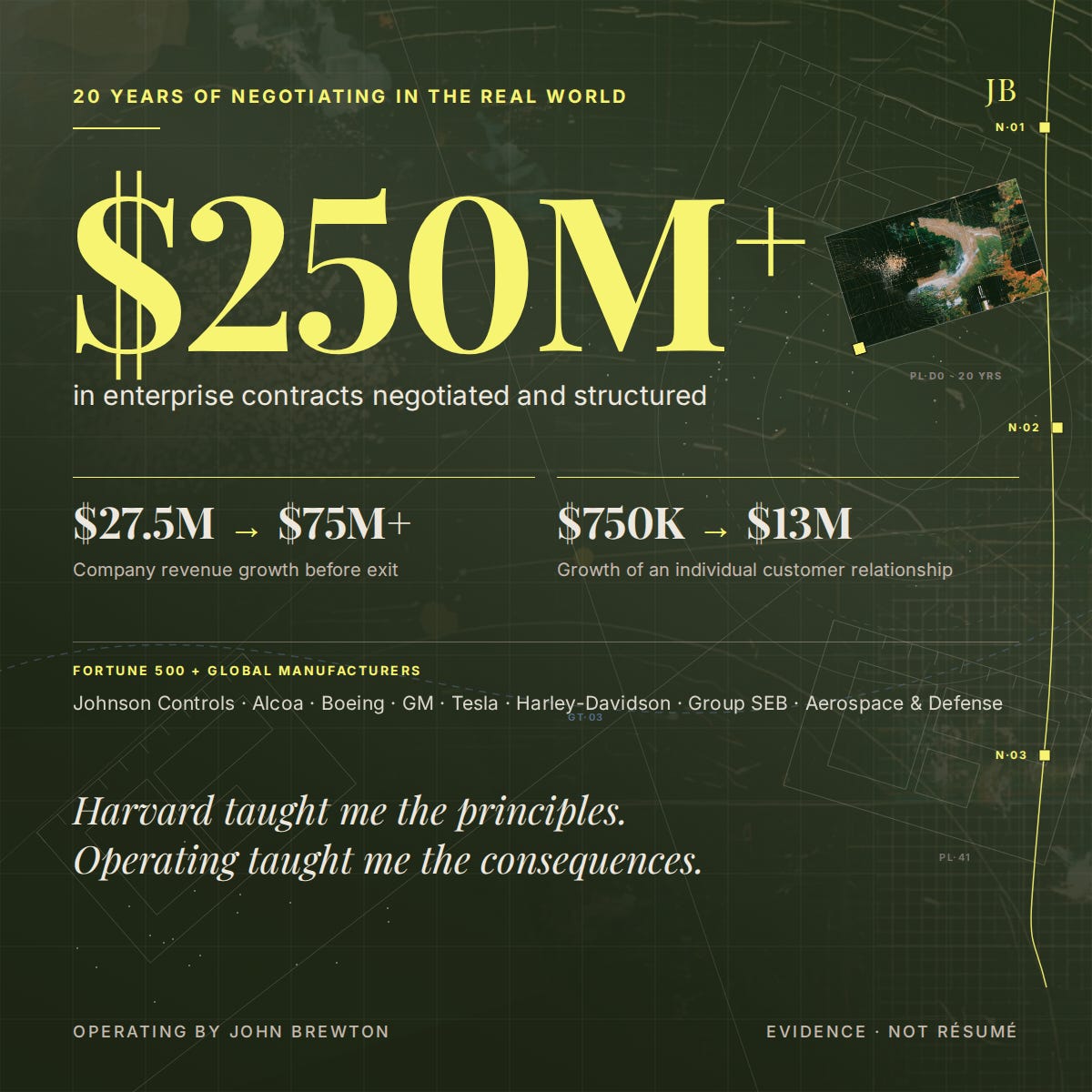
I eventually became CEO of an industrial distribution business. Over 12 years, we grew the company from roughly $27.5 million to more than $75 million in annual revenue before selling it in 2021. Negotiation sat underneath almost everything we did.
I negotiated with companies like Johnson Controls, All-Clad Metalcrafters, and more automative, aerospace and defense OEMs than I can count. Over time, I negotiated and structured more than $250 million in enterprise contracts, including customer relationships that grew from roughly $750,000 to $13 million in annual revenue for the company. It was an extraordinary learning experience not only in negotiating deals, but also in understanding how offers for services and products are built and optimized.
These were rarely simple negotiations over a number on a purchase order. They involved engineering requirements, sourcing, inventory, quality, capacity, tooling, lead times, service levels, payment terms, logistics, forecasting, capital, risk, contractual commitments, and relationships that could last for years.
There was another important difference: I often had to operate the deal after I negotiated it. That may be the single biggest thing that changed how I think about negotiation. A salesperson can celebrate the signed agreement. An operator eventually discovers whether the agreement was any good.
Harvard Gave Me the Language
The Harvard approach to negotiation begins with several deceptively simple principles: separate the people from the problem, focus on interests rather than positions, create options for mutual gain, rely on objective criteria rather than arguing over whose number is right, and understand your BATNA—your best alternative if an agreement cannot be reached.
I still believe all of those things. What operating taught me was what they look like after they collide with reality.
Take the classic distinction between a position and an interest. A customer says, “We need the price reduced by 10 percent.” That is a position. The more important question is why.
Maybe procurement has a savings target. Maybe another supplier quoted less. Maybe the customer’s budget changed. Maybe somebody internally needs to demonstrate a concession before approving the contract. Maybe total price matters less than cash flow. Maybe the real issue isn’t price at all but inventory, lead time, quality, capacity, service, or uncertainty about whether you can deliver.
If you negotiate only the position, you have one variable: price. Understand the interest and you may suddenly have ten.
That distinction probably saved me millions of dollars during my career. It also led me toward one of the first additions I made to what I had learned academically: before you concede on one variable, create more variables.
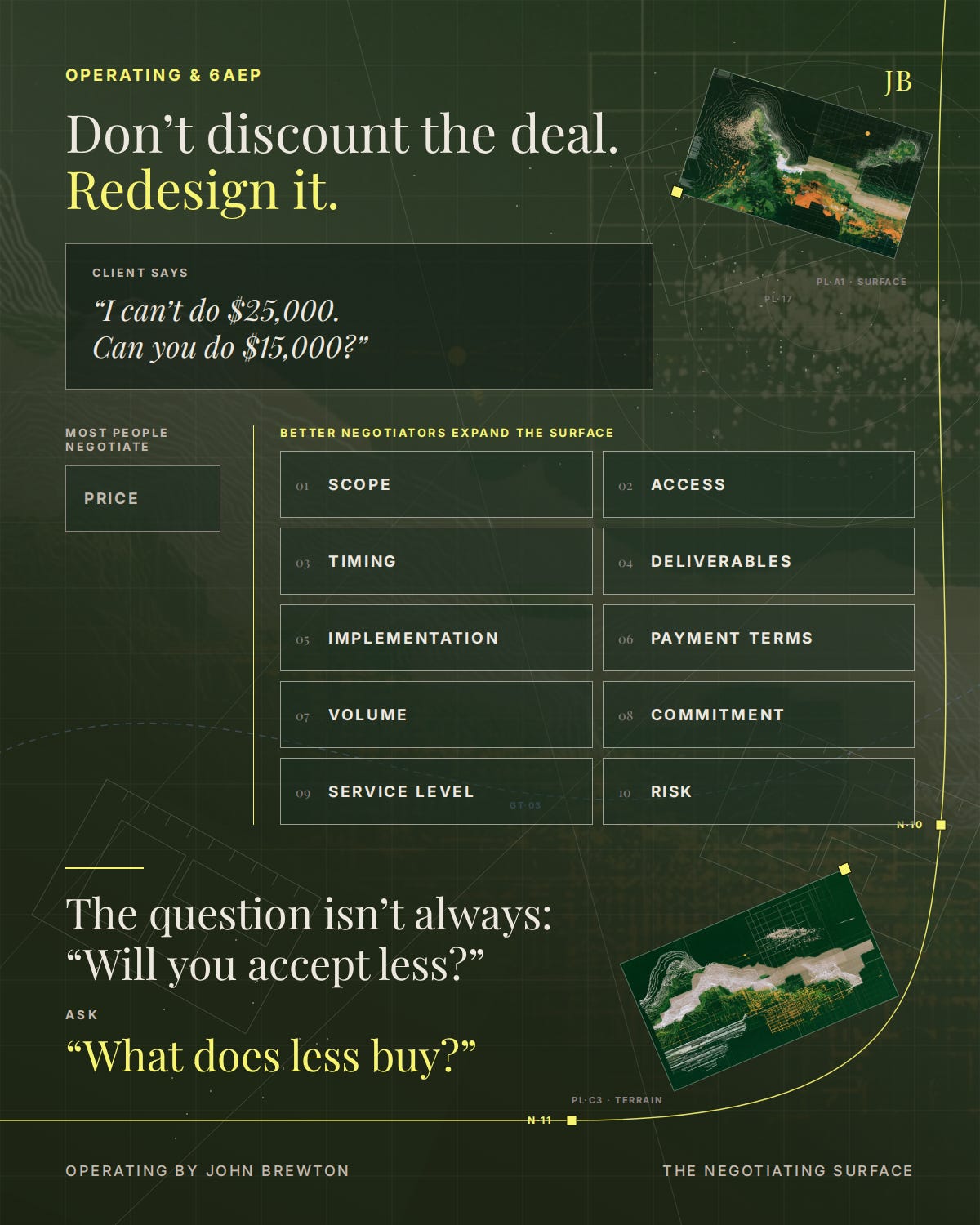
A customer wants a lower price. Fine. What changes with it? Volume? Payment terms? Length of commitment? Inventory? Freight? Implementation? Service levels? Scope? Forecast guarantees? Exclusivity?
Sophisticated enterprise agreements tend to make these variables explicit. Independent professionals frequently do the opposite and reduce their entire negotiation to a single number.
A client says, “I can’t do $25,000. Can you do $15,000?” The consultant hears two possible agreements: $25,000 or $15,000. In reality, there may be twenty. Perhaps $15,000 buys a smaller scope, fewer deliverables, less access, a different timeline, no implementation, different payment terms, or a group format rather than one-to-one support.
The question does not always have to be whether you will accept less. A better question is: What does less buy?
That is an entirely different negotiation.

AI Was Supposed to Kill Consulting. Instead It Has Started a Golden Age.
The Quiet Builders Are Coming. Great Companies Will Build Around Them.
Never Win a Deal You Cannot Afford to Deliver
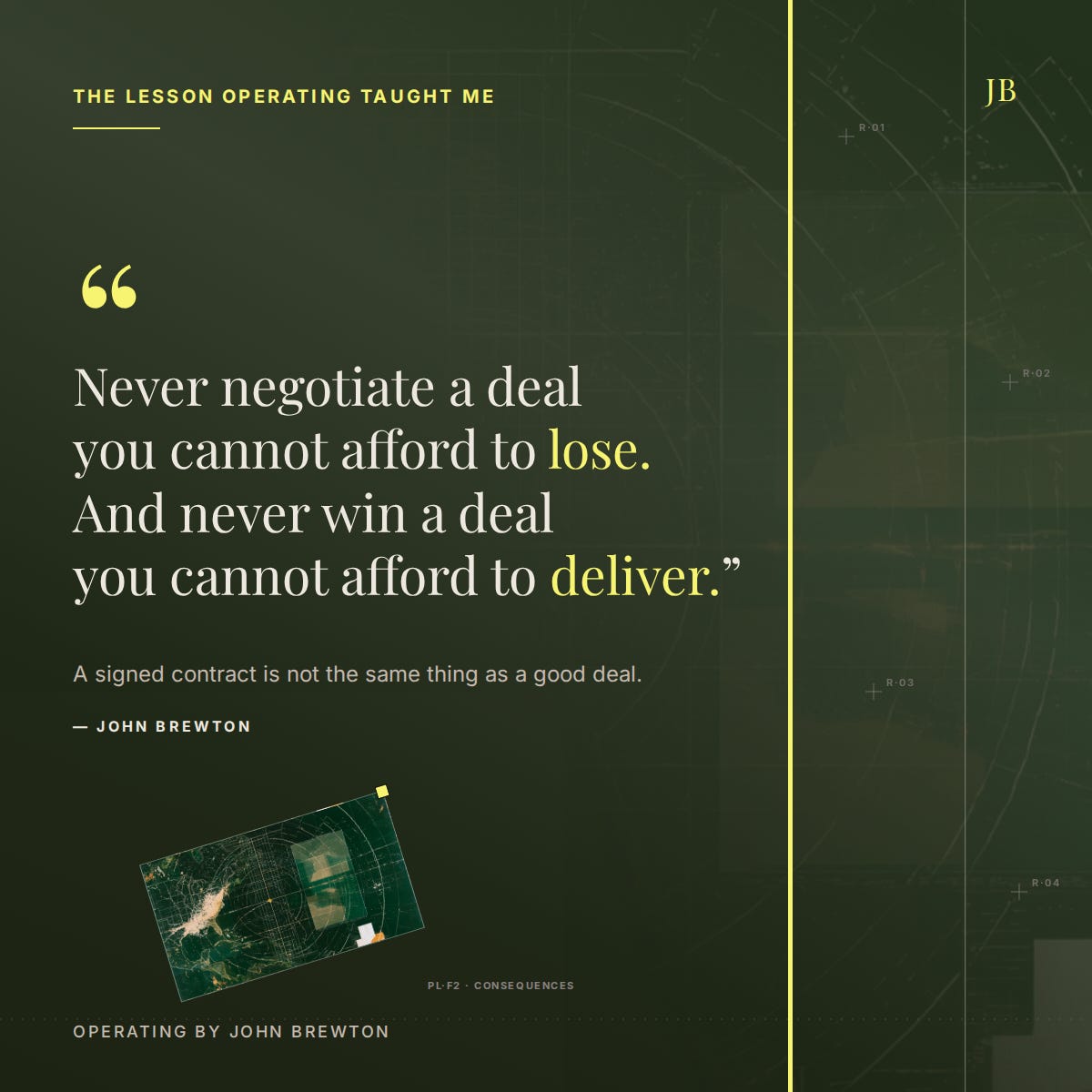
BATNA taught me to understand what happened if the deal did not occur. Operating taught me to add another test: never negotiate a deal you cannot afford to lose, and never win a deal you cannot afford to deliver.
That sounds obvious until a very large revenue number is sitting in front of you.
A $5 million contract can be a terrible contract. Can you source it profitably? Can you finance the inventory? Can you meet the quality requirements? Do you have the engineering capacity? What does the working-capital requirement look like? What happens if the forecast is wrong, freight costs rise, or the customer suddenly needs twice as much product? What happens if the agreement consumes the people and capital you need for a better opportunity?
Revenue is seductive. Bad revenue is still bad.
As an operator, I learned to view the agreement and the operating system required to support it as the same decision. That principle applies just as readily to a one-person consulting company. If you sell unlimited access for a fixed fee, for example, you have not merely made a pricing concession. You have designed an operating model, and it may be a terrible one.
The same experience changed my definition of what it means to win a negotiation. When you negotiate with the same customers and suppliers for years, you stop believing every transaction should be maximized independently. Some of the most valuable customer relationships we built at R.G. Brewton became many times larger than where they began. That happens only when both sides keep wanting to return to the table.
Sometimes that meant making a concession. Sometimes we invested more in engineering, inventory, service, or some new capability because we believed the relationship could become much larger. Sometimes we simply did more than the agreement technically required.
That isn’t weakness. It’s strategy.
The important distinction is whether the concession is intentional. There is an enormous difference between giving something because you believe it creates more long-term value and giving something because you are afraid the customer will say no. One is an investment. The other is fear dressed up as customer service.
My definition of a great negotiation today is therefore different from what it was when I first encountered these ideas in a classroom:
A great negotiation improves the economics, protects your ability to deliver, and increases the probability that both sides want to do the next deal.
Winning the room and losing the relationship isn’t winning. Neither is winning the contract and losing money fulfilling it.
The Operating Negotiation Framework
After enough repetitions, I found myself reducing much of what I had learned into six questions. Together, they form what I now think of as the Operating Negotiation Framework: Proof → Market → Value → Price → Terms → Walk.
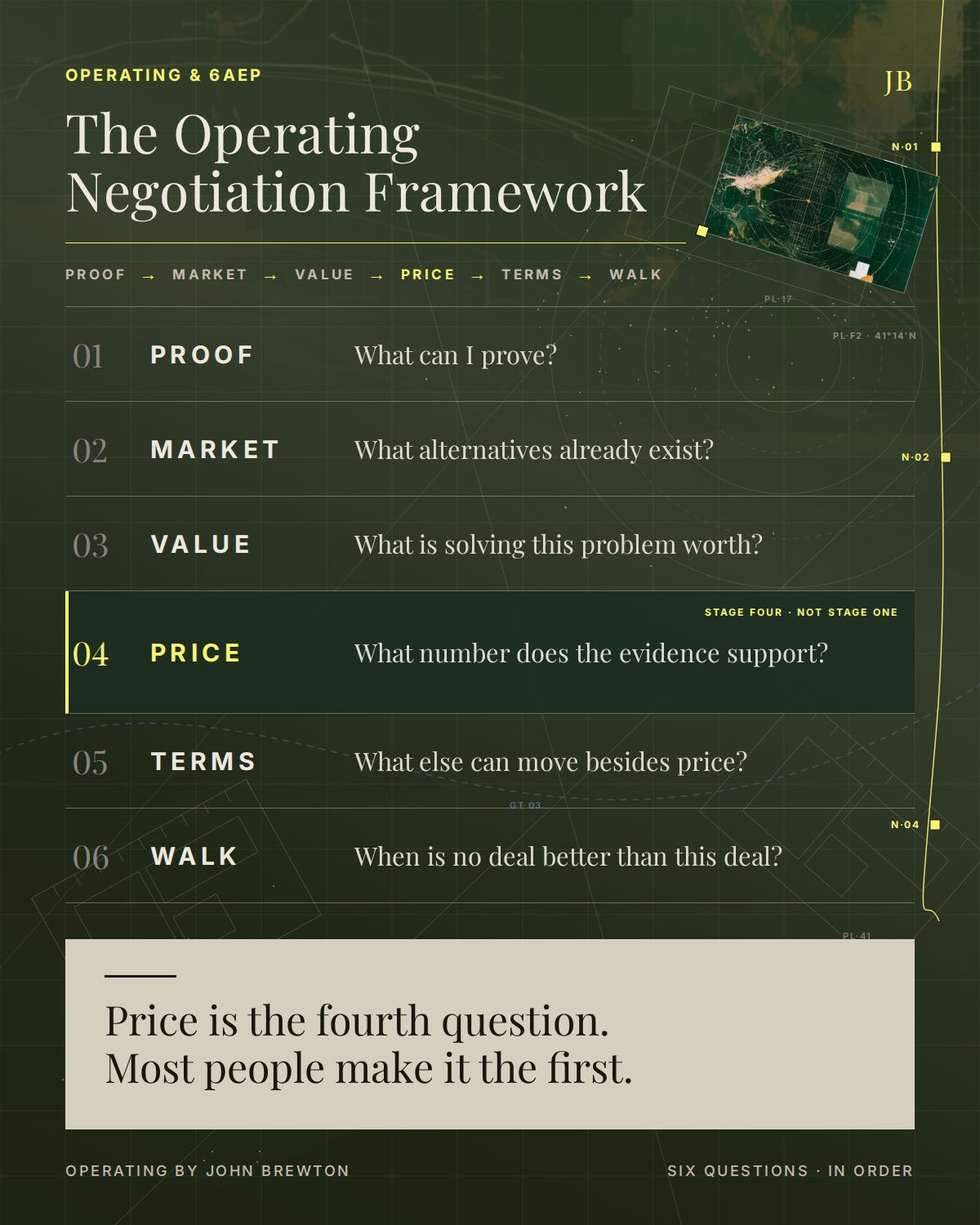
It incorporates ideas I first encountered while a student at Harvard College, but the sequence reflects two decades of actually having to live with the agreements I made.
Proof asks: What can I demonstrate? Before I tell someone what something is worth, I want evidence. What have we delivered before? What outcomes have we produced? What capabilities actually exist? Why should the other person believe the promise we are making?
This has become particularly important to me now that so much of my work involves selling expertise. Your career is not merely background information. Your career is evidence. The projects matter. The promotions matter. The customers matter. The P&L responsibility matters. The failures matter. The problems people repeatedly trusted you to solve matter. You should know your proof before you ever defend your price.
Market asks: What alternatives exist? What does the market already pay? What other suppliers are available? What would it cost to hire someone, build the capability internally, buy software, engage another advisor, or simply live with the problem?
This is where Harvard’s emphasis on objective criteria and alternatives becomes particularly useful. Pricing should not begin with how confident you feel that morning. It should begin with evidence about the market surrounding the decision.
Value asks: Why does this problem matter to this buyer? A company is rarely buying the literal thing printed on the proposal. It isn’t merely buying a component, a consulting engagement, a software implementation, or an hour of somebody’s time. It is buying what happens afterward: more throughput, less downtime, lower risk, faster growth, a solved problem, an avoided mistake, or a capability the company did not previously possess.
Understanding value means understanding why the buyer is in the room at all.
Only then do I want to arrive at price. What number can the evidence actually support? Not, “What would I feel comfortable asking?” Not, “What did somebody on LinkedIn tell me consultants are supposed to charge?” And certainly not, “What number seems unlikely to scare the customer away?”
Proof. Market. Value. Then price.
For my own work today, I also want to know three prices before any meaningful negotiation begins.
There is the market price: what does this problem normally cost to solve?
There is a strategic price: is there a legitimate reason this particular relationship deserves different economics?
There is a walk-away price: below what number does the work stop making sense?
Those numbers are much easier to determine before somebody is sitting across the table waiting for your answer.
Then come terms. What else can move besides price? Scope, access, volume, timing, implementation, payment, service, commitment, deliverables, risk. Never assume that a disagreement over price has to be solved with price. Often the best agreement is hiding inside a different combination of terms.
Finally comes walk. At what point is no deal better than this deal? Know what you will not do. Know the economics that no longer work. Know the terms that create more risk than reward, and know when your capacity is worth more somewhere else.
The important thing is to determine that boundary before emotion enters the room. You should not have to invent your principles while somebody is asking you to violate them.
THE OFFER PROBLEM
For most of your career, an employer did four incredibly valuable things for you: it packaged your expertise, found the customer, established an economic model around your work, and gave you permission to defend that model.
When you become independent, all four responsibilities become yours.
Your expertise did not suddenly become less valuable. The commercial infrastructure around it disappeared.
Oper(AI)te: The Hidden Offer
Oper(AI)te™: The Hidden Offer is a four-week live cohort that helps experienced founders and operators turn the expertise they’ve already built into one clear, market-validated offer with a defensible price. You leave with the offer named, priced, published on a live sales page, and supported by AI tools designed to help you start buyer conversations.
Then I Put My Own Name on the Proposal
This is the part of my negotiation history I find most interesting now.
After Harvard, after running a company, after negotiating with sophisticated procurement organizations and multinational manufacturers, after more than $250 million in enterprise agreements, and after selling the company, I started working for myself.
And I became worse at negotiating.
My first coaching offer was four hours of my time for $99. One hundred people bought it in 12 days. There was obviously demand. There was also an obvious pricing problem.
The person who had spent years protecting millions of dollars of company economics had put his own name on the proposal and begun behaving completely differently.
That became more interesting as I spent hundreds of hours coaching founders, consultants, executives, and operators and watched the same pattern repeat. People who had spent 15 or 20 years confidently defending budgets, margins, compensation, contracts, and corporate pricing suddenly started apologizing for their own invoices.
They discount before anyone asks. They add another deliverable and then another. They take another call, expand the scope, and turn a defined project into unlimited access. Because they genuinely care about doing great work, they describe all of this as overdelivering.
Sometimes it is. Sometimes it is a permission problem.
The corporation gave you permission to protect its economics. Once your own name replaces the logo on the proposal, you have to give yourself the same permission.
This is also why I no longer believe pricing an offer should primarily be an act of confidence. It should be an act of research.
Instead of beginning with, “What should I charge?” start somewhere else. What have I repeatedly proven I can do? Who has an expensive reason to need it? What alternatives are they using today? What do those alternatives cost? What changes economically if the problem gets solved? Where does my experience make me unusually credible?
Then price it.
The number becomes easier to say because you are no longer asking another person to validate your self-worth. You are presenting a conclusion supported by evidence.
BUILD THE OFFER BEFORE YOU NEGOTIATE IT
This is much of what Wessal Khader and I have built into Oper(AI)te™: The Hidden Offer.
We don’t begin by inventing a product or asking what someone wants to charge. We begin with the evidence accumulated across a career. We use that evidence to identify the expertise with the greatest commercial value, map it against what buyers are paying for now, turn the intersection into one clear offer, and establish a defensible price.
Proof → Market → Value → Price.
The objective isn’t to teach an experienced operator another random skill. It is to identify the valuable skill they have already spent 15 or 20 years proving and finally build the offer around it.
The Hardest Person I Have Ever Negotiated For Is Myself
I’m grateful I got to study negotiation when I did. Harvard gave me a vocabulary for ideas I would encounter thousands of times afterward: interests, positions, options, objective criteria, alternatives, relationships, commitments.
Running companies gave those ideas consequences.
Operating taught me that price is only one part of an agreement and that a signed contract can still be a terrible deal. It taught me to create variables before giving one away, to consider the economics of fulfilling an agreement as carefully as the economics of signing it, and to recognize that the biggest opportunity is often not the first transaction but the relationship that follows it.
Entrepreneurship taught me something different.
You can spend 20 years learning to defend the value of companies, products, contracts, employees, inventory, engineering, and entire operating systems and still hesitate when the thing being valued is you.
So today I use the same framework.
Know the proof your career has accumulated. Know the market surrounding the problem. Understand the value of solving it. Let the price follow from the evidence. Create enough terms that price isn’t your only lever. Decide in advance where the agreement stops making sense.
Then be generous. Overdeliver when overdelivering is a strategic decision. Build relationships worth protecting, and create enough value that people want to sit across from you and negotiate the next deal.
And when your own name is finally on the proposal, negotiate for it with the same discipline you spent your career applying to everyone else’s.
Then send the invoice.
- j -

John Brewton documents the history and future of operating companies at Operating by John Brewton. He is a graduate of Harvard University and began his career as a PhD student in economics at the University of Chicago. Since selling his family’s B2B industrial distribution company in 2021, he has been helping business owners, founders, and investors optimize their operations.
Thanks, John. This is such brilliant advice, especially around the idea of redesigning the deal rather than renegotiating it or lowering the price point. Substack is very lucky to have your expertise here, offered always with such kindness and humility.
Education + experience, both crucial