
Operating Habits: My Morning Protocol
How I Combined Steven Pressfield’s War of Art Series with Cal Newport’s Deep Work and Slow Productivity Systems to Build A Morning Routine That Actually Produces Creative and Practical Results

We sold out the first 100 Operating Founder seats in two weeks.
Since then, I’ve spent more than 50 (of the 400 I committed to this project) working with Substack creators who are building incredible companies, projects and futures.
What I’m learning has changed leveled-up my excitement for the work.
We’re not hobbyists.
We’re consultants, newsletter operators, coaches and creators, founders and CEOs.
We’re an extraordinary community of people who want better, more meaningful work, who want to help more people, who want to scale companies with AI, who want to build lives, work and futures that are owned by us, not someone else.
So I’ve opened 100 new seats (50 are already taken).
What You Get
Every Friday, you get a 60-minute live cohort session with me. Here’s what’s inside:
The real numbers. Behind the scenes of everything I’m building — strategy, mistakes, pivots, revenue — documented in real time.
Business model development. Business plans, pricing strategy, revenue models, and scalable operations — not content tips.
Live tutorials + my actual data. The same Google Sheets I use, walked through live. No curated screenshots.
Every template I use. Download and deploy immediately.
20 min of open Q&A. Strategy, content, growth, monetization — nothing off-limits.
Monthly guest speakers. Platform growth, content design, creator ops, and the tools that actually move the needle.
$99 gets you 52 consecutive weeks — a front-row seat to how I build everything, plus a cohort of serious founders building alongside you.
The offer closes February 28th, or when the remaining 50 seats fill. Whichever comes first.
Once they’re gone, the Operating Founder tier goes away entirely.
[Become an Operating Founder → 50 seats remaining]
Previously in Operating Habits
This is the latest edition of a 52-week series. Each week builds on the last. If you’re just joining, here’s where we’ve been.
Week 1 — Building Your One-Person Creator Business One Habit & One Week at a Time put your hands on the numbers. You built the Content Performance Tracker — a daily logging habit of manually recording every post’s performance. Five to ten minutes every morning. Asset: Content Performance Tracker v1.0 (Google Sheet).
Week 2 — The Friday Forensic turned daily numbers into weekly decisions. Every Friday, you run a 15-minute review across five passes: Vanity vs. Sanity, Format Efficiency, Outlier Hunt, Relationships & Conversations, and Kill / Keep / Double decisions. Assets: Content Performance Tracker v2.0 (Excel), Weekly Analysis Worksheet (Google Doc / Word).
Week 3 — The Platform Verdict forced a resource allocation decision. You used the Platform Efficiency Scorecard and Platform Verdict Worksheet to make data-driven Stay, Sunset, and Experiment decisions across your platforms. Assets: Platform Efficiency Scorecard (Excel), Platform Verdict Worksheet (Google Doc / Word).
This week doesn’t require those tools. This is a standalone habit installation. But if you’ve been following along, you’ll see how this morning protocol feeds directly into the content that populates your tracker and gets analyzed every Friday.
In This Week’s Issue
The Problem — You don’t have a strategy problem. You have a showing up problem.
Two Operating Systems — Pressfield’s inner OS and Newport’s outer OS, and why you need both
The Morning Protocol — A six-phase daily system I built from both authors
The Daily Operating Card — Your one-page morning worksheet
The Invocation Builder — How to write your personal creative purpose statement
The Weekly Resistance Audit — Your Sunday/Monday reflection tool
The Operator’s Day — A combined hour-by-hour schedule template
This Week’s Assignment — Six deliverables by Friday
TL;DR
Steven Pressfield (The War of Art, Turning Pro) built the inner operating system for creative work, how to identify Resistance, adopt a professional mindset, and show up every day regardless of how you feel.
Cal Newport (Deep Work, Slow Productivity) built the outer operating system — how to protect focused time, structure your day, and avoid burnout. I combined both into a six-phase morning protocol that produces everything you read from me.
This week, you install that system: a daily morning card, a personal creative Invocation, a combined Pressfield/Newport schedule, and a weekly audit that tracks both your Resistance patterns and your sustainability.
Six deliverables by Friday.
Your production engine starts building now.
Start Here
I’ve been building Operating by John Brewton for over a year now. In that time, I’ve tested dozens of productivity systems, morning routines, and creative workflows. Most of them were either too rigid or too vague. Too focused on discipline without sustainability, or too focused on flexibility without output.
The system I actually use — the one that produces the newsletter you’re reading right now — is built from two authors who never wrote a word together but whose ideas fit like two halves of the same operating system.
Steven Pressfield wrote The War of Art, Turning Pro, Do The Work, Nobody Wants to Read Your Sh*t, and The Artist’s Journey. He’s been publishing for decades. His books are about one thing: the invisible internal war every creator fights before, during, and after they sit down to do the work.
Cal Newport wrote Deep Work and Slow Productivity. He’s a Georgetown computer science professor who’s spent his career studying how focused, distraction-free concentration drives meaningful output — and how to design your day around protecting it.
Pressfield answers the question: Why do the work, and with what mindset?
Newport answers the question: How, when, and how much?
I use both. Every day.
Here’s how, and how you can install the same system this week.
- j -
The Problem
Most creators I work with don’t have a strategy problem.
They have a showing-up challenge.
Three failure modes. You’ll recognize at least one.
The Perpetual Researcher. Always consuming, never producing. One more article, one more podcast, one more competitor’s post before you start writing. This is what Pressfield calls Resistance wearing a lab coat. You feel productive because you’re learning, but nothing ships.
The Manic Creator. Publishes in bursts, disappears for weeks. High output on Tuesday, nothing by Friday. No sustainable rhythm. This is the absence of Newport’s system design — intensity without structure burns you out.
The Scattered Operator. Shows up daily but spends the best cognitive hours on email, Slack, analytics, and admin. Creates in the margins. The deep work never gets the deep time. Newport calls this pseudo-productivity — visible busyness masquerading as real output.
The solution isn’t more discipline. It’s better architecture. You need Pressfield’s inner operating system — identity, ritual, Resistance management — running alongside Newport’s outer operating system — capacity planning, time architecture, anti-burnout design.
This week, you can install both.
(Access the entire library of articles and resources for $7.99 per month)
This Week’s Assets — Available to Paid Subscribers
Five downloadable templates to install the system immediately. No building from scratch — just print, fill, and go.
The Daily Operating Card (PDF + Word/Google Doc) — Your one-page morning worksheet. Pre-session: name Resistance, read your Invocation, set your #1 creative priority, time-block your day, check the session rules. Post-session: log whether you defeated Resistance, record deep work minutes, and note where you left off for tomorrow. Print daily.
The Invocation Builder (Word/Google Doc) — A guided worksheet for writing your personal creative purpose statement. Walks you through the five required elements, gives you a template, and provides a full-page writing surface to compose your final Invocation. Complete once, read daily.
The Weekly Resistance Audit (Word/Google Doc) — Your Sunday/Monday reflection tool. Six sections: Scoreboard (days showed up, sessions completed, work shipped), Resistance Inventory (pattern recognition), Professional Audit (rate yourself 1–5 on seven Pressfield qualities), Content Operator’s Check, Slow Productivity Check (Newport’s sustainability questions), and Next Week’s Battle Plan. Complete weekly.
The Operator’s Day — Combined Schedule Template (Word/Google Doc + PNG) — The default Pressfield/Newport hour-by-hour schedule as a reference, plus a blank customizable version you can adapt to your own life. Shows which system governs each block. Post on your wall or set as your calendar blueprint.
The Pressfield/Newport Pocket Reference Card (Word/Google Doc) — A single-page desk or wall reference. Pressfield’s core principles (the Inner OS) on top, Newport’s principles (the Outer OS) below, and the combined protocol at the bottom. Keep visible at your workspace.
Become a Paid Subscriber for $7.99 / month to gain access to all the assets
🚗 [Download All Week 4 Assets Here →] 🚗
The Two Operating Systems
The Inner OS — Pressfield
Pressfield’s entire body of work orbits a single concept: Resistance — with a capital R.
Resistance is the invisible internal force that opposes any act of creative, meaningful work. It’s not a character flaw. It’s not a lack of talent. It’s a force of nature that every person building something faces. And it has specific properties that matter to you as a content creator.
It’s a compass. The more important a project is to your growth, the more Resistance you’ll feel toward it. The newsletter topic that scares you is the one your readers need most. The article you keep putting off is the one that will define your brand.
It’s strongest at the finish line. Resistance marshals its heaviest assault when you’re about to ship. The last 10% of a piece — the editing pass, the headline, hitting publish — is where most creators quit or endlessly tinker.
It feeds on procrastination. You don’t tell yourself, “I’m never going to write my newsletter.” You tell yourself, “I’ll write it tomorrow.” Endlessly tweaking your website. Researching one more source. Scrolling competitor content instead of creating your own. Overdesigning templates instead of shipping. All Resistance.
It’s proportional to love. If you’re feeling massive Resistance toward a project, there’s tremendous creative energy there too. The things that scare you most to create are usually the things most worth creating.
This leads directly to Pressfield’s central framework: the amateur vs. the professional.
This isn’t about getting paid. It’s about mindset. The amateur shows up when inspired. The professional shows up every day regardless of how they feel. The amateur believes fear must be overcome before work begins. The professional knows fear never goes away — you work alongside it. The amateur over-identifies with the work and takes failure personally. The professional maintains distance and self-validates.
The litmus test Pressfield offers is simple: If I were the last person on earth, would I still do this work? If yes, you’re working from intrinsic motivation — what he calls working territorially. If no, you’re chasing external validation — working hierarchically. For personal brand builders, this distinction is everything. The creator who writes to discover and serve will outlast the one who writes to perform and impress.
One more principle from Pressfield that every content operator needs tattooed on their forearm: Nobody wants to read your sh*t. Every piece of content is a transaction. The reader donates time and attention. In return, you must give them something worthy of that gift. Every newsletter issue must answer: What does my reader get from this? Why should they care?
The Outer OS — Newport
Where Pressfield tells you to show up and fight the war, Newport designs the container for that fight.
Three commands from Slow Productivity that directly counter the overloaded-creator pathology:
1. Do fewer things. Aggressively cap active projects at every level — overarching missions, current projects, daily goals. For a one-person media business: one flagship newsletter, one primary distribution channel, one deep research project at a time. Say no before you feel exhausted, otherwise you normalize a permanently unsustainable workload.
2. Work at a natural pace. Introduce seasonal variation instead of trying to stay at “launch mode” intensity year-round. Some phases are heavy on research, some on drafting, some on promotion. This aligns with Pressfield’s daily practice but replaces constant grind with rhythm.
3. Obsess over quality. Shift performance metrics toward long-term quality of output — body of work, durability of ideas — not visible busyness. This reinforces Pressfield’s territorial orientation: do the work for what it becomes, not for social metrics.
From Deep Work, Newport gives you the mechanical system:
Rhythmic deep work. Build a regular, daily deep work slot — same time, every day — so you don’t spend willpower deciding when to focus.
Time blocking. Every morning, allocate the workday into 30+ minute blocks. Assign a task to each. As the day breaks your plan, revise the remaining blocks. The goal isn’t rigidity — it’s continuous intentionality about where your hours go.
Fixed-schedule productivity. Decide when work ends, then work backward. Set a hard stop and treat that boundary as sacred.
Shutdown ritual. At day’s end, sweep open loops into a trusted system. Review tasks, capture what’s undone, plan next steps, and declare shutdown. This is what keeps Pressfield-style creative intensity from bleeding into chronic overwork.
Here’s the frame I want you to hold: Pressfield is the inner operating system — identity, Resistance, ritual. Newport is the outer operating system — capacity planning, calendar architecture, anti-burnout design. Act like Pressfield. Plan like an operations engineer.
The Operator’s Morning Protocol
Here’s the morning system I built from both authors. Six phases. I run this every day, and it’s the engine that produces everything you read from me.
Phase 1 — The Foundation (Wake → 60 min)
Purpose: Physical readiness and mental clearing.
Wake at a consistent time. Non-negotiable. The professional shows up every day.
Physical movement — gym, walk, stretching. Pressfield starts his day with exercise. This isn’t about fitness optimization. It’s rehearsal. You’re rehearsing focus. Rehearsing the confrontation with Resistance. Rehearsing patience and intensity.
No phone. No email. No social media. Protect the morning mind from external Resistance before you’ve had a chance to build internal momentum.
Coffee and hydration as a ritual cue — the physical act that signals the transition is beginning.
Phase 2 — The Transition Ritual (15 min)
Purpose: Cross the threshold from consumer to creator.
Sit at your designated workspace. Same seat, same setup, every day. Pressfield goes to extreme lengths here — lucky boots with lucky laces from his niece, a charm from a gypsy in southern France, a cannon pointed at his chair to “fire inspiration into me,” his father’s cuff links nearby. Then he recites the Invocation of the Muse from Homer’s Odyssey.
These aren’t superstition. They’re transition devices. They signal to your subconscious that the threshold between ordinary life and creative work has been crossed. As choreographer Twyla Tharp puts it: the ritual isn’t the gym — the ritual is the cab. The physical act of preparation triggers the mental shift.
Your version doesn’t need to be elaborate. It needs to be consistent:
Put on your “uniform” — whatever signals work mode. Headphones. A specific playlist. Closing the door. A desk lamp switched on.
Open your Resistance Journal. Write one sentence naming what Resistance is telling you today. “You’re not ready.” “This idea isn’t good enough.” “Check analytics first.” Name it so you can fight it.
Read your Invocation — your personal statement of creative purpose. I’ll give you a template below.
Review your Daily Operating Card — confirm your #1 creative priority and your time blocks for the day.
Phase 3 — The Deep Work Block (2–4 hours)
Purpose: Produce the work that matters most.
This is your highest-value creative output. The newsletter draft. The article. The next piece of content that will populate the tracker you built in Week 1 and get analyzed in the Friday Forensic from Week 2.
Pressfield writes for approximately four hours of focused, uninterrupted work every day. No email, no distractions, nobody enters the room. Newport’s research suggests that 2 to 4 hours is the sustainable upper limit of deep work per day for most knowledge workers.
Rules during this block:
No email
No Slack or messages
No research (research is a separate block)
No editing yesterday’s work — fresh creation only
No judgment of quality
Stop when you start making “typos” — Pressfield’s signal for diminishing returns. When the quality of your thinking degrades, the session is over. Don’t push past it. The professional clocks 2 hours minimum, up to 4 max.
This block is non-negotiable, but it’s time-blocked into the broader day using Newport’s method so it coexists with other responsibilities. It’s not “I’ll write when I find time.” It’s “6:45 to 10:00 AM is creation. Everything else waits.”
Phase 4 — The Close (10 min)
Purpose: Protect the work and release judgment.
Save and back up your work. Pressfield copies to disk and stashes a backup in his truck’s glove compartment.
Write a one-line note about where you left off. For tomorrow’s you. This single sentence eliminates the start-up friction that Resistance exploits every morning.
Close the document. Do not re-read what you wrote. Do not assess quality. Do not count words or pages. Pressfield: “All that matters is I’ve put in my time and hit it with all I’ve got.”
Record on your Daily Operating Card: Resistance defeated: Yes/No.
The session is over. You are free.
Phase 5 — The Operating Block (Afternoon)
Purpose: Handle the business of the business.
This is where email, social media scheduling, analytics review, audience engagement, and admin live. Time-block this section using Newport’s method — every 30-minute block gets a task.
The critical principle: separate creation from operation. Pressfield’s model keeps the sacred work completely isolated from the mundane work. Newport’s time-blocking ensures the mundane work doesn’t expand to fill all available time.
If you’re running the Friday Forensic from Week 2, this is when you pull your analytics. If you’re maintaining the Platform Efficiency Scorecard from Week 3, this is when you log time investments. Creation happens in Phase 3. Operations happen here.
Phase 6 — The Shutdown (End of Day)
Purpose: Anti-burnout guardrail.
Newport pushes fixed-schedule productivity: decide when work ends, then treat that boundary as sacred.
At your predetermined stop time:
Review your task list and calendar for unresolved commitments
Move or schedule all unfinished tasks into a trusted system
Time-block a rough outline for tomorrow’s day
Declare shutdown — Newport uses a verbal “Shutdown complete” to mark the boundary
The day is over. Protect the evening. Rest rebuilds the creative capacity you’ll need tomorrow. This pairs with Pressfield’s end-of-session non-judgment — close the work, protect the rest of your life.
You get: Morning Pressfield “battle with Resistance,” afternoon Newport “structured shallows,” and a shutdown that protects rest and thinking capacity.
The Daily Operating Card
Print this or keep it digitally. Fill it out every morning before you sit down to create.

The Invocation Builder
Pressfield recites the Invocation of the Muse from Homer’s Odyssey every morning before work. It’s a psychological trigger that signals the threshold between ordinary life and creative work has been crossed.
Your Invocation should include five elements:
1. An acknowledgment of your calling — why you do this work beyond money.
2. A declaration of professional identity — “I am a professional.” The act of self-naming matters. In Turning Pro, Pressfield argues that this single shift — deciding to view yourself as a professional — changes everything downstream.
3. A recognition of Resistance — name the enemy so you can fight it.
4. A commitment to the process, not the outcome — “I have a right to my labor, but not to the fruits of my labor.”
5. A request for aid — from the Muse, the unconscious, your future self, whatever language resonates.
Template:
I sit down today to do my work. I am a professional — I show up whether I feel like it or not. I recognize that Resistance will try to stop me through [fear / distraction / perfectionism / comparison]. I commit to the process. I do not judge the work today. I ask only to be present, to give my best, and to serve my reader with something worthy of their time. The session begins now.
Write yours this week. Read it every morning before Phase 3.
It takes 15 seconds and changes the entire energy of the session.
The Weekly Resistance Audit
Complete every Sunday or Monday. This is your reflection tool — Pressfield’s professional self-assessment layered with Newport’s sustainability checks.
Section 1: The Scoreboard
How many days this week did I show up and do the work? ___/7
How many deep work sessions did I complete? ___
Total deep work hours this week? ___
Did I ship/publish anything? YES / NO — What? ___
Section 2: Resistance Inventory
What was Resistance’s most effective attack this week? (Procrastination, perfectionism, distraction, self-doubt, comparison, fear of publishing)
When was Resistance strongest? (Day / time / context)
When was I most in the zone? (Day / time / context)
What pattern do I notice?
Section 3: The Professional Audit (Rate 1–5)
Showed up every day: /5
Stayed on task during sessions: /5
Acted in the face of fear: /5
Did not take failure or success personally: /5
Dedicated to mastering technique: /5
Self-validated — didn’t seek external approval: /5
Maintained patience with the process: /5
Section 4: The Content Operator’s Check
Did I create with empathy for my reader? Did I make my content worth their time?
What did I give my audience this week that was genuinely valuable?
Section 5: The Slow Productivity Check (Newport)
Am I working on too many things? What can I cut or defer?
Did I protect my deep work blocks, or did shallows bleed in?
Am I at a sustainable pace, or am I in “launch mode” that can’t last?
Did I shut down on time this week?
Section 6: Next Week’s Battle Plan
My #1 creative priority: ___
My deep work schedule (block the hours): ___
The Resistance attack I expect and how I’ll counter it: ___
My Slow Productivity constraint — what I’m NOT doing next week: ___
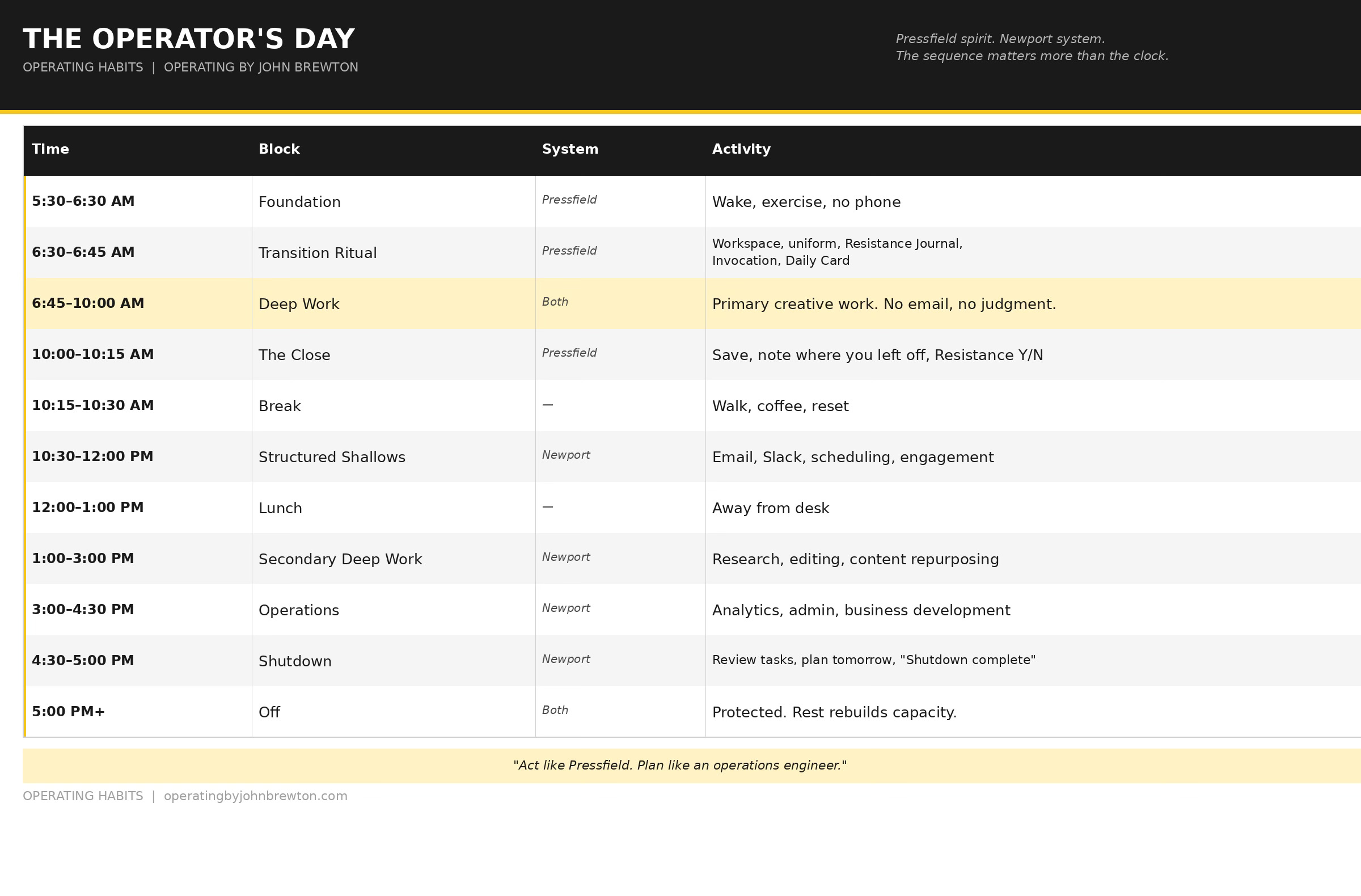
The Operator’s Day
A combined hour-by-hour schedule showing how both systems coexist. Adapt the times to your life — the sequence matters more than the clock.
This Week’s Assignment
Six deliverables. Install the protocol.
Write your personal Invocation using the builder template above.
Print or save the Daily Operating Card — fill it out every morning this week.
Set your deep work block hours for the week. Same time, every day.
Identify your #1 Resistance pattern — procrastination? perfectionism? comparison? — and write it on a sticky note at your workspace.
Time-block at least one full day using Newport’s method. Track deep vs. shallow hours.
Set a hard shutdown time and honor it every day this week.
Complete the Weekly Resistance Audit on Sunday.
Then, if you want to commit, write it down:
My deep work block is ______ every day this week.
My #1 Resistance pattern is ___.
My shutdown time is ___.
The session begins now.”
That sentence is the moment you stop hoping you’ll create and start engineering the conditions for creation to happen.
If you found this useful, share it with a creator friend who sits down every morning, stares at the screen, and doesn’t know where to start. This is the fix.
- j -
Just finding this series? Start from the beginning — each week builds on the last:
→ Week 1: The Daily Content Performance Tracker
→ Week 3: The Platform Verdict → This week.
All templates and assets are available to paid subscribers in the archive and below
We sold out the first 100 Operating Founder seats in two weeks.
Since then, I’ve spent more than 50 (of the 400 I committed to this project) working with Substack creators who are building incredible companies, projects and futures.
What I’m learning has changed leveled-up my excitement for the work.
We’re not hobbyists.
We’re consultants, newsletter operators, coaches and creators, founders and CEOs.
We’re an extraordinary community of people who want better, more meaningful work, who want to help more people, who want to scale companies with AI, who want to build lives, work and futures that are owned by us, not someone else.
So I’ve opened 100 new seats (50 are already taken).
What You Get
Every Friday, you get a 60-minute live cohort session with me. Here’s what’s inside:
The real numbers. Behind the scenes of everything I’m building — strategy, mistakes, pivots, revenue — documented in real time.
Business model development. Business plans, pricing strategy, revenue models, and scalable operations — not content tips.
Live tutorials + my actual data. The same Google Sheets I use, walked through live. No curated screenshots.
Every template I use. Download and deploy immediately.
20 min of open Q&A. Strategy, content, growth, monetization — nothing off-limits.
Monthly guest speakers. Platform growth, content design, creator ops, and the tools that actually move the needle.
$99 gets you 52 consecutive weeks — a front-row seat to how I build everything, plus a cohort of serious founders building alongside you.
The offer closes February 28th, or when the remaining 50 seats fill. Whichever comes first.
Once they’re gone, the Operating Founder tier goes away entirely.
[Become an Operating Founder → 50 seats remaining]
The Reading List
The books that built this system. If you want to go deeper on any of the ideas in this article, start here.
Steven Pressfield:
The War of Art (2002) — Identifies Resistance; the amateur vs. professional mindset
Do The Work (2011) — Tactical guide for starting, pushing through the middle, and finishing projects
Turning Pro (2012) — Deep dive into the interior shift from amateur to professional
Nobody Wants to Read Your Sh*t (2016) — Audience empathy and value-first communication
Cal Newport:
Deep Work (2016) — Rules for focused success in a distracted world
Slow Productivity (2024) — The lost art of accomplishment without burnout
John Brewton documents the history and future of operating companies at Operating by John Brewton. He is a graduate of Harvard University and began his career as a Phd. student in economics at the University of Chicago. After selling his family’s B2B industrial distribution company in 2021, he has been helping business owners, founders and investors optimize their operations ever since. He is the founder of 6A East Partners, a research and advisory firm asking the question: What is the future of companies? He still cringes at his early LinkedIn posts and loves making content each and everyday, despite the protestations of his beloved wife, Fabiola, at times.
I'm guilty of sometimes being the scattered operator, but now I'm working on tackling the hardest thing first, whether it's editing, writing, or recording, that takes precedence over admin, correspondence and other distractions.
Most people don’t need more strategy, they need a system that makes showing up inevitable. Pressfield for the fight, Newport for the container.