
Operating Founder: $99/year
Four 1:1 (60 minute) strategy sessions with me.
Weekly live cohort calls. A private Skool community with every framework and tool I’ve built. Plus a room full of +160 founders actively promoting each other’s work, learning and collaborating on Substack.
The first cohort sold out in 12 days.
Limited seats are open again (until the Skool launch on Monday, March 9th)
JOHN BREWTON
Start Here
You used to have a boss.
Not a good one, probably. But someone who sat across from you once a week and asked questions you couldn’t dodge.
What are you working on? Why?
Is it moving the needle or are you just busy?
You hated those meetings. You thought they were performative. You rolled your eyes when the calendar invite hit your inbox every Monday at 10am.
Then you went out on your own. And nobody ever asked you those questions again.
You made a pricing decision last month. Do you remember why?
Not what you decided. Why.
The actual reasoning.
The thing you told yourself at 11pm when you changed your rate card and hoped nobody would notice.
You don’t remember.
I know you don’t. Because nobody does.
And here’s the part that should bother you: nobody is going to ask.
The loneliest job in business
When you worked inside a company, you had structure you didn’t even notice.
Weekly 1:1s.
Quarterly reviews.
A manager who checked your work.
A team that pushed back on your ideas before they shipped.
You thought that structure was bureaucracy.
You were wrong. It was a valuable feedback loop.
Now you’re the founder, the operator, the strategist, the executor.
You’re making dozens of decisions a week.
Pricing. Content. Clients. Hires. Tools.
And there is exactly zero structural accountability for any of it.
No one reviews your priorities. No one challenges your assumptions. No one asks you the uncomfortable question about why you spent Tuesday building a landing page instead of following up with the client who’s about to churn.
You are running a company with no management layer.
Including no management of yourself.
Sound familiar?
Are you new to Operating?
You Might Enjoy These
(Access the entire library of articles and resources for $7.99 per month)
0 to 55,000 - The First 90 Days Playbook - What I’d Do Differently Knowing What I Know Now
The Operating by John Brewton Resource Library - No Filler. All Killer.
WINNING THE LOSER’S GAME: The Creator Economy and the Companies We All Need to Build
Become a paid subscriber to access all the content ($7.99 / month) or get to work with us and become a member of the Operating Founder cohort for $99 (annual).
[Join the Operating Founder Program — 40 spots remaining]
The fix is a meeting you already know how to run.
Here’s this week’s Operating Habit:
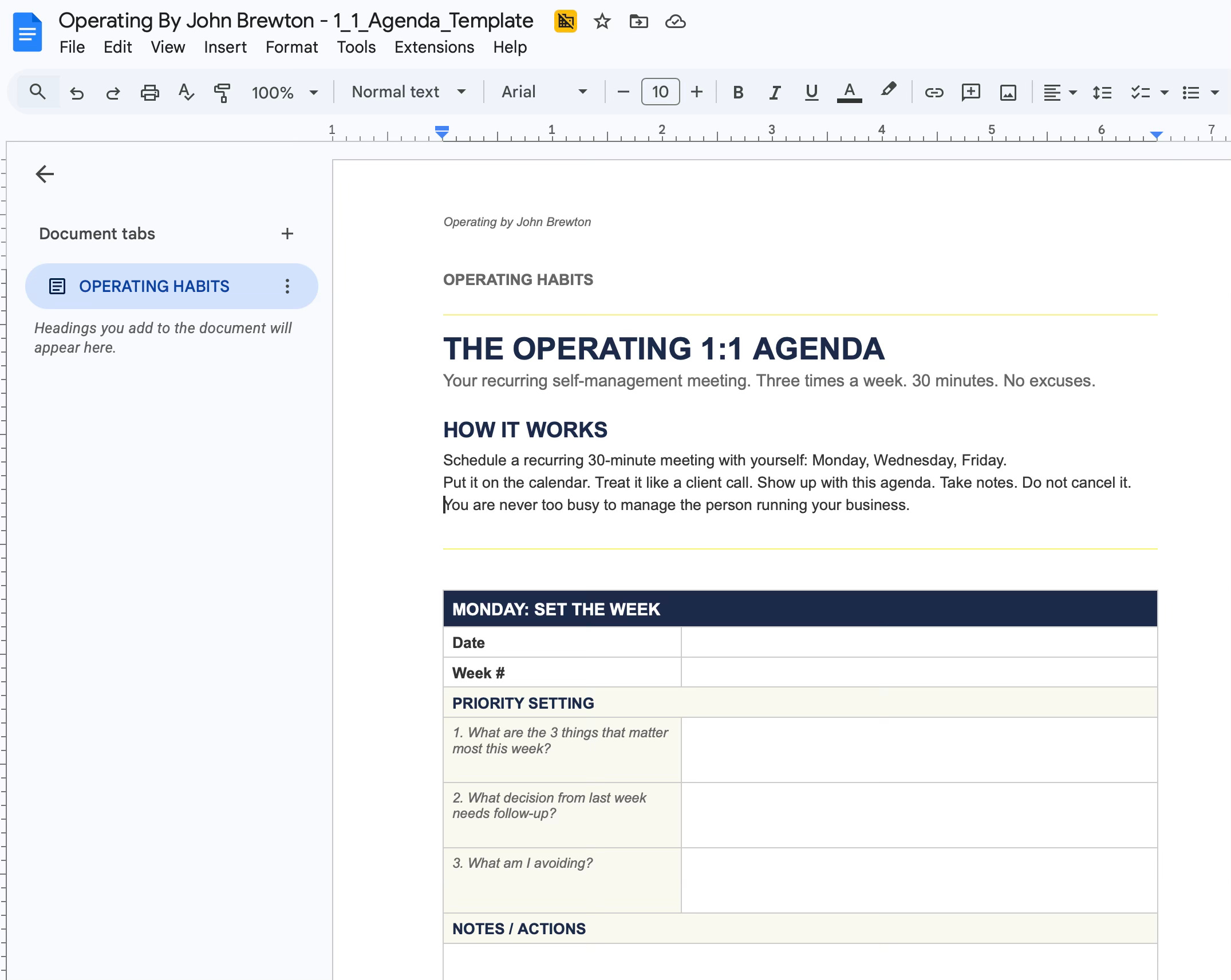
Schedule a recurring 30-minute 1:1 with yourself, three times a week.
Monday. Wednesday. Friday.
Put it on the calendar.
Treat it like a client call.
Show up with an agenda.
Take notes.
Do not cancel it because you’re “too busy.”
You are never too busy to manage the person running your business.
Monday: Set the Week
This is your planning session.
Three questions:
What are the 3 things that matter most this week?
What decision from last week needs a follow-up?
What am I avoiding?
That third question is the whole game. The thing you’re avoiding is almost always the thing that matters most. If you can name it on Monday, you can act on it by Wednesday.
Wednesday: Midweek Audit
This is your accountability check. Three questions:
Am I on track with my Monday priorities?
What slipped and why?
What do I need to say no to for the rest of the week?
Wednesday is where most solo operators lose the plot. The inbox has taken over. A new opportunity appeared. Someone asked for a “quick call.” The priorities you set 48 hours ago are already buried under other people’s agendas.
The Wednesday check pulls you back.
Friday: Close the Loop
This is your review session. Three questions:
What decisions did I make this week and why?
What worked? What didn’t?
What’s one thing I’ll do differently next week?
Friday is where the learning compounds. Without it, every week is a standalone event. You never build on what you did. You just start over.
Why three times, not once
You might be thinking: I can do this once a week.
You can’t. I’ve tried. Here’s what happens:
You schedule a weekly review for Friday afternoon. Week one, you do it. Week two, you move it to Monday because Friday got busy. Week three, you skip it because Monday was packed. By week four, the habit is dead and you’re back to operating on instinct and anxiety.
Three times a week works because the gap between sessions is never more than two days. You can’t drift far enough to lose the thread. The Monday/Wednesday/Friday rhythm mirrors the natural arc of a work week: set up, check in, close out.
It’s the same reason good managers don’t do monthly 1:1s. Too much happens between sessions. The conversations become retrospectives instead of real-time course corrections.
The rules
It goes on the calendar. Not a mental note. A real calendar event with a real time block.
30 minutes, maximum. This is not journaling. This is management. Be efficient.
Use the agenda every time. Don’t wing it. The structure is the point.
Write things down. Your memory is lying to you. That’s the whole thesis of this series.
Don’t cancel it for other people. You wouldn’t cancel a meeting with your biggest client. This meeting is more important than that.
Start this week.
I built a free 1:1 Agenda Template for you [download here →].
Three sessions. Nine questions. Pre-formatted for 90 days of self-management.
Free subscribers: [Download the 1:1 Agenda Template here →]
Paid subscribers get the full toolkit:
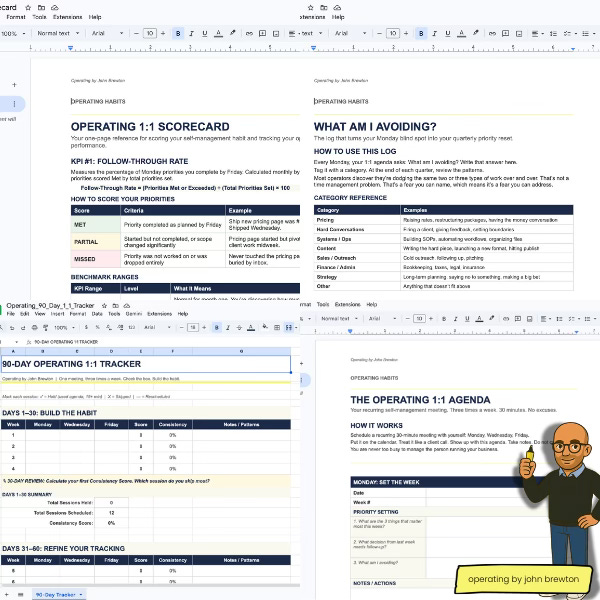
The Operating 1:1 Scorecard — a one-page reference with weekly scoring criteria, a 30/60/90 day self-assessment framework, and benchmark ranges for tracking your consistency and follow-through rate.
The 90-Day 1:1 Tracker — a visual progress tracker with built-in review prompts at Day 30, 60, and 90 so you never lose momentum.
The “What Am I Avoiding?” Log (Bonus Tool)
[Become a paid subscriber and get this week’s full Operating 1:1 toolkit.]
hope this helps.
we are all becoming companies.
- john -