

SCALING DOWN THE BIG IDEAS | Edition 02
We sold out the first 100 Operating Founder seats in two weeks.
So I’ve opened 100 new seats (50 are already taken).
What You Get
Every Friday, you get a 60-minute live cohort session with me. Here’s what’s inside:
The real numbers. Behind the scenes of everything I’m building — strategy, mistakes, pivots, revenue — documented in real time.
Business model development. Business plans, pricing strategy, revenue models, and scalable operations — not content tips.
Live tutorials + my actual data. The same Google Sheets I use, walked through live. No curated screenshots.
Every template I use. Download and deploy immediately.
20 min of open Q&A. Strategy, content, growth, monetization — nothing off-limits.
Monthly guest speakers. Platform growth, content design, creator ops, and the tools that actually move the needle.
Access to a community of top-quality Substack writers and collaborators to build your audiences and content alongside and in partnership with.
$99 gets you 52 consecutive weeks — a front-row seat to how I build everything, plus a cohort of serious founders building alongside you.
The offer closes February 28th, or when the remaining 50 seats fill. Whichever comes first.
Once they’re gone, the Operating Founder tier goes away entirely.
[Become an Operating Founder → 50 seats remaining]
Breaking down Jim Collins’ seminal framework — and why every insight in it is more actionable for creators, solo operators and founders than for the Fortune 500 companies it was written about.
In 2001, Jim Collins published one of the most influential business books ever written. He and his research team spent five years studying 11 companies that made a dramatic, sustained leap from average to exceptional performance. They wanted to know why some companies become truly great while most stay permanently stuck at good.
I read Good to Great for the first time in 2006 and then used at as my operating manual, alongside Any Grove’s High Output Management to optimize and scale R.G. Brewton, my family’s B2B industrial distribution and inventory management company. The ideas in this book were integral to our scaling from $27 million to +$50 million in annual revenues, and building a truly world-class operation that attracted high-quality buyers.
Using Collins’ framework as a philosophical foundation, we scaled and successfully exited. The Hedgehog Concept clarified our focus. The flywheel gave us language for why consistent, compounding action was beating our more reactive competitors. Level 5 thinking changed how I showed up as a leader and developed leaders within the organization.
The framework is equally, if not more, powerful for one-person businesses, embryonic startups, and small operators than it ever was for the large corporations Collins studied.
Why? Because the scarce inputs (humility, discipline, focus, and consistent action) are completely accessible to you right now. No board approval required. And if you build these traits into your operation from the start, then each incremental level of growth you achieve will adopt these core characteristics that predict success.
Here are the seven big ideas, translated for builders like you.
The Seven Ideas — Translated for Operators
1. Level 5 Leadership → Make the work the hero, not you.
Collins found that the leaders who drove the most dramatic transformations were paradoxically humble, ferociously ambitious for the institution, not for themselves. For solo founders, this translates into a single discipline: anchor your status in the quality and consistency of your output, not in being seen as a visionary. When you stop needing the business to validate your identity, you can make clearer decisions about it and produce more value for your audience, not your ego.
2. First Who, Then What → Choose your collaborators before your projects.
Before strategy, Collins argues, comes people. For tiny teams, the “bus” metaphor becomes: who gets access to your time, attention, and trust. One misaligned collaborator (designer, co-host, advisor, early hire) can distort your roadmap for months. For creators, this also applies to your audience: be more intentional about who you’re building for than what you’re building.
3. Confront the Brutal Facts → Replace vibes with reality loops.
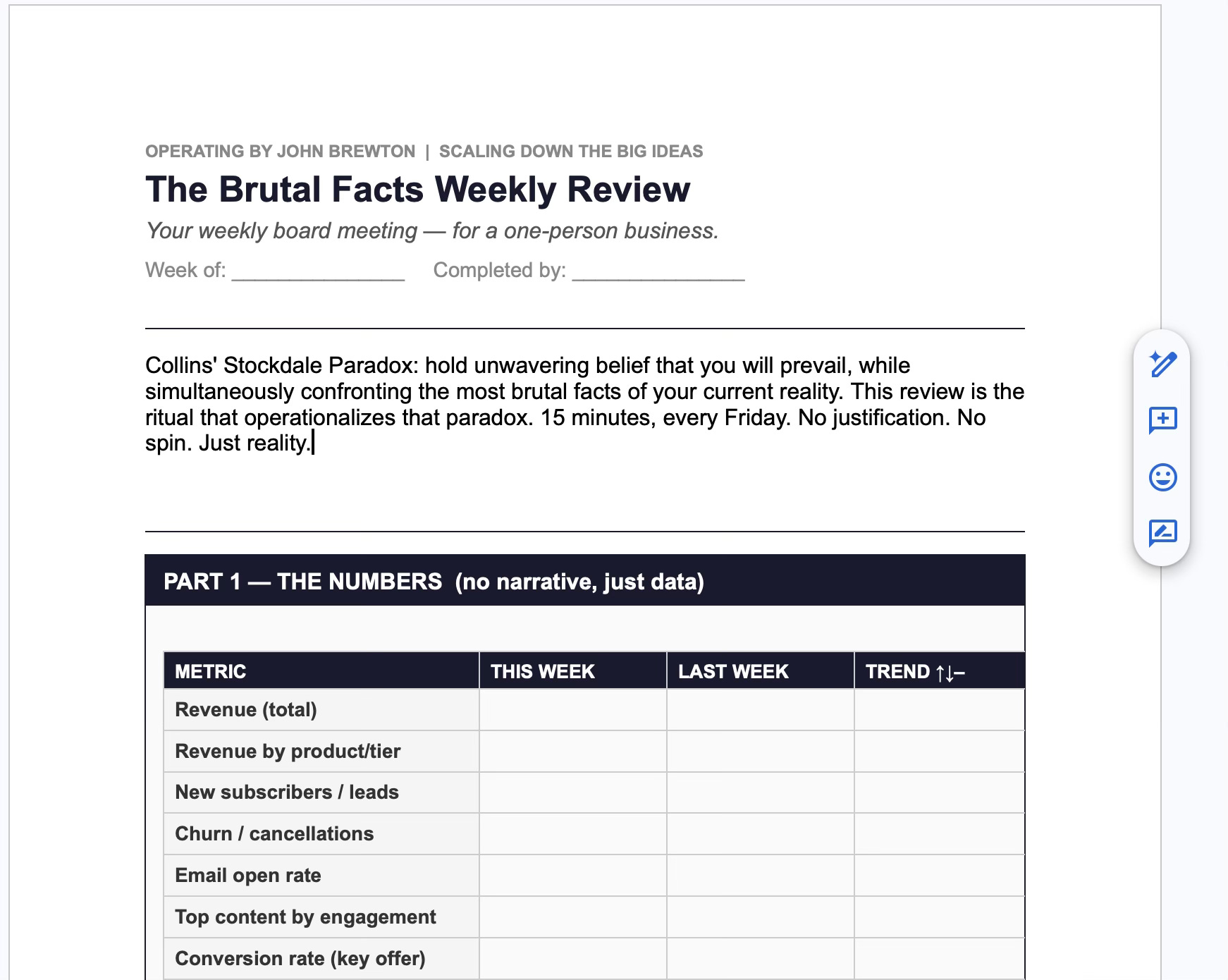
Great companies build a culture where inconvenient truths are welcomed, not punished. For solo operators, the danger is you have no internal checks, you can stay in delusion indefinitely. A weekly one-page reality check (revenue by product, retention, content performance, deep work hours) is your Stockdale Paradox ritual: hold the belief that you will succeed while fully accepting what your current numbers are actually telling you.
4. The Hedgehog Concept → Design your personal monopoly.
This is the most immediately actionable idea in the book. It sits at the intersection of three circles: what you can be genuinely best at, what you’re deeply passionate about, and what drives your economic engine. For one-person operators, “best in the world” becomes “undeniably top-tier for a specific someone.” The narrower you define the scope, the more tractable “best” becomes. This is the concept I’d encourage you to take most seriously, it’s the clearest path from good to great at any scale.
5. Culture of Discipline → Systems that survive your moods.
Discipline, Collins argues, is what allows consistent output when motivation fluctuates. For micro-operators, culture is mostly: your habits, your calendar, and your willingness to say no. A non-negotiable publishing cadence, a firm “stop-doing” list, and two or three hard constraints about who you serve, these are the structures inside which great work becomes possible.
6. Technology as Accelerator → Tools amplify strategy; they don’t replace it.
Collins found that great companies adopted technology to fit their Hedgehog Concept, not to keep up with trends. For solo founders, this is permission to ignore most of what appears in a trend deck. If a tool doesn’t directly accelerate content creation, sales, or product improvement within your actual strategy, it’s probably distraction dressed as productivity. New software, new tools, new applications are not going to become your differentiator; how you learn to work with the primary pieces of technology you use is essential.
Note: You don’t need to add new AI tools every month (most of these apps will become features of the larger platforms anyway). Specialize into a primary set of tools or platforms, not an everchanging suite of more. For me its been Perplexity and Claude, my design tools (Canva/Gamma/MidJourney) and Google Drive/Notion.
7. The Flywheel → Tiny wins compound if you don’t interrupt them.
The doom loop for one-person businesses is particularly vicious: a bad month leads to a new niche, new offer, new platform — destroying whatever slow-building compounding was already happening. The flywheel is the alternative: a repeatable loop where each cycle makes the next easier. Create → attract → convert → deliver → learn → improve → repeat. Run the same core loop enough times that you can predict its output. Only then add complexity.
(Access the entire library of articles and resources for $7.99 per month)
Good to Great Solopreneur Tools
The free version above has given you the map.
The paid version below gives you the tools to navigate it.
Paid subscribers get the full deep-dive analysis — three movements covering the personal operating system, the strategy layer, and the compounding engine — plus four purpose-built assets you can use immediately in your own business:
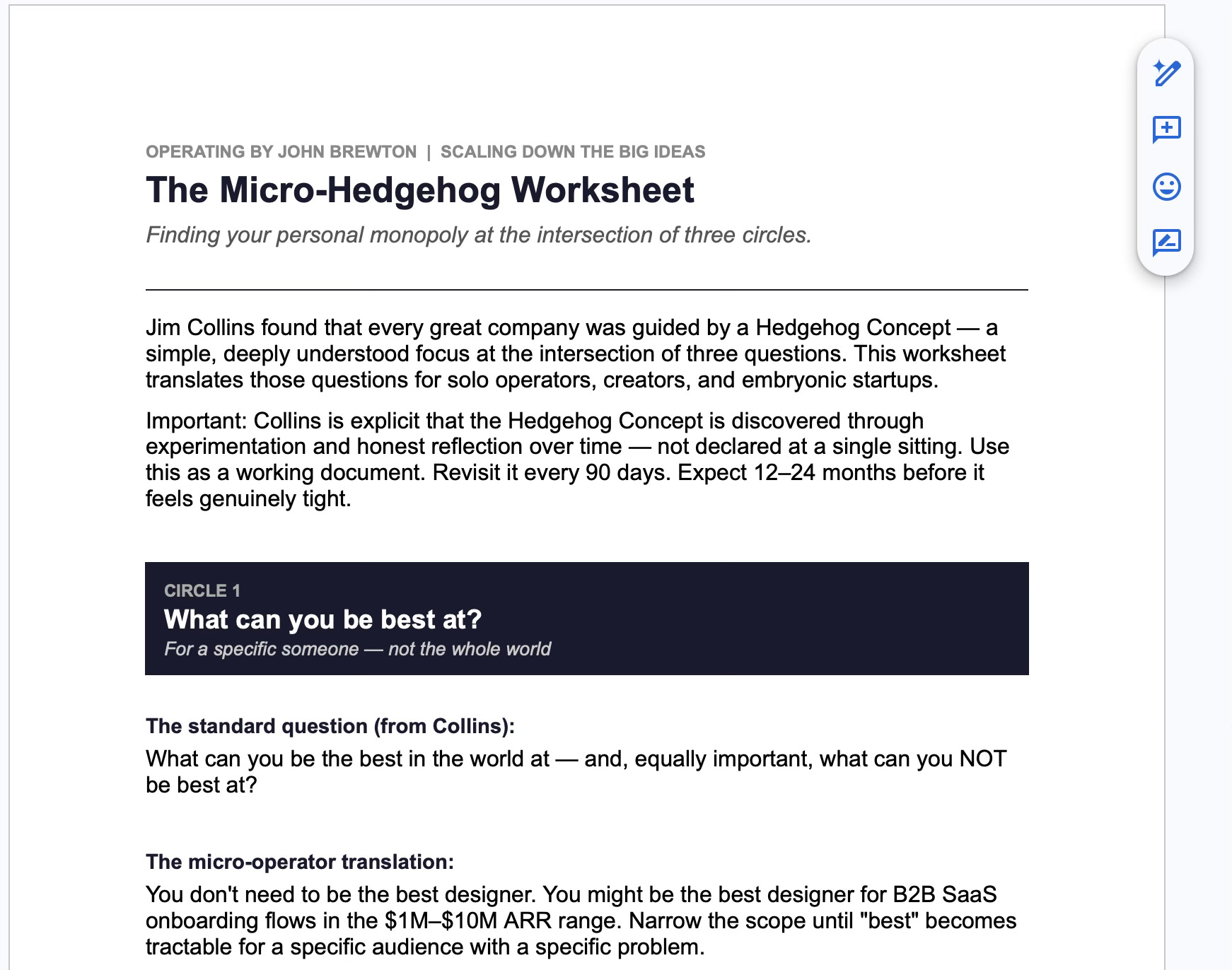
Asset 1: The Micro-Hedgehog Worksheet — The single most important strategic exercise you can do for a one-person business. Three circles, calibrated for solo operators, with guiding questions designed to surface your personal monopoly. Most founders spend years circling what could be discovered in an afternoon with the right framework.
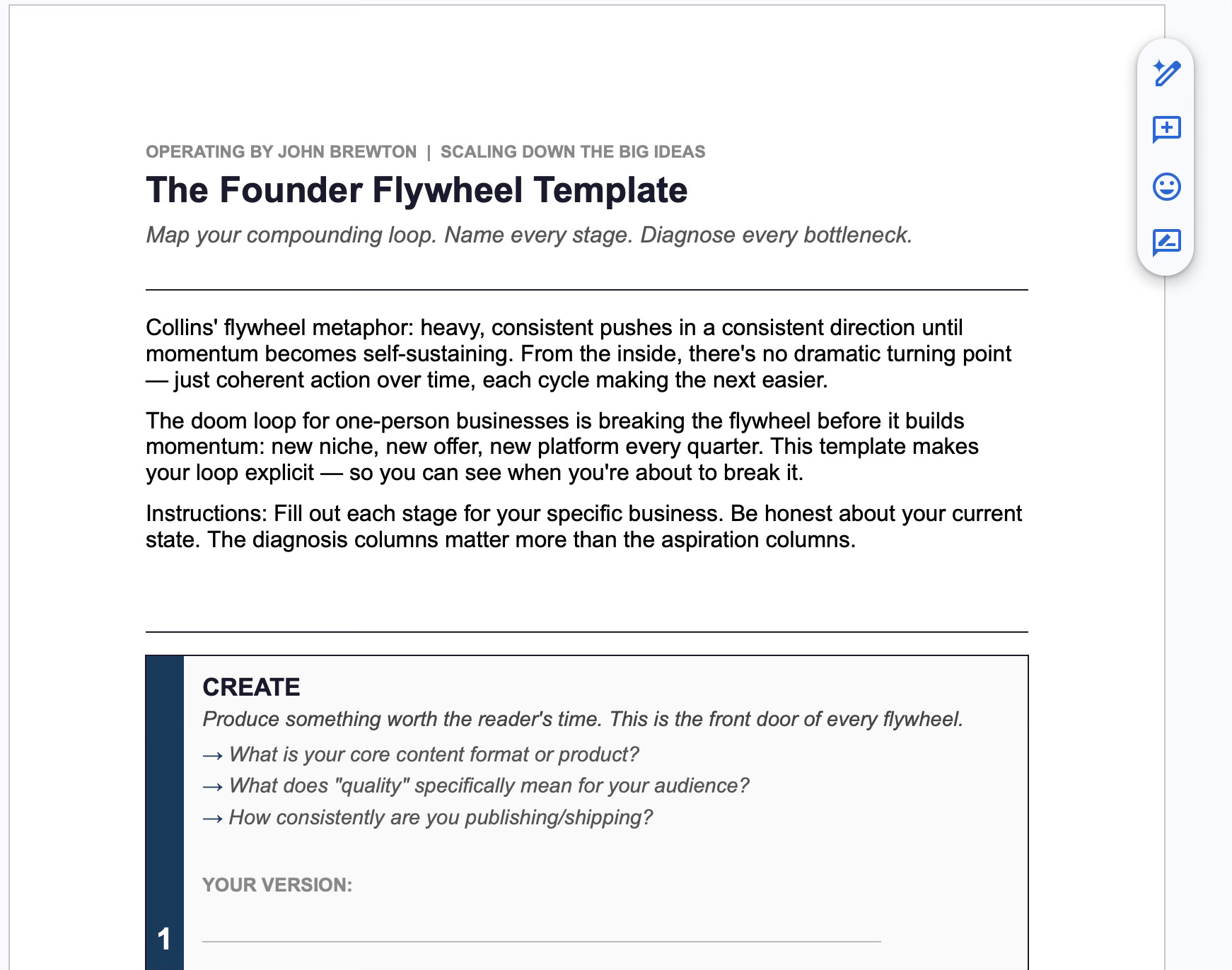
Asset 2: The Founder Flywheel Template — A fillable visual map of your personal creator-consultant flywheel, with diagnostic questions at each stage. Designed to make your compounding loop explicit — so you can stop accidentally breaking it every time growth plateaus.
Asset 3: The Brutal Facts Weekly Review — A one-page operating ritual: revenue by product, key metrics, deep work vs. admin hours, and a structured “autopsy without blame” for the week’s biggest miss. This is the closest thing to a weekly board meeting for a one-person business.
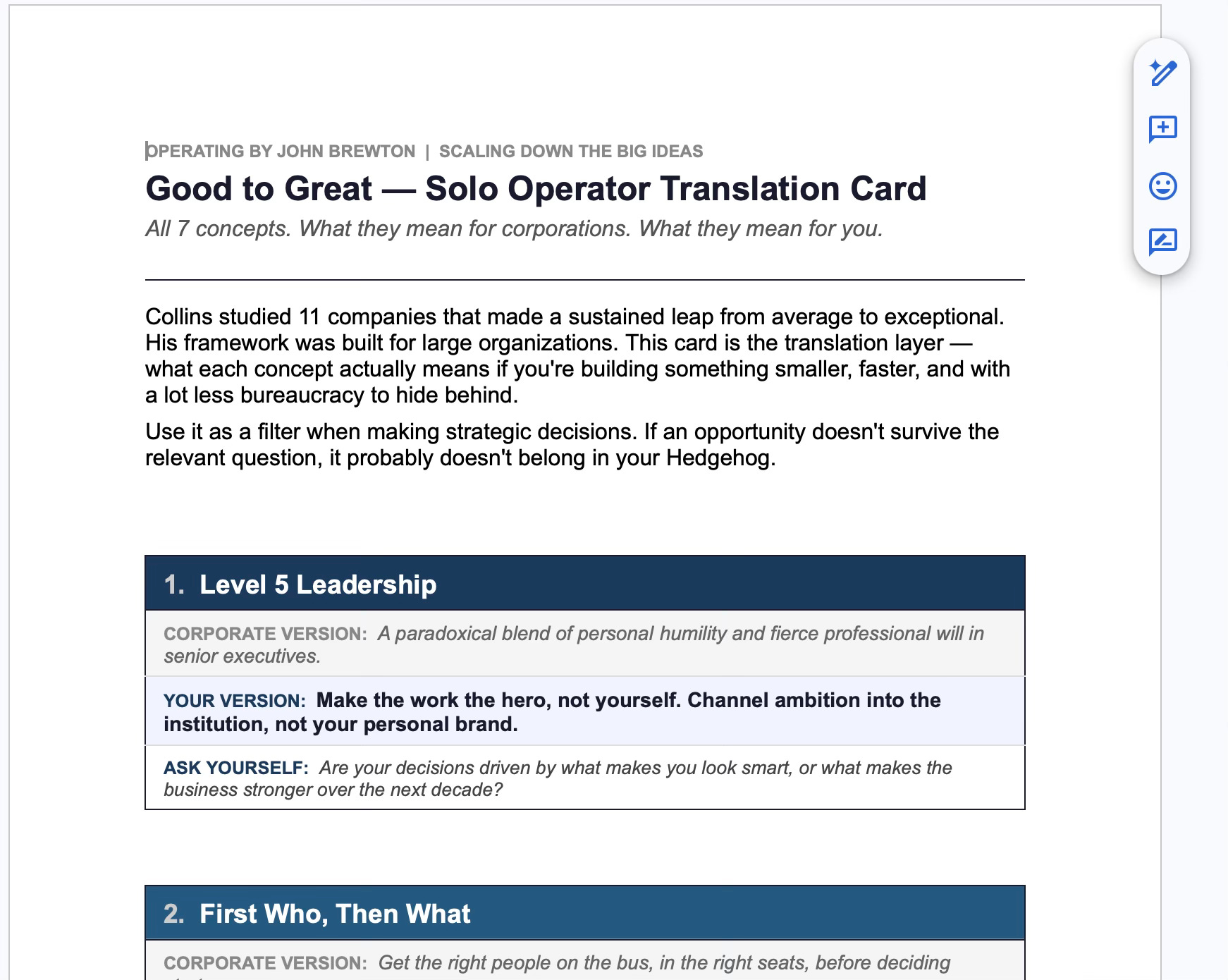
Asset 4: The Good-to-Great Translation Card — A clean, shareable reference card mapping all seven Collins concepts to their solo-operator equivalent in a single sentence each. Keep it. Use it as a filter when you’re making strategic decisions.
Collins’ framework took five years and a research team to develop. These tools compress the most actionable parts into something you can actually use this week — in your business, at your scale, without a management layer or a consultant.
A Word About Operating Founder
Every Friday, I run a 60-minute live session for Operating Founders — documenting how I’m building this newsletter and business in real time. Not polished case studies. The actual strategy, the real numbers, the live decisions.
Here’s what you get:
Weekly 60-minute live Zoom sessions
Behind-the-scenes of everything I’m building, as I’m building it
Content creation walkthroughs — exactly how I make what I make
My actual growth data and performance spreadsheets (not screenshots — the real files)
Blank templates of every asset I use, yours to download immediately
20 minutes of open Q&A every session — nothing off limits
We sold out 100 seats in two weeks. I opened more.
If you’re building something and want to do it with someone who has done it before — this is the room. Become an Operating Founder →
