
Scenes From a Corporate Obituary
A Short Story About the End of Corporate Life...and the Beginning of Yours

By John Brewton | Operating by John Brewton
I. The Machine
You showed up on a Monday.
You were going to do great work.
You had ideas.
You had energy.
You had a company backpack and a water bottle with the corporate logo.
You wore them the way you wore your college sweatshirt on orientation weekend, as if belonging to an institution was the same thing as having a future.
It never was.
But the backpack was free and the water bottle kept things cold and for a few weeks.
Momentarily, it felt like enough. You were enough.
Your first Monday morning standup:
Fifteen minutes. Harmless.
A small, clean thing.
A meeting so brief it barely qualified as one.
It had a purpose. It had an end time.
It was, for one shining moment, almost functional.
Then someone said “we should probably loop in stakeholders” and it became 30 minutes. Then someone else said “can we add a weekly retro” and now there were two meetings. Then a director asked for a “leadership readout” of the standup. Which is a meeting about a meeting.
Which should be a felony but is instead standard operating procedure.
Then the retro started generating action items that needed their own follow-up meeting. The follow-up meeting generated a sub-committee. The sub-committee requested a Slack channel. The Slack channel went unread, which triggered a meeting to discuss why nobody was reading the Slack channel.
Then quarterly planning started and suddenly there were eight new recurring meetings on the calendar, three of which overlap, one of which has no owner and has been happening every Thursday at 2pm for seven months with perfect attendance and nobody can remember why it was originally scheduled.
It has a Zoom link.
It has a Google Doc.
The Google Doc is empty.
Everyone joins on time. No one speaks first.
Someone eventually says “Should we just cancel this?”
Nobody responds. The meeting continues.
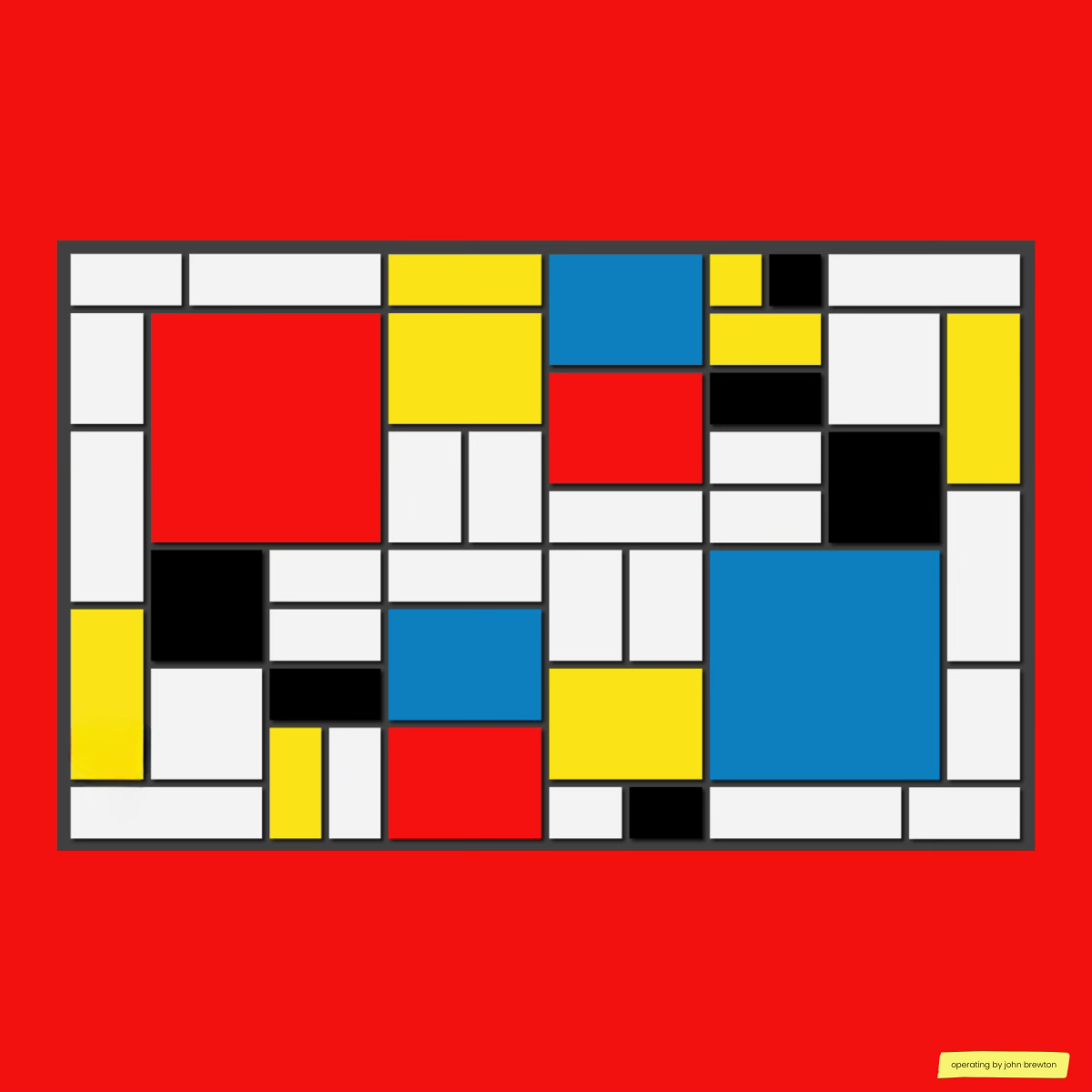
The calendar became a solid wall of color from 8am to 6pm.
No gaps. No white space.
It looked like a Mondrian painting if Mondrian hated you.
There was no time to do the work the meetings were about.
The work didn’t get done.
So someone scheduled a meeting to discuss why the work wasn’t getting done. Fourteen people attended. They agreed the problem was “bandwidth.” Nobody defined bandwidth. Nobody has ever defined bandwidth.
It is the corporate equivalent of “the Lord works in mysterious ways”…an explanation that explains nothing but makes everyone feel like something has been acknowledged.
Someone scheduled a follow-up. The follow-up was next Tuesday at 3pm. It went 45 minutes. Nothing changed. A new meeting was born.
It had a Google Doc.
The Google Doc was empty.
The meetings were not a symptom of the dysfunction.
The meetings were the company.
The work died a long time ago.
Nobody noticed because they were in a meeting. The company had become an orchestra of calendar invites performing for an empty auditorium.
II. The People
And then there were the people.
Four hundred of you on a Zoom. The CEO reading slides word for word for 25 minutes. Every slide had a stock photo of people shaking hands. Someone asked a tough question in the chat.
It got buried under 40 “👏” emojis and a GIF of a golden retriever.
HR shared a “pulse survey” that would be read by no one and summarized by an intern. You were told the company was “in a strong position,” which is exactly what they said three weeks before the last round of layoffs.
And the round before that.
“Strong position” was a leading indicator of unemployment.
You stepped away for 11 minutes and had 47 unread messages across 9 channels. Three were people tagging you to “loop you in.”
Into what?
Nobody knew.
One said “just flagging this” with no context.
Another said “putting a pin in this” which meant it would never be discussed again.
If your green dot went yellow for more than six minutes, your manager assumed you’d died or quit. Both would require the same amount of paperwork.
The Performance Review
Friday.
Annual review.
You sat across from someone who managed 14 people and remembered maybe three things you did this year, two of which were actually done by your teammate.
She had a rubric with nine dimensions.
One of them was “strategic impact.”
You once fixed a broken hyperlink in a board deck.
That was your strategic impact.
You were rated “meets expectations.”
Which is corporate for “we acknowledge you exist.”
You received a 2.8% raise, which after inflation was a pay cut wearing a party hat.
They asked about your “growth areas.”
You said you wanted to get better at “cross-functional communication” when what you actually wanted was to never hear the phrase “cross-functional” again, not even at your own funeral, where someone from Product would probably still try to “align on next steps.”
That Guy
And of course there was, That Guy.
He cc’d your VP on things that didn’t need a VP.
He cc’d your VP on things that didn’t need an email.
He once cc’d your VP on a lunch order.
He said things like “let’s pressure-test this” with a look in his eyes that said he hadn’t felt joy since 2014. Joy was a Q2 initiative that got deprioritized.
He didn’t eat lunch. He took “working lunches,” which was just a sad desk salad consumed over a call he scheduled during someone else’s blocked calendar time.
He had never once respected a calendar block.
To him, “Focus Time” was a suggestion, like a speed limit in a parking lot.
He was in the office on days nobody else was.
Not because he had to be, but because the empty cubicles made him feel powerful. The silence was his kingdom.
The vending machine hum created his happy space.
He had 43 unused vacation days.
He considered this a personal achievement.
HR considered it a liability.
He once described himself as “passionate about operational excellence” in a LinkedIn post that got 11 likes, 9 of which were from people who reported to him.
The other two were bots.
Then there was “That Guy’s” best friend, The Other Guy.
The one who couldn’t explain what his 40-person team actually produced.
Not won’t. Cannot.
The question broke him. You could see it happen in real time. His eyes went somewhere else.
A boardroom he once walked through.
A whiteboard he once stood near.
“We’re driving alignment across the enterprise.”
Alignment of what? “Strategic priorities.”
Which ones? “The ones we identified in Q2.”
Nobody remembered Q2.
Q2 was corporate Atlantis, a utopic civilization referenced constantly, visited never.
He was not in Q2.
He started in Q3.
He inherited a team, a budget, and a Confluence page he had never opened.
The page was last updated by someone laid off in 2023.
It contained a Gantt chart and a broken image link. It was the Rosetta Stone of organizational dysfunction and he had never read a word of it.
He presented other people’s slides in leadership meetings and said “we” the way a general says “we” about a war he watched from a helicopter.
But he sent a Friday recap email every week that said “great work this week team 🙏” and somehow that was enough.
It was the load-bearing emoji of a $340,000 salary.
He golfed on Wednesdays. He called it a “client relationship touchpoint.”
The client was his college roommate.
The touchpoint was nine holes and a beer.
His last performance review said “strong executive presence,” which is corporate for “tall, confident, and nobody has figured out he’s empty yet.”
His team burned out one by one. He replaced them one by one.
He called it “evolution” at a town hall.
He showed a slide with a butterfly on it.
He got promoted. He always gets promoted.
The system wasn’t broken by guys like him. The system is guys like him.
III. The Reckoning
And then one Wednesday, it’s always a Wednesday, you got the calendar invite.
“Quick Sync — 15 min.”
No agenda.
Your manager’s manager was on it.
HR was on it.
You knew.
They said “difficult decision.”
They said “restructuring.”
They said “this is not a reflection of your performance.”
They read from a script. The script had been written by legal, reviewed by HR, and approved by someone who had never met you and never would.
In 2025, more than 1.2 million Americans were laid off. The highest number since the pandemic.
January 2026 was the worst jobs markets to start a year since the financial crisis.
Companies don’t do big dramatic layoffs anymore.
They do “forever layoffs”…small, rolling cuts every few weeks so nobody outside the building notices. Colleagues disappear quietly, like a slow leak.
Workloads creep up for the survivors.
No one ever feels safe.
Fifty-five percent of Americans now fear losing their jobs. That’s higher anxiety than March 2020, when the entire global economy shut down overnight.
In 2026, the enemy is an earnings call, an AI demo and a CEO who read an article about “doing more with less.”
So you updated your resume.
You rewrote your LinkedIn headline.
You applied. And applied. And applied…
IV. The Wasteland
The job market was not a market.
It was a simulation of one.
Postings that were already filled.
Roles that existed only to justify a recruiter’s headcount. Ghost jobs.
You applied to 200 of them.
You heard back from 11.
You got to the final round on three.
One went silent.
One “went in a different direction.”
One got eliminated because the hiring manager was herself laid off between your second and third interview.
Hiring was at a decade low.
Job openings had fallen to 0.87 per unemployed worker, down from 2-to-1 just two years before. The ratio had flipped.
Thirty-seven percent of companies said they planned to replace roles with AI by the end of 2026. Not augment. Replace.
The CEO of Salesforce said chatbots had already taken over the work of 4,000 customer service agents. Amazon cited AI’s “transformative potential” while cutting +30,000 corporate jobs in three months.
Every company was “investing in AI”…
Which is a nice way of saying “investing in not paying you.”
You sat on your couch on a Tuesday afternoon, laptop open, 47 rejection emails deep, and realized something that had been quietly true for a long time.
The system was never going to save you.
Because you were never the point of the system.
V. The Exit
The company was always a tech stack. We were just doing work computers couldn’t do, yet. Corporates were a bundle of tools and processes and recurring calendar invites held together by inertia and middle management.
Management was only there to manage the people, who were doing the work, that the computers could not yet perform.
You were a node in that stack.
A resource.
A line item.
You could be rearchitected. Deprecated. Sunsetted.
And you were.
But here is what else is true. The same technology that made you replaceable inside the machine makes you dangerous outside of it.
You could’ve written a newsletter.
You could’ve called a client, closed a deal, learned a skill, taken a walk.
You could have taken time to remember what your own ideas feel like.
Instead, you updated a status tracker about the status of another status tracker.
Nobody owned anything. Everyone was accountable.
Nobody was accountable, but it sounded better on a slide.
And then came the ping. Someone on Slack:
“Hey, can we get 15 minutes to debrief on that sync?”
No.
No we cannot.
Not today. Not tomorrow. Not ever again.
Companies are becoming tech stacks.
You can become a company.
Not a node. Not a resource. Not a line item waiting to be sunsetted.
A company of one. Built on your expertise.
Powered by the same technology that was used to replace you.
No meetings about meetings. No status trackers tracking status trackers.
No Friday recap emails from a man who golfs on Wednesdays.
Just you. Your work. Your clients. Your life.
The machine doesn’t need you anymore.
Good. You don’t need the machine either.
It’s easy to forget.
Companies are becoming tech stacks.
We are all becoming companies.
It’s time to build yours.
- j -
Become a founder and build with our community at Operating by John Brewton.
(Access the entire library of articles and resources for $7.99 per month)

John Brewton documents the history and future of operating companies at Operating by John Brewton. He is a graduate of Harvard University and began his career as a Phd. student in economics at the University of Chicago. After selling his family’s B2B industrial distribution company in 2021, he has been helping business owners, founders and investors optimize their operations ever since. He is the founder of 6A East Partners, a research and advisory firm asking the question: What is the future of companies? He still cringes at his early LinkedIn posts and loves making content each and everyday, despite the protestations of his beloved wife, Fabiola, at times.
This was a great read—both darkly funny and also oddly liberating. It captures exactly how corporate life can quietly drain you, and makes the idea of writing your own next chapter feel urgent in the best way.
"death by all talking to yourselves because you all need your role to be so important" vs "success by spending time with buyers and being in market asking challenging questions because you're obsessed with customers problems"