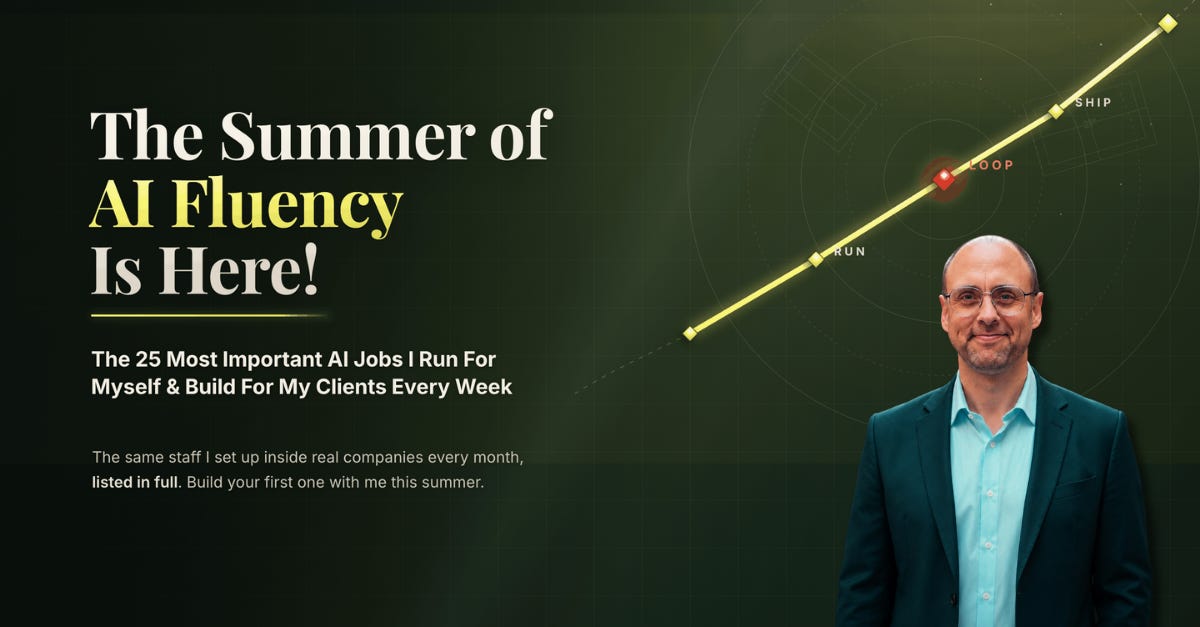
The 25 Most Important AI Jobs I Run For Myself & Build For My Clients Every Week
The full list of what an AI-fluent founders, companies and operators run and loop, from writing to research to deals. Pick one and build it this summer with me!
TL → DR
Most people run 2 jobs with AI. They ask a question and close the tab.
I run 25. Each one is a skill you can own, not a prompt you retype.
The list below is the whole staff, sorted into 5 groups.
The gap between 2 and 25 is the difference between using AI and running it.
11 of the 25 run as autonomous loops, several agents working together with no hand on the wheel.
You can build your first one this summer, live, in about 90 minutes.
What does an AI-fluent founder or operator actually do all day?
Most people are still using AI like a Google search box. They ask one thing, read the answer, and close the tab. And if the results aren’t strong enough, or seem not to make sense, they walk away and choose to do the work themselves.
That is their first mistake
That is 1 job, done by hand, every time, from scratch.
I run a team of +25 Agentic Employees every week. Not 25 prompts I retype. 25 agents that know my voice, my standards, my thinking, and my work. 25 team members who produce the same high-quality output every time and who adapt to the changing needs of my business each and every day
The gap is no longer between those who use AI and those who do not. The gap is who runs 25 jobs with it, while everyone else runs 2.
Here is the whole entry-level list of the work my team produces each week and the 25 most common first builds I engineer for my clients each month
Each one carries a tag.
Run means you operate it, one job at a time.
Scheduled means it runs on a trigger without you.
Loop means several agents run it end to end, in a loop, checking their own work, with no hand on the wheel.
What are the 25 things operators run with AI right now?
Writing in your voice
Draft a client email in 3 versions, one for the client, one for the team, one for the board, each in your tone, off one line. Run
Turn a 2-minute voice memo into a finished post in your own written voice. Run
Self-check every draft against your banned-phrase list before you read it. Run
Research a named prospect, write the cold outreach, then run the whole follow-up sequence on its own. Loop
Rewrite a stiff paragraph into your voice in under a minute. Run
Research that comes back sourced
Watch your calendar and deliver a sourced brief before every meeting, every claim cited, with no ask. Loop
Scan 3 rivals on a cadence, one agent each, and return the positioning gaps you can take. Loop
Turn 10 customer interviews into the 3 jobs they hire you for, one reader agent per transcript into one synthesizer. Loop
Fan out across a new market and return a sourced read in an afternoon, not a week. Loop
Pull a one-page memo on a person before every first call, triggered off the invite. Loop
Meetings that write themselves up
Turn rough bullets into a deck outline you would actually send. Run
End every call with the notes, the decisions, and the next steps already written, every time, automatically. Scheduled
Run the meeting pipeline, from transcript to notes to counterparty research to a relationship memo to a drafted email, on its own. Loop
Get the agenda and the pre-read from a 2-line goal. Run
Turn a long email thread into a summary and a recommended reply. Scheduled
How I Built a $200,000 Newsletter Business From a Substack Nobody Was Reading
The Five Moves That Turned My Substack Into a $200,000 Business
The Operating Project: Most Coaching Ends With Notes. This Ends With a Machine.
Money and deals
Normalize EBITDA on a founder’s spreadsheet and flag what will not survive diligence. Run
Read a deal room with one agent per section into one screen on whether the business is real. Loop
Turn a discovery call into a full proposal and a scope on its own. Loop
Build a 13-week cash view from raw numbers each week and name the weeks that get tight. Scheduled
Reconcile 2 months of statements and surface the duplicates and the gaps on a schedule. Scheduled
The work that is yours alone
Build the one weekly report that eats your Friday so it runs from your inputs each week. Scheduled
Stand up a brand voice profile and write everything through it. Run
Turn a research report into a finished carousel, research agents to writer to designer, charts and all. Loop
Triage your inbox every morning into needs-you, needs-a-reply, needs-nothing before you sit down. Loop
Build a custom skill for the one task no template fits. Run
Which of these run without me, completely?
Run, schedule, loop.
11 of the 25 reach the top rung.
Most teams stop at Run. They operate one skill at a time, by hand, and call that AI fluency. They are mistaken.
The ladder has 3 rungs. A skill you run becomes a job that runs on a schedule. A scheduled job becomes a loop that several agents run together, each one doing a piece, checking the work, and handing it to the next, until the result lands on your desk finished.
11 of the 25 above are at the top rung. A research brief that triggers off your calendar and writes itself before the meeting. A meeting pipeline that takes a transcript and returns a relationship memo and a drafted email with no prompt from you. A market read that fans 6 agents across the sources and comes back in the afternoon.
You are not prompting these. You build and schedule them once, and they run in perpetuity.
Caption: Four agents on one loop. The work moves without you.
That is the move most people have not seen yet. Not a faster search box. A staff of agents that runs the loop while you are in the room doing the work only you can do.
Why is this the summer to become AI-fluent?
Count how many of the 25 you run today.
If the number is 2, that is normal. It is also the problem.
Waiting until the gap is loud is the costly move. By the time it is obvious, it has already cost you the deal, the raise, or the year.
Oper(AI)te is where you build the whole staff, not one skill: 8 sessions, 4 employees, and the one workflow that defines your job, built start to finish with Wessal Khader and me.
The summer cohort starts July 21, and for the next 48 hours, you can use code EARLY500 to receive a $500 discount on the regular price of $2500. Seats are selling fast; make sure to grab yours today!
How do I build my first one?
You do not need to build all 25 to start. You need to build 1.
Become an Operating Founder. $99, one time.
What comes with it:
A live build session. We take one skill from this list and build it on screen, start to finish, yours to keep. You leave with a working employee and the method to build the next 24.
One year in my Skool community, with my Friday noon Q&A every week.
One 50-minute working session with me, one to one.
What the $99 unlocks next:
Your seat in Oper(AI)te at $1,500 for the July 21 cohort, $1,000 off the $2,500 list.
A place in the affiliate program, 20% net on every seat you sell.
The $99 is the front door. The live build proves the method. Oper(AI)te is where you build the other 24, and the $1,500 rate closes with the July 21 cohort.
The founder rate is open for 14 days. When the 14 days end, the founder door closes. The list above is the menu. The first build is the key to the first item.
Frequently asked questions
What is the difference between using AI and running it? Using AI is one prompt at a time, from scratch, every time. Running it means you built a setup that already knows your voice and your work and does the same job the same way every time.
Can these really run on their own? 11 of the 25 can. Past the single skill, a job runs on a schedule, then several agents run it as a loop, each doing a piece and checking the work. You set it once and it runs without you.
Do I need to know how to code? No. You answer questions and paste in samples. The build does the rest.
Which AI app should I use? Any of the big ones works. Claude is strong for writing and voice. Perplexity is built for research. ChatGPT and Gemini both work. Pick one and start.
How long does the first one take? About 90 minutes in the live build session. Then you run drafts to make it sharp.
What does $99 get me? Lifetime access to the Operating Founder community, the weekly Friday office hours, a new weekly AI fluency session through the summer, one live build session, the right to join Oper(AI)te at $1,500 for the July 21 cohort, and a place in the affiliate program at $300 a seat.
What happens after the 14 days? The founder door closes. The $99 rate is sold only inside the 14-day window.
Is this safe with my private writing? Your profile lives in your own account. You read every file before you turn it on.
About John
John Brewton documents the history and future of operating companies at Operating by John Brewton. He is a graduate of Harvard University and began his career as a PhD student in economics at the University of Chicago. After selling his family’s B2B industrial distribution company in 2021, he has been helping business owners, founders, and investors optimize their operations ever since. He is the founder of 6A East Partners, a research and advisory firm asking the question: What is the future of companies


