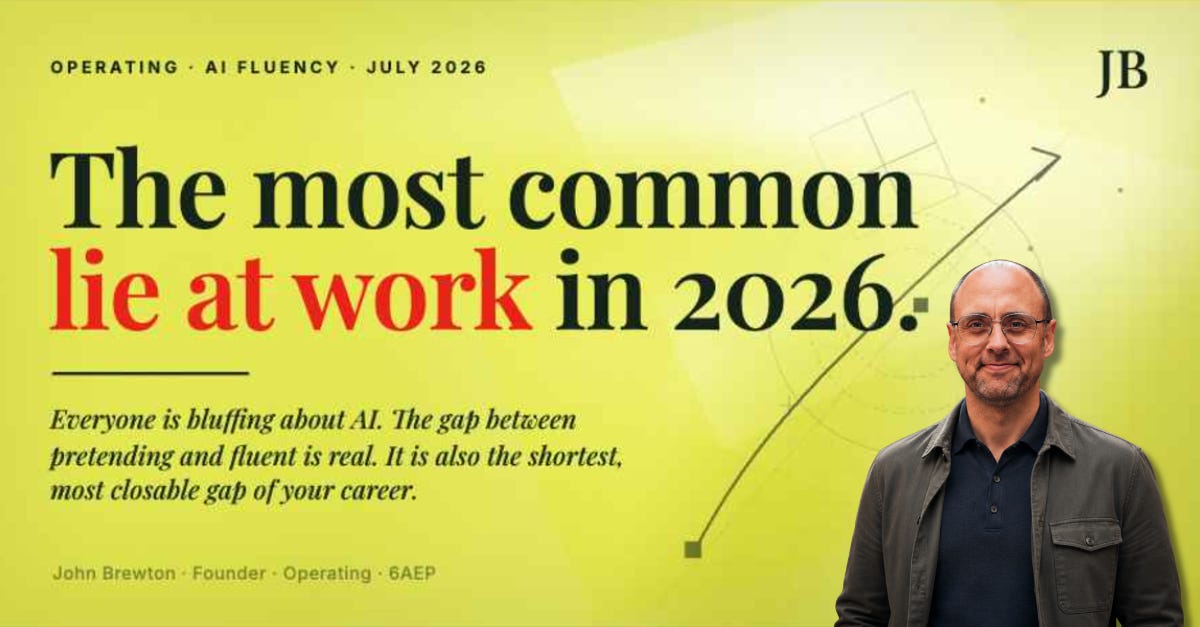
The Most Common Lie at Work in 2026
Everyone is bluffing about AI.The gap between pretending and fluent is real. It is also the shortest, most closable gap of your career.
Operating by John Brewton
Here is the secret almost nobody in your office or amongst your friend group is saying out loud. We are not using AI nearly as much as we pretend to, and we are not using it nearly as well as we would like the work world to think.
And that’s okay, friends.
This is one of the most common truths in the workforce and across corporates right now. The models sprinted ahead at a pace no prior technology has matched. Most people who did not start 2 years ago are quietly walking behind, overspending on tokens, prompting vaguely, and hoping nobody checks. Directors are reviewing reports that were completely generated by the models and are doing so with direct reports who can barely speak to their specifics. And the employees creating those reports are relying on models to draw conclusions from data that inaccurately communicates the company’s reality.
No shame in any of it, it’s just the simple, common truth of our times. The gap is real, but it is also the shortest, most closable gap of your career.
The space between layoff or promotion, anxiety and peace, becoming irrelevant versus becoming profoundly relevant to our companies’ futures is much smaller than we understand. Our social feeds, friendly conversations, and even late-night dreams are inundated with fearful headlines, images, and stories that we need to cast aside as we make the simple but powerful choice to become AI-fluent.
How I Built a $200,000 Newsletter Business From a Substack Nobody Was Reading
The Five Moves That Turned My Substack Into a $200,000 Business
The Operating Project: Most Coaching Ends With Notes. This Ends With a Machine.
TL;DR
Most people are using AI less and less well than they let on. So are most companies. The evidence says this is the norm, not the exception.
95 percent of enterprise AI pilots return nothing. The cause is a fluency and data gap, not weak models. (MIT NANDA, 2025)
“Workslop” is what the bluff looks like from the outside. It is a prompting-clarity problem that makes colleagues rate the sender 42 percent less trustworthy. (HBR)
The cost of a fixed level of AI performance fell by about 10 times per year, a 1,000x drop across 3 years. When the machine is nearly free, the value moves to the operator, who can aim it. (a16z)
AI raises the floor for everyone by about 14 percent on routine tasks. An uplift everyone gets is worth nothing as an edge. The edge sits at the ceiling, a 56 percent wage premium for real fluency. (Brynjolfsson, PwC)
The distance from bluffing to fluency is now measured in weeks, not years. Fluency is built, not innately gifted.
OPER(AI)TE · THE STAKES
A line is forming, and it runs straight through your industry. On one side are the people who use AI, or say they do. On the other hand, there are the people who operate it. The first group is already commoditized. The second group is getting promoted, paid, and hired to run the transformations the first group cannot finish.
Oper(AI)te exists to move you across that line before the fall. It is a live build, not a course you watch. Six sessions, a cohort, and a working staff of AI systems that you finish and keep. You can stop bluffing and get on with growing.
Use code TAKE500 to receive a $500 discount on your seat.
Why do 95 percent of enterprise AI pilots fail?
They fail on fluency, not on technology. MIT’s NANDA initiative studied enterprise generative AI and found that roughly 95 percent of pilots deliver no measurable return. The barrier was not model quality, regulation, or compute. It was a learning gap. Generic tools do not adapt to a company’s workflow; the data feeding them is too dirty to trust, and the people deploying them never learned to direct them.
Sit with what that number means for you personally. If you have been privately worried that you are the one who is behind, the evidence says otherwise. Nearly everyone is behind, including enterprises spending millions to make it look like they are not. You are not late. You are early and quietly bluffing, like almost everyone else in the building.
The same report found that internal builds succeed only a third as often as builds from vendor-purchased tools. Read casually, that sounds like an argument against building your own. It is the opposite. Internal builds fail because fluency is scarce. The operators who know how to scope, direct, and finish a build are the missing input, and they are the ones who turn a dead pilot into a working system.
The 95 percent that return nothing, against the thin margin that breaks through. The models were not the problem.
Is using AI the same as being AI-fluent?
No. Using AI is an activity. Fluency is direction. Harvard Business Review studied 2,500 employees over 8 months inside a company that already had high AI adoption. The best users did not use AI more than everyone else. They used it differently. They set ambitious objectives, treated AI as a reasoning partner rather than a task executor, and delegated complex work with clear, direct, thorough instructions.
The people struggling with AI are not failing at technology. They are failing at clarity. They prompt vaguely, burn tokens on wandering conversations, and get wandering output back. The fix is not a certification or a computer science degree. The fix is learning to say exactly what you want, with the context the model needs, in as few tokens as possible. That is a writing skill and a thinking skill that operators already possess.
The most striking finding in the study concerns measurement. Leaders track how much AI their people use because it's easy to see. They do not track how well because that number is hard to see and is the one that matters. Usage is a vanity metric. Fluency is the real one. Which is also why the bluff has survived this long. Nobody was measuring the thing that would expose it.
What is “workslop” and why is it not a character flaw?
Workslop is AI output that looks like work and shifts the real effort onto whoever receives it. Harvard Business Review found it now accounts for an estimated 15.4 percent of workplace content. Each incident costs the receiver close to 2 hours. Modeled across a 10,000-person company, the bill runs past $9 million a year.
The reputational cost is an issue. Colleagues rated the senders of workslop 50 percent less capable, 42 percent less trustworthy, and 54 percent less creative. Un-fluency is not neutral. It leaves fingerprints, and everyone around you can see them.
Workslop is not a you problem. It is a clarity problem. It is the direct byproduct of vague prompting meeting dirty data, a person who has not yet learned to direct the model, working inside a company that has not yet cleaned what the model reads. Both halves are fixable, and neither is a verdict on anyone’s intelligence. The data mess is not incompetence. It is the plumbing that needs to be fixed. The vague prompt is not a lack of talent. It is an unpracticed skill; it takes roughly 6 weeks to become competent.
OPER(AI)TE · WHAT YOU BUILD
Fluency is not something you watch. You get fluent by building real tools, on your real work, until the systems run without you narrating them. The bluff ends the first time a system you built does your actual job while you watch.
In Oper(AI)te, you build a staff of AI systems across 6 live sessions. A voice model trained on your own writing. Research and synthesis that deliver results in hours rather than afternoons. Meeting prep and first-draft decks in 45 minutes. One problem you choose, built live with the cohort. This is the same work inside John’s $50,000 to $250,000 consulting engagements, rebuilt for an individual operator.
Use code TAKE500 to receive a $500 discount on your seat.
Why does the falling cost of AI make skilled operators more valuable?
Because the scarce input ceases to be the machine and becomes the person aiming it. Andreessen Horowitz documents what it calls LLMflation. The cost of a given level of AI performance decreases by about 10x every year. GPT-3-level capability cost $60 per million tokens in 2021 and $0.06 per million tokens by 2024, a 1,000x collapse in 3 years.
Falling costs changed what AI could do. This changed who could use it. Which changed where the value sits. Most people are still arguing about which model to buy. The value already left the model and moved to the operator who can point it at the right problem, in the right way, without waste. Token efficiency is not a technical footnote. It is judgment, priced. The person who gets the right answer in 1 precise prompt is doing fundamentally different work than the person who circles it for 40.
Cost per million tokens fell from $60.00 to $0.06 in 3 years. As the machine approached free, the value rose to the operator.
Does AI give a company a lasting competitive advantage?
MIT Sloan Management Review clearly makes the argument. AI cannot deliver a sustainable advantage because access to models, data, and hardware is commoditizing in the same way access to personal computers and the internet did. Every rival will run the same models within a year.
What remains is the human layer. “AI does not change anything about the fundamental nature of sustained competitive advantage when its use is pervasive,” the review concludes. The differentiation moves to creativity, judgment, and the capacity to build. Those are the assets that are not commoditized by a vendor’s release schedule. For a company, becoming AI-native is not a purchasing decision. It is a fluency installation and workflow-reimagining event, person by person.
Does AI fluency actually raise your salary?
PwC’s Global AI Jobs Barometer puts the wage premium for AI skills at 56 percent. Roles that require those skills show pay growing 42 percent faster than roles that do not, and senior-level skills are appearing in junior AI-exposed jobs at 7 times the normal rate. Fluency is a promotable and money-making event for us operators.
The anxiety running through the workforce right now is rational. Layoffs are real, the pressure to sound confident about a technology you privately do not understand is real, and the people who were laid off and are now building consulting practices overnight are carrying both at once. The fear is rational. It is also pointed at the wrong thing. The threat was never the technology. The threat is staying a bluffer while the premium for being real compounds. The same force producing the fear is producing the widest opening most operators will ever get, and it is open right now.
The Brynjolfsson, Li, and Raymond study of 5,000 support agents found a 14 percent average productivity gain from generative AI, concentrated among the least experienced workers. AI lifts the floor for everyone. An uplift everyone receives is worth nothing as a differentiator. The premium migrated to the ceiling, to the people who can do what cheap, universal AI cannot do on its own. The distance between those two ends is now measured in weeks of deliberate building, not years of study. That is the part nobody carrying the anxiety has been told.
AI raises the floor by about 14 percent for everyone. Fluency reaches the ceiling, a 56 percent wage premium that stays scarce.
Has a technology shift like this happened before?
Twice, at least, and both times the pattern held. In 1979, VisiCalc put a spreadsheet on a personal computer. Within a decade, the tool was everywhere and nearly free. The people who captured the careers and the equity were not the ones who owned the software. They were the analysts who learned to model with it. The tool was the floor. Fluency was the ceiling.
Economic historian Paul David studied why electricity produced almost no measurable productivity gains for 40 years after its arrival. The dynamo was installed. The factories had not yet reorganized the work around it. The gain came only when the work changed, not when the machine did. MIT’s learning gap is the same finding, a century later. There is one difference this time, and it favors you. The spreadsheet and dynamo generations had to wait decades for the reorganization. This skill installs in weeks, on tools that cost less per month than a business lunch.
How do you actually become AI-fluent?
You build. Reading about AI produces the same result as reading about swimming. Start this week with 1 task you repeat every day, build an AI system that handles it end-to-end, and measure the time it takes to return. That single loop, run repeatedly, is the entire difference between using AI and operating it.
You do not need to write code. You do not need a developer. You do not need to have been early. You need clear prompting, clean inputs, and the discipline to build instead of watch. The most efficient way to destroy your own relevance is to wait for your employer to train you. The operators who close the gap first will spend the next decade running the transformations everyone else is still piloting, and they will do it without the knot in their stomach, because the confidence will be real.
What are the Oper(AI)te workbooks, and why should you never print them?
They look like documents. They behave like software. Sound Like You, the voice workbook, is the one I hand people first. It runs 21 pages, 4 steps, and about 1 hour, and the first inside page says it plainly. This is not a worksheet. Do not print it.
You upload the whole file to Claude, ChatGPT, or Gemini. The model reads it, finds the instruction block written directly to it, and turns into your interviewer. It asks 9 questions about how you actually write, pushes back when an answer is vague enough to describe anybody, collects real sentences you have written, and assembles the output. A locked voice profile. A measured prohibition list of the words and phrases that mark a draft as machine-made, each ban backed by published frequency data. A scoring audit that catches those tells in any draft you produce from that day forward.
Look at what that object is. A program, delivered as a document, that runs on whatever model you already pay $20 a month for. The document is the software. The model is the computer. Your work is the data. An operator 30 years ago would have called it a disk, and that is how to think about the full set. There is one for each segment of the course. Voice. Research. Administrative and calendar management. Brand identity. Each installs a capability into your model, then helps you direct your growing staff of agents with it.
How a workbook installs. The document goes into the model, the model interviews you through 9 questions, and a working skill comes out the other side.
Notice what the voice workbook does in the language of this article. Its entire function is to strip the machine accent out of your writing until what is left is you. It is an un-bluffing machine. You hand it to the model, answer honestly for an hour, and one of the fingerprints that exposes the bluff is gone for good.
Why does watching the build matter more than the curriculum?
Because fluency transfers by observation, not by syllabus. In the course I do not present these workbooks as finished artifacts. I build them live, from scratch, with the cohort watching. You see how I speak to the models. How I prompt, how I direct, how I tweak when the output drifts, how I adjust when a platform update changes the behavior underneath me. That layer never survives the trip into a slide deck or a recording, and it is the layer that actually makes someone fluent.
For more than 2 and a half years, all of my work has run through these models and platforms. Every capability jump, every quiet regression, every workflow rebuilt mid-quarter because a release changed what was possible, absorbed step by step because the business depended on it. The cohort compresses those spans into 6 sessions of standing next to the work as it happens. This is the oldest training method there is. The apprentice does not learn the trade from the manual. The apprentice learns it beside someone who has already made the mistakes, and asks questions while the tool is still open on the bench.
The individual Oper(AI)te cohort is $2,499. Set that number next to a 56 percent wage premium and a market where 95 percent of companies are still waiting up to 3 years for a return they may never see.
You leave with a staff of AI employees that does your real work, not a certificate that says you watched. Six build sessions. Two weekly Operator Build Labs. One cohort. A workbook for every segment, built live in front of you and installed into your own model.
Everyone is bluffing.
You no longer have to. It’s time to start building your AI-Fluent future.
Use code TAKE500 to receive a $500 discount on your seat.
FAQ
What is AI fluency? AI fluency is the ability to direct AI systems toward real work precisely, cheaply, and end to end. It is distinct from AI usage, which is measured by activity. Fluency is measured by output, by token efficiency, and by the systems you can build and run.
Is everyone really exaggerating how much they use AI? The measurable evidence points that way. 95 percent of enterprise pilots return nothing, leaders track usage instead of skill, and 15.4 percent of workplace content is AI output that pushes work onto the receiver. The gap between claimed adoption and real fluency is the defining feature of this moment.
Why do most enterprise AI projects fail? Because of a learning and data gap, not model quality. MIT found 95 percent of pilots return nothing. Generic tools do not adapt to a company’s workflow, the underlying data is too messy to trust, and most teams never build the fluency to fix either.
Is it too late to learn AI in 2026? No. The wage premium for AI skills is 56 percent and the skill requirements are still moving faster than most workers, which means the gap is open and closing. The honest starting point is admitting where you are, and nearly everyone is starting from the same place.
Will AI replace my job? AI raises the baseline for routine tasks by roughly 14 percent, which compresses the bottom of the skill curve. The durable roles belong to operators who build and direct AI, not to those who only produce the same output AI now produces for free.
What is workslop? Workslop is AI-generated output that looks like work but pushes the real effort onto the receiver. It accounts for about 15.4 percent of workplace content and makes the sender look 42 percent less trustworthy to colleagues. It is a prompting-clarity and data-quality problem, not a character flaw, and it is fixable.
What is Oper(AI)te? Oper(AI)te is a live, 6-session build program by John Brewton that teaches operators to build and direct AI systems on their own real work. Participants leave with a working set of AI tools, not a video library. The individual cohort is $2,499.
Who is Oper(AI)te for? It is built for operators. Employed managers, directors, executives, founders, and owners running lean, including people rebuilding as consultants or coaches after a layoff. It is not built for anyone looking for passive consumption or a done-for-you service.
How is Oper(AI)te different from a normal AI course? A normal course is something you watch. Oper(AI)te is a build you finish. The tools are built live from scratch in front of the cohort, so you see the prompting, directing, and adjusting that recordings never carry. Fluency comes from that, not from lessons.
What are the Oper(AI)te workbooks? They are documents designed to be uploaded into Claude, ChatGPT, or Gemini rather than printed. The model reads the workbook, interviews you, and assembles a working skill from your answers, such as a voice profile, a research system, a calendar and administrative manager, or a brand identity. One ships with every segment of the course. Sound Like You, the voice workbook, takes about 1 hour and runs 4 steps.
Appendix · Sources
MIT NANDA initiative, on the 95 percent enterprise AI pilot failure rate and the learning gap, reported by Fortune, August 2025. Link
MIT Sloan Management Review, “Why AI Will Not Provide Sustainable Competitive Advantage.” Link
Harvard Business Review, “What the Best AI Users Do Differently,” March 2026 (study of 2,500 employees over 8 months with KPMG and UT Austin). Link
Harvard Business Review, “AI-Generated ‘Workslop’ Is Destroying Productivity,” September 2025. Link
Andreessen Horowitz, “Welcome to LLMflation,” on the 1,000x decline in inference cost. Link
Brynjolfsson, Li & Raymond, “Generative AI at Work,” NBER Working Paper 31161, published in the Quarterly Journal of Economics, 2025. Link
PwC, 2026 Global AI Jobs Barometer, on the 56 percent wage premium and 42 percent faster wage growth. Link
Deloitte Insights, “AI tokens: How to navigate AI’s new spend dynamics.” Link
Note on sourcing: findings 1, 7, and 8 come from MIT NANDA, PwC, and Deloitte, which sit just outside the core elite-source tiers used for the rest of this piece. They carry the most quotable figures and are flagged here for transparency.
John Brewton documents the history and future of operating companies at Operating by John Brewton. He is a graduate of Harvard University and began his career as a PhD student in economics at the University of Chicago. After selling his family’s B2B industrial distribution company in 2021, he has been helping business owners, founders, and investors optimize their operations ever since. He is the founder of 6A East Partners, a research and advisory firm asking the question: What is the future of companies