

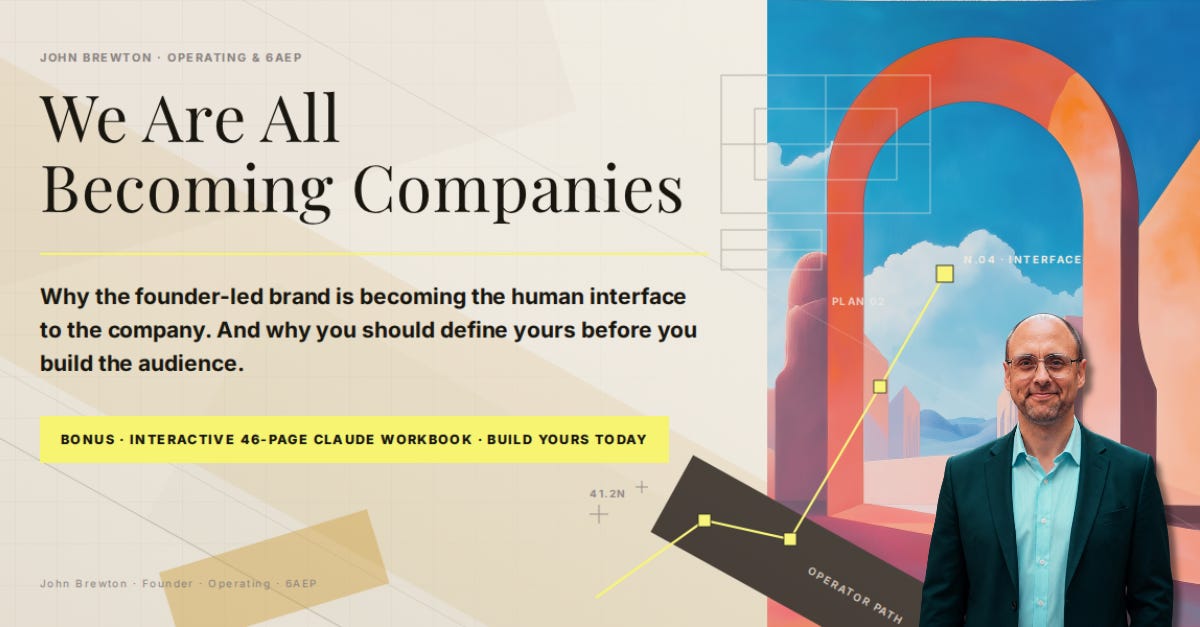
Every company is racing toward the same destination. They are buying the same AI models, installing the same copilots, building the same agents and automating the same workflows. That will make companies more productive, but it will also make more of what they do easier for competitors to reproduce.
A study of 5,179 customer-support agents found that an AI assistant raised productivity most among novice and lower-skilled workers; other experiments with professional writing found faster, higher-quality output, while research into creative writing found that AI-assisted stories became better individually but more similar collectively. The floor rises, the range compresses, and competent work becomes more abundant.
At the same time, something is happening in the opposite direction. For more than a century, companies have manufactured humanity around an institutional container. Betty Crocker gave a flour company a woman customers could relate to; KFC turned its founder into an enduring character; corporate brands built voices and personalities because a legal entity has no childhood, scars, convictions or lived experience.
The company needed humanity because the actual human did not scale very well. Now the human scales. One founder can increasingly research, analyze, design, build, publish, distribute and operate with capabilities that once required teams.
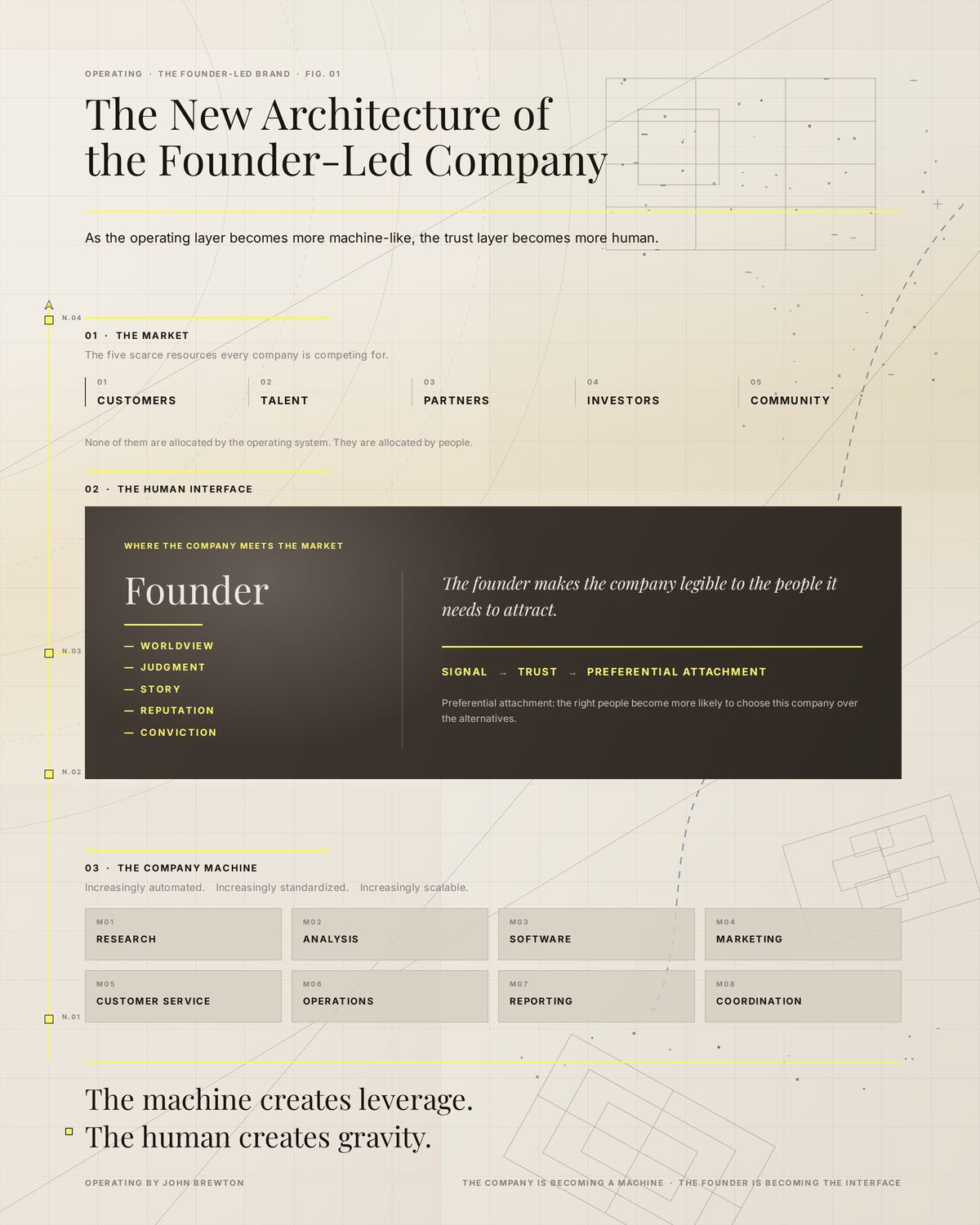
Companies are becoming more machine-like while people are acquiring the capabilities of companies.
We are all becoming companies.
How I Built a $200,000 Newsletter Business From a Substack Nobody Was Reading
The Five Moves That Turned My Substack Into a $200,000 Business
The Operating Project: Most Coaching Ends With Notes. This Ends With a Machine.
How to Produce World-Class Research with Perplexity Computer & Claude -> Fable 5
The Founder Becomes the Human Interface
A founder-led brand makes the company’s judgment, worldview and reason for existing more legible. Customers, employees, partners and investors are not only evaluating what a company sells; they are deciding whether they trust the people and ideas behind it.
Andreessen Horowitz has been building an explicit New Media strategy around a similar shift. Its recent New Media Playbook argues that individuals increasingly matter more than corporate brands, while its Lighthouse Playbook says founders should define their worldview before growth tactics and create preferential attachment: enough signal and trust that scarce customers, employees, partners and other resources are more likely to choose your company.
You can see extreme versions in Alex Karp, Palmer Luckey and Elon Musk. They are polarizing, but structurally useful examples: their names carry recognizable worldviews, and their companies are understood partly through the founder’s public decisions and personality. a16z has itself highlighted Musk and Karp as examples of technical thinkers newly advantaged by long-form and clip-based media, while giving founders like Palmer Luckey extensive space to communicate their ideas directly.
You do not need their fame or controversy to learn from the structure. If your name is going to become one of your company’s important interfaces with the world, define what that name means before you spend years amplifying it.
I Learned the Distribution Playbook First
I know this partly because I built my own audience in almost the opposite order. When I started creating content, I became obsessed with distribution: I committed to publishing every day for a year, learned LinkedIn deeply, invested in creator communities, and held more than 150 unpaid Zoom conversations with other creators.
It worked. I eventually documented the process in 0 to 55,000: The First 90 Days Playbook, and I still believe in much of it: show up, publish, build relationships, track what works, and get your reps.

One early breakthrough came from writing about Andy Grove’s High Output Management. Instead of summarizing the book, I wrote about mistakes I had made managing people myself, and the post took off. I came away with a formula I still believe in:
Credible source material + personal experience + external amplification = breakthrough.
But another lesson matters more now. For 12 to 15 months, I obsessed over follower growth and brand awareness while assuming the business model would eventually emerge. Viral posts sent large amounts of attention toward me before I had a sufficiently clear offer, owned audience or system for turning that attention into a business.
My conclusion at the time was: build the business while you build the audience. I still believe that, but today I would put another instruction before it: build the brand before you amplify the brand.
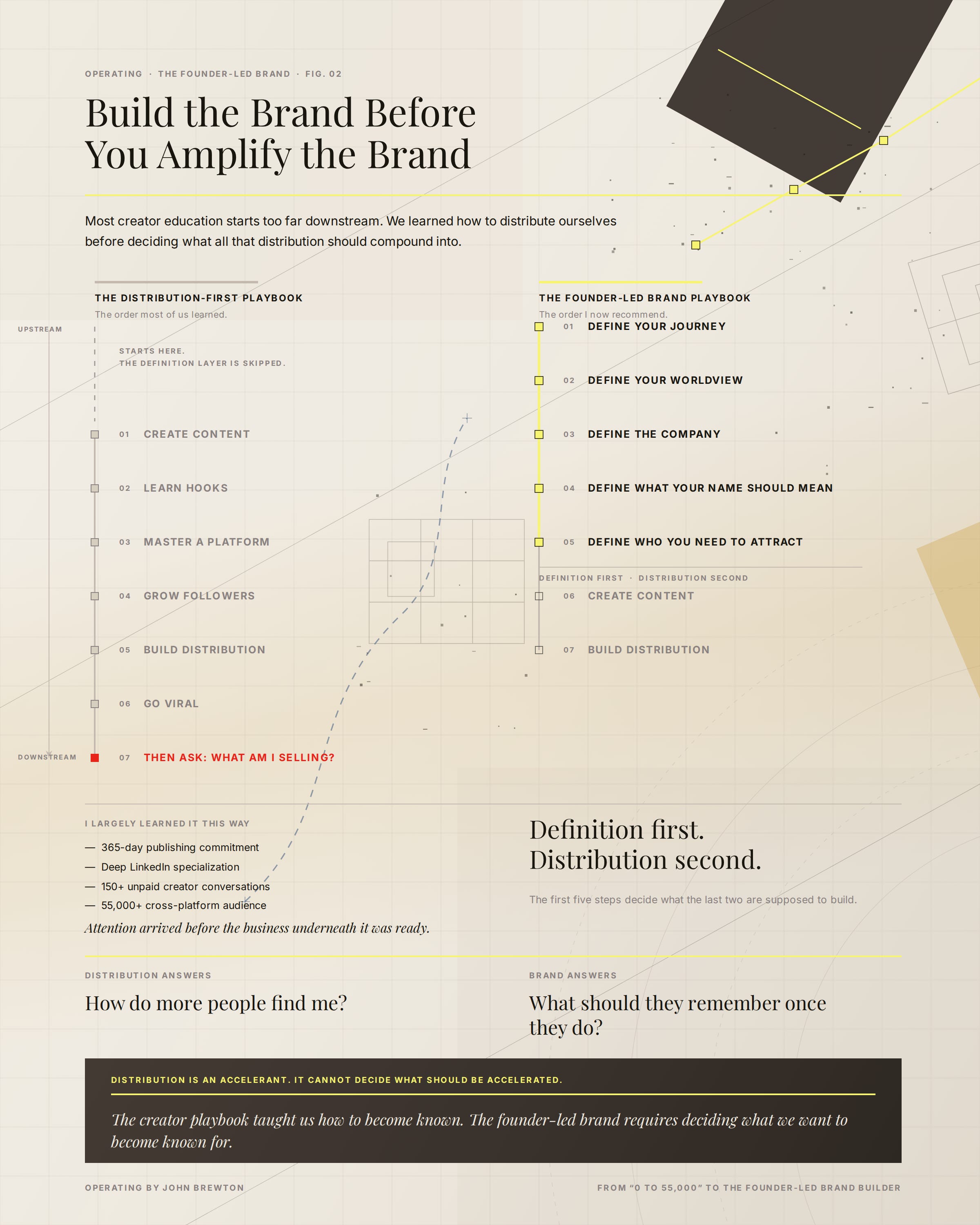
A lot of creator education starts downstream. It teaches hooks, carousels, social growth and distribution, all useful skills. But distribution is an accelerant; it cannot tell you what should be accelerated.
The creator playbook teaches us how to become known. The founder-led brand requires deciding what we want to become known for.
A Founder-Led Brand Is Not a Following
A founder-led brand is not your follower count, logo, headshot, or chosen family of fonts. It is not even your content; those are expressions and distribution layers targeted to your ICP. Your brand is the set of associations that forms when someone repeatedly encounters your name.
What do you believe?
What have you done?
What problem do you understand unusually well, what are you building because of it, and why should somebody trust you?
Eventually the question becomes more commercial: why should I attach myself to what you are building? The best founder-led brands do not simply create awareness; they make the right people more likely to move toward the company.
That is why I like a16z’s preferential attachment framing. Brand becomes more than communications.
Brand becomes a resource-allocation mechanism.
Seven Questions to Build Yours
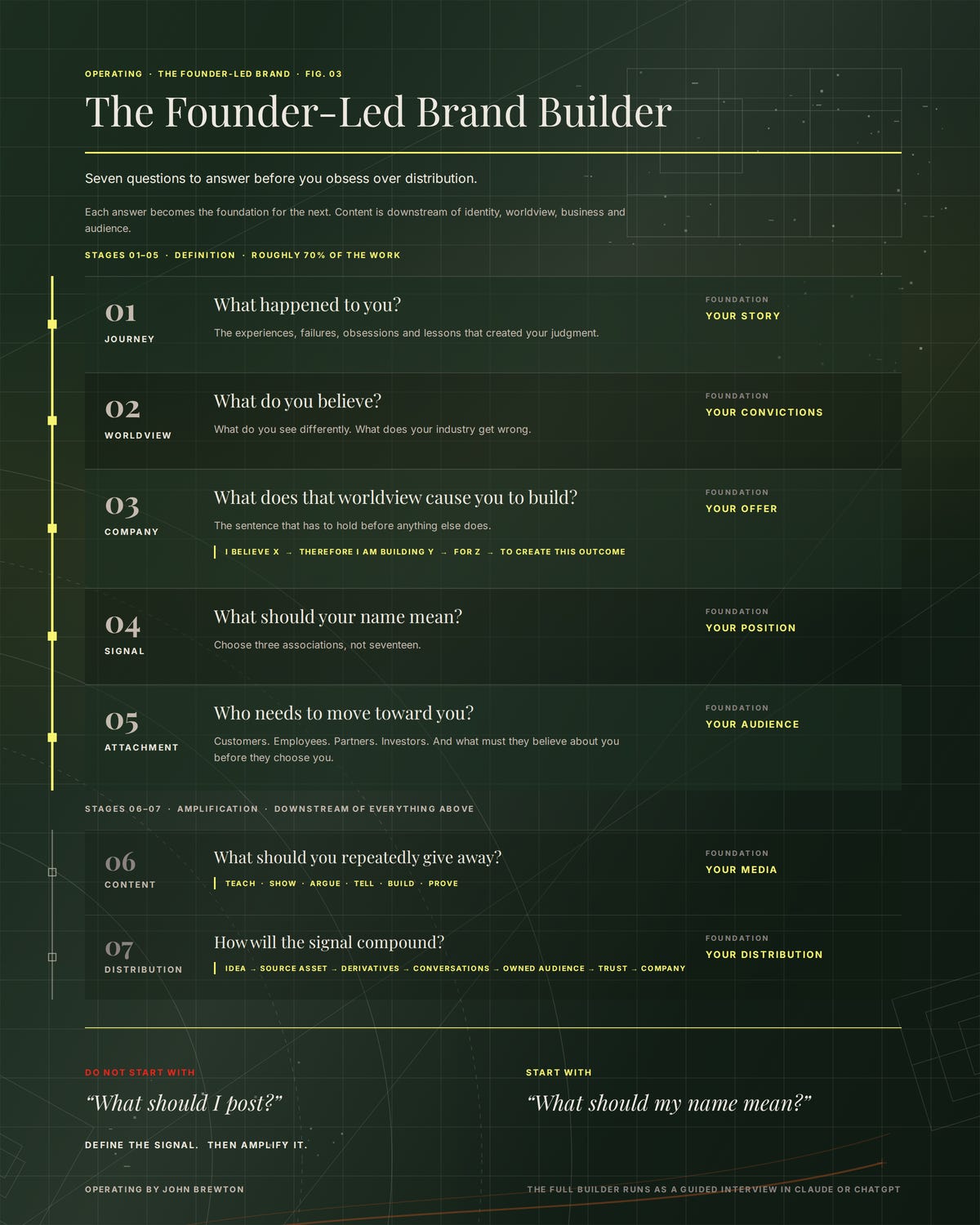
I think every founder should answer seven questions before obsessing over distribution.
1. What is your journey?
Your résumé compresses your life into titles, companies and dates. Your founder brand should recover the experiences that explain how you became the person making today’s decisions: the terrible boss, the company you failed to build, the customer who changed your mind, or the decade you spent learning something that only recently became useful.
The journey is the moat. A model can acquire much of the information you learned, but it did not live the sequence that formed your judgment.
2. What do you believe?
This is your worldview. Not “integrity matters” or “AI is changing everything,” but the things you see differently enough to take a position on.
What does your industry get wrong? What advice has become outdated? What future are you trying to create? A memorable founder-led brand comes from conviction, not manufactured controversy.
3. What company does that worldview lead you to build?
The founder brand has to connect to an actual business. Otherwise, you risk becoming an interesting creator without becoming a stronger founder.
The bridge should be simple:
I believe X. Therefore I am building Y. For Z. To produce this outcome.
If you cannot complete that clearly, the brand and company are still too disconnected.
4. What should your name mean?
Force yourself to choose three associations, not seventeen. What do you want somebody to think after encountering your work 20 times?
Then choose what you do not want to be known for. Brands are shaped by exclusion as much as addition.
5. Who do you want to attach to you?
Not all attention is equal. Whose attention could actually change the trajectory of your company: customers, employees, investors, partners or collaborators?
For each group, ask: what must they believe about me before they choose to move toward me? That is a better question than simply asking how to get more followers.
6. What should you repeatedly give away?
Only now do we reach content. Teach, explain, document, show your work and make your thinking useful enough that people understand your worldview through what you give them.
AI should make this easier. Use it for research, organization, editing and derivative content, but keep the scarce part human: the ideas, judgment, story and final selection. As a16z’s Olivia Moore argues in Humans Are for Ideas, AI Is for Execution, the increasing abundance of execution raises the relative value of distinctive ideas, taste and creative direction.
7. How will the signal compound?
Now design distribution. Choose an owned surface, a primary discovery channel, a long-form format, and a cadence you can sustain.
Founder-led should not mean founder-only. a16z’s Lighthouse Playbook extends the idea to executives, engineers, customers and advisors whose own expertise can become additional human nodes of trust around the company.
The Workbook I Wish I Had When I Started

I still believe in publishing before you feel ready, but before telling somebody to publish every day, I would now spend a few hours answering more fundamental questions. Who are you? What shaped how you see the world? What are you building because of what you believe, and what should your name mean to the people who matter?
So I built the Founder-Led Brand Builder for exactly that. Upload it to ChatGPT or Claude and the model interviews you one question at a time, pushes past generic answers, looks for patterns in your experiences and beliefs, and turns the conversation into a Founder-Led Brand Blueprint: your origin story, worldview, positioning, desired associations, target audiences, signature stories, content territories and a 90-day distribution plan.
The workbook cannot manufacture your brand. The raw material is your life; it simply helps you see that material more clearly before you amplify it.
If building this kind of business and capability is especially appealing to you, and you want to learn everything you can in the year ahead, become an Operating Founder and join my 52-week-per-year Friday live Q&A sessions with The Operating Founder Community. We are a +100-strong group of Operators and Builders choosing a new vision for our futures.
The Human Interface to the Company
Companies are going to become extraordinarily capable machines. We should automate workflows, deploy agents, standardize what should be standardized and use AI everywhere it creates leverage.
But something else should happen at the same time: the humans should become more visible. The judgment, taste, history, conviction, and people willing to attach their names to decisions should become easier to see.
AI is giving more of us the operational capabilities of companies. That means more of us need to start thinking like companies about what our names stand for. The creator playbook taught us how to become known; the founder-led brand starts with a different question:
What do you want to become known for?
Define that first, then build the business and the audience around it. Because when everyone has access to increasingly similar machines, who is operating the machine matters more.
Companies are becoming machines.
We are all becoming companies.
- j -
Want to Build This With Me?

If the hard part is not understanding this framework but actually turning your brand, offer or content strategy into a working system, that is what I built The Operating Project to do.
Across four one-to-one working sessions, we take one important problem in your business from diagnosis to a finished result. We build the strategy, create the artifact, and then install the ChatGPT or Claude system that keeps doing the work after our sessions are over.
If your problem is your founder-led brand, we can turn your worldview, positioning, offers and content into a system you actually own.
Learn Everything About The Operating Project and grab your seat →
Frequently Asked Questions
Is a founder-led brand the same thing as a personal brand?
Not quite. A personal brand can exist independently of a business; a founder-led brand is deliberately connected to the company you are building. Your worldview, reputation and identity create trust, but that trust should eventually make the company itself stronger.
Do I need to become an influencer?
No. The objective is not maximum visibility; it is useful visibility among the people whose decisions matter to your business. A founder with 5,000 highly relevant followers can have a far more economically valuable brand than someone with 500,000 people who have little connection to what they sell.
Do I need to become controversial?
No. Musk, Karp and Luckey are useful because their brands make the underlying structure obvious, not because founders should imitate their personalities. Distinctiveness requires conviction, not performative controversy.
Should AI write my content?
AI should absolutely help you research, organize, edit, repurpose and execute. I would be much more cautious about outsourcing your worldview, consequential opinions, personal experiences and final judgment; those are precisely the parts becoming more valuable as execution gets cheaper.
Does founder-led mean the company can never outgrow the founder?
No. In fact, the stronger model may eventually become a network of trusted humans around the company: founders, executives, technical leaders, employees, customers and advisors. The founder begins the signal; the organization eventually creates many credible sources of it.
What should I do first if I have no founder brand today?
Do not begin by choosing platforms or designing a content calendar. Start by answering three questions: What do I believe? What company does that belief cause me to build? What three things do I want my name to mean? Then use the Founder-Led Brand Builder to turn those answers into the rest of the system.
Appendix: Research and Sources
A. AI, Performance and the Compression of Competence
Erik Brynjolfsson, Danielle Li and Lindsey Raymond — “Generative AI at Work.”
NBER working paper studying 5,179 customer-support agents. AI assistance increased productivity by 14% on average, with substantially larger benefits for novice and lower-skilled workers. Read the research at NBER. (National Bureau of Economic Research)
Shakked Noy and Whitney Zhang — “Experimental Evidence on the Productivity Effects of Generative Artificial Intelligence.”
Published in Science. Participants using ChatGPT completed professional writing tasks substantially faster while average output quality increased. Read the paper in Science. (Science)
Anil Doshi and Oliver Hauser — “Generative AI Enhances Individual Creativity but Reduces the Collective Diversity of Novel Content.”
Published in Science Advances. AI-assisted stories were rated more creative and better written, while the collective set of outputs became more similar. Read the paper. (Science)
Andreessen Horowitz — “From Copilots to Agents: Rebuilding the Company Around AI.”
A current company-building example of AI moving beyond isolated assistance toward systems that perform increasingly large shares of business workflows. Listen/read at a16z. (Andreessen Horowitz)
B. Companies Manufacturing Human Identity
General Mills — “How Betty Crocker Got Its Start.”
The corporate history of the 1921 Gold Medal Flour promotion that led Washburn-Crosby to create Betty Crocker as a human persona for answering consumer questions. Read the history. (General Mills)
General Mills — “The Many Portraits of Betty Crocker.”
Additional history of how the fictional persona became a recognizable human face and trusted voice for the company. Read the history. (General Mills)
C. Andreessen Horowitz on New Media and Founder-Led Brands
Erik Torenberg, Ben Horowitz and Marc Andreessen — “a16z’s New Media Playbook.”
The February 2026 discussion in which a16z explicitly argues that individuals increasingly matter more than corporate brands and lays out its evolving approach to direct media. Listen at a16z. (Andreessen Horowitz)
David Booth — “The Lighthouse Playbook.”
The most directly relevant a16z source for this article. It argues that founders should define their worldview before growth tactics, develops the idea of preferential attachment, and describes how employees, customers and advisors can become trusted “lighthouses” around a company. Read the playbook. (Andreessen Horowitz)
Erik Torenberg, Alex Danco, Elena Burger, Henry Williams, Tom Hollands, Brent Liang and Gaby Goldberg — “New Media, One Year In.”
a16z’s June 2026 retrospective describes New Media as effectively “go-direct as a service” for startups and treats creative capabilities, owned distribution and founder communication as company-building infrastructure. Read the retrospective. (Andreessen Horowitz)
Olivia Moore — “Humans Are for Ideas, AI Is for Execution.”
A February 2026 argument that AI increasingly commoditizes execution while distinctive ideas, taste, identity and creative direction remain disproportionately human sources of value. Read the essay. (Andreessen Horowitz)
Alex Danco — “Why Nerds Are More Clippable.”
Explores how the shift from short, tightly controlled media appearances toward long-form source material and short-form clips creates new advantages for technical thinkers with distinctive personalities. The essay specifically cites Elon Musk and Alex Karp as examples. Read the essay. (Andreessen Horowitz)
Chris Dixon and Palmer Luckey — “Palmer Luckey on Hardware, Building, and the Next Frontiers of Innovation.”
A long-form founder conversation recorded at a16z’s Founders Summit and a useful example of the direct founder-media model discussed in the article. Watch/listen at a16z. (Andreessen Horowitz)
D. My Own Audience-Building Lessons
John Brewton — “0 to 55,000: The First 90 Days Playbook — What I’d Do Differently Knowing What I Know Now.”
My earlier breakdown of daily publishing, platform mastery, creator relationships, tracking and distribution—and, more importantly for this article, my realization that I spent too long optimizing follower growth before building the offers and business infrastructure beneath the audience. Read the full Operating article.
The same piece documents the early Andy Grove post that led me to the “credible source material + personal vulnerability + external amplification” formula and the 150+ unpaid creator conversations that became an important part of my education.
E. Work With Me
John Brewton — The Operating Project.
Four working sessions focused on one defined business problem and one finished outcome. The engagement moves from diagnosis to design, then builds a working system inside ChatGPT or Claude and installs it on a live piece of the client’s business. Learn about The Operating Project. (Operating by John Brewton)
The line that stops me is "people are acquiring the capabilities of companies." Capability isn't the same as capacity. Most founders scale the output long before they've built the internal structure to carry what that output starts demanding of them.
How does a brand wrapped entirely around the founder then get sold later? How does it get passed to an heir when the founder dies? What's the tangible asset in this realm of "personal brand" ?