

I wanted to build something more useful than another article you bookmark and never reopen. So this piece comes in layers.
The article gives you Grove's framework in under five minutes. Below it is a resource hub with a scored diagnostic, a decision-making exercise, and a full experiment library, each built with copy-paste prompts that turn Claude into a strategic advisor who tracks your business month to month and tells you what you do not want to hear.
Every tool includes instructions for setting up Claude Projects so the system stays alive between conversations and gets sharper the longer you use it.
I hope this helps.
- john -

100 People Became Operating Founders in Two Weeks
So I’ve opened 100 new seats (50 are already taken).
What You Get
Every Friday, you get a 60-minute live cohort session with me. Here’s what’s inside:
The real numbers. Behind the scenes of everything I’m building — strategy, mistakes, pivots, revenue — documented in real time.
Business model development. Business plans, pricing strategy, revenue models, and scalable operations — not content tips.
Live tutorials + my actual data. The same Google Sheets I use, walked through live. No curated screenshots.
Every template I use. Download and deploy immediately.
20 min of open Q&A. Strategy, content, growth, monetization — nothing off-limits.
Monthly guest speakers. Platform growth, content design, creator ops, and the tools that actually move the needle.
Access to a community of top-quality Substack writers and collaborators to build your audiences and content alongside and in partnership with.
$99 gets you 52 consecutive weeks — a front-row seat to how I build everything, plus a cohort of serious founders building alongside you.
The offer closes February 28th, or when the remaining 50 seats fill. Whichever comes first.
Once they’re gone, the Operating Founder tier goes away entirely.
[Become an Operating Founder → 50 seats remaining]
Start Here
Grove wrote Only the Paranoid Survive as the CEO of Intel. But his real contribution was a system any business can use to recognize when the current game is over and find the next one. This is my attempt to scale it down to something you can run from a laptop.
At the start of Only the Paranoid Survive, Intel is not the Intel we know. It is a memory company. DRAMs are its identity, its pride, its origin story. Then Japanese competitors arrive with lower costs, better quality, and patient capital. The old moves stop working. Grove eventually makes the call that defines the company: exit memories, pivot to microprocessors.
Inside the building, that decision feels like amputating a limb. Outside, in hindsight, it looks obvious.
You and I don’t run Intel. But we live smaller versions of this arc constantly. Your main traffic source collapses after a platform tweak. A new AI tool does 70 percent of what you sell, for free. A customer segment you built around quietly stops buying.
Grove’s core question is the same one you face: what do you do when the way you have always made money quietly stops working?
What Is a Strategic Inflection Point?
Grove called it a strategic inflection point: the moment when forces shaping your business change enough that the old rules no longer apply. Not 10 percent more competition. An order-of-magnitude shift in technology, regulation, or customer behavior.
From the inside, it does not arrive as an announcement. It feels like this: what used to work stops working, even when you execute well. Your forecasts break. Small, weird competitors suddenly matter more than the big, familiar ones.
The language matters. Once you can say “this might be a strategic inflection point,” you give yourself permission to ask a bigger question than “how do I fix my funnel?” The question becomes: is it time to change the business, not just the tactics?
How to Build a Paranoia Radar for Your Business
Grove’s paranoia was not anxiety. It was a radar. At Intel, he leaned on people at the periphery, sales reps and field engineers, because they felt shifts before the spreadsheets showed them.
If you are a solo operator or running a small team, that radar has to be built into how you work. Three inputs matter most.
Metrics that actually represent health. Leads per week, close rate, churn, effective hourly rate. Watch for decoupling: more effort, worse results.
Customer conversations. Keep a running log of objections, new use cases, and tools your customers are trying instead of you. Pay attention when the questions change.
Edge competitors and substitutes. Once a month, ask: what are my customers trying instead of hiring me? Templates, AI tools, DIY, bigger platforms. These are the Japanese DRAM makers in your world.
Then run a 30-minute monthly paranoia review. What changed in my metrics? What changed in what customers are saying? What changed in the ecosystem? The goal is not to predict the future. It is to avoid being surprised by the present.
How to Run Bounded Experiments When You Don’t Know What’s Next
One of Grove’s best lines: “Let chaos reign, then rein it in.” Early on, you need experiments and multiple bets because you do not yet know which path will work. Later, you must converge.
For a small business, “chaos” means deliberately running bounded experiments. A 30-day positioning test around a narrower niche. A higher-ticket offer pitched to 10 warm prospects. A four-to-six-week sprint on one new channel with a concrete cadence. The chaos is in running multiple probes at once. The hard part is what comes after: you pick one direction and kill most of the rest.
Your unfair advantage over Intel is that you do not have fabs and 10,000 employees pointing one way. Your disadvantage is that the only person who can decide to rein chaos in is you.
Why You Have to Kill Your Old Business Identity
The most painful part of Grove’s story is not intellectual. It is emotional. Intel had to stop being “a memory company” to survive.
Grove once asked his chairman, Gordon Moore: “If we got kicked out and the board brought in a new CEO, what would he do?” Moore said he would get them out of memories. Grove responded: “Why shouldn’t you and I walk out the door, come back, and do it ourselves?”
Run that exercise on your own business. If an outsider took over tomorrow with no attachment to your history, what would they shut down? What would they raise prices on? Which customer segment would they walk away from? Pick the answer that makes you slightly nauseous and build a small, time-boxed test around it.
A Paranoid Operating System You Can Actually Run
Assemble this into a rhythm.
Weekly. One paranoia check: did anything signal that something important is changing? One micro-experiment with a clear hypothesis.
Monthly. Review your core numbers. Read through customer conversations for new patterns. Scan for ecosystem changes that could compound over six to twelve months.
Quarterly. Run the outside CEO exercise. Choose one bigger bet and give it a real 90-day run.
You do not need to live like a 1990s CEO grinding through back-to-back crisis meetings. You just need to be paranoid enough, in a structured way, that your business evolves a little faster than the world around it.
You Might Enjoy These
(Access the entire library of articles and resources for $7.99 per month)
0 to 55,000 - The First 90 Days Playbook - What I’d Do Differently Knowing What I Know Now
WINNING THE LOSER’S GAME: The Creator Economy and the Companies We All Need to Build
I built this article as a system, not just an essay. Below are the tools that turn Grove’s ideas into something you can run in your business this week. Pick the level that fits where you are right now.
📄 Read: The Visual Deep Dive

Download the full article as a designed visual PDF
The complete argument in a scannable, shareable format. Same ideas, better for reading on a tablet, printing, or sending to a business partner. If you prefer visuals over long-scroll text, start here.
📊 Assess: Strategic Inflection Point Diagnostic

Download the Inflection Point Diagnostic
A 12-question scored self-assessment organized into four categories: Execution Decay, Customer Signal Shift, Ecosystem Disruption, and Identity Grip. Score yourself, match your total to one of three interpretation bands (Stable, Watch Closely, Act Now), and see which category is your biggest risk. Includes a full Claude Project companion with monthly prompts and setup instructions so you can turn this into a living monthly practice with AI as your confrontation partner. Run it quarterly before your Outside CEO Exercise.
🎯 Decide: The Outside CEO Exercise
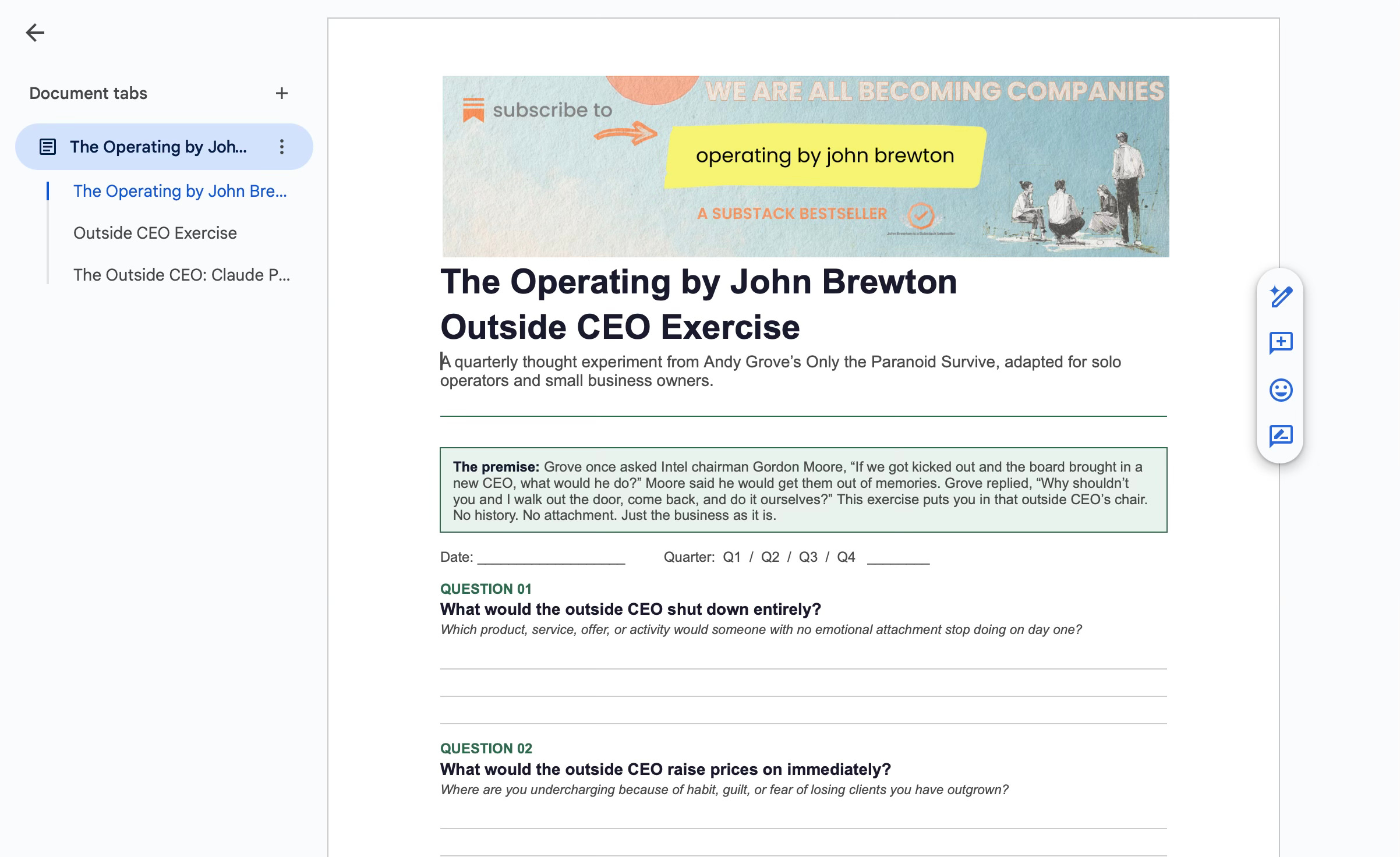
Download the Outside CEO Exercise
Five questions that put you in the chair of a new CEO with zero emotional attachment to your history. What would they shut down? What would they raise prices on? Which customers would they fire? Includes a Claude Prompt Companion with five copy-paste prompts engineered to produce the blunt, uncomfortable feedback you cannot get from yourself. Use it quarterly.
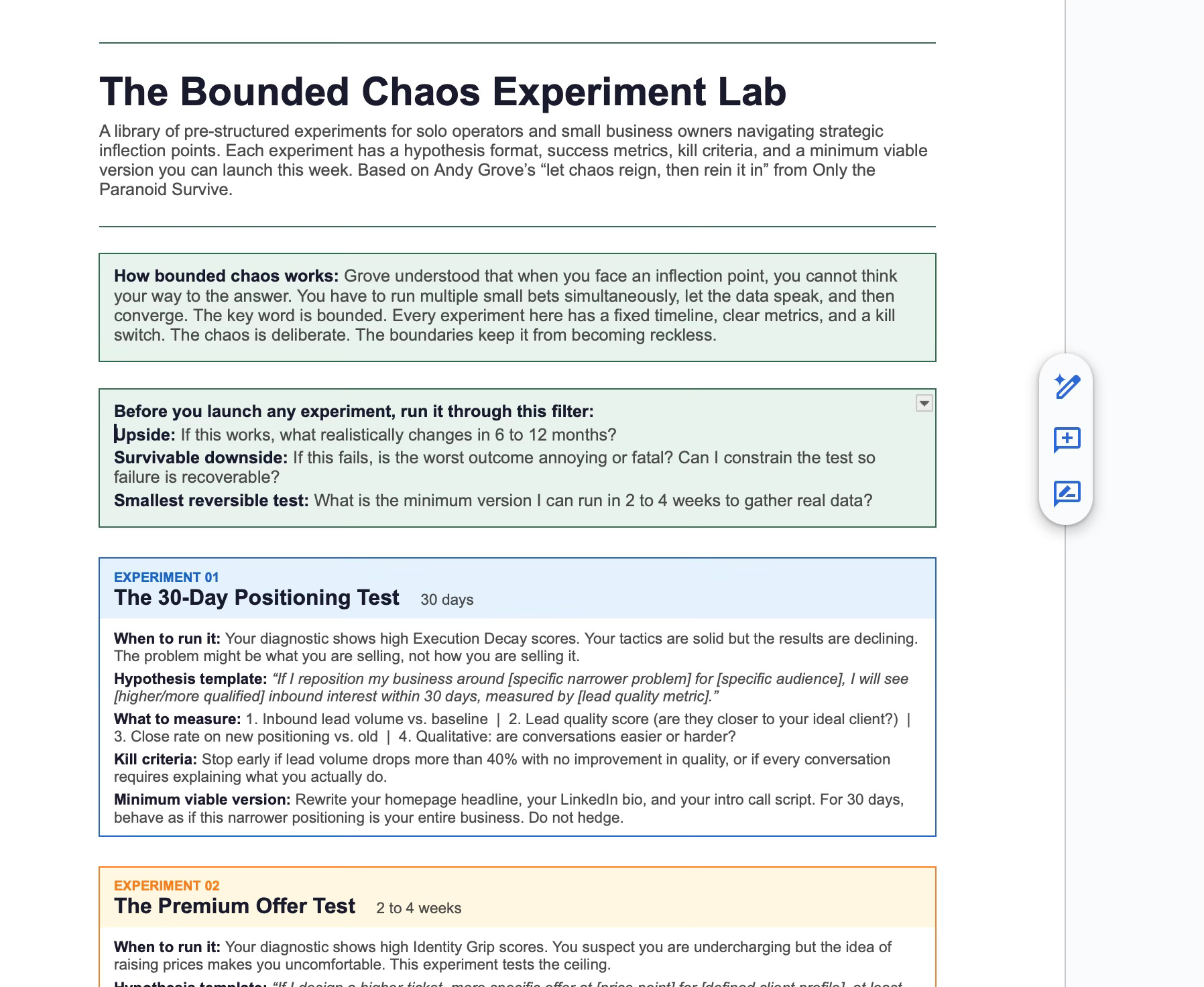
🧪 Act: The Bounded Chaos Experiment Lab (Paid Subscribers)
If the diagnostic told you to watch closely or act now, and the Outside CEO Exercise showed you what needs to change, the Experiment Lab gives you the system for testing that change without betting the whole business.
Six pre-structured experiments (positioning tests, premium offer tests, channel sprints, segment exits, content bets, pricing architecture shifts), each with hypothesis templates, metrics, kill criteria, and minimum viable versions you can launch this week. Plus a full Claude Project companion with lifecycle prompts that take you from experiment selection through the convergence decision.
This is the asset that turns Grove’s “let chaos reign, then rein it in” into an operating system.
👇 Available to paid subscribers below.
📚 Go Deep: The Full Long-Form Article and Research Appendix (Paid Subscribers)
The complete 3,000-word analysis including sections not in the condensed version above: a decision-making framework for uncertainty (upside, survivable downside, smallest reversible test), how to build constructive confrontation mechanisms when you work alone, how The Economist and The New York Times framed Grove’s ideas differently over two decades, and a full research appendix with categorized sources.
👇 Available to paid subscribers below.
