


AI Was Supposed to Kill Consulting. Instead It Has Started a Golden Age.
The Quiet Builders Are Coming. Great Companies Will Build Around Them.
Start Here
Executives and leaders have an AI Slop problem, and they’re not happy about it.
If they receive one more 40-page report that is nothing more than an AI dump about an issue they’re dealing with internally, manufactured from half-clean data and with zero examination, clean summarization, or actionable direction by the deliverer of said file, there are going to be issues…
A 40-page report can contain useful information and most likely still be a poor piece of work to put in front of an executive. The numbers might be right. The research might be relevant. But the person receiving it still has to identify the important part and decide what to do with it.
Add several reports like that to a normal working week, and the time saved by the people producing them becomes work for the people reading them.
AI makes this easy to do. Give a model enough company data, and it can produce a document that looks finished long before anyone has decided what belongs in it.
Companies need to spend some of the time they save generating work on deciding what is worth sending.
The cost of an unfinished report
There is evidence of the cost of skipping that step. In a September 2025 survey by BetterUp Labs and Stanford’s Social Media Lab, 40% of 1,150 U.S. desk workers said they had received low-quality AI-generated work in the previous month.
Resolving an incident took roughly 2 hours on average, according to respondents. The researchers call this “workslop.”
Long documents deserve particular attention. In Zapier’s survey of 1,100 enterprise AI users, 52% identified long-form reporting among the tasks requiring the most cleanup or rework. Both studies rely on people’s reports of their experience, rather than an audit of company productivity. They still describe a recognizable problem: work arrives looking more complete than it is.
The version that concerns me goes beyond bad information. A report can have plenty of substance and very little judgment about what the reader needs. The author has gathered the material and passed the selection work upstairs.
Christian Catalini’s work on the economics of AI explains why verification becomes more valuable as execution gets cheaper. Companies need to know whether they can trust what their systems produce. Curation adds another obligation: deciding which of those trustworthy findings deserve attention in this particular decision.
An executive needs enough detail to make a sound decision, with the supporting work available when needed. That requires someone to understand the material well enough to organize it around the decision.
The report remains unfinished until that last bit of work is complete.
Use the time AI gives back
The time to finish it is part of what AI gives us back. In a 2023 randomized experiment, Shakked Noy and Whitney Zhang assigned writing tasks to 453 professionals. Access to ChatGPT reduced completion time by 40% and increased assessed quality by 18%. These were bounded writing assignments, so the figures shouldn’t be treated as a forecast for every company’s work. They show that faster production and better work can go hand in hand.
We need to make a deliberate choice about where the savings go.
If a first draft that used to take an afternoon now takes 30 minutes, use the remaining time to examine the recommendation. Check the source behind the number that drives it. Consider the alternative the draft dismissed too quickly. Then edit the document for the person who has to act on it.
I think of this as the final 20%: the work between a plausible draft and something you are willing to put your name on. The percentage is shorthand. For a difficult decision, that stage may take most of the time.
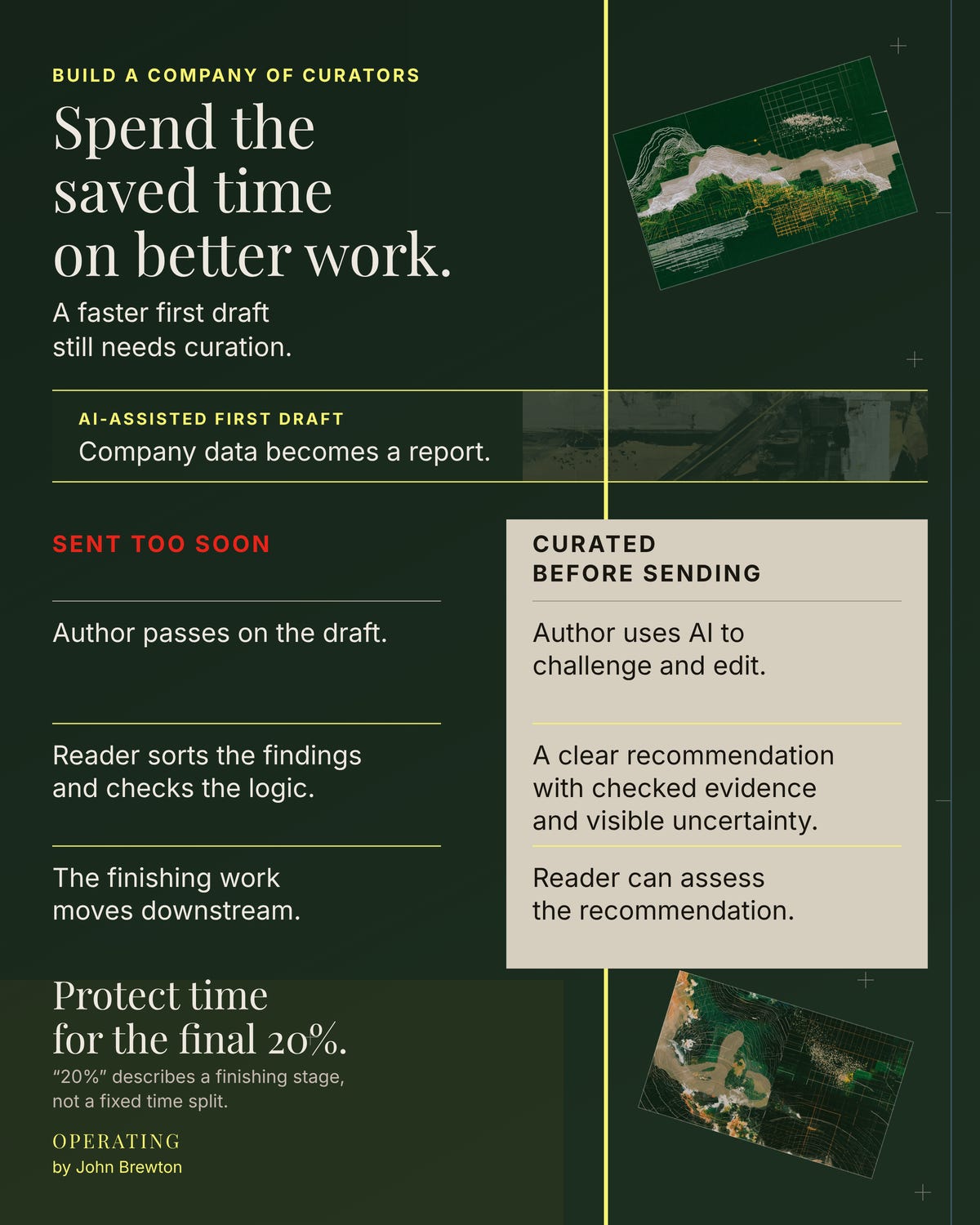
AI can help throughout it. It can compare alternative structures, identify repetition, and challenge whether a conclusion follows from the supplied evidence. We should use those capabilities to improve the final work. A faster first draft gives us room to raise the standard.

If you like this piece, you’ll love this one!
The 5 Curation Skills
Taste is the ability to recognize that standard in a particular context and explain why one version serves the reader better than another. In “The Overhang,” Ethan Mollick argues that, as production becomes easier, selecting what to keep and what to discard becomes a more valuable contribution. That’s a useful way to think about taste inside a company.
A finance team and a CEO may need different documents from the same analysis. The finance team needs enough detail to investigate. The CEO may need a recommendation about pricing and the evidence that would change it. Knowing how to serve each reader is a skill people can practice.
I would teach it through 5 curation skills.
1. Frame the decision
Before generating the report, finish this sentence: “After reading this, this person needs to decide _____.”
“An update on margins” leaves the assignment open. “Decide whether to change pricing on this product line before the next quoting cycle” gives the work a purpose. The reader’s responsibilities and the deadline determine what belongs in the brief.
For an informational update, name what the reader needs to understand and what would trigger action. There should be a reason to send it even when no immediate decision is required.
2. Judge the evidence
A confident paragraph and a well-formatted chart can make a weak conclusion look settled. Trace the claims that drive the recommendation back to their sources. Check the period covered and whether the data actually answers the question.
In a margin review, an observed decline is a fact. The explanation for that decline may still be an inference. A proposed price increase is a recommendation. Keep those distinctions visible, especially when the explanation is uncertain.
AI can help assemble a claim-and-source table. The author still needs to inspect the evidence behind the consequential claims. A second model agreeing with the first is insufficient on its own.
3. Rank what matters
Give the most consequential finding the most attention. A movement in a small product line may be interesting. A smaller movement in the company’s largest account may matter much more.
Ask AI to rank the findings against the stated decision and explain its ranking. Then challenge the order using what you know about the business. Financial size matters, but so can urgency or an obligation the model doesn’t understand.
The first page should make your priorities apparent. Equal space for every finding leaves the reader to establish the priorities themselves.
4. Connect the findings
Explain how the evidence leads to the proposed action.
In a hypothetical margin review, higher freight costs and lower margins might appear in separate sections. A useful analysis establishes whether freight explains the decline, how much remains unexplained, and whether changing prices would address it. Putting the observations next to each other doesn’t establish the connection.
Use AI to test the reasoning: have it identify the strongest supported objection and the missing evidence that could change the recommendation. Resolve those gaps or make them explicit in the brief.
5. Cut with care
Remove anything that doesn’t help the reader understand the decision, assess the evidence, or act. Move useful reference material into an appendix. Delete repeated background and findings included only because they were easy to generate.
Keep the uncomfortable fact that weakens your recommendation. Keep the uncertainty that could change the outcome. Curation becomes misleading when the editor removes the material a decision-maker most needs to see.
For each proposed cut, identify what the reader would lose. Sometimes the right answer is to keep the paragraph. A shorter document earns its length through better selection, not smaller type.
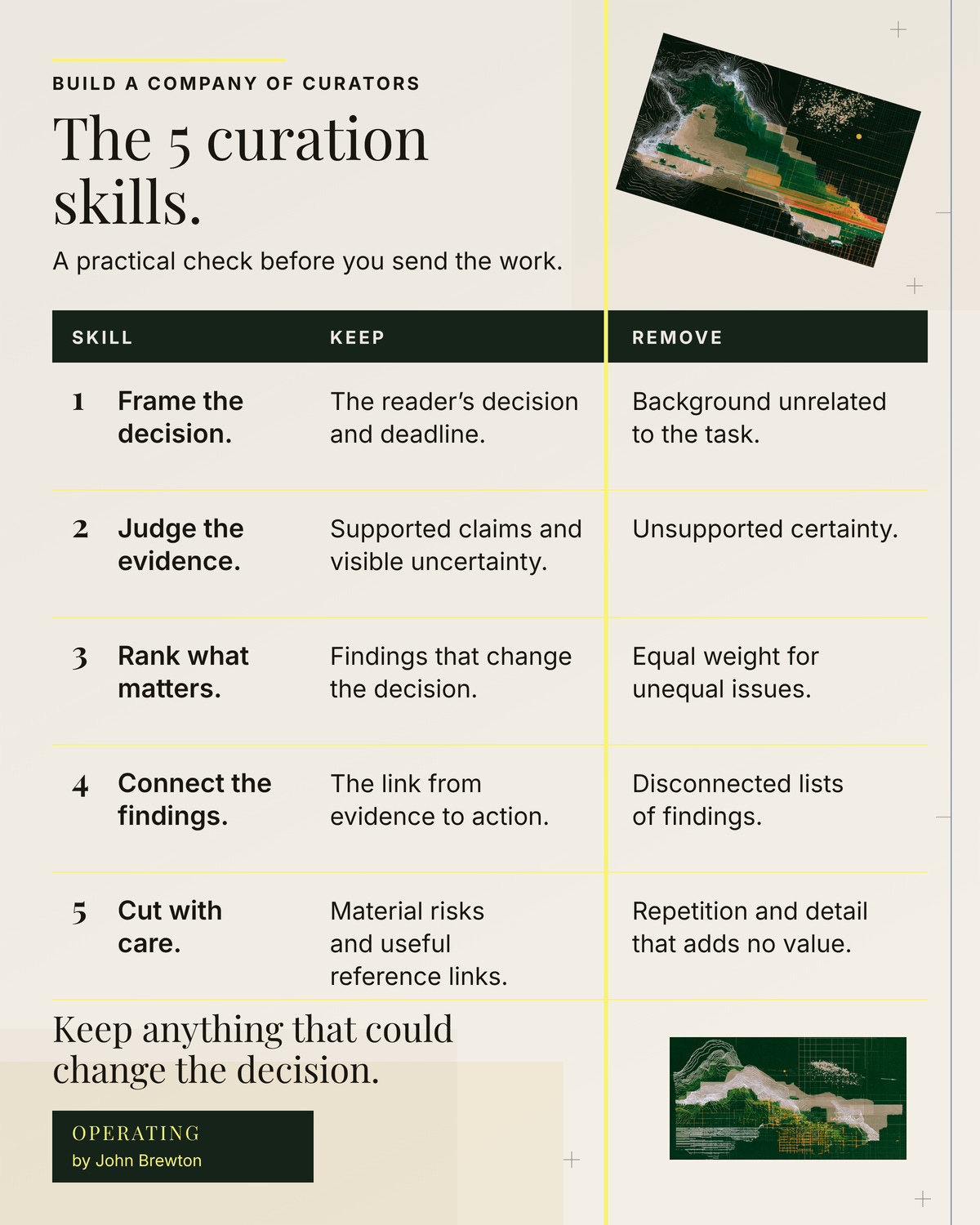
Use these 5 skills to select what the reader needs, including the evidence that complicates your recommendation.
Use AI to Help With the Edit
Employees can use AI for a separate editorial pass after the research and drafting. Give it the audience, the decision, and the source material. An instruction like this is much more useful than asking it to “make this better”:
Review this draft for the person who must decide [decision] by [date]. Identify the findings that could change that decision.
Show which consequential claims lack support in the supplied sources. Propose what to keep, move to the appendix, or cut, and explain each choice.
Preserve conflicting evidence and uncertainty that could affect the recommendation. Suggest a clearer order. Give me an edit plan before rewriting.
Review the proposed changes before accepting them. After the rewrite, compare the final brief with the source material and check what disappeared. The editing process can introduce omissions as easily as the drafting process can introduce errors.
Build curation into the job
This work needs a place in the job. A Microsoft Research and Carnegie Mellon study of 319 knowledge workers found that greater confidence in generative AI was associated with less reported critical thinking. It was a survey, not proof of skill loss. For a manager, it is a reason to make evaluation an explicit responsibility and give people the means to do it.
Leaders have to make the standard visible.
For a recurring executive report, agree on what “finished” means before the next version is commissioned. A useful default is a short opening brief containing the decision and recommendation, followed by the evidence needed to assess it. Material uncertainty belongs beside the recommendation. Supporting analysis should be easy to find. The document should name the person responsible for its conclusions.
Then show people examples. Keep a small library of strong briefs with annotations explaining the editorial choices. Include a before-and-after version so employees can see what was removed and why.
There is a useful research tradition behind this approach. Joanna Tai and colleagues’ work on evaluative judgment describes how learners can develop their ability to assess quality through examples and feedback. Applying that idea at work, I’d give employees 2 versions of the same brief and ask them to choose the stronger one, explaining their reasoning before a manager shares an assessment. That makes the company’s standards open to discussion and practice.
Protect some of the time saved for that work. If every faster draft earns the employee another assignment immediately, review will compete with a growing queue. An 8-month Berkeley Haas study at a 200-person technology company observed employees expanding their tasks and working longer hours as they adopted AI. That’s evidence from 1 company, but it is a useful warning against assuming that saved time will automatically translate into better judgment.
Return unfinished analysis with specific feedback and have the author revise it. Quietly rewriting everyone’s reports teaches dependence on the manager. Recognize useful selection, including the decision to stop producing a report nobody uses.
Managers should model the same discipline in what they send downward. Give a team a clear assignment with relevant context. Explain what needs their judgment. Forwarding an unreviewed AI analysis and asking everyone to make sense of it creates the same burden in the other direction.
Measure the result across the handoff. For 1 recurring report, record production time, review and correction time, and the recipient’s time spent clarifying it. Ask whether the brief supported the decision it was commissioned for. Faster drafting is a partial result until you know what happened to the people downstream.
Building a company of curators means developing this judgment throughout the organization. Start with the next recurring report. Have its author apply the 5 skills, use AI to challenge the edit, and get specific feedback from the recipient. Keep the changes that made it easier to use, and carry that standard into the next version.
- j -

AI Was Supposed to Kill Consulting. Instead It Has Started a Golden Age.
The Quiet Builders Are Coming. Great Companies Will Build Around Them.

John Brewton documents the history and future of operating companies at Operating by John Brewton. He is a graduate of Harvard University and began his career as a PhD student in economics at the University of Chicago. Since selling his family’s B2B industrial distribution company in 2021, he has been helping business owners, founders, and investors optimize their operations.
“Plausible” output does not mean you used the necessary critical thinking, judgment, and taste to create something additive, insightful, and meaningful. Every leader and manager delegates and gets back tons of slop with insights buried somewhere. This is huge problem in the org. This is indeed a path forward, John.