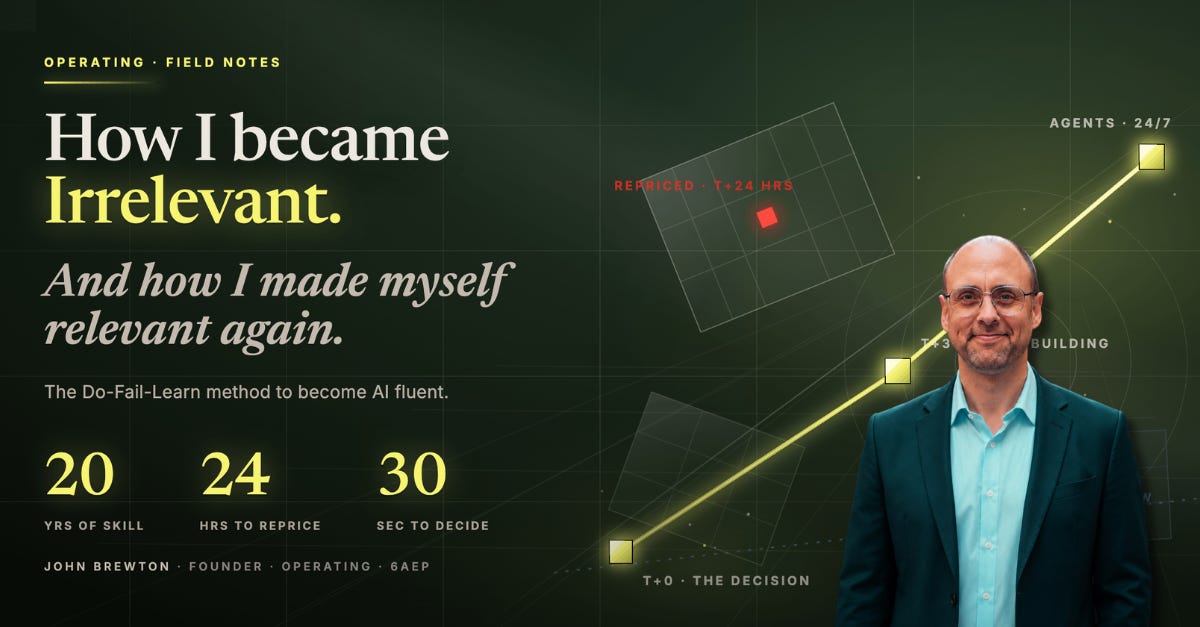
How I Became Irrelevant. And How I Made Myself Relevant Again.
The three-step loop that took me from irrelevance back to relevance: the Do-Fail-Learn Method to become AI fluent.
TL → DR
Two and a half years ago, a college intern on a consulting job I was working with zero hours in Excel and a $20 ChatGPT subscription completed work in 24 hours that I had blocked 25 to 35 hours to do myself, work built on skills I spent 20 years sharpening.
Being made irrelevant took 24 hours, and I never got a vote. Deciding to become relevant again took 30 seconds.
Fluency came from 1 method on repeat: Do. Fail. Learn. The skill that survived was not a skill. It was the decision to keep running the loop.
What happens when AI reprices 20 years of expertise?
The engagement was unglamorous. A consulting client needed to migrate to a new ERP system, which meant a mountain of dirty inventory data, the work no one wants. It was also the exact work I had spent 20 years building expertise in.
I had 1 person helping. A college intern, sharp, but with zero hours in Excel and zero in spreadsheets. Not a CS major. Not an engineer. Everything I knew how to do, he had never touched.
I handed him 3 things:
A laptop.
A ChatGPT subscription at $20 a month.
A pile of work I would not have time to finish.
The job required complex Excel workbooks, clean data, and advanced analysis. I had blocked 25 to 35 hours to do that work myself.
How I Built a $200,000 Newsletter Business From a Substack Nobody Was Reading
The Five Moves That Turned My Substack Into a $200,000 Business
The Operating Project: Most Coaching Ends With Notes. This Ends With a Machine.
How did an intern with no Excel skills finish 30 hours of expert work in 24 hours?
He came back in 24 hours. Most of it was done faster than I and cleaner than I. He also brought recommendations on where to take the analysis next and questions I had not thought to ask.
The method was simple. He never learned Excel. He asked ChatGPT to write code, dropped the code into Apps Script, and delivered everything I asked for and more. He never touched one of the spreadsheet skills I spent 20 years sharpening.
Sitting in that office, I said it out loud. I have become irrelevant. 20 years of hard skills, some of which I was very proud of, were repriced in an afternoon by a college intern with a $20 subscription.
What is the difference between being made irrelevant and becoming irrelevant?
I was made irrelevant. The repricing happened, and I never got a vote. Becoming irrelevant was up to me. Keep doing the old thing, and I would have finished the job myself, slower and prouder.
The repricing took 24 hours. The decision to do whatever I had to do to become relevant again took 30 seconds.
How do you become relevant again after AI reprices your skills?
The chain has 2 links. You become relevant by becoming fluent. You become fluent by running a loop, not by finishing a course.
Hard problems rarely yield to one attempt. They yield to a loop. You do. You fail. You learn. Then you run it again. Each turn carries the last correction forward. The failures get cheaper. The signal gets sharper.
How does the Do. Fail. Learn. Loop rebuild fluency in practice?
Do: The attempt, a specific bet put into contact with reality. I decided in that office and I tripled down. I pushed every workflow through these systems, smallest real attempt first, time-boxed. The chat tools were only the on-ramp. ChatGPT first, then Perplexity, then Claude, then Gemini. The first version was a probe, not the product.
Fail: The breakdown, reality returning a verdict I did not want. Prompts that produced garbage. Workflows that broke on contact with real client data. Automations I rebuilt 3 times before they held. Each failure was honest signal at contained cost. I named what broke, measured the gap, and kept the evidence. Failure was data, not identity. A cheap failure is a paid lesson.
Learn: The extraction, converting each verdict into a rule I could carry. Write the lesson down. Change 1 variable. Re-enter the loop. A lesson you cannot repeat is just a story. The correction is the asset.
Run with discipline, the turns compounded. What followed was more than automation. It was a retreat to first principles. Not the old workflow runs faster. A new operating model, with every process redrawn around what these systems can actually do.
Then the loop carried me past the chat tools entirely. I learned how databases were changing. I learned to ship AI-native applications. I learned to deploy agents through Cursor, Codex, and Claude Code, agents that do the work rather than answer questions about it. The work stopped stopping. I split jobs across machine instances running in parallel at 3 a.m., while I slept or worked on something else. The line that kept circling broke out.
What skill actually survives AI?
The skill that survived was not a skill. It was the decision to stay fluent. Staying fluent is refusing to exit the loop.
You will be made irrelevant. The shift is underway and you do not get a vote on that part. You do not have to become it. That part is a 30-second decision, and it is entirely yours. The decision has a method. Do. Fail. Learn. Run the loop until the breakout happens.
Oper(AI)te is where you build the whole staff, not one skill: 8 sessions, 4 employees, and the one workflow that defines your job, built start to finish with Wessal Khader and me.
The summer cohort starts July 21, and for the next 48 hours, you can use code EARLY500 to receive a $500 discount on the regular price of $2500. Seats are selling fast; make sure to grab yours today!
FREE DOWNLOAD
The Loop Log: the worksheet that runs the method. 1 page per turn, 10 turns. The bet, the verdict, the rule, the 1 variable changed. Print it or annotate it.
The 30-Day Fluency Sprint and the Failure Ledger arrive in the paid edition of this article on Saturday.
- j -
How do I build my first one?
You do not need to build all 25 to start. You need to build 1.
Become an Operating Founder. $99, one time.
What comes with it:
A live build session. We take one skill from this list and build it on screen, start to finish, yours to keep. You leave with a working employee and the method to build the next 24.
One year in my Skool community, with my Friday noon Q&A every week.
One 50-minute working session with me, one to one.
About John
John Brewton documents the history and future of operating companies at Operating by John Brewton. He is a graduate of Harvard University and began his career as a PhD student in economics at the University of Chicago. After selling his family’s B2B industrial distribution company in 2021, he has been helping business owners, founders, and investors optimize their operations ever since. He is the founder of 6A East Partners, a research and advisory firm asking the question: What is the future of companies
Frequently asked questions
What is the Do. Fail. Learn. method? A 3-step loop for problems that do not yield to one attempt. You make the smallest real attempt, log the verdict reality returns, extract a rule you can carry, change 1 variable, and run it again. Each turn carries the last correction forward.
How is this different from just practicing with AI? Practice repeats the attempt. The loop repeats the correction. Without the written rule and the 1 changed variable, you run the same turn 10 times and call it experience.
How long does it take to become AI fluent? The decision takes 30 seconds. The first automation that holds takes most people 2 to 4 weeks of daily turns. I ran the loop from chat tools to deployed agents in under a year, working 60 to 90 minutes a day.
Do I need to know how to code? No. The intern who repriced me had zero hours in Excel and never learned it. He asked the model to write the code. The loop teaches you to direct the work, not to type it.
Which AI tool should I start with? Any of the big ones. Claude is strong for writing and voice. Perplexity is built for research. ChatGPT and Gemini both work. The tool matters less than the turn count.
How do I know when a lesson is real? Run the test in the Loop Log. A lesson you cannot repeat is just a story. If the rule changes your next attempt, it is an asset. If it only decorates the last one, re-enter the loop.
Will AI make my skills irrelevant? Parts of them, and you do not get a vote on that. The repricing of my Excel skills took 24 hours. What you control is the other side: whether you become irrelevant, which is a decision, and it has a method.


