

Give the right people a reason to buy.

People can enjoy your posts for months and still have no idea what they can hire you to do. That gap between attention and a clear offer is what we’re tackling in Master LinkedIn’s New Feed and Build an Offer People Want.
On September 29, I’m joining Alicia Teltz and Wessal Khader for a free, 90-minute masterclass covering how to:
Get your content in front of relevant buyers as LinkedIn’s feed changes.
Use customer insights to identify problems your audience wants solved.
Turn those insights into an offer people understand and want to pay for.
If you’re putting time into LinkedIn and struggling to connect that effort to something you can sell, join us.
Tuesday, September 29 · 1pm Eastern / 6pm UK · Free · Online
Start Here
This year, I’ve trained hundreds of employees inside companies to use AI and become AI-fluent. I’ve also worked with executives and teams to build their personal capabilities and the systems that support them.
The same problems keep showing up. Someone has access but cannot find a use for it. Someone else gets a poor answer and gives up. A capable employee quietly wonders whether getting better at this means helping the company eliminate their job.
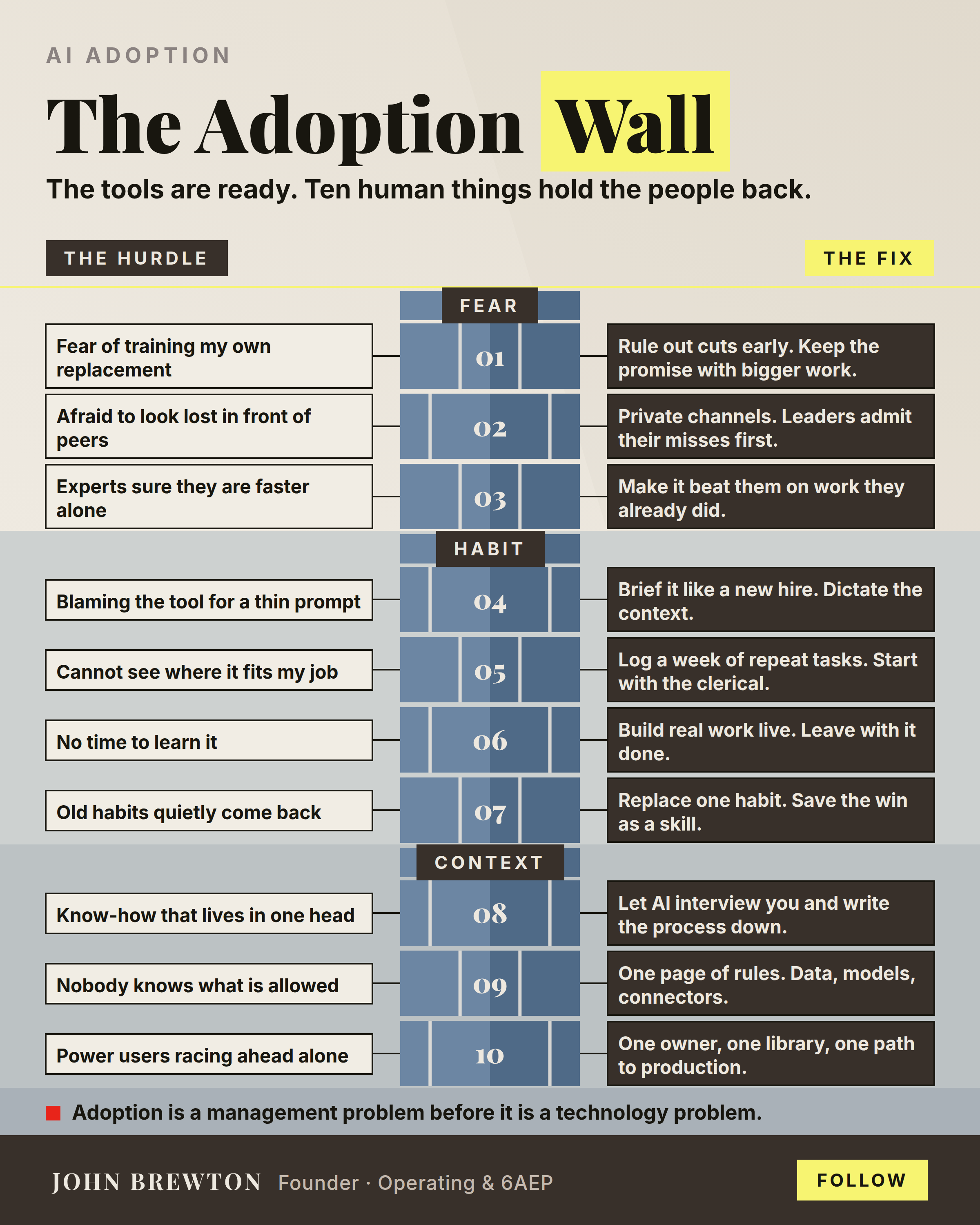
Adoption is a management problem before it is a technology problem.
That is the argument behind The Adoption Wall. Its 10 hurdles fall into 3 groups: fear, habit, and context. Each needs a different response. Another demonstration of what the software can do will only get you so far.
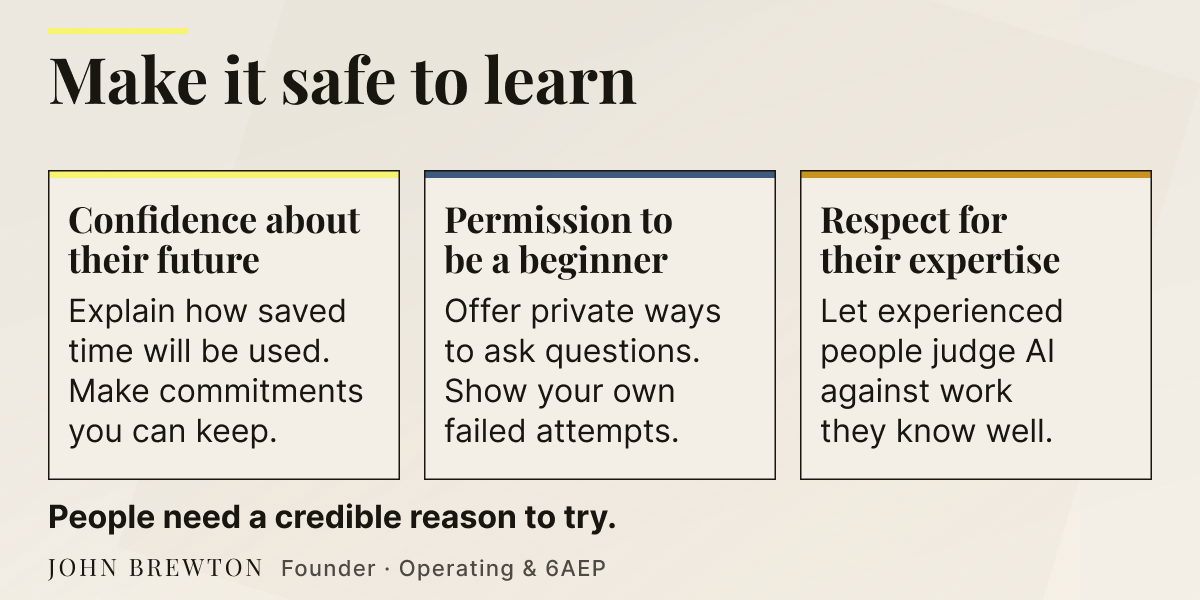
I start with fear because it changes how people interpret everything that follows. An employee who thinks they are training their replacement has a sensible reason to hold back. Asking them to document their knowledge and automate their work without addressing that concern makes the request harder to trust.
My advice to leaders is to state what this program is for and how the company will use the capacity it creates. If you can commit that the program will not drive job cuts, say so early and keep that commitment. Name the bigger work people will take on. Never borrow trust with a promise you cannot keep.
Then there is the fear of looking incompetent.
Experienced people have spent years becoming the person others ask for help. A blank chat window can put them back in the position of a beginner, this time in front of their colleagues.
I make room for private questions and encourage leaders to show their own failed attempts. People need to see a poor first answer get corrected. That gives them permission to learn without treating every attempt as a public assessment of their ability.

AI Was Supposed to Kill Consulting. Instead It Has Started a Golden Age.
The Quiet Builders Are Coming. Great Companies Will Build Around Them.
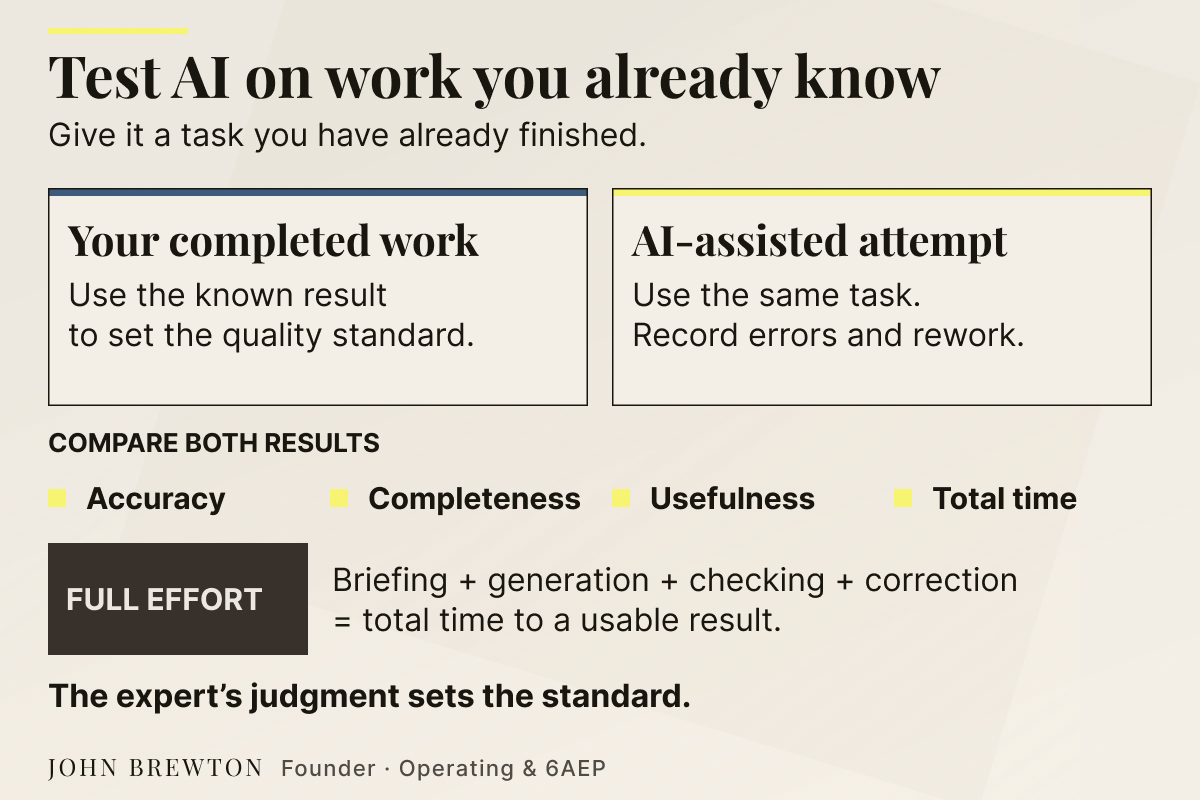
The confident expert presents a different challenge. They believe they are faster alone, and on some tasks they are. I use work they have already completed as the test. We have a known result and someone qualified to judge it. Then we compare the assisted approach, including the time needed to check and correct the output. The expert’s judgment sets the standard. A useful result earns another attempt.
Once people are willing to try, the next obstacle is how they work and improve.
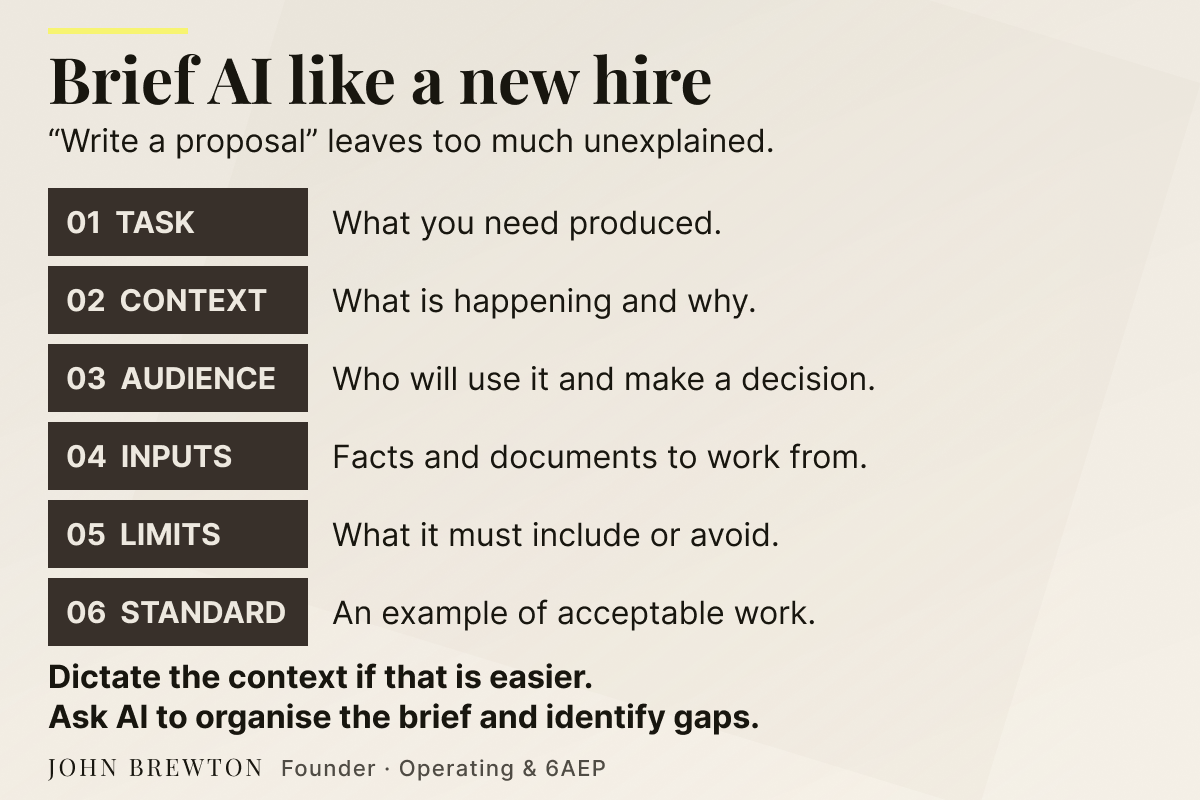
One of the most common mistakes I see is asking for a substantial piece of work with almost no context. The request might be “write a proposal,” followed by disappointment that the proposal sounds like every other proposal.
I teach people to brief AI as they would a new employee. Explain the customer’s situation and the decision the document needs to support. Supply the constraints and an example of acceptable work. State what information is missing.
For people who struggle to write that brief, I suggest dictating it. Talk through the situation as if you were explaining it to a colleague. Then ask AI to organize the brief and identify gaps before starting the work.
Finding the right task is another difficulty. “Use AI in your job” leaves a busy person with the entire problem of deciding where to begin.
I ask them to log repeated work for 1 week. Look for information they keep reformatting, notes they keep organizing, or routine drafts they keep rebuilding. Start with a clerical task whose result they can check. The first useful application should be easy to recognize in their working day.
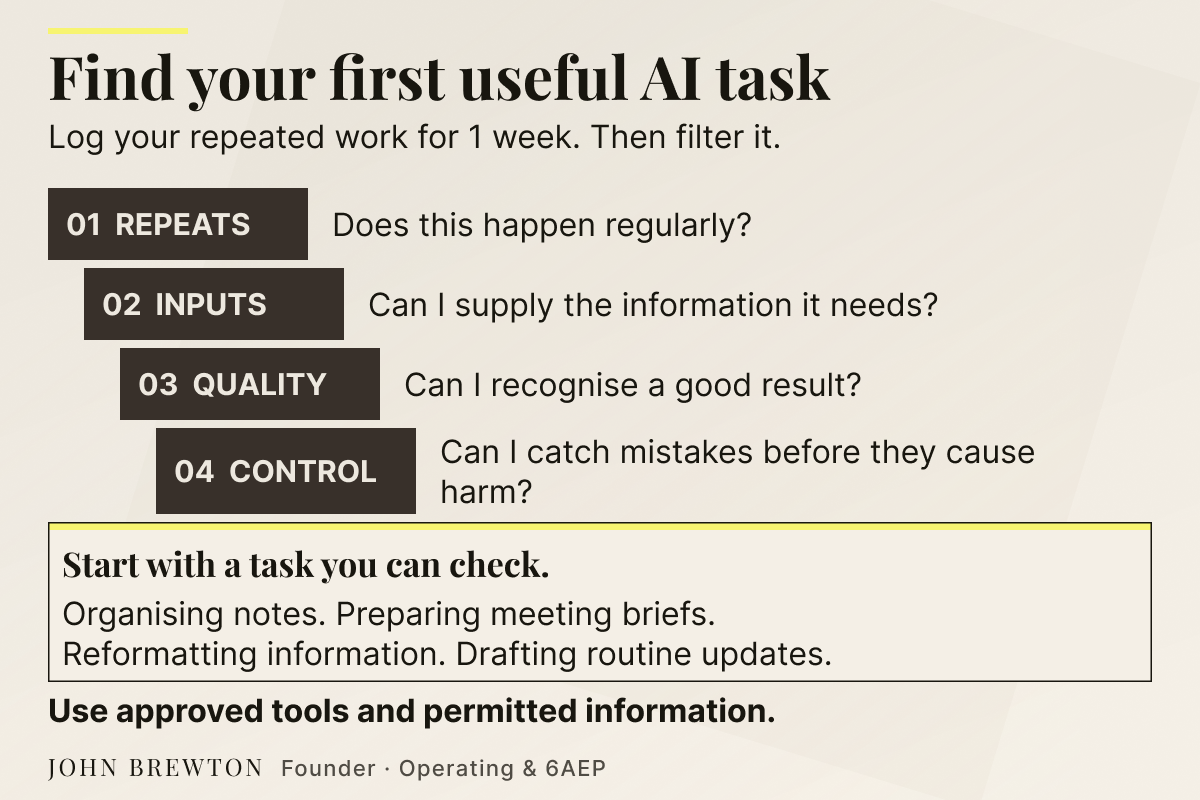
That also helps address the objection that there is no time to learn.
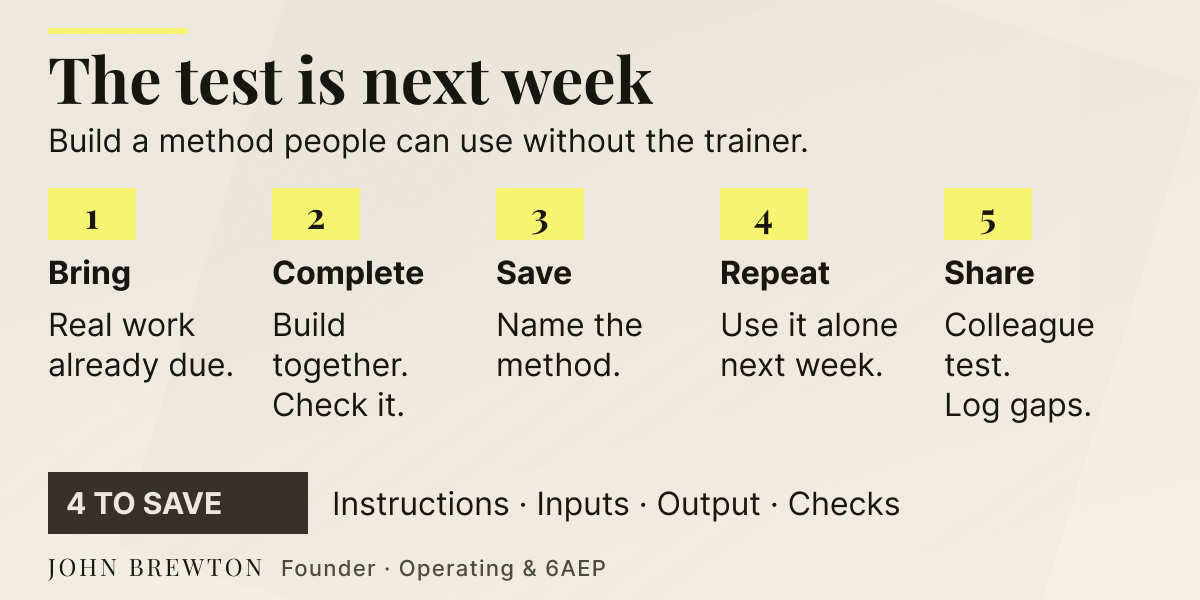
My approach is to bring real work into the session. Take something already due and build it together. A manager might prepare a meeting brief. A salesperson might turn approved notes into a follow-up draft. The learning happens while an existing piece of work gets done.
Managers also need to protect time for practice. If every hour remains committed to existing demands, people will return to the method they already know under pressure.
Then we have to make it happen again.
Old habits return when the deadline arrives, and the new method takes effort to reconstruct. I focus on replacing 1 recurring habit and saving the method as a reusable skill: the instructions, required inputs, expected output, and checks. Give it a clear name and keep it where the work happens.
The test comes the following week, when the person uses it without me.
This is where personal capability begins to become a system. Someone can explain the job clearly, judge the answer, and repeat the process. Their useful experiment now has a method another person can follow.
The final group of barriers concerns the context around the work.
Much of a company’s operating knowledge lives in people’s heads. An experienced employee knows which exceptions matter and when the usual process will fail. None of that appears in the request they give AI.
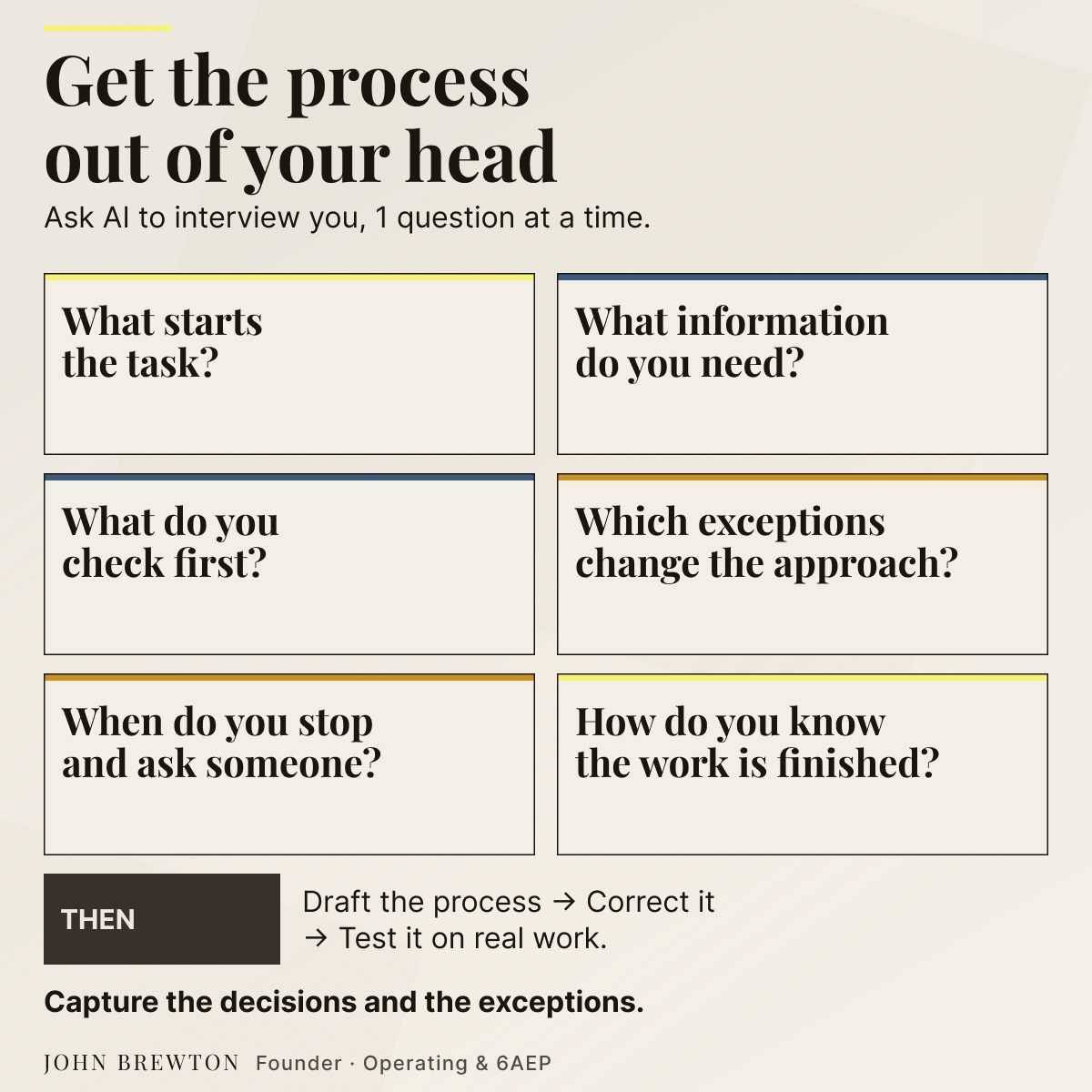
I use AI to interview the person about how they do the job. Have it ask 1 question at a time, work through an example, and probe the exceptions. Then turn the answers into a draft process for the employee to correct. Their review matters because a plausible process can still be wrong.
There is also the uncertainty about what is allowed.
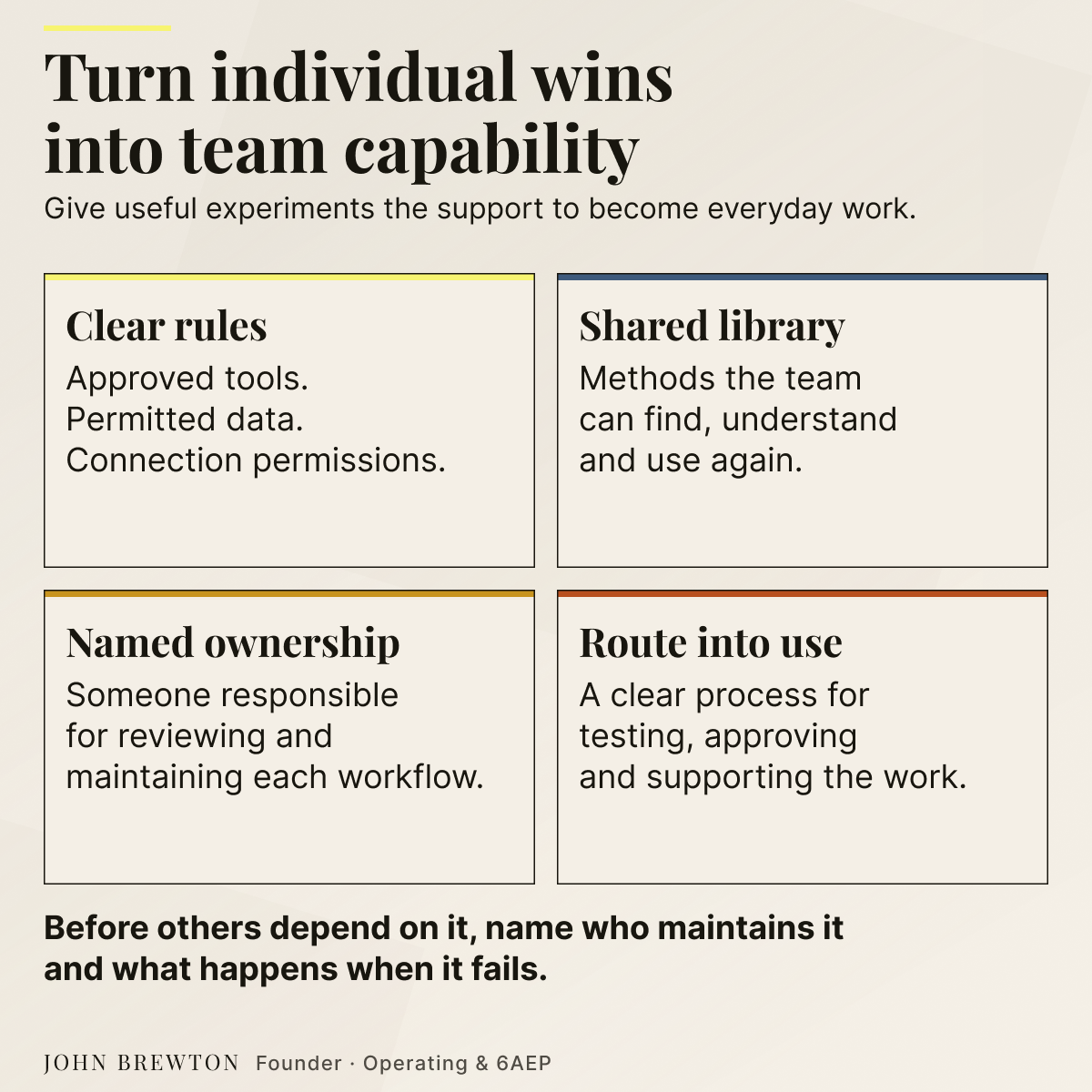
Employees need usable answers about which tools they can use and what information they can share. I recommend a 1-page document covering approved models, permitted data, connector permissions, and where to take an uncertain case. It should point to the fuller policies where necessary.
Make the rules easy to find when someone needs them.
At the other end of the spectrum are the power users racing ahead alone. They build useful things, but the team cannot maintain a process it cannot find or understand.
I want a named owner, a shared library, and a clear route from experiment to production. Record what each workflow does and who checks its output. Before anyone depends on it, establish who maintains it and what happens when it fails.
A company can have several impressive AI users and still have no dependable way to share their work.
This is why I work on executive capability alongside employee training. Leaders need enough direct experience to judge whether an application is useful and to understand the work required to make it dependable. Delegating every experiment leaves them poorly placed to decide what deserves investment.
An executive’s own recurring task is a useful starting point. Build the method, use it again, and notice where it breaks. That experience makes the next conversation about team adoption more concrete.
For a team starting this week, I would choose 1 repeated task and 1 person to own the trial. Record the current time and quality standard. Build the assisted method using the approved information, then measure the time spent on checking and correction.
Save what works. Run it again the following week. Ask someone else to follow the instructions and record where they get stuck.
Those observations tell you what to fix next: the brief, the process, the rules, or the training. They also give the next session a task.
Put that review on the calendar before the first session ends.
Concluding Thought
After training hundreds of employees this year, the lesson I keep coming back to is that AI adoption depends on what happens after the training. People need to feel safe enough to try, understand where the tools fit their work, and have a method they can use again. Leaders are responsible for creating those conditions and helping useful individual experiments become something the whole team can rely on.
Start with 1 recurring task this week. Set the quality standard, build the assisted method, and count the time spent checking and correcting it. Save the instructions and ask someone else to follow them the next week. When another person can produce acceptable work with less effort, you have evidence of progress. That is what I want companies to leave training with: the capability to keep improving the work themselves.
The models and technology will continue to improve exponentially. That’s why the training should prioritize driving meaningful changes within the organization, enabling the team to move forward and evolve into a company that fosters continuous learning, improvement, and adaptation.
Hope this helped you today. If you have a company that is looking to make these changes, I’d love to talk with you. If you are a consultant or coach who is in the midst of doing this work with your clients, be sure to drop me a message as well.
- j -
Give the right people a reason to buy.
People can enjoy your posts for months and still have no idea what they can hire you to do. That gap between attention and a clear offer is what we’re tackling in Master LinkedIn’s New Feed and Build an Offer People Want.
On September 29, I’m joining Alicia Teltz and Wessal Khader for a free, 90-minute masterclass covering how to:
Get your content in front of relevant buyers as LinkedIn’s feed changes.
Use customer insights to identify problems your audience wants solved.
Turn those insights into an offer people understand and want to pay for.
If you’re putting time into LinkedIn and struggling to connect that effort to something you can sell, join us.
Tuesday, September 29 · 1pm Eastern / 6pm UK · Free · Online

I like the idea of getting AI to interview someone about how they do their job.
It's only while building agents I realised how many micro decisions I make on autopilot because of experience and repeating the same thing.