Hello Operators!
Most founders do not really choose a business model. They copy one.
They watch someone build a course, so they start outlining a course. They see a consultant with five retainers, so they decide they need retainers. Someone launches a cohort. Someone else sells a $10,000 advisory package. Someone licenses their IP.
What was visible becomes what feels possible.
The problem is that a business model is not a trend, a personality type, or an identity. It is the delivery system for your expertise. And the right delivery system has to fit two things at the same time: the shape of what you know and the shape of the life you actually want to live.
Today’s free Oper(AI)te drop is built to sort those two things.
FREE DROP 05: The Model Sorter

This is not really a workbook you read. Upload the PDF into Claude or ChatGPT. Paste one sentence describing what you do. The workbook takes over from there.
You give it one capability and answer a short interview. It scores six business models against your constraints, shows you the grid before it sorts, lets you correct anything you disagree with, and then produces a one-page PDF with the result.
The workbook estimates the conversation at about seven minutes. Go get to work.
AI Was Supposed to Kill Consulting. Instead It Has Started a Golden Age.
The Quiet Builders Are Coming. Great Companies Will Build Around Them.
Your Expertise Is Only Half the Business Model
The first four Oper(AI)te drops were largely about evidence.
The Calendar Autopsy looked at what your work has actually required you to do.

The Receipt Finder turned an accomplishment into a claim you can defend.

The Compliment Decoder looked for the language other people already use to describe your value.

The Free Advice Audit looked for expertise you may be giving away because it feels too easy to you.

If you have been running them, you are beginning to accumulate something useful: a picture of what you are unusually good at and evidence that you have actually done it.
But knowing what you could sell does not tell you how you should sell it.
That is a different decision.
And founders routinely make it without considering the constraints that will eventually determine whether they love or hate the company they built.
The Workbook Output
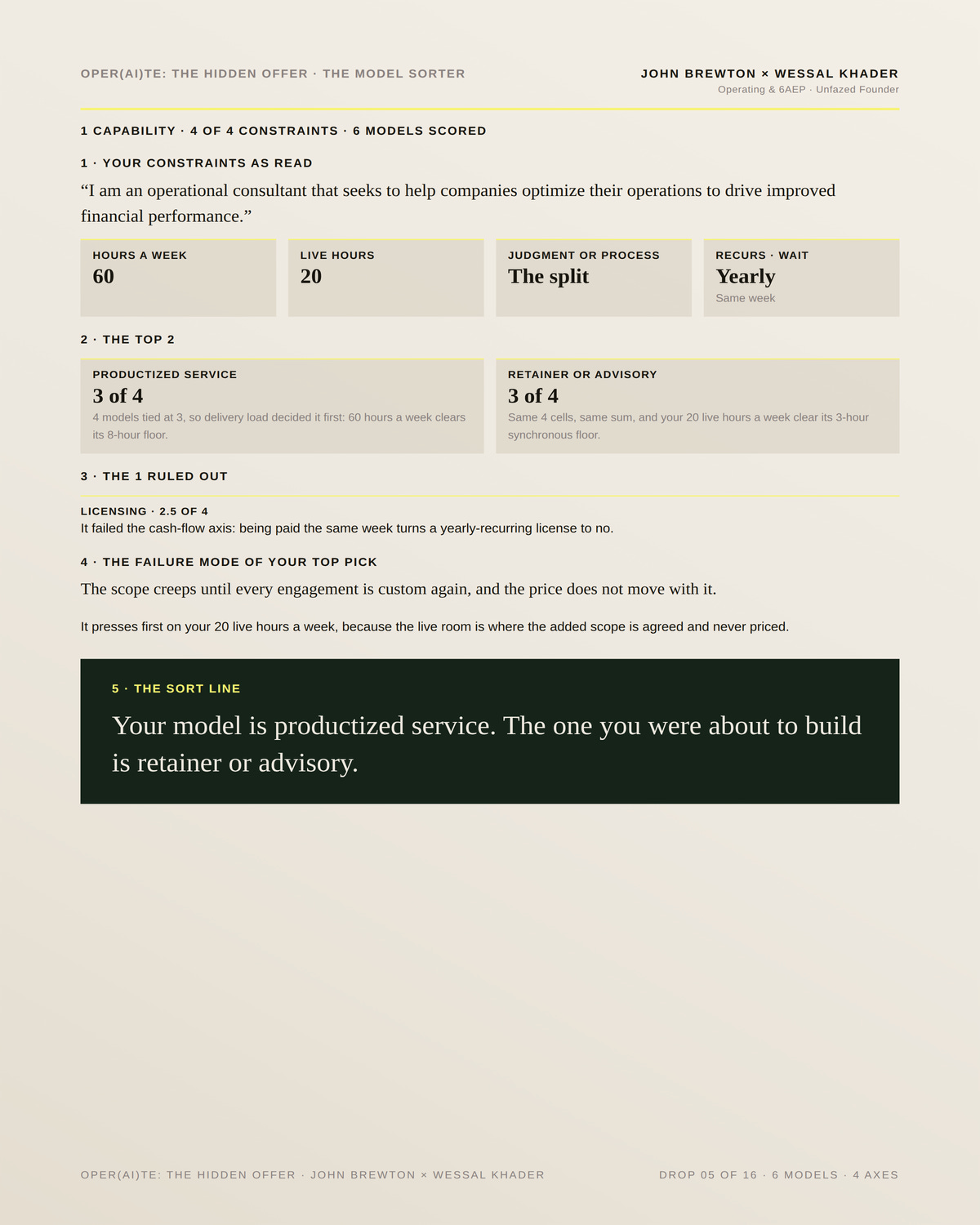
The final output is deliberately small, clear, crisp and clean.
Your top two models appear with their scores out of four and the constraint that separated them. You get the one model the Sorter ruled out and why it made that choice.
Then you get something I find more useful than another list of advantages and disadvantages:
The characteristic failure mode of your winning model.
Productized service fails when scope creeps until every engagement becomes custom again, but the price never moves with it.
Retainer or advisory fails when the founder slowly becomes the client’s employee without the salary, equity, or exit.
Licensing fails when nobody wants to buy a method they have never watched the founder run, so the founder keeps running it.
A cohort can turn your calendar into a permanent launch treadmill.
A self-serve course can quietly turn the founder into a full-time marketer.
The diagnostic can get given away in an attempt to win an implementation that never closes.
And then the workbook ends with one clean, clear, crisp line:
Your model is X. The one you were about to build is Y.
Where the Free Drops End and Oper(AI)te: The Hidden Offer Begins
The Model Sorter can help you answer one important question:
What shape should this business take?
It cannot build the rest of the business for you.
That is the distinction between these free drops and the Oper(AI)te: The Hidden Offer cohort Wessal Khader and I are building.
The drops isolate one problem and give you one useful output. The October program connects the evidence, expertise, model, market, pricing, offer, sales page, and selling system into one operating system.
Most experienced founders, operators, executives, consultants, and advisors do not have an expertise problem. They have a problem seeing, packaging, pricing, and selling what they already know.
That is our entire premise behind Oper(AI)te: The Hidden Offer.

The offer someone will pay you for is probably not something you need to invent from scratch. It is much more likely to be sitting inside the work you have already done, the results you have already produced, the problems people already bring you, and the expertise you have accumulated so gradually that you no longer recognize how unusual it is.
From October 1 through October 29, we are building that system live across six sessions. You build nine AI agents on our IP and keep them: the Everything File, Superpower Scan, Fit Test, Client Evidence Pull, Market Map, Intersection Engine, Price Evidence Sheet, Page Builder and Language Audit, and the Selling Agent with its Daily 15 rhythm.
The goal is to exit October with your offer ready to launch as this year ends and 2027 awaits!
Here’s what our cohort members will leave with:
Your evidence gathered.
Your expertise named.
Your model selected.
Your market researched.
Your price supported.
Your sales page published.
Your first buyer conversations underway.
And a 90-day operating rhythm for continuing the work after the cohort ends.
See everything inside Oper(AI)te: The Hidden Offer →
Doors close September 30.
The live cohort runs October 1–29.
I am keeping all 16 free Oper(AI)te drops together here and updating the library as each one goes live.
Because your ideal offer is probably not something you need to dream up. And the business model probably should not be something you copy.
Both should come from the evidence of the work you’ve already done, been paid for, and delivered immense value to your companies, teams, colleagues, and customers with already.