

How to Build an AI Operating Team in Grok Bot: The Field Manual
AI Was Supposed to Kill Consulting. Instead It Has Started a Golden Age.
The Quiet Builders Are Coming. Great Companies Will Build Around Them.
Start Here
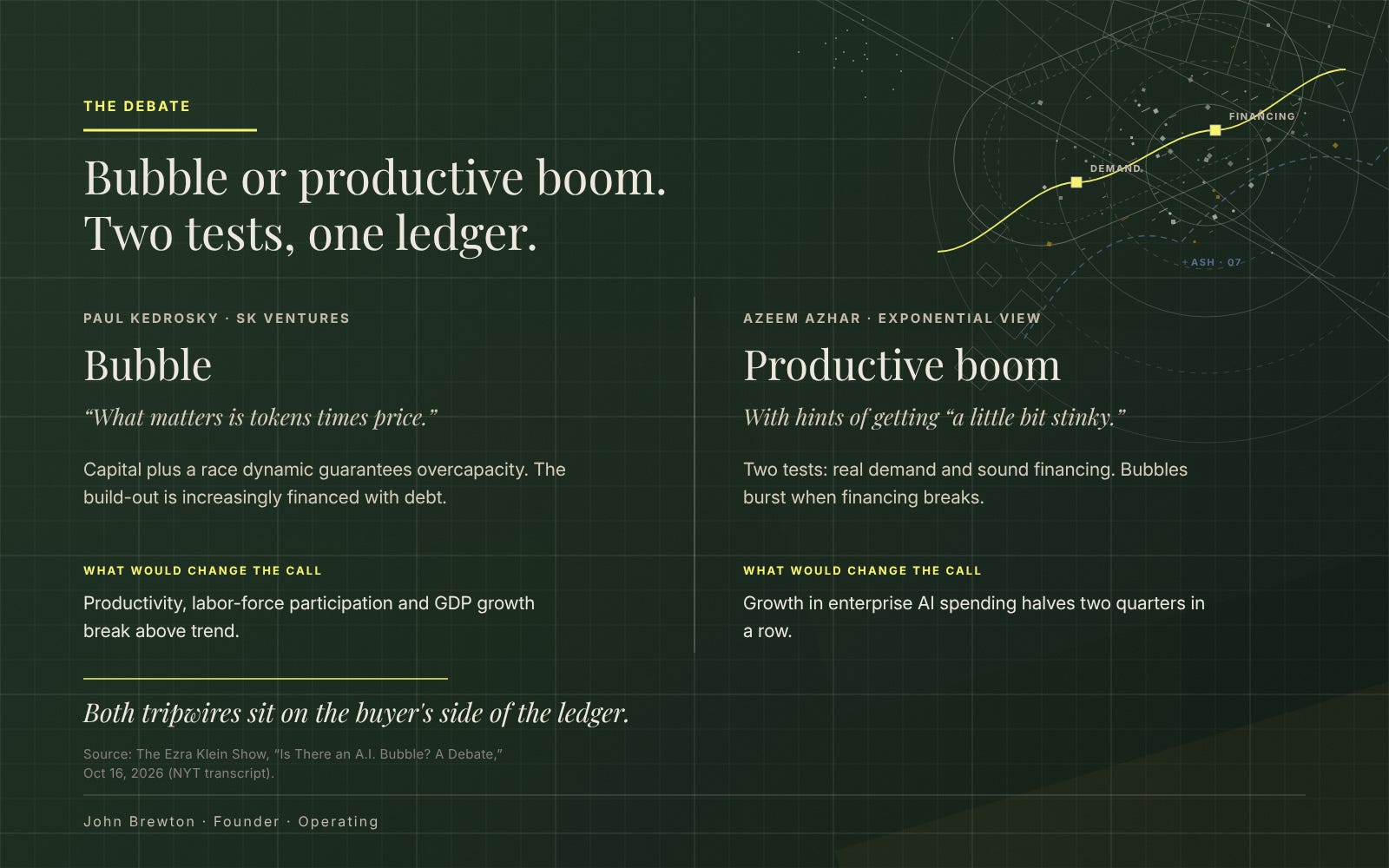
Paul Kedrosky thinks artificial intelligence is a bubble. Azeem Azhar thinks it is a productive boom with hints of getting “a little bit stinky.” On the Ezra Klein Show last week, in an episode titled “Is There an A.I. Bubble? A Debate,” the two gave the clearest account yet of the argument hanging over markets. Each got something important right.
Kedrosky, of SK Ventures, is right that build-outs of general-purpose technologies, from canals and railroads to electricity and fiber, tend to overshoot, and that this one is increasingly financed with debt. Azhar, of Exponential View, is right that bubbles burst when financing breaks, not merely when returns disappoint, and that what keeps a boom healthy is real customers paying real money.
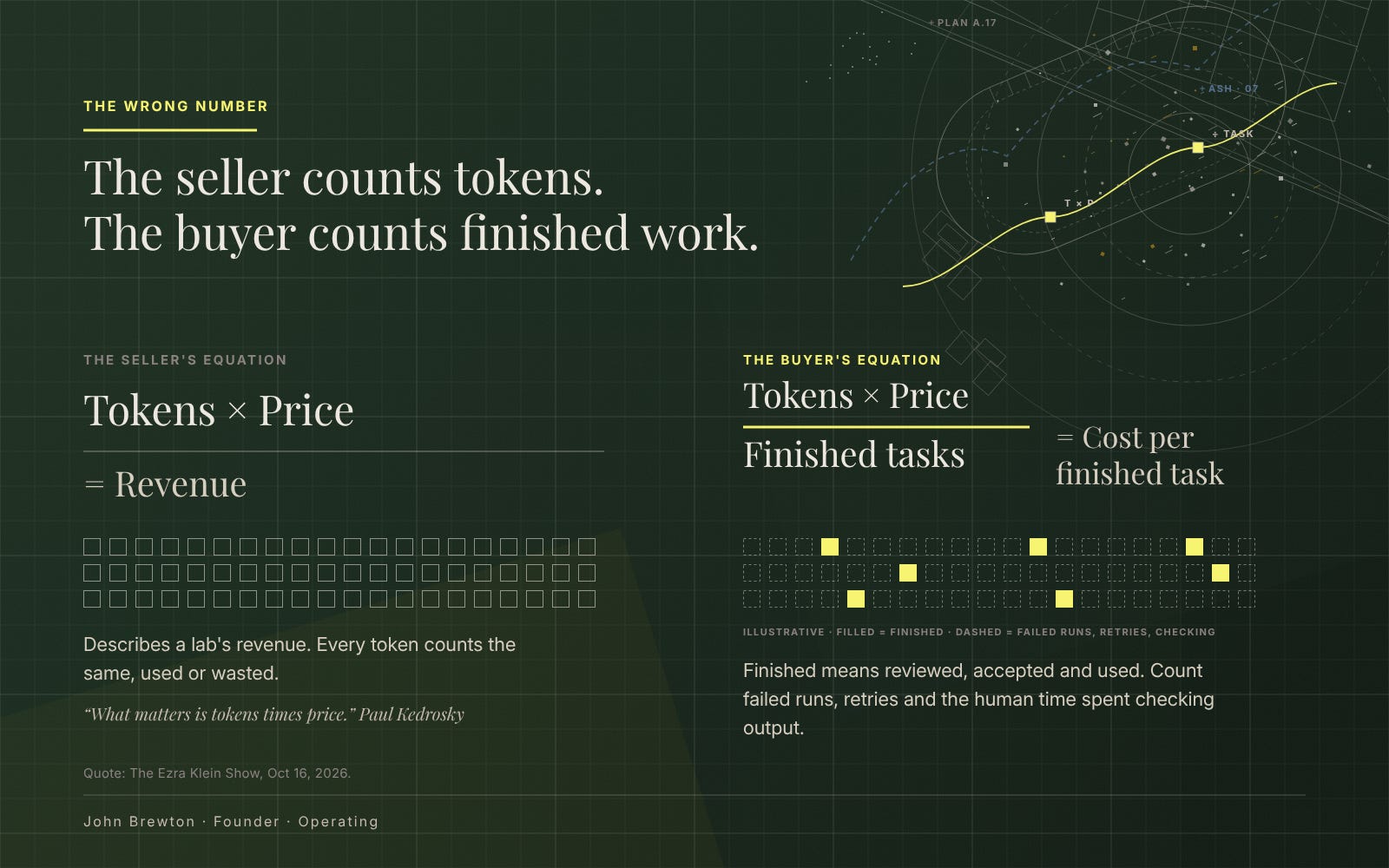
But both are arguing about the wrong number. Kedrosky’s case rests on one line: “What matters is tokens times price.” That is the seller’s equation. It describes a lab’s revenue. The buyer’s equation has a denominator: tokens times price, divided by the work that actually got done. Call it the cost per finished task. Companies are only now discovering that number, and the evidence is that they have started to ration.
Rationing is neither the bubble popping nor a blip. It is what happens when AI stops being a perk and becomes an operating cost with an owner.
The Bear’s Case
Kedrosky’s definition is strict: “A bubble occurs whenever asset prices detach from any semblance of economic reality.” By his account, that has nothing to do with whether AI is useful. Railroads were useful, too. The problem is capital meeting competition. “As long as you have a supply of capital and a race dynamic, you’re guaranteed overcapacity,” he said.
His demand argument is sharper. Kedrosky estimated that token prices have been falling about 13-fold a year on a performance-adjusted basis, and that coders account for something like 80% of frontier-model usage and revenue. Neither figure came with a source, but the logic holds. If price falls that fast, volume has to grow even faster. And coders are an unusual market. Their use is expansive, turning a short prompt into a mountain of code, while most office work is compressive, turning a pile of email into a summary. “Never confuse your early customers for what the real market will look like,” he said.
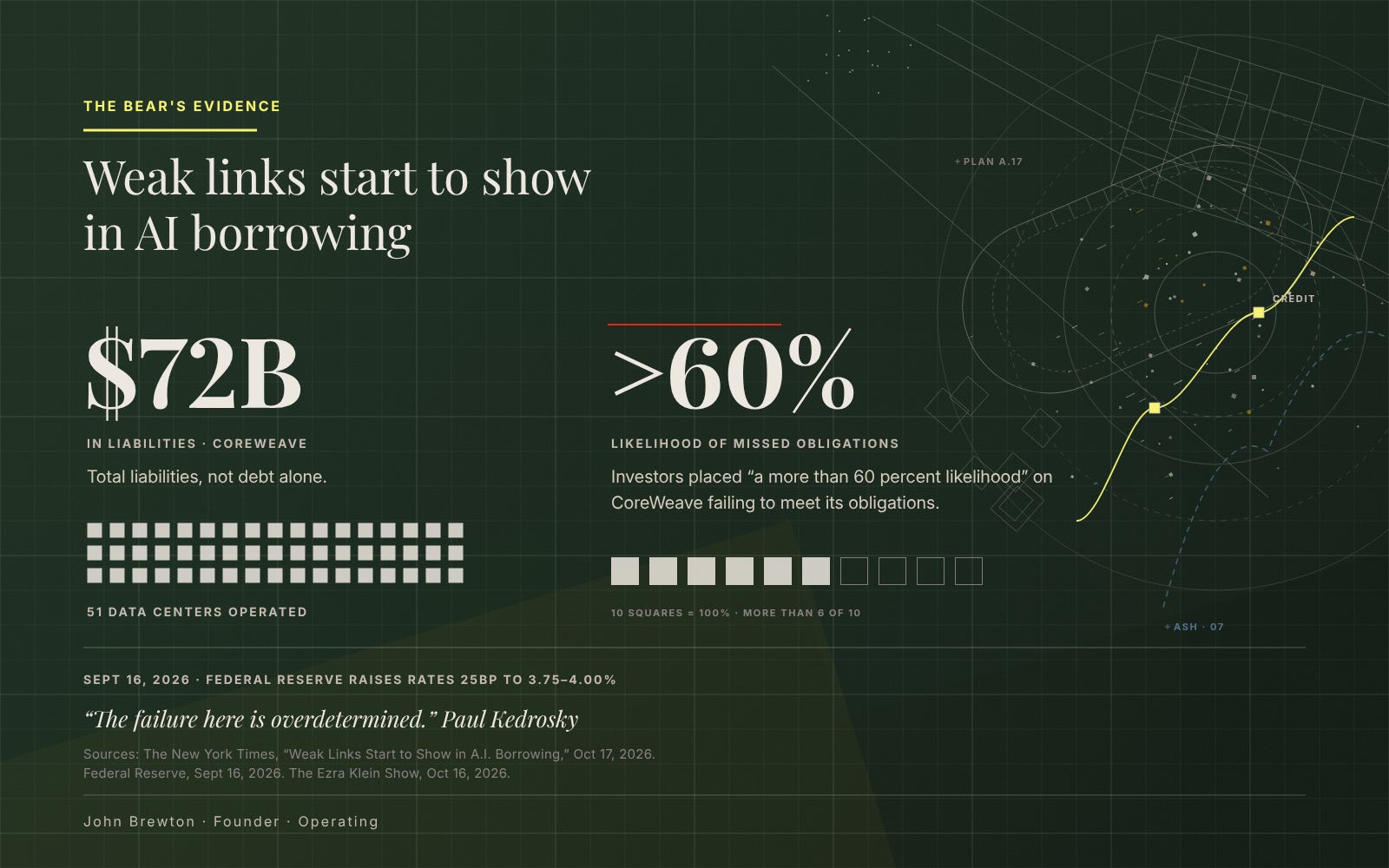
Credit markets have given him material. Under the headline “Weak Links Start to Show in A.I. Borrowing,” The New York Times reported last week that investors placed “a more than 60 percent likelihood” on CoreWeave, which “has accrued $72 billion in liabilities to operate 51 data centers,” failing to meet its obligations. The Federal Reserve raised rates in September for the first time since 2023. “The failure here is overdetermined,” Kedrosky said.
The Bull’s Case
Azhar applies two tests: Is demand real, and is the financing sound? On the first, he sees strong enterprise demand and too little compute, not too much. On the second, he concedes that the big cloud companies are shifting from cash to debt, but argues that borrowing has not yet reached dangerous levels.
His strongest reply is about where demand goes. If customers move to cheaper or open-weight models, he said, “that is just the demand moving. It may hurt Anthropic’s margins, but it still monetizes the underlying capital expenditure.” A lab can struggle while the data centers stay busy. Aaron Levie, Box’s chief executive, goes further. He has written that agent swarms “will consume 1,000X more tokens than people prompting agents 1 at a time.”
Azhar is also candid about the pace. “It’s just not the case that you get the best model from OpenAI and say: Fix my company — and it fixes it,” he said. His horizon is five to 10 years, not one or two.
The Number Neither Side Measured
“Tokens times price” and “demand moving” both describe the vendor. Neither tells a buyer whether the spending worked.
Leave out the denominator and both camps go wrong. The bear treats a drop in volume as a drop in value, even when the work cut was waste. The bull treats a rise in volume as a rise in value, even when the tokens bought nothing. A thousand times more tokens is a forecast of spending, not of output.
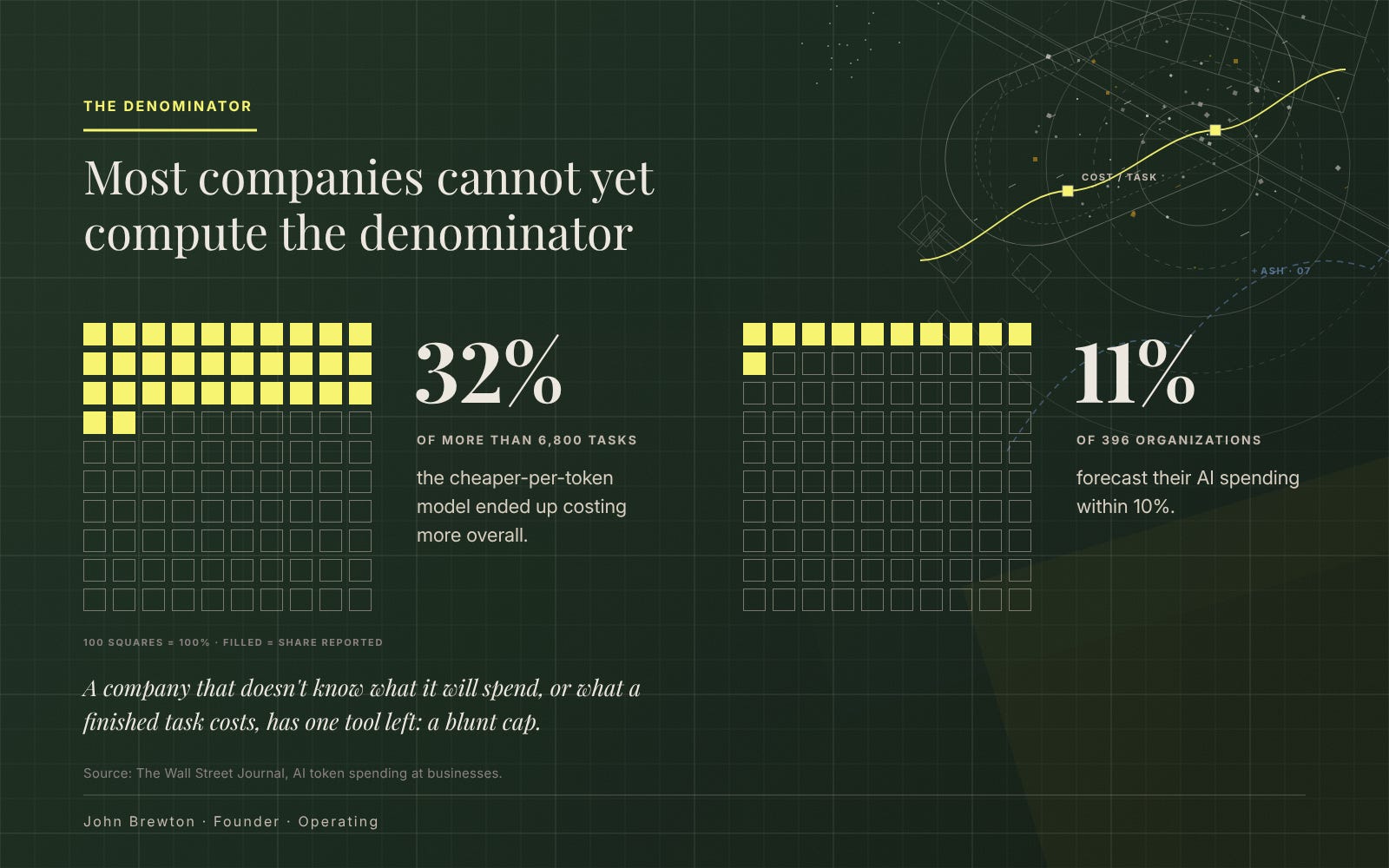
Most companies cannot yet compute the denominator. The WSJ found that in 32% of more than 6,800 tasks, the cheaper-per-token model ended up costing more overall, and that only 11% of 396 organizations forecast their AI spending within 10%. A company that doesn’t know what it will spend, or what a finished task costs, has one tool left: a blunt cap.
Tellingly, when Klein asked what would change their minds, neither guest named a token count. Azhar said he would worry if growth in enterprise AI spending halved two quarters in a row. Kedrosky said he would reconsider if productivity, labor-force participation and GDP growth broke above trend. Both tripwires sit on the buyer’s side of the ledger.
The Budgets Are Getting Owners
That is what the first wave of rationing is. In August, Microsoft’s Jay Parikh told engineers that “tokenmaxxing is not what we are optimizing for,” 404 Media reported, as divisions moved onto AI token budget targets. “We are not optimizing for fewer tokens,” Parikh reportedly wrote. “We are optimizing for more impact per token.” In October, The Information reported that Meta and Microsoft had cut back employees’ use of Claude Code. On the show, Kedrosky went further, saying Meta was halving the number of in-house developers allowed to use outside frontier tools, that Microsoft was doing the same, and that the days of token-maxxing were long over.
Accenture shows the mechanics. This month the consultancy told many employees that it would centrally fund only $29 a month per person for Claude, according to an internal announcement reported by 404 Media. Some had been spending as much as $1,000 a month. Usage above $29 isn’t banned. It is charged to a project or team budget code. “All costs are consumption-based,” the announcement says.
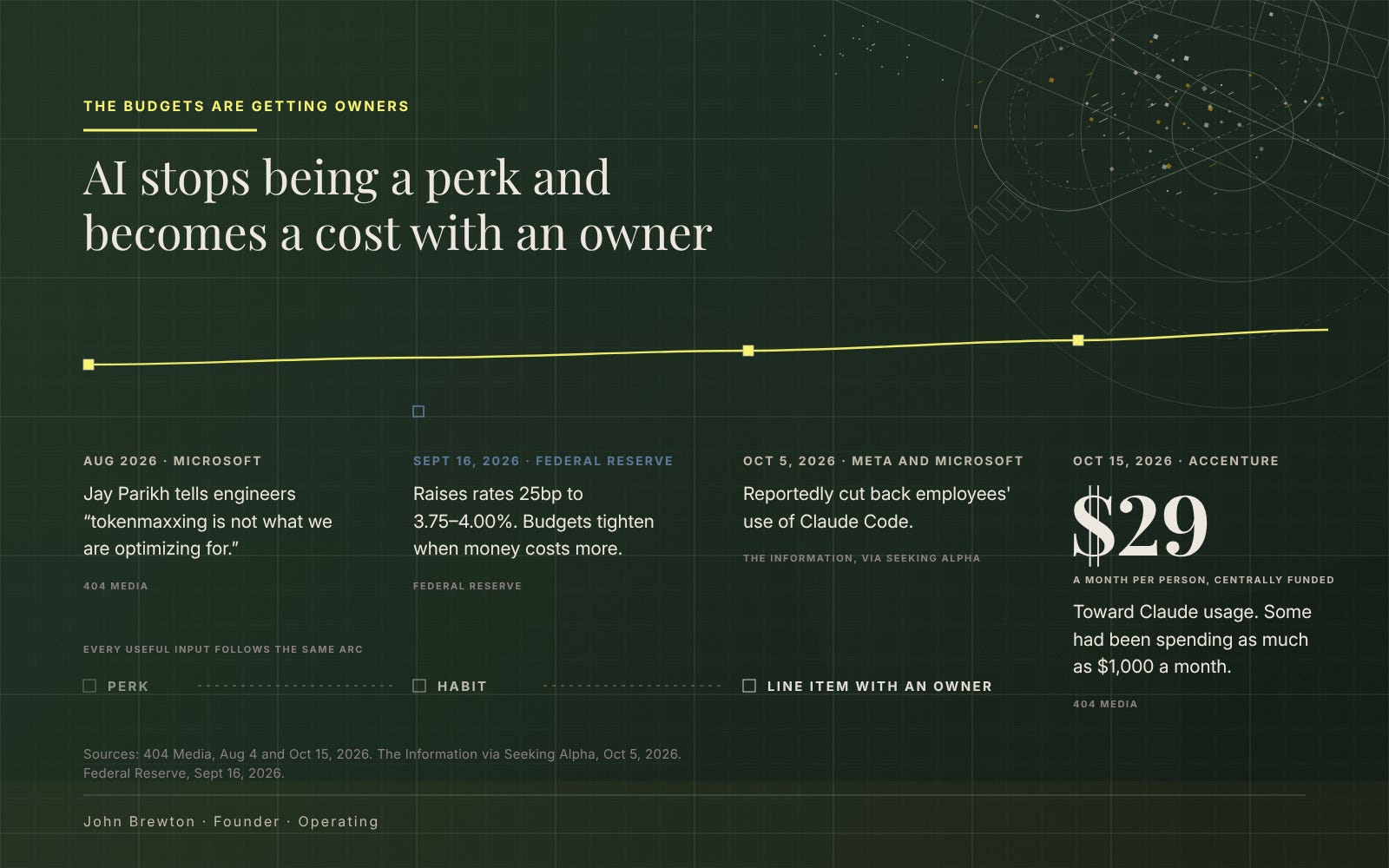
None of this means demand is collapsing. The Information noted that Microsoft’s internal cutbacks have been offset by customer demand for Anthropic models on Microsoft’s own platforms, and Meta and Microsoft are steering staff toward in-house and partner tools, not away from AI. What has changed is that demand now has to be underwritten. Every useful input follows this arc. It arrives as a perk, spreads as a habit and ends up as a line item with an owner. The Fed’s turn will speed that along, because budgets that were loose in a boom tighten fast when money costs more.
What It Means For Companies
Companies are becoming tech stacks. A stack comes with a bill, and the bill always finds an owner. The question for management is no longer whether to buy AI, but which work it may do, at what cost per unit and with whose approval.
That is where Azhar’s most interesting claim comes in. The people who gain, he argued, will be “the layers of humans doing verification, doing the last sign-off,” who “will end up being paid more and more… as a consequence of sitting at that choke point.” In a metered company, sign-off is also where the cost per finished task gets decided. A task isn’t finished until someone accepts it, and the person who signs is the one who knows whether the tokens bought anything.
We are all becoming companies, too. An employee with a monthly AI allowance and a budget code for anything above it is running a small P&L, whether anyone calls it that or not.
Rationing can still go badly. A flat allowance treats every employee alike, and AI use isn’t alike. Cap tokens without defining the task and the heavy users who create the most value hit the ceiling first, while light users go untouched. People quietly go back to doing the work by hand, or find workarounds the company can’t see.
The Operator’s Playbook
1. Price AI per finished task. Define “finished” as work that was reviewed, accepted and used. Count failed runs, retries and the human time spent checking output. If the cheaper model often costs more, the per-token price is the wrong number to optimize.
2. Budget by workflow, not by seat. A seat license is a buffet. A workflow budget is a menu with prices. Fund invoice matching, code review or contract redlining at a cost per unit, and let volume flex with the work.
3. Run two budgets. Separate expansive use (engineering, agents, research) from compressive use (drafting, summarizing, search). Give the first a higher ceiling and a review of output. Give the second a low flat allowance. One cap for both will starve the wrong people.
4. Name an owner for the token P&L. Charging costs to project codes is the right instinct only if the project owner can see cost per task, not just a monthly total. Finance should own the definitions; the business should own the outcome.
5. Retire the usage leaderboard. Kedrosky described internal charts ranking who used the most tokens. Any dashboard that rewards volume will produce volume. Replace it with cost per accepted output.
6. Keep the right to switch. Microsoft moved its internal default to a cheaper model. Route routine work to the cheapest model that clears your quality bar, and save the frontier for tasks that need it.
The Kicker
Kedrosky and Azhar will keep arguing about valuations, credit and timing, and the coming IPO filings will settle some of it. The question underneath is simpler: Does a finished piece of work cost less with AI than without it?
Token-maxxing was what AI looked like when it was free to the person using it. Rationing is what it looks like when it costs money. Neither phase answers the question. The operators who win the next one won’t be those who buy the most tokens or cut the most licenses. They’ll be the leaders who know what a finished job costs.
- j -

John Brewton documents the history and future of operating companies at Operating by John Brewton. He is a graduate of Harvard University and began his career as a PhD student in economics at the University of Chicago. Since selling his family’s B2B industrial distribution company in 2021, he has been helping business owners, founders, and investors optimize their operations.
Sources
The Ezra Klein Show, “Is There an A.I. Bubble? A Debate,” with Paul Kedrosky and Azeem Azhar, Oct 16, 2026: youtu.be/9GLdGc9OX-A ; NYT transcript: https://www.nytimes.com/2026/10/16/opinion/ezra-klein-podcast-azeem-azhar-paul-kedrosky.html (read via DNYUZ mirror https://dnyuz.com/2026/10/16/is-there-an-a-i-bubble-a-debate/)
The New York Times, “Weak Links Start to Show in A.I. Borrowing,” Oct 17, 2026 (CoreWeave “$72 billion in liabilities to operate 51 data centers”; “a more than 60 percent likelihood”), read via DNYUZ mirror: https://dnyuz.com/2026/10/17/weak-links-start-to-show-in-a-i-borrowing/ (canonical NYT URL returned 403; slug https://www.nytimes.com/2026/10/17/business/weak-links-start-to-show-in-ai-borrowing.html unconfirmed)
404 Media (Joseph Cox), “Accenture Tells Employees They Can Now Spend Only $29 on Claude Per Month,” Oct 15, 2026: https://www.404media.co/accenture-tells-employees-they-can-now-spend-only-29-on-claude-per-month/
The Next Web, summary of the 404 Media memo reporting (WBS chargeback, licence review, employee messages), Oct 16, 2026: https://thenextweb.com/news/accenture-claude-29-a-month-cap
404 Media (Emanuel Maiberg), “Microsoft Tells Engineers ‘Tokenmaxxing Is Not What We Are Optimizing For’,” Aug 4, 2026: https://www.404media.co/microsoft-tells-engineers-tokenmaxxing-is-not-what-we-are-optimizing-for/
TechRadar, Parikh memo quotes (”more impact per token”), Aug 5, 2026: https://www.techradar.com/pro/tokenmaxxing-is-not-what-we-are-optimizing-for-microsoft-tells-engineer-to-calm-down-on-ai-usage
The Information, “Microsoft Slashes Internal Claude Spending by a Third” (paywalled): https://www.theinformation.com/articles/meta-microsoft-work-wean-staff-anthropics-claude
Seeking Alpha, “Meta, Microsoft scale back employee use of Claude: report,” Oct 5, 2026: https://seekingalpha.com/news/4650314-meta-microsoft-scale-back-employee-use-of-claude-report
Investing.com, summary of The Information (internal cuts vs. customer demand on Microsoft platforms): https://www.investing.com/news/stock-market-news/meta-and-microsoft-scale-back-internal-use-of-anthropics-claude-report-says-4932709
Fortune, May 22, 2026 (Microsoft moving engineers from Claude Code to GitHub Copilot CLI, citing The Verge): https://fortune.com/2026/05/22/microsoft-ai-cost-problem-tokens-agents/
WSJ, AI token spending at businesses (32% of 6,800+ tasks; 11% of 396 orgs): https://www.wsj.com/tech/personal-tech/ai-token-spending-businesses-431ee94a
Aaron Levie on X, agent swarms “will consume 1,000X more tokens”: x.com/levie/status/2108750943680630893
Federal Reserve FOMC statement, Sept 16, 2026: https://www.federalreserve.gov/newsevents/pressreleases/monetary20260916a.htm