The Mckinsey Seven Ss Became Eight in 2023
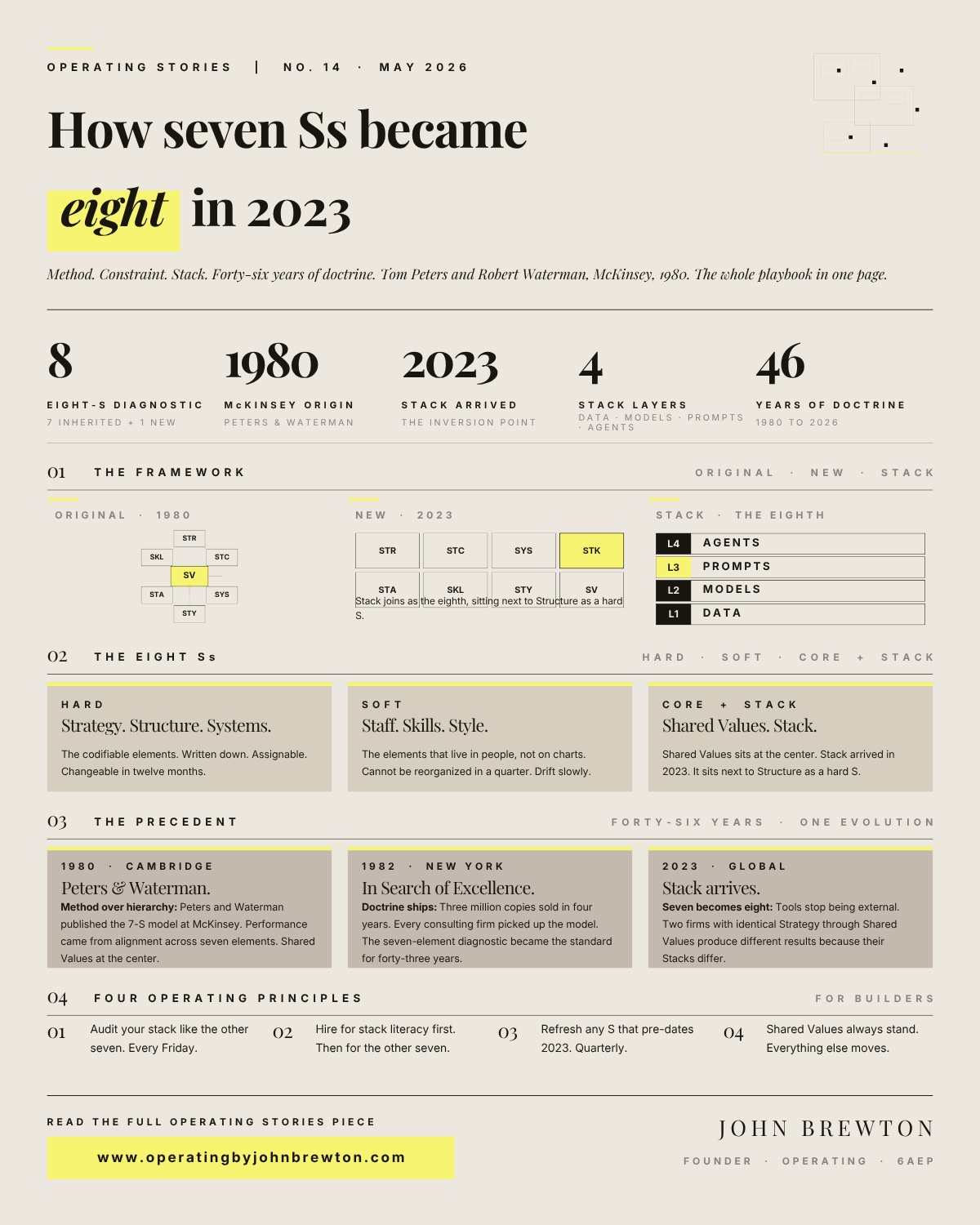
Tom Peters and Robert Waterman built the McKinsey 7-S model in 1980. The Stack joined as the eighth in 2023. Most orgs and strategies charts have not accounted, yet.
New to Operating?
Check out these reader favorites:
Winning the Loser’s Game: The Creator Economy and the Companies We All Need to Build
0 to 55,000 - The First 90 Days Playbook - What I’d Do Differently Knowing What I Know Now
Become a paid subscriber to join the Operating Skool community and attend our weekly live Office Hour Q&A’s w/ John.
Start Here
The 7-S model is the longest-surviving organizational diagnostic in management. Peters and Waterman built it at McKinsey in 1980 and shipped it to the world in In Search of Excellence in 1982. Three million copies sold in four years. Every consulting firm picked up the model. For forty-three years, the seven-element diagnostic was the standard frame for thinking about organizational performance: Strategy, Structure, Systems, Staff, Skills, Style, Shared Values. Three hard. Three soft. One core, at the center, that the other six rotate around.
For forty-three years it held. Then the Stack arrived.
The Assumption
Peters and Waterman built the model on a single assumption that was unimpeachable in 1980. Tools were external. The IT department picked them. Strategy did not depend on which database the firm bought. Marketing did not depend on which CRM the firm rented. Performance came from how seven human and procedural elements aligned around Shared Values.
That assumption broke in 2023. Frontier models compressed the cost of capability. Tools stopped being external. Two firms with identical Strategy, Structure, Systems, Staff, Skills, Style, and Shared Values now produce different results because their Stacks differ. The seven-element model under-specifies the firm.
The 8th S
Stack is the model and tool layer the firm now runs on. It has four sub-layers.
L1 Data: Owned, observable, indexed.
L2 Models: Frontier and specialist.
L3 Prompts: Codified team patterns.
L4 Agents: Autonomous workflows.
Stack sits next to Structure as a determinant of performance. It is a hard S.
Codifiable. Assignable. Changeable in twelve months.
The 1980 diagnostic placed seven elements in the model because these were what consultants could move. The 2026 diagnostic adds the eighth for the same reason.
Strategy depends on which models the firm runs. Structure depends on which agents sit in which roles. Skills depend on which prompts the team has codified. Performance is now an eight-element function.
Three operator translations
The 7+1-S diagnostic translates differently for each operating tier.
Solo operator - Run weekly: Maintain one document that names all eight Ss for your practice. Update the Stack row weekly. Update the other seven quarterly. Read the document before any new tool decision.
Startup founder - Run on a 90-day build: Hire for stack literacy first. Then for the other seven. Builders who know their tools. Operators who codify their prompts. The Stack belongs in the onboarding pack, not the IT request queue.
SMB strategist - Run quarterly: Walk every existing 7-S diagnostic the firm uses. Strategy decks. Org charts. Operating reviews. For each row, write the year it was last refreshed and the assumption it was built on. If the row pre-dates 2023, add a Stack column and refresh the row alongside.
The full pack
The prompt pack: Five prompts that turn the 7-S into an 8-S diagnostic any team can run quarterly. DIAGNOSE. MAP STACK. REALIGN. DECIDE. LOOP. Built for the copy-paste-into-Claude workflow. [Download here →]
The worksheet: Ten-page fillable diagnostic. The Stack row is pre-printed as the eighth. Walk every row through ALIGNED, DRIFTED, or REFRESH. Pick the move. Schedule the loop. Built for the quiet ninety minutes. [Download here →]
The principle
Shared Values still sits at the center. Stack joins as a hard S. The new diagnostic has eight rows, where the old one had seven. Performance is now an eight-element function.
Every other framework in the McKinsey library is getting the same treatment. Stack column added. Assumption checked against 2023. Most rows predate the Stack. Most rows need to be refreshed.
Operating publishes one of these every week. The next framework, the next pack, the field notes from operators running the stack live. Subscribe to keep getting them.
- j -
About the author
John Brewton documents the history and future of operating companies at Operating by John Brewton. He is a graduate of Harvard University and began his career as a PhD student in economics at the University of Chicago. After selling his family’s B2B industrial distribution company in 2021, he has been helping business owners, founders, and investors optimize their operations ever since. He is the founder of 6A East Partners, a research and advisory firm asking the question: What is the future of companies


